Encyclopedia of Ancient and Modern India
Chhatrapati Shivaji Maharaj Terminus
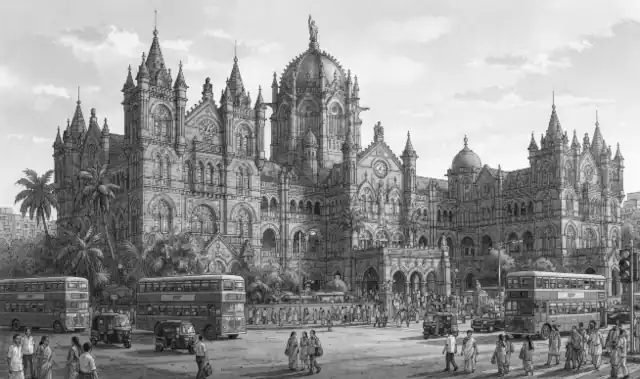
Chhatrapati Shivaji Maharaj Terminus (CSMT), formerly known as Victoria Terminus (VT), is a historic railway station situated in the Fort district of South Mumbai, Maharashtra, India. Constructed between 1878 and 1888, the terminus represents one of the most significant architectural and infrastructural achievements of nineteenth-century British India. It was designed by British architect and architectural engineer Frederick William Stevens for the Great Indian Peninsula Railway (GIPR), which required a monumental headquarters and railway station reflecting Bombay’s growing importance as a commercial, maritime and industrial centre. The building occupies approximately 2.85 hectares and combines Victorian Gothic Revival architecture with traditional Indian architectural forms. It was inscribed on the UNESCO World Heritage List in 2004, recognising its architectural significance and its association with the development of railway infrastructure during the colonial period.
The historical importance of the site predates the construction of the present building. On 16 April 1853, India’s first passenger train departed from the original Bori Bunder railway station in Bombay for Thane, covering approximately 34 kilometres. Operated by the Great Indian Peninsula Railway, the train marked the beginning of passenger railway transportation in India. Bori Bunder subsequently developed into an important railway terminus as Bombay expanded through maritime trade, cotton exports and industrial investment. The opening of the Suez Canal in 1869 strengthened Bombay’s commercial connections with Europe and increased the importance of its railway network. Consequently, the GIPR commissioned Stevens in 1878 to design a substantially larger station and administrative headquarters. Before commencing the project, Stevens travelled to Europe to study prominent railway buildings and contemporary architectural developments.
Construction began in May 1878 and continued for approximately ten years, concluding in 1888. The railway station facilities were brought into operation on 1 January 1882, while the principal administrative building was completed subsequently. The combined original expenditure was approximately ₹26.76 lakh, equivalent to around £260,000–£300,000 in contemporary British currency. Of this amount, approximately ₹16.14–16.36 lakh was spent on the administrative headquarters, while approximately ₹10.40 lakh was allocated to station facilities and platforms. The substantial expenditure reflected the extensive use of dressed stone, imported decorative materials, specialised engineering and elaborate craftsmanship. The project employed local stoneworkers, sculptors, metalworkers and artisans, including craftsmen associated with the Sir Jamsetjee Jeejeebhoy School of Art.
Architecturally, CSMT is regarded as an outstanding example of Victorian Gothic Revival architecture, incorporating elements of Italianate Gothic, Indian palace architecture and traditional decorative craftsmanship. Its overall composition includes a monumental central octagonal ribbed dome, pointed arches, flying buttresses, turrets, pinnacles, towers and elaborate stone façades. The principal structure is organised around a central courtyard and follows a complex, asymmetrical ground plan. Yellow Malad stone, red sandstone and Porbandar limestone were used extensively, complemented by Italian marble, stained glass, ornamental ironwork and decorative tiles. The building’s central dome is crowned by a sculpted female figure representing Progress, holding a torch. The sculpture is attributed to Thomas Earp and symbolises technological advancement and the expansion of modern transportation.
The exterior decoration demonstrates the integration of European structural design with Indian artistic traditions. Stone carvings depict indigenous plants, peacocks, monkeys, other animals and ornamental motifs. Traditional Indian architectural features, including jharokhas, carved balconies and jali stone screens, appear alongside Gothic arches and European sculptural compositions. The principal entrance is particularly notable for its sculpted representations of a British lion and an Indian tiger, traditionally interpreted as symbols of Britain and India. The interiors contain stained-glass windows, Minton tiles, carved wooden panels, marble flooring, vaulted ceilings and elaborate wrought-iron staircases. Among the most significant interior spaces is the Star Chamber, a richly decorated booking hall distinguished by its ornamental ceiling, stonework and stained glass.
The terminus underwent several administrative and historical changes during the twentieth century. Following Indian independence in 1947, the railway system was progressively reorganised under the Government of India. The former Great Indian Peninsula Railway became part of the reorganised Central Railway administration in 1951. The station retained the name Victoria Terminus until 1996, when it was renamed Chhatrapati Shivaji Terminus in honour of the seventeenth-century Maratha ruler Chhatrapati Shivaji Maharaj. In 2017, its official name was further modified to Chhatrapati Shivaji Maharaj Terminus. The renaming reflected the historical and cultural importance of the Maratha ruler in Maharashtra.
CSMT is both a protected architectural monument and an operational railway establishment. It serves as the headquarters of Central Railway, one of the major zones of Indian Railways, and handles suburban as well as long-distance passenger services. Its network connections include the Central and Harbour suburban railway lines, express and mail trains, BEST bus services and Mumbai Metro’s Aqua Line 3. The station’s extensive passenger movement has required successive improvements in signalling, platforms, passenger circulation, security and railway infrastructure without fundamentally altering the protected historic building.
The property is owned by the Government of India through the Ministry of Railways and is administered operationally by Central Railway. Its heritage protection is governed by Maharashtra’s heritage conservation regulations, under which it is classified as a Grade-I heritage structure. The Mumbai Heritage Conservation Committee exercises regulatory oversight over proposed conservation works and alterations affecting the protected building and its surroundings. Its UNESCO-designated buffer zone extends approximately 90.21 hectares across the surrounding historic precinct. Conservation work must consider the effects of Mumbai’s coastal humidity, monsoon rainfall, water seepage, stone erosion and environmental pollution. Traditional lime mortar, specialised stone cleaning and appropriate waterproofing techniques are therefore important components of restoration.
The station’s historical significance also extends to its financial and commercial role. It is classified among India’s major non-suburban railway stations and generates substantial passenger revenue through suburban and long-distance ticket sales. Additional commercial income arises from advertising, licensed retail establishments, catering facilities, parcel services, parking and film production activities. Its architectural appearance has made it a prominent location for Indian cinema, documentary production and commercial photography.
Security arrangements were substantially strengthened following the 26 November 2008 Mumbai terrorist attacks, during which CSMT was one of the principal sites of violence. Railway Protection Force personnel, Government Railway Police, Mumbai Police, bomb-disposal units and specialised security teams contribute to station protection. CCTV surveillance, baggage screening, metal detectors, access-control arrangements and emergency response systems form part of its security infrastructure.
Modern redevelopment represents another important phase in the station’s history. The proposed ₹2,450-crore Phase-I redevelopment programme, undertaken through Indian Railways’ infrastructure agencies, is intended to improve passenger circulation, platform capacity, concourse facilities and commercial infrastructure. Plans include an elevated roof plaza, improved arrival and departure arrangements, additional passenger amenities and supporting railway facilities, with completion targeted for October 2028. These improvements are being undertaken alongside the requirement to preserve the historic architectural fabric.
Today, Chhatrapati Shivaji Maharaj Terminus occupies a distinctive position in India’s architectural, industrial and transportation history. It records the development of the country’s first passenger railway network, the commercial expansion of colonial Bombay, the contribution of Indian artisans to Victorian-era architecture and the transformation of railway administration after independence. Unlike monuments preserved exclusively for historical display, CSMT continues to perform its original transportation function. Its significance therefore lies not merely in its monumental façade or architectural ornamentation, but also in the continuity of railway operations within a nineteenth-century heritage structure.
Sarvarthapedia: Cross-Referenced Conceptual Knowledge Network
1. Core Concept: Sarvarthapedia
Sarvarthapedia is conceived as an interconnected encyclopaedic knowledge system in which individual articles function as independent knowledge units while remaining connected through conceptual, historical, geographical, institutional and thematic relationships.
Its structure is based on four fundamental components:
- Node: An individual article or identifiable knowledge unit.
- See also: A cross-reference connecting related articles and concepts.
- Cluster: A thematic grouping of interconnected nodes.
- Conceptual Network: The overall web of relationships connecting nodes, clusters and core knowledge domains.
The objective is to move beyond a conventional alphabetical encyclopaedia towards a multidimensional knowledge architecture.
2. Fundamental Structural Elements
A. Node — Individual Knowledge Unit
A node represents an independent encyclopaedic subject with its own historical identity, factual content and conceptual significance.
Example:
Primary Node: Chhatrapati Shivaji Maharaj Terminus
Related nodes:
- India
- Victoria Terminus
- Bori Bunder Railway Station
- Frederick William Stevens
- Great Indian Peninsula Railway
- Central Railway
- Indian Railways
- Victorian Gothic Architecture
- UNESCO World Heritage Sites
- Bombay Presidency
- History of Mumbai
- Indian Railway Heritage
Each node should contain identifiable attributes:
- Subject identity
- Historical chronology
- Geographical location
- Associated personalities
- Institutions and organisations
- Architectural or technical characteristics
- Historical events
- Related concepts
- Primary and secondary references
- Cross-referenced articles
B. See Also — Cross-Reference System
The See also system connects one encyclopaedic node to other nodes through meaningful relationships.
It should not operate merely as a collection of similar subjects. Each reference should establish a recognisable intellectual connection.
For example:
Chhatrapati Shivaji Maharaj Terminus — See also
- Bori Bunder: Historical predecessor.
- Victoria Terminus: Former identity.
- Frederick William Stevens: Architect.
- Great Indian Peninsula Railway: Commissioning institution.
- Victorian Gothic Architecture: Architectural tradition.
- Central Railway: Present administrative organisation.
- UNESCO World Heritage Convention: International heritage framework.
- Mumbai Heritage Conservation: Conservation context.
- Indian Railways: National transportation network.
C. Cluster — Thematic Knowledge Group
A cluster is a collection of nodes organised around a common subject, historical process, institution or conceptual domain.
For example, the CSMT article belongs to several overlapping clusters rather than just one.
Architectural Heritage Cluster
- Chhatrapati Shivaji Maharaj Terminus
- Victorian Gothic Architecture
- Indo-Saracenic Architecture
- Frederick William Stevens
- Sir Jamsetjee Jeejeebhoy School of Art
- Heritage Conservation
- UNESCO World Heritage Sites
Indian Railway History Cluster
- Bori Bunder
- First Passenger Train in India
- Great Indian Peninsula Railway
- Indian Railways
- Central Railway
- Railway Nationalisation
- Railway Infrastructure Development
Mumbai Urban History Cluster
- Bombay Presidency
- History of Mumbai
- Fort District
- Suez Canal
- Bombay Port
- Colonial Urban Development
- Municipal Administration of Mumbai
- List of People Who Signed Ajmal Kasab’s Mercy Petition
3. Hierarchical Conceptual Network
The following structure establishes the relationship between the central subject, its thematic clusters and individual nodes.
Central Node: Chhatrapati Shivaji Maharaj Terminus
Cluster I — Historical Development
- Bori Bunder Railway Station
- First Passenger Train in India (1853)
- Great Indian Peninsula Railway
- Bombay Commercial Expansion
- Suez Canal (1869)
- Victoria Terminus (1888)
- Indian Independence (1947)
- Railway Reorganisation (1951)
- Renaming of Victoria Terminus (1996)
- UNESCO Inscription (2004)
- Renaming as CSMT (2017)
Cluster II — Architecture and Engineering
- Frederick William Stevens
- Victorian Gothic Revival
- Italianate Gothic Architecture
- Indian Architectural Traditions
- Octagonal Ribbed Dome
- Flying Buttresses
- Stone Carving
- Stained Glass
- Wrought-Iron Craftsmanship
- Structural Conservation
Cluster III — Institutional and Administrative Structure
- Ministry of Railways
- Indian Railways
- Central Railway
- Railway Board
- Mumbai Division
- Rail Land Development Authority
- Mumbai Heritage Conservation Committee
- Archaeological Survey of India
- UNESCO World Heritage Centre
Cluster IV — Economic and Commercial History
- Bombay Cotton Trade
- Maritime Commerce
- Colonial Railway Investment
- Passenger Revenue
- Non-Fare Revenue
- Railway Commercialisation
- Station Redevelopment
- Urban Economic Development
Cluster V — Heritage and Conservation
- UNESCO World Heritage Convention
- Grade-I Heritage Classification
- Mumbai Heritage Regulations
- Heritage Buffer Zone
- Conservation Architecture
- Traditional Building Materials
- Stone Restoration
- Structural Maintenance
- Cultural Heritage Management
Cluster VI — Transportation and Urban Mobility
- Mumbai Suburban Railway
- Central Line
- Harbour Line
- Long-Distance Railway Services
- Mumbai Metro Line 3
- BEST Bus Network
- Railway Passenger Management
- Urban Transportation Planning
Cluster VII — Security and Public Infrastructure
- Railway Protection Force
- Government Railway Police
- Mumbai Police
- Railway Security Systems
- 26/11 Mumbai Terrorist Attacks
- CCTV Surveillance
- Passenger Safety
- Emergency Response Management
4. Cross-Cluster Relationship Matrix
The following matrix identifies the principal conceptual connections between clusters.
| Cluster | Primary relationship | Connected cluster |
|---|---|---|
| Historical Development | Railway expansion | Transportation |
| Historical Development | Colonial urbanisation | Mumbai Urban History |
| Architecture | Architectural conservation | Heritage |
| Architecture | Engineering development | Infrastructure |
| Institutional Structure | Heritage regulation | Heritage |
| Institutional Structure | Railway administration | Transportation |
| Economic History | Commercial expansion | Mumbai Urban History |
| Economic History | Station redevelopment | Infrastructure |
| Transportation | Passenger security | Security |
| Heritage | UNESCO recognition | International Heritage |
| Security | Railway operations | Institutional Structure |
These relationships establish a multidirectional knowledge structure. A single node can belong to multiple clusters, and each cluster can connect to several other clusters.
5. Extended See Also Knowledge Web
Node A: Frederick William Stevens
See also:
- Bombay Municipal Corporation Headquarters
- Victorian Gothic Architecture
- Colonial Architecture in Bombay
- British Architects in India
- Nineteenth-Century Railway Architecture
Connected clusters: Architecture, Colonial History, Urban Development.
Node B: Great Indian Peninsula Railway
See also:
- Bori Bunder
- First Passenger Train in India
- Indian Railway History
- Central Railway
- Railway Development under British Rule
Connected clusters: Transportation History, Colonial Economy, Institutional History.
Node C: Victorian Gothic Architecture
See also:
- Bombay High Court
- University of Mumbai
- Rajabai Clock Tower
- Frederick William Stevens
- Gothic Revival Architecture
- UNESCO Architectural Heritage
Connected clusters: Architectural History, Heritage Conservation, Colonial Urbanism.
Node D: UNESCO World Heritage Sites in India
See also:
- Elephanta Caves
- Ajanta Caves
- Ellora Caves
- Red Fort Complex
- Architectural Conservation
- World Heritage Convention
- Cultural Heritage Management
Connected clusters: Indian Heritage, International Institutions, Conservation Policy.
Sarvarthapedia’s Conceptual Relationship Types
For consistency, every See also connection should be classified according to the nature of its relationship.
| Relationship type | Meaning | Example |
|---|---|---|
| Historical predecessor | Earlier form or institution | Bori Bunder → CSMT |
| Renamed identity | Former or subsequent name | Victoria Terminus → CSMT |
| Designed by | Creative or technical attribution | Stevens → CSMT |
| Established by | Institutional origin | GIPR → CSMT |
| Located in | Geographical relationship | CSMT → Mumbai |
| Part of | Administrative hierarchy | CSMT → Central Railway |
| Exemplifies | Conceptual or architectural classification | CSMT → Gothic Revival |
| Regulated by | Legal or administrative authority | CSMT → Heritage Regulations |
| Recognised by | Institutional recognition | CSMT → UNESCO |
| Influenced by | Historical or conceptual influence | Bombay’s commercial growth → Railway expansion |
| Connected to | Functional or infrastructural relationship | CSMT → Mumbai Suburban Railway |
| Compared with | Comparative historical or conceptual relationship | CSMT → Bombay High Court |
Proposed Sarvarthapedia Knowledge Architecture
Level I — Primary Knowledge Domains
- History
- Geography
- Architecture
- Science and Technology
- Institutions
- Economics
- Politics and Governance
- Society and Culture
- Transportation
- Heritage and Archaeology
Level II — Thematic Clusters
Each primary domain contains multiple thematic clusters.
For example:
History
- Ancient History
- Medieval History
- Modern History
- Colonial History
- Economic History
- Institutional History
- Urban History
Architecture
- Classical Architecture
- Gothic Architecture
- Indian Temple Architecture
- Islamic Architecture
- Colonial Architecture
- Modern Architecture
- Architectural Conservation
Level III — Individual Nodes
Each cluster contains independent encyclopaedic articles, historical events, personalities, institutions, geographical locations and technical concepts.
Level IV — Cross-References
Each node contains See also references linking it to:
- Its parent knowledge domain.
- Its thematic cluster.
- Related historical developments.
- Associated personalities and institutions.
- Geographical locations.
- Relevant technical and conceptual subjects.
- Other nodes with direct or indirect relationships.
Editorial Principles for Cross-Referencing
Every Sarvarthapedia article should follow a consistent cross-referencing methodology.
- Independent identity: Every node must be capable of functioning as a complete encyclopaedic article.
- Contextual relevance: A reference must have a demonstrable historical, geographical, institutional, technical or conceptual connection.
- Multicluster membership: Articles may belong to multiple clusters without duplication.
- Bidirectional relationships: Where appropriate, related articles should refer to one another.
- Chronological integrity: Historical relationships must preserve dates, sequences and changes in institutional identity.
- Hierarchical consistency: Each node should have identifiable parent domains and thematic associations.
- Reference transparency: Relationships such as designed by, established by, predecessor of and located in should be distinguished rather than treated as interchangeable.
- Controlled duplication: The same subject should have one authoritative primary node, with secondary articles linking to it.
- Continuous expansion: New nodes should connect to existing clusters wherever meaningful relationships exist.
Ultimate Knowledge Structure
The defining principle of Sarvarthapedia is that an encyclopaedic article should never remain an isolated information repository.
A historical railway station, for example, should connect simultaneously to architectural history, colonial economic development, transportation engineering, institutional administration, urban geography, heritage legislation and contemporary infrastructure.
Thus, the relationship between the four principal elements can be expressed as:
Node → See Also → Cluster → Core Concept → Related Nodes → Extended Knowledge Network.
In this architecture, the Node preserves individual knowledge, See also establishes intellectual relationships, Cluster organises related subjects, and the Conceptual Network integrates the entire encyclopaedia into a continuously expandable system of interconnected knowledge.
More Stories
Global Encyclopedia of Regime Change (12-Volume): Methods, Strategies, and Civilizational Transformation