Intelligence Civilization Studies
100 Foundational Functions and the People Who Embodied Them
Civilization can be defined as:
A self-preserving, self-organizing, and self-adapting intelligence architecture that enables human societies to accumulate memory, coordinate action, transmit knowledge, manage power, and survive across generations.
Under this definition:
- Agriculture is important because it stabilizes memory.
- Writing is important because it externalizes memory.
- Law is important because it stabilizes expectations.
- Markets are important because they process distributed information.
- Science is important because it improves reality-modeling.
- Governments are important because they coordinate collective action.
- Religions are important because they transmit meaning and norms.
- Education is important because it transfers cognitive capital.
- Armies are important because they defend continuity.
- Archives are important because they preserve accumulated intelligence.
The Four Core Civilizational Engines
1. Memory
The ability to preserve experience.
Examples:
- oral tradition
- writing
- archives
- libraries
- law codes
- myths
Without memory, every generation starts from zero.
2. Coordination
The ability to align behavior among strangers.
Examples:
- governments
- markets
- religions
- legal systems
- military hierarchies
Without coordination large societies fragment.
3. Communication
The ability to transmit information.
Examples:
- language
- writing
- printing
- telegraph
- internet
Without communication knowledge remains local.
4. Adaptation
The ability to update behavior when reality changes.
Examples:
- science
- entrepreneurship
- political reform
- innovation
Without adaptation, civilizations become brittle.
Sarvarthapedia says that Civilization is not a city, a nation, an empire, a religion, or a technology. These are merely its visible expressions.
At its deepest level, civilization is an architecture of accumulated intelligence. It stores memory beyond individual lifetimes, coordinates action among millions of strangers, transmits knowledge across generations, and adapts to changing conditions through learning and innovation.
The survival of civilization depends not on any particular ruler, prophet, creed, or institution, but on a set of irreducible functions. These functions preserve continuity, generate knowledge, organize power, create prosperity, resolve conflict, and provide meaning.
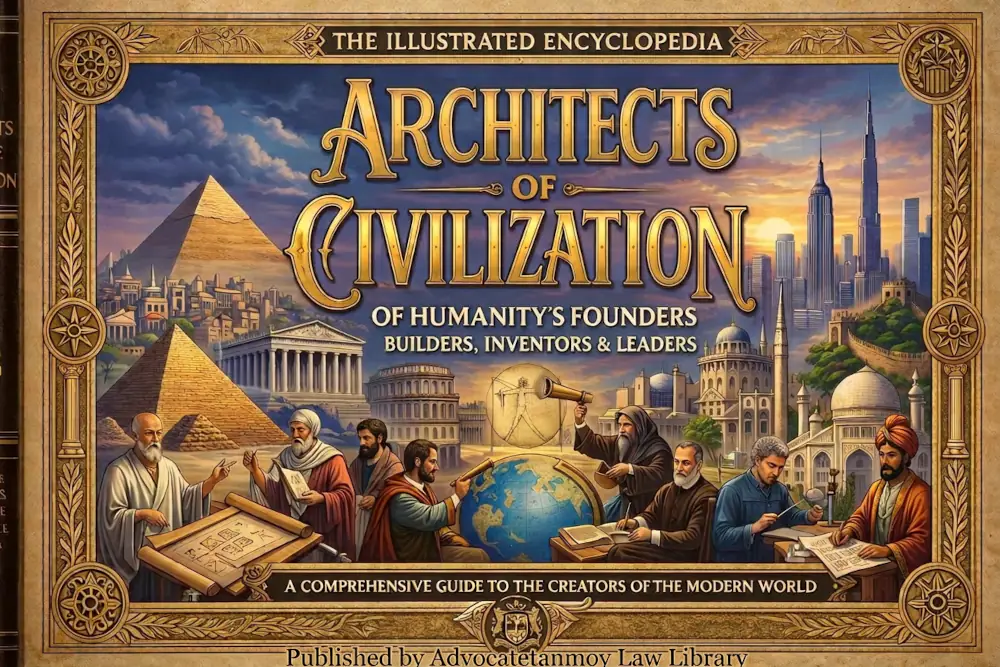
This encyclopedia, Architects of Civilization, is therefore not a collection of biographies. It is a map of civilization’s essential architecture. Each volume explores a fundamental civilizational function without which civilization cannot endure. Each individual included is not honored as a hero, but studied as an architect who embodied or advanced one of these indispensable capacities.
Together, these one hundred pillars form a blueprint for understanding how civilizations emerge, survive, collapse, and regenerate. (Also See Smallest Library for the Largest Understanding)
Volume I — Memory
Civilizations survive because they remember.
- Noah (Manu in India) — Preservation
- Moses — Cultural Continuity
- Krishna Dvaipayana Vyasa — Civilizational Narrative
- Sima Qian — Historical Memory
- Aristotle — Classification
- Carl Linnaeus — Taxonomic Memory
- Denis Diderot — Encyclopedic Memory
- Nikolai Vavilov — Biological Memory
- Melvil Dewey — Retrieval Systems
- Vannevar Bush — Knowledge Architecture
Volume II — Consciousness
Civilizations think because individuals think.
- Socrates — Questioning
- Nagarjuna — Self Observation (Madhymic Observation)
- Confucius — Ethical Self-Cultivation
- Laozi — Natural Harmony
- Descartes — Rational Doubt
- Kant — Critical Reason
- Nietzsche — Value Revaluation
- Freud — Unconscious Mind
- Carl Jung — Symbolic Consciousness
- Viktor Frankl — Meaning
Volume III — Reality Discovery
- Copernicus — Cosmic Order
- Bacon — Scientific Method
- Newton — Universal Law
- Faraday — Field Reality
- Maxwell — Unification
- Mendel — Heredity
- Pasteur — Microbial Reality
- Einstein — Relativity
- Planck — Quantum Reality
- Turing — Computability
Volume IV — Power
- Krishna Vasudeva — Duty and Action in the Middle of Uncertainty
- Chanakya — Statecraft (Dharmic Administration)
- Sun Tzu — Strategy
- Machiavelli — Political Realism
- Richelieu — Centralized State
- Bismarck — Administrative State
- Napoleon — Legal Power
- Lenin — Revolutionary Organization
- Deng Xiaoping — Adaptive Governance
- Lee Kuan Yew — Developmental State
Volume V — Law
- Manu Vaivaswata — Dharma
- Hammurabi — Codification
- Cicero — Civic Law
- Justinian — Legal Systematization
- Grotius — International Law
- Locke — Rights
- Montesquieu — Separation of Powers
- Beccaria — Justice Reform
- Kelsen — Constitutionalism
- Weber — Legitimate Authority
Volume VI — Production
- Adam Smith — Markets
- Ricardo — Comparative Advantage
- Hamilton — Financial Architecture
- Rothschild — Capital Networks
- J. P. Morgan — Industrial Capital
- Schumpeter — Innovation
- Ford — Mass Production
- Drucker — Management
- Buffett — Capital Allocation
- Deming — Quality Systems
Volume VII — Technology
- Archimedes — Engineering Principles
- Watt — Mechanical Power
- Stephenson — Rail Systems
- Bessemer — Industrial Materials
- Tesla — Electrification
- Edison — Technological Deployment
- von Neumann — Computing Architecture
- Berners-Lee — Web Architecture
- Malcolm McLean — Containerization
- Honda — Manufacturing Excellence
Volume VIII — Communication
- Panini — Language Formalization
- Gutenberg — Printing
- Morse — Telegraph
- Bell — Telephony
- Marconi — Radio
- Shannon — Information Theory
- McLuhan — Media Ecology
- Cerf — Internet Protocols
- Berners-Lee (if moved here) — Web
- Jimmy Wales — Collaborative Knowledge
Volume IX — Defense & Survival
- Leonidas I — Warrior Ethos
- Julius Caesar — Military Organization
- Francis Walsingham — Intelligence & Counterintelligence
- Carl von Clausewitz — Theory of War
- Genghis Khan — Operational Mobility
- Giuseppe Garibaldi — Mass Mobilization
- Alfred Thayer Mahan — Maritime Strategy
- Helmuth von Moltke the Elder — Operational Command
- George Kennan — Grand Strategy
- John Boyd — Adaptive Decision Cycles
Volume X — Integration & Evolution
This is the most important and hardest volume.
These people helped civilization become a single adaptive system.
- Marco Polo — Civilizational Contact
- Ibn Battuta — Global Observation
- Vavilov — Biological Integration
- Béla Balassa — Trade Integration
- Jean Monnet — Political Integration
- Norbert Wiener — Cybernetics
- Peter Drucker — Organizational Integration
- Deming — Continuous Improvement
- Jean Monnet — Economic Integration
- Buckminster Fuller — Planetary Systems Thinking
Civilizations rise and fall. Cities are abandoned. Religions transform. Languages disappear. Empires collapse. Technologies become obsolete.
Yet the underlying functions remain.
Every successful civilization must solve the same problems:
- How to preserve memory.
- How to discover truth.
- How to organize power.
- How to coordinate strangers.
- How to create prosperity.
- How to transmit knowledge.
- How to defend itself.
- How to adapt to change.
- How to provide meaning.
- How to endure uncertainty.
These problems are permanent.
The solutions vary.
The functions (Pillars of Civilization) do not.
Civilization is a living intelligence system.
It is humanity’s collective attempt to store knowledge beyond a single lifetime, coordinate action beyond a single tribe, and project purpose beyond a single generation.
The true inheritance of humanity is therefore not monuments, territories, or institutions.
It is the accumulated architecture of these functions. (See Meta-Civilizational Architecture)
If every library burned, every government vanished, every city fell, and humanity were forced to begin again, the names in these volumes would matter less than the capacities they represent.
The builders may be forgotten.
The functions must survive.
For it is not the architects who ultimately sustain civilization.
It is the pillars. (See Intelligence Civilization Studies)
And as long as those pillars endure, civilization can always be rebuilt.