

Encyclopedia of Ancient and Modern India
Encyclopedia History of Pakistan
The Indo–Pakistan War of 1971: A Comprehensive Encyclopedia of Conflict, Liberation, and Nation-Building
The Encyclopedia of the Indo–Pakistan War of 1971 is a comprehensive scholarly reference work published under the auspices of Sarvarthapedia, an ambitious civilizational knowledge project dedicated to the systematic organization and integration of human understanding across disciplines, cultures, institutions, and historical experiences. This encyclopedia seeks to provide a definitive account of one of the most transformative events in modern South Asian history—the crisis that culminated in the Indo–Pakistan War of 1971 and the emergence of Bangladesh as an independent Bengali Nation-State.
Within the broader Sarvarthapedia framework, this work occupies a distinct yet interconnected position. Sarvarthapedia has previously published the Encyclopedia of Political History of Bangladesh, in which the Bengali nationalist movement, the constitutional crisis of Pakistan, and the Bangladesh Liberation Movement were examined as part of Bangladesh’s political evolution. The present encyclopedia expands that treatment considerably by situating the liberation struggle within the wider military, diplomatic, intelligence, humanitarian, and geopolitical dimensions of the 1971 conflict.
At a higher level of integration, the Encyclopedia of the Indo–Pakistan War of 1971 constitutes a major chapter within the Encyclopedia of India’s Internal and External Intelligence System: Special Emphasis on the Research and Analysis Wing (R&AW). The events of 1971 cannot be adequately understood without examining intelligence collection, covert operations, strategic assessment, diplomatic signaling, and the role of Indian and international intelligence institutions. In turn, that encyclopedia forms part of the Encyclopedia of Indian Military Civilization (55-Volume): War Strategy and Armed Institutions From Antiquity to 2026, which studies the evolution of Indian military thought, statecraft, warfare, and security institutions across millennia.
The Encyclopedia of Indian Military Civilization itself is embedded within the larger Encyclopedia of Ancient and Modern India: A 120-Volume Civilizational Knowledge System, which examines India as a long-duration civilization encompassing political, intellectual, cultural, economic, military, and technological developments. This broader work forms one component of the Encyclopedia of Contemporary World History (2001–Present): A 100-Volume Statement on World System, which explores the structures and dynamics of the modern international order. Beyond this stands Meta-Civilizational Architecture: How Complex Systems Survive, a theoretical framework for understanding the resilience and transformation of civilizations, states, institutions, and knowledge systems. Ultimately, all of these projects are integrated into the Global Encyclopedia (180-Volume) of Intelligence, Espionage, and Counterintelligence, which has been placed within Sarvarthapedia Area 1: The Foundations—Knowledge, Information, and Inquiry.
Area 1 establishes the epistemological basis of the Sarvarthapedia system. It investigates the nature of knowledge, the relationship between data, information, and wisdom, and the methodologies through which evidence is collected, verified, interpreted, and transformed into reliable understanding. Through research methodologies, logic, critical thinking, scientific reasoning, information systems, archives, libraries, and digital infrastructures, this foundational area cultivates the principles of objectivity, verification, and systematic inquiry. Sarvarthapedia as a whole represents an intelligent and integrative macro-structural architecture—a knowledge graph of human civilization—in which all domains of inquiry are interconnected within a unified intellectual framework. (See Intelligence)
The present encyclopedia embodies that philosophy by treating the events of 1971 not merely as a conventional interstate war but as a multidimensional historical process. It examines the constitutional and political failures of Pakistan between 1947 and 1971; the systematic discrimination experienced by East Pakistan; the rise of Bengali nationalism and the state’s coercive response; the humanitarian catastrophe that accompanied military repression; the diplomatic and strategic calculations of India, Pakistan, the United States, the Soviet Union, China, and the wider international community; and the military campaigns that ultimately reshaped the political map of South Asia.
The central purpose of this encyclopedia is therefore explanatory as much as descriptive. It seeks to provide a broader understanding of why Pakistan’s internal political crisis evolved into state violence, international intervention, and ultimately the creation of Bangladesh, while simultaneously presenting a rigorous and comprehensive military history of the Indo–Pakistan War of 1971. By integrating political history, military studies, intelligence analysis, diplomatic history, humanitarian inquiry, and civilizational perspectives, this work aspires to become a definitive reference for scholars, students, policymakers, military professionals, and future generations seeking to understand one of the pivotal conflicts of the twentieth century. (See Diplomacy and India’s Unity)
This encyclopedia of the Indo–Pakistan War undertakes a comprehensive examination of the multiple dimensions that shaped the crisis and conflict of 1971. Particular emphasis is placed upon:
- The constitutional and political failures of Pakistan (1947–1971).
- Systematic discrimination against East Pakistan.
- The Bengali national movement and state repression.
- The humanitarian catastrophe of 1971.
- International diplomacy and Cold War geopolitics.
Finally, this work investigates the aftermath and legacy of 1971, including the creation of Bangladesh, post-war reconstruction, prisoners of war, war-crimes debates, regional security transformations, collective memory, competing national narratives, and the continuing impact of the conflict on South Asian politics and international relations. Through the integration of political history, military history, intelligence studies, diplomatic history, humanitarian inquiry, legal analysis, and historiography, the encyclopedia seeks to provide a holistic understanding of how an internal political crisis evolved into a major international conflict that reshaped the geopolitical landscape of South Asia and led to the emergence of Bangladesh as an independent state.
VOLUME I: Pakistan’s Internal Crisis, Bengali Resistance, and the Birth of Bangladesh (1947–1971)
General Synopsis
This volume examines how the Pakistani state evolved from independence in 1947 to collapse in East Pakistan in 1971. It investigates constitutional failures, economic exploitation, military dominance, ethnic discrimination, language politics, repression, and the emergence of Bengali nationalism.
The volume argues that the 1971 crisis cannot be understood merely as a war between India and Pakistan; it was first and foremost a crisis of state legitimacy inside Pakistan.
PART I – The Making of an Unequal State (1947–1958)
Chapter 1
Creation of Pakistan
- Ideological foundations
- Geographical anomaly
- East-West demographic imbalance
- Expectations of Bengali Muslims
Chapter 2
East Pakistan and the Colonial Legacy
- Bengal under British rule
- Muslim politics in Bengal
- Economic structures inherited from colonialism
Chapter 3
Early Administrative Domination by West Pakistan
- Civil services
- Military establishment
- Political representation
Chapter 4
The Language Question
Detailed treatment of:
- Bengali language movement
- Student mobilization
- February 1952 shootings
- Creation of Bengali political identity
PART II: Structural Discrimination Against East Pakistan
Chapter 5
Political Marginalization
- Constitutional engineering
- One Unit Scheme
- Parliamentary manipulation
Chapter 6
Military Exclusion
Statistical studies of:
- Officer corps
- Recruitment patterns
- Promotions
- Strategic distrust of Bengalis
Chapter 7
Economic Exploitation Debate
Detailed analysis of:
- Foreign exchange earnings
- Jute exports
- Development expenditures
- Infrastructure spending
Appendix:
Economic indicators 1947–1970
Chapter 8
Cultural Discrimination
- State narratives
- Urduization policies
- Media control
Chapter 9
The Myth of “Martial Races”
- Colonial origins
- Pakistani military ideology
- Impact on Bengali identity
PART III – Military Rule and Bengali Nationalism
Chapter 10
Rise of Military Dominance
- Iskander Mirza
- Ayub Khan
Chapter 11
The Ayub Era
- Developmental state
- Authoritarian modernization
- East Pakistani perceptions
Chapter 12
Sheikh Mujib and the Awami League
Extensive biographical chapter on
Sheikh Mujibur Rahman
Chapter 13
Six Point Movement
Detailed analysis of:
- Federalism
- Provincial autonomy
- Economic sovereignty
Chapter 14
Agartala Case
- Intelligence dimensions
- Political consequences
PART IV – The Road to Breakdown (1969–1971)
Chapter 15
Yahya Khan’s Regime
- Martial law
- Electoral promises
Chapter 16
Bhola Cyclone
- Government failures
- Public anger
Chapter 17
Election of 1970
Complete district-by-district study
Chapter 18
Constitutional Crisis
- National Assembly dispute
- Role of
- Zulfikar Ali Bhutto
- Yahya Khan
- Sheikh Mujib
Chapter 19
Negotiations of March 1971
Day-by-day reconstruction
PART V – Operation Searchlight and State Violence
This section should be one of the largest in the encyclopedia.
Chapter 20
Planning of Operation Searchlight
- Military documents
- Strategic assumptions
Chapter 21
Night of 25 March 1971
Detailed chronology
Dhaka:
- University
- Student halls
- Media centers
- Political headquarters
Chapter 22
Attacks on Intellectuals
Chapter 23
Targeting of Political Activists
Chapter 24
Violence Against Minority Communities
Discussion of attacks on:
- Hindus
- Political dissidents
- Intellectuals
Chapter 25
Counterinsurgency Campaign
Military operations:
- Search-and-destroy missions
- Village clearances
- Collective punishments
Chapter 26
Refugee Crisis
Nearly ten million refugees entering
India
PART VI – Mukti Bahini and the Liberation Struggle
Chapter 27
Formation of Provisional Government
Chapter 28
Organization of Mukti Bahini
Chapter 29
Sector Commanders
Biographies of all sector commanders
Chapter 30
Guerrilla Warfare
Chapter 31
Intelligence Networks
Chapter 32
Women in the Liberation War
Chapter 33
International Media and Reporting
Coverage by:
- Anthony Mascarenhas
- Foreign correspondents
- Human rights observers
PART VII – International Reactions and Cold War Diplomacy
This entire section is usually underdeveloped in existing histories.
Chapter 34
The United States and Pakistan
Extensive treatment of:
The Nixon Administration
- Richard Nixon
- Henry Kissinger
Topics:
- Strategic reliance on Pakistan
- Secret opening to China
- Internal policy debates
- White House recordings
- Diplomatic correspondence
The Blood Telegram
Analysis of dissent within the U.S. diplomatic corps.
Chapter 35
Soviet Policy
Role of the
Soviet Union
- Strategic calculations
- Support for India
- UN diplomacy
- Military cooperation
Chapter 36
Chinese Policy
Role of China
- Relations with Pakistan
- Response to crisis
- Strategic constraints
Chapter 37
British Policy
Role of
United Kingdom
Chapter 38
United Nations Responses
Role of:
- Refugee agencies
- Humanitarian institutions
- Security Council
Chapter 39
Global Public Opinion
- Student movements
- Human rights organizations
- International press
VOLUME II: The Indo–Pakistan War of 1971: Strategy, Campaigns, and Military History
General Synopsis
This volume treats the war as a complete military campaign from March to December 1971, incorporating the Mukti Bahini campaign, Indian military planning, Pakistani strategy, air and naval operations, and the collapse of Eastern Command.
PART I – Military Situation Before War
Chapter 1
Strategic Geography of East Pakistan
Chapter 2
Pakistan Eastern Command
Detailed study of:
- Force dispositions
- Defensive plans
- Command problems
Chapter 3
Indian Military Planning
Leadership of
Sam Manekshaw
Chapter 4
Joint Planning with Mukti Bahini
PART II – The Hidden War (March–November 1971)
Chapter 5
Border Operations
Chapter 6
Guerrilla Campaign
Chapter 7
Operation Jackpot
Chapter 8
Special Operations
Chapter 9
Intelligence Warfare
RAW, military intelligence, and resistance networks.
PART III – Conventional War
Chapter 10
Pakistani Air Strikes of 3 December
Chapter 11
Indian War Aims
Chapter 12
Eastern Campaign Overview
PART IV – Campaign for Dhaka
A highly detailed operational history.
Chapter 13
- Northern Axis
- Hilli
- Bogra
- Rangpur
- Chapter 14
- Eastern Axis
- Sylhet
- Akhaura
- Brahmanbaria
Chapter 15
- Western Axis
- Jessore
- Jhenidah
- Khulna
Chapter 16
Meghna Heli Bridge
Chapter 17
Tangail Airdrop
Chapter 18
Race to Dhaka
Chapter 19
Collapse of Eastern Command
Chapter 20
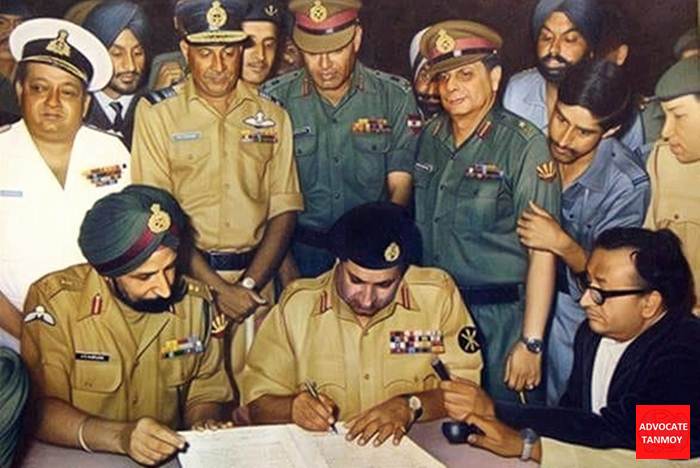
Instrument of Surrender
Detailed documentary analysis.
PART V – Western Front
Chapter 21
Kashmir Operations
Chapter 22
Punjab Sector
Chapter 23
Shakargarh Bulge
Chapter 24
Battle of Basantar
Chapter 25
Battle of Longewala
Chapter 26
Rajasthan Campaign
PART VI – Air War
Chapter 27
Indian Air Force Strategy
Chapter 28
Pakistan Air Force Strategy
Chapter 29
Air Superiority Campaign
Chapter 30
Tactical Air Support
PART VII – Naval War
Chapter 31
Bay of Bengal
Chapter 32
Arabian Sea
Chapter 33
Operation Trident
Chapter 34
Operation Python
Chapter 35
Submarine Warfare
PNS Ghazi
INS Khukri
PART VIII – Superpowers and the War
This is another area often neglected.
Chapter 36
U.S. Seventh Fleet
Task Force 74
USS Enterprise Deployment
Political implications.
Chapter 37
Soviet Naval Response
Counter-deployment of Soviet forces.
Chapter 38
UN Security Council Crisis
Voting records
Diplomatic negotiations
Ceasefire efforts
Chapter 39
Chinese Military Options
Why intervention did not occur.
PART IX – Aftermath and Historical Debate
Chapter 40
Prisoners of War
Chapter 41
Simla Negotiations
Simla Agreement
Chapter 42
Recognition of Bangladesh
Chapter 43
Competing Historical Narratives
Indian, Pakistani, Bangladeshi, American, Soviet, Chinese, and international interpretations.
VOLUME III: Exploitation and Failure of the Islamic Republic of Pakistan
- Economic exploitation and regional inequality (1947–1971)
- Revenue generation vs expenditure.
- Jute economy.
- Development disparities.
- Role of intelligence agencies
- R&AW.
- Pakistani intelligence organizations.
- CIA assessments.
- Soviet intelligence reporting.
- Chinese intelligence perspectives.
- Media, journalism, and information warfare
- International correspondents.
- The Blood Telegram.
- Foreign press coverage.
- Propaganda campaigns.
- International law and human rights
- Self-determination.
- Sovereignty.
- Genocide debates.
- Refugee law.
- Women and gender
- Sexual violence during the conflict.
- Women in the liberation movement.
- Post-war rehabilitation.
- Historiography and memory
- Bangladeshi interpretations.
- Pakistani interpretations.
- Indian interpretations.
- Western scholarship.
- Russian and Chinese perspectives.
- Comparative nation-building
- Why Pakistan failed to remain united.
- State formation in Bangladesh.
- Lessons for multinational states.
Volume IV: Nationalism (Islamic, Pakistani, Bengali)
1. State Formation and the Failure of Nation-Building
The crisis was not only a war or a liberation movement; it was also one of the twentieth century’s most significant cases of state disintegration. A dedicated section should examine:
- Why Pakistan failed as a bi-national state.
- Competing concepts of nationalism (Islamic, Pakistani, Bengali).
- Federalism versus centralization.
- Comparative studies with other multinational states.
2. Civil-Military Relations in Pakistan
The role of the military establishment deserves independent treatment:
- Military dominance in politics.
- Decision-making structures.
- Civilian–military tensions.
- Strategic culture of the Pakistan Army.
- Post-war institutional responses.
3. Bureaucratic and Administrative History
Often overlooked, but crucial:
- Role of the Civil Service of Pakistan.
- Provincial administration in East Pakistan.
- Governance collapse during 1971.
- Emergency administration and refugee management.
4. Intelligence and Strategic Assessment
Since this work connects to a larger intelligence encyclopedia, a separate analytical section could cover:
- Intelligence failures of Pakistan.
- Indian strategic assessments.
- American intelligence estimates.
- Soviet intelligence reporting.
- Chinese assessments.
- Signals intelligence and communications interception.
5. Refugee Studies and Human Security
The refugee crisis was one of the largest in the twentieth century:
- Refugee camp administration.
- Public health.
- International relief operations.
- Economic burden on India.
- Long-term demographic consequences.
6. Comparative Atrocity Studies
Without entering advocacy, an encyclopedia should examine:
- Patterns of state violence.
- Civilian targeting.
- Counterinsurgency doctrines.
- Comparative cases from other conflicts.
- Documentation and evidentiary debates.
7. International Media and Public Opinion
A surprisingly underexplored area:
- Foreign correspondents.
- Global newspaper coverage.
- Television reporting.
- Public campaigns in Europe and North America.
- Role of intellectuals and activists.
8. Law, Legitimacy, and Recognition
Key questions include:
- Legal basis of Bangladesh’s independence.
- International recognition.
- Self-determination.
- Humanitarian intervention.
- Sovereignty and secession.
9. Technology and Military Systems
A reference encyclopedia should document:
- Aircraft.
- Naval platforms.
- Armored vehicles.
- Communications systems.
- Logistics infrastructure.
- Riverine warfare technologies.
10. Geography and Environment of War
The physical environment shaped the conflict:
- River systems of East Bengal.
- Monsoon conditions.
- Terrain and mobility.
- Ports, railways, and bridges.
- Strategic geography.
11. Economic Consequences of 1971
Separate chapters could analyze:
- Economic losses.
- Reconstruction of Bangladesh.
- Impact on Pakistan’s economy.
- Regional trade disruption.
- Foreign aid and development assistance.
12. Memory, Commemoration, and National Identity
How the conflict is remembered:
- School textbooks.
- Museums.
- Monuments.
- National holidays.
- Veterans’ associations.
- Public memory in Bangladesh, India, and Pakistan.
13. Sources, Archives, and Historical Methodology
For a serious encyclopedia, include:
- Archival repositories.
- Government records.
- Military documents.
- Oral history collections.
- Declassified intelligence materials.
- Historiographical controversies.
14. The Global Cold War Context
Go beyond simple U.S.–Soviet rivalry:
- Sino-Soviet split.
- U.S.–China rapprochement.
- South Asian balance of power.
- Non-Aligned Movement.
- Strategic implications for the Indian Ocean.
15. Long-Term Legacy (1971–Present)
The consequences continue today:
- India–Bangladesh relations.
- Pakistan’s strategic evolution.
- Nuclearization of South Asia.
- Regional security architecture.
- Lessons for contemporary conflicts.
Appendix
- Complete transcripts of March 1971 negotiations.
- Declassified U.S. State Department records.
- White House tapes relating to South Asia.
- Soviet Politburo discussions on the crisis.
- Chinese Foreign Ministry assessments.
- Pakistan Army internal assessments before and after the war.
- Hamoodur Rahman Commission documents.
- Refugee camp administration records in India.
- Oral histories from Bengali civilians.
- Oral histories from Pakistani soldiers.
- International journalist dispatches.
- UN Security Council verbatim debates.
- Statistical database of casualties, displacement, and military losses.
- Comparative historiography showing how the war is taught in India, Pakistan, Bangladesh, the U.S., Britain, Russia, and China.
Volume V: Psychology of Indo–Pakistan War 1971 War
1. Psychology of Decision-Making
Not just what leaders decided, but how they thought.
Key questions:
- Why did Pakistan’s leadership believe force would solve the crisis?
- How did perceptions of Bengali identity influence decisions?
- What assumptions guided Indian strategic planning?
- How did cognitive biases affect military and political leaders?
Subjects:
- Leadership psychology.
- Crisis decision-making.
- Strategic miscalculation.
- Groupthink.
- Risk perception.
2. Political Communication and Propaganda
Study:
- State-controlled media.
- Radio broadcasts.
- International publicity campaigns.
- Wartime narratives.
- Information operations.
Sources:
- Radio Pakistan.
- Swadhin Bangla Betar Kendra.
- All India Radio.
- International broadcasting services.
3. Intellectual History of the Crisis
Investigate:
- Competing ideas of nationhood.
- Islamic nationalism.
- Bengali linguistic nationalism.
- Federalism.
- Self-determination.
This helps explain why political compromise became increasingly difficult.
4. Sociology of Violence
Questions:
- How do states mobilize violence?
- Why do ordinary people participate in violence?
- How do communities fracture under political stress?
This introduces broader social-science perspectives beyond military history.
5. Urban History of 1971
Dedicated studies of:
- Dhaka.
- Chittagong.
- Khulna.
- Rajshahi.
- Sylhet.
Urban centers often experienced the conflict differently from rural regions.
6. Rural History of the Conflict
Many studies focus on cities and leaders.
An encyclopedia should also examine:
- Village-level experiences.
- Local resistance networks.
- Agricultural disruption.
- Rural governance collapse.
7. Demographic History
Include:
- Population movements.
- Refugee flows.
- Internal displacement.
- Religious and ethnic demographic changes.
- Long-term population effects.
8. Cartographic and Spatial Analysis
A world-class encyclopedia should contain:
- Historical maps.
- Ethnic maps.
- Electoral maps.
- Refugee-route maps.
- Military campaign maps.
- Intelligence maps.
Maps often reveal patterns invisible in narrative histories.
9. Documentary History Section
This is perhaps the single most valuable addition.
Include full or annotated versions of:
- Six-Point Programme.
- Election documents.
- March 1971 speeches.
- Diplomatic cables.
- The Blood Telegram.
- UN debates.
- Surrender Instrument.
- Simla Agreement documents.
- Hamoodur Rahman Commission excerpts.
Future researchers often use documentary sections more than narrative chapters.
10. Historiography and Historical Controversies
Every major controversy should have its own entry:
Examples:
- Casualty estimates.
- Refugee statistics.
- Military effectiveness.
- International intervention.
- Recognition politics.
- War-crimes debates.
The encyclopedia should explain:
- What is known.
- What is disputed.
- What evidence exists.
- Where scholarly disagreement remains.
11. Comparative Perspective
Compare 1971 with:
- Nigeria–Biafra.
- Algeria.
- Vietnam.
- Yugoslavia.
- Eritrea.
- South Sudan.
This helps place the conflict in global context.
12. Memory Across Generations
Study:
- First-generation participants.
- Post-1971 generations.
- School curricula.
- Public monuments.
- Films and literature.
- Digital memory in the 21st century.
13. Knowledge and Sources Architecture
Knowledge Architecture of the 1971 War
This section would classify sources according to:
- Government archives.
- Military records.
- Intelligence records.
- Diplomatic correspondence.
- Oral histories.
- Newspapers.
- Photographs.
- Maps.
- Statistical datasets.
14. The “1971 System” Approach
A distinctive Sarvarthapedia contribution would be to study 1971 as an interconnected system composed of:
- Political System.
- Military System.
- Intelligence System.
- Diplomatic System.
- Economic System.
- Information System.
- Refugee and Humanitarian System.
- International System.
Instead of treating events separately, this approach examines how failures and decisions in one system affected all the others.
Appendix
A combined reading of 1971 History:
- Constitutional and political history,
- Economic inequality,
- Bengali nationalism,
- State repression,
- Humanitarian catastrophe,
- Intelligence and covert action,
- Military campaigns,
- International diplomacy,
- Cold War geopolitics,
- Documentary history,
- Historiography,
- Memory studies,
- Comparative conflict analysis,
- Knowledge architecture,
Central Thesis: The Encyclopedia of the Indo–Pakistan War of 1971 advances the thesis that the conflict of 1971 was not merely a conventional war between India and Pakistan, nor solely a successful national liberation movement that culminated in the creation of Bangladesh. Rather, it was the culmination of a long-term crisis of state formation within Pakistan, arising from unresolved constitutional contradictions, political exclusion, economic inequality, cultural marginalization, and the systematic denial of democratic representation to the Bengali majority between 1947 and 1971. The failure of successive Pakistani governments and military regimes to construct an inclusive and equitable political order transformed constitutional disputes into a legitimacy crisis, a legitimacy crisis into mass resistance, and mass resistance into violent confrontation.
The encyclopedia further argues that the events of 1971 must be understood as the interaction of multiple interconnected systems: political institutions, military establishments, intelligence organizations, economic structures, diplomatic networks, information systems, humanitarian processes, and international power relations. The crisis evolved from an internal political conflict into a regional war because domestic repression, large-scale displacement of civilians, the emergence of organized armed resistance, and the strategic calculations of neighboring states progressively internationalized the conflict. Consequently, the Indo–Pakistan War of 1971 became both a decisive military campaign and a transformative geopolitical event that reshaped the balance of power in South Asia.
At the international level, the conflict represented one of the most significant Cold War crises outside Europe, revealing the competing interests of the United States, the Soviet Union, China, India, Pakistan, and the United Nations within a rapidly changing global order. Simultaneously, it raised enduring questions concerning sovereignty, self-determination, humanitarian intervention, intelligence operations, and the relationship between state power and popular legitimacy.
The Indo–Pakistan War of 1971 was the culmination of Pakistan’s unresolved constitutional, political, economic, and cultural contradictions, transforming an internal crisis of legitimacy into a liberation struggle, an international humanitarian emergency, a Cold War diplomatic confrontation, and ultimately the birth of Bangladesh and the reconfiguration of South Asian geopolitics.
This encyclopedia therefore contends that the birth of Bangladesh was not the product of a single military victory or political declaration but the outcome of a complex historical process in which constitutional failure, state violence, nationalist mobilization, humanitarian catastrophe, international diplomacy, intelligence activity, and military operations converged to produce one of the most consequential transformations in modern South Asian history. The study of 1971 is thus fundamentally a study of how states lose legitimacy, how nations emerge, how regional conflicts become international crises, and how political systems are ultimately reshaped by the interaction of power, identity, and historical circumstance.
More Stories
Abhay Charan Bhaktivedanta: An Anointed Apostle in America
Foreign NGO Control in China: Laws, Registration, Public Security Oversight and Regulation
Communist Persecution of Christianity in China: A Historical Analysis (1949–2026)