Meta-Civilizational Architecture
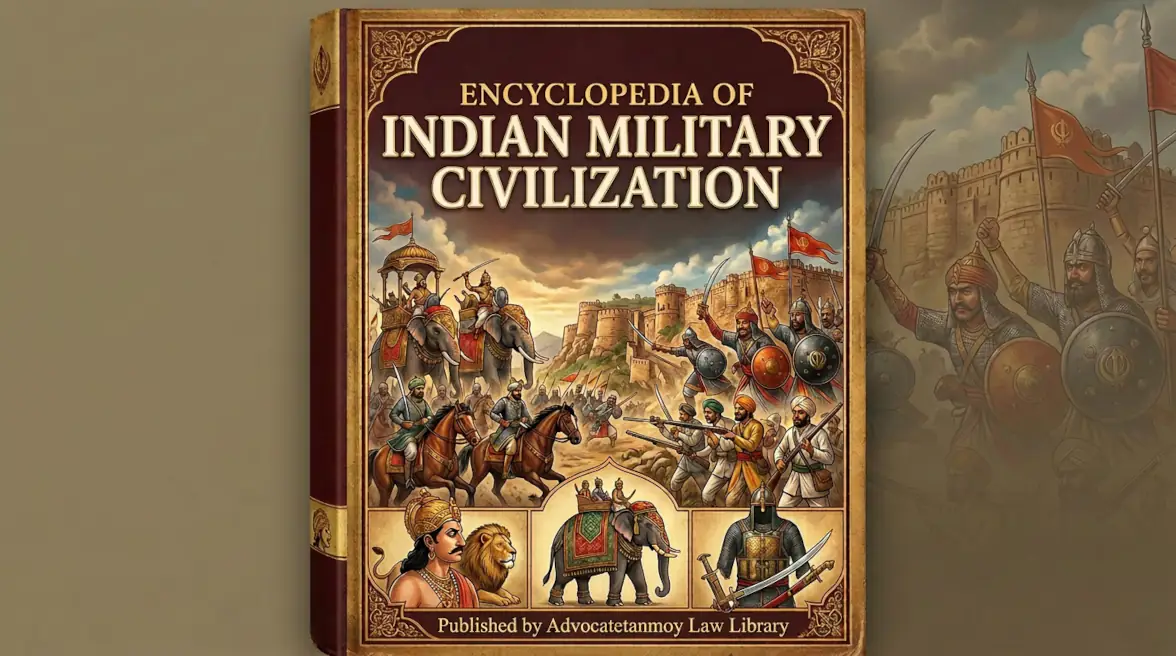
How a civilization organized violence, defended territory, projected power, and imagined sovereignty across five millennia. Indian Military Civilization is a continuous civilizational phenomenon extending across more than three millennia, expressed through changing forms of statehood, military organization, strategic thought, technology, frontiers, maritime systems, and institutions of power.
The Encyclopedia of Indian Military Civilization expands upon Volume 79: Military Traditions from the Encyclopedia of Ancient and Modern India, providing a long-duration study of warfare, defence systems, military cultures, political power, and strategic imagination in the Indian world.
In this project, we shall address questions such as:
- How did India repeatedly create and lose empires?
- Why did some military systems endure for centuries while others collapsed rapidly?
- How did geography shape Indian strategy?
- How did military institutions contribute to state formation?
- What continuities link the armies of the Mauryas, Mughals, Company State, British Raj, and Republic of India?
- Is there an identifiable Indian strategic tradition across millennia?
Encyclopedia of Indian Military Civilization
We are going to study the relationship between war, state formation, strategic thought, military institutions, technology, economy, society, and civilizational identity in the Indian subcontinent from antiquity to 2026.
PART I – CIVILIZATIONAL FOUNDATIONS
Volumes 1–10: These establish the intellectual framework.
Volume 1: India as a Military Civilization
Questions:
- What is military civilization?
- Can India be understood as a strategic civilization?
- Continuity versus rupture.
- Geography and power.
- State formation and warfare.
Sections:
- Historiography
- Comparative Civilizations
- Theories of Military Power
- Indian Strategic Tradition
Volume 2: Geography and the Military Making of India
Topics:
- Himalayas
- Indus System
- Ganges Basin
- Deccan Plateau
- Coastal Systems
- Indian Ocean
- Monsoon and Warfare
- Ecology and Campaigning
Volume 3: Sources of Indian Military History
Topics:
- Vedas
- Vedic warfare
- Epics
- Puranas
- Arthashastra
- Inscriptions
- Persian Chronicles
- Colonial Archives
- Oral Traditions
- Archaeology
Volume 4: State Formation and Military Power
Evolution:
- Tribal Confederacies
- Kingdoms
- Empires
- Sultanates
- Confederacies
- Colonial State
- Republic
Volume 5: Strategic Thought in India
Core texts:
- Arthashastra
- Mahabharata
- Nitisara
- Mughal texts
- Maratha correspondence
- Modern doctrine
Volume 6: Military Labour and Warrior Communities
Topics:
- Kshatriyas
- Rajputs
- Jats
- Sikhs
- Marathas
- Gurkhas
- Tribal warriors
- Sepoys
Volume 7: Technology and Innovation
Long-term evolution:
- Chariots
- Metallurgy
- Cavalry
- Gunpowder
- Rockets
- Nuclear systems
Volume 8: Economics of War
Topics:
- Revenue systems
- Military finance
- Logistics
- Military-industrial structures
See also: Encyclopedia of Indian Economy
Volume 9: Religion, Ethics and Warfare
Topics:
- Dharma Yuddha
- Jihad
- Just War Concepts
- Military ethics
- Yuddha Gita (700-Volumes)
- War Strategy in Valmiki Ramayana
Volume 10: Military Culture and Memory
Topics:
- Epics
- Heroic traditions
- Regimental culture
- National memory
PART II – ANCIENT INDIA (Volumes 11–18)
Volume 11: Military Systems of the Vedic Age
Volume 12: Mahajanapadas and Early States
Volume 13: The Mauryan Military Revolution
Focus:
- Chandragupta Maurya
- Kautilya
- Imperial military administration
Volume 14: Post-Mauryan Military Systems
Volume 15: The Gupta Age
Volume 16: South Indian Military Traditions
Volume 17: Frontiers and Invasions
Volume 18: India and the Ancient Military World
PART III – MEDIEVAL INDIA (Volumes 19–28)
Volume 19: Early Medieval Warfare
Volume 20: The Turkish Military Revolution
Volume 21: Delhi Sultanate
Volume 22: Military Institutions of the Sultanates
Volume 23: The Mughal Military State
Volume 24: Mughal Warfare and Expansion
Volume 25: The Military Economy of the Mughal Empire
Volume 26: Maratha Military Civilization
One of the most important volumes.
Volume 27: Sikh Military Power
Volume 28: Indian Ocean Warfare Before European Dominance
PART IV – COMPANY AND IMPERIAL INDIA (Volumes 29 – 38)
Volume 29: European Military Penetration
Volume 30: The East India Company Military State
Volume 31: Plassey to Buxar
Volume 32: Company Rule in India
Mysore
Marathas
Punjab
Burma
Volume 33: The Presidency Armies
Bengal
Madras
Bombay
Volume 34: Military Society Under Company Rule
Volume 35: The Revolt of 1857
Volume 36: The British Indian Army
Volume 37: Frontier Empire and Imperial Defence
Volume 38: Indian Soldiers in World Wars
PART V – THE MILITARY FOUNDING OF MODERN INDIA (Volumes 39 – 44)
Volume 39: Indian National Army and Independence
Volume 40: Partition and Military Division
Volume 41: Founding the Armed Forces of India
- Indian Army under British Rule in 1905
- Recruitment in the Indian Military
- 1947–1962
- India and Pakistan’s Military Evolution Since Partition in 1947
Volume 42: Wars of National Consolidation
1947
1962
1965
1971
Volume 43: Nuclear India
- Indian Nuclear Doctrine
- Neuclear Command
Volume 44: Kargil and the Rise of Modern India
- Operation Sindoor
- Surgical Strike Method
PART VI – CONTEMPORARY STRATEGIC INDIA (Volumes 45–47)
Volume 45: India as a Maritime Power
Indian Ocean strategy.
Volume 46: Space, Cyber and Information Warfare
Volume 47: Military Transformation 2000–2026
AI
Drones
Joint commands
Future warfare
PART VII – GRAND REFERENCE SECTION (Volumes 48–50)
Volume 48: Institutions of Indian Military Civilization
Coverage:
- Kings
- President of India
- Indian Defence Ministers
- Strategists Partnership with Foreign Powers
- Military Engineering
- Indian Military Manufacturing
- Military Logistic Support
- Military Command Language
- Indian Military Financing
- Military Commands and Theaters
- Cantonment Administration
- Military Laws
- India`s military procurement
- Arms and Ammunition Factories
Volume 49: Battles, Campaigns and Military Institutions
Coverage:
- Ancient battles
- Medieval campaigns
- Colonial wars
- Modern conflicts
Volume 50: Atlas, Documents and Strategic Gazetteer
Contains:
Strategic Atlas
- Ancient trade routes
- Invasion corridors
- Imperial frontiers
- Campaign maps
- Maritime networks
Documentary Collection
Selections from:
- Arthashastra
- Imperial edicts
- Farmans
- Military regulations
- War dispatches
- Defence policy documents
Military Gazetteer
- Forts
- Cantonments
- Dockyards
- Airbases
- Battlefields
Volume 51 – Commanders of the Republic
Indian Military Leadership and the Making of Modern India (1947–2026)
Synopsis
This volume examines the evolution of the Republic of India’s military institutions (Expansion of Volume 48) through the careers, strategic decisions, reforms, campaigns, and legacies of its principal military commanders. Rather than presenting isolated biographies, it studies military leadership as a historical force that shaped national security, defence policy, military modernization, strategic doctrine, and warfighting capability from Independence in 1947 to the emergence of India as a major regional and global power in the twenty-first century.
Beginning with the partition of the British Indian Army and the establishment of sovereign military institutions in August 1947, the volume follows the succession of Commanders-in-Chief, Chiefs of Army Staff, naval and air chiefs, theatre commanders, field generals, and defence reformers who guided the armed forces through wars, crises, modernization programmes, nuclearization, counterinsurgency campaigns, maritime expansion, and the technological transformation of warfare.
The volume argues that the history of independent India’s military development can be understood through distinct leadership eras, each associated with specific strategic challenges and institutional achievements.
Part I: Founding Generation (1947–1962)
Chapter 1
General Sir Roy Bucher (1948–1949)
- Last British Commander-in-Chief
- Kashmir War administration
- Transfer of command
Chapter 2
General K. M. Cariappa Era (1949–1953)
Major Achievements
- First Indian Commander-in-Chief
- Nationalization of military leadership
- Integration of princely state forces
- Professionalization of officer corps
- Foundation of modern Indian Army traditions
Chapter 3
General Rajendrasinhji Era (1953–1955)
Achievements
- Consolidation phase
- Expansion of indigenous command structures
- Institutional stabilization
Chapter 4
General S. M. Srinagesh Era (1955–1957)
Achievements
- Training reforms
- Operational planning
Chapter 5
General K. S. Thimayya Era (1957–1961)
Achievements
- Modernization initiatives
- Strategic warnings regarding China
- Professional military advocacy
Part II: The Crisis Generation (1962–1971)
Chapter 6
General P. N. Thapar and the Sino-Indian War
- Strategic failures
- Command challenges
- Lessons of 1962
Chapter 7
General J. N. Chaudhuri Era
Achievements
- Army reconstruction after 1962
- Force expansion
- Mountain warfare doctrine
Chapter 8
General P. P. Kumaramangalam Era
Achievements
- Mechanization initiatives
- Professional military education
Chapter 9
General Sam Manekshaw Era
Topics
- Eastern Command
- Military planning
- Leadership philosophy
- 1971 Bangladesh Campaign
Strategic Achievement
Victory in the Indo-Pakistan War of 1971 and the creation of Bangladesh.
Part III: Consolidation and Professionalization (1971–1986)
Chapter 10
General G. G. Bewoor
Chapter 11
General T. N. Raina
Achievement
- Post-war restructuring
Chapter 12
General O. P. Malhotra
Achievement
- Mechanization expansion
Chapter 13
General K. V. Krishna Rao
Achievement
- Counterinsurgency concepts
Chapter 14
General A. S. Vaidya
Achievement
- Operation Blue Star
- Armoured warfare development
Part IV: Technological and Regional Power Era (1986–1999)
Chapter 15
General K. Sundarji
A transformative chapter.
Major Contributions
- Mechanized warfare doctrine
- Operation Brasstacks
- Computerization initiatives
- Strategic modernization
Chapter 16
General V. N. Sharma
Chapter 17
General S. F. Rodrigues
Contributions
- Strategic mobility
- Force modernization
Chapter 18
General B. C. Joshi
Contributions
- Vision 2000 reforms
Chapter 19
General V. P. Malik
Major Achievement
- Kargil War leadership
- Joint operations
Part V: Twenty-First Century Transformation (1999–2014)
Chapter 20
General S. Padmanabhan
Chapter 21
General N. C. Vij
Achievement
- Defence modernization
Chapter 22
General J. J. Singh
Achievement
- Human resource reforms
Chapter 23
General Deepak Kapoor
Achievement
- Network-centric warfare concepts
Chapter 24
General V. K. Singh
Achievement
- Organizational reform initiatives
Chapter 25
General Bikram Singh
Achievement
- Operational readiness programmes
Part VI: Era of Jointness and Emerging Technologies (2014–2026)
Chapter 26
General Dalbir Singh Suhag
Chapter 27
General Bipin Rawat
A major chapter.
Achievements
- Counterinsurgency doctrine
- First Chief of Defence Staff
- Theatre command initiatives
Chapter 28
General Manoj Mukund Naravane
Achievements
- Northern border preparedness
- China crisis management
Chapter 29
General Manoj Pande
Achievements
- Infrastructure modernization
- Indigenous systems integration
Chapter 30
General Upendra Dwivedi and the Contemporary Army
Topics
- Multi-domain warfare
- AI-enabled operations
- Future battlefield concepts
Part VII: Beyond the Army
Naval Leadership
From:
- Admiral Ram Dass Katari
- Admiral S. M. Nanda
- Admiral Arun Prakash
- Admiral Karambir Singh
- Admiral Dinesh K. Tripathi
Air Force Leadership
From:
- Air Marshal Subroto Mukerjee
- Air Chief Marshal Arjan Singh
- Air Chief Marshal P. C. Lal
- Air Chief Marshal B. S. Dhanoa
- Air Chief Marshal Amar Preet Singh
Chapter 31
Evolution of Indian Military Leadership
Themes:
- Colonial inheritance
- Indianization
- Professionalism
- Jointness
Chapter 32
The Strategic Generals
Comparative study of:
- Cariappa
- Thimayya
- Manekshaw
- Sundarji
- Malik
- Bipin Rawat
Chapter 33
Command, Leadership and the Future of Indian Military Power
1947–2026 assessment.
The history of the Indian Armed Forces after Independence can be read as a succession of leadership generations:
- Founders (1947–1962) — Cariappa, Rajendrasinhji, Thimayya.
- Rebuilders (1962–1971) — Chaudhuri, Kumaramangalam, Manekshaw.
- Consolidators (1971–1986) — Raina, Krishna Rao, Vaidya.
- Modernizers (1986–1999) — Sundarji, Rodrigues, Malik.
- Transformers (1999–2014) — Vij, Kapoor, V. K. Singh.
- Joint-Warfare Architects (2014–2026) — Bipin Rawat and his successors.
Volume 52: Field Commanders versus Army Chiefs
Some of India’s most influential military leaders were not necessarily serving as Army Chiefs when they made their greatest contributions.
- Kodandera Subayya Thimayya in Korea and Kashmir.
- Sagat Singh in Goa (1961) and the Meghna Heli Bridge operations (1971).
- Hanut Singh in the Battle of Basantar (1971).
- Zorawar Chand Bakshi in Kashmir and 1971.
- Jagjit Singh Aurora as commander of Eastern Command in 1971.
Theatre and Campaign Leadership
Kashmir Generation (1947–48)
- Cariappa
- Thimayya
- Atma Singh
Himalayan Crisis Generation (1962)
- Kaul
- Thapar
- Chaudhuri
Western Front Generation (1965)
- Harbaksh Singh
- Chaudhuri
Bangladesh Generation (1971)
- Manekshaw
- Aurora
- Sagat Singh
- Jacob
Siachen Generation (1984 onward)
- Chibber
- Channa
- Hoon
Kargil Generation (1999)
- Malik
- Mohinder Puri
- Padmapani Acharya
- Others
The Forgotten Institution Builders
Military history is not won only on battlefields.
India’s military system was built by:
Training Reformers
- Cariappa
- Thimayya
- Sundarji
Logistics Reformers
- Numerous Quartermaster and Ordnance leaders
Intelligence Reformers
- Founders of post-1962 intelligence restructuring
Defence Industrial Reformers
- Military-scientific leadership
Without them there is no military power.
Chiefs of Naval and Air Staff Need Equal Weight
The Army naturally dominates Indian military history, but a civilizational encyclopedia should avoid becoming army-centric.
Naval Leadership Eras
Founders
- Ram Dass Katari
Maritime Expansion
- Sardarilal Mathradas Nanda
Blue Water Navy
- Later naval chiefs who transformed India into an Indian Ocean power.
Air Power Leadership
Air Force Foundations
- Subroto Mukerjee
Strategic Air Power
- Arjan Singh
Modern Air Warfare
- Chiefs who oversaw network-centric and aerospace transformation.
Military Scientists
Modern military power cannot be understood without scientists.
- Homi Jehangir Bhabha
- Vikram Sarabhai
- A. P. J. Abdul Kalam
These individuals arguably changed India’s strategic position as much as many generals.
Political-Military Leadership
Can India’s military development be understood without civilian strategic leaders?
Probably not, We Shall Study
- Jawaharlal Nehru
- Lal Bahadur Shastri
- Indira Gandhi
- Atal Bihari Vajpayee
- Narendra Modi
Volume 53: The Idea of the Enemy
Threat Perception, Strategic Adversaries, and National Security in Indian Civilization
Central Thesis
The history of Indian military power is inseparable from the history of threat perception. Every military institution—from the Mauryan Empire to the Republic of India—has been shaped by its understanding of who or what constitutes a danger to the state, society, territory, economy, or civilization.
This volume studies not merely actual enemies, but the intellectual process through which enemies are identified, assessed, prioritized, and managed.
Part I – The Theory of the Enemy
Topics:
What is an Enemy?
- Military enemy
- Political enemy
- Ideological enemy
- Economic enemy
- Civilizational enemy
- Internal enemy
- External enemy
Kautilya’s Theory
Friend, enemy, neutral, and intermediary powers.
Strategic Categories
- Threat
- Rival
- Competitor
- Adversary
- Ally
- Proxy
Part II – Historical Enemies of Indian States
Not India as a modern nation, but Indian polities across time.
Ancient Era
- Frontier invaders
- Rival kingdoms
- Imperial challengers
Medieval Era
- Competing dynasties
- Steppe powers
- Regional rivals
Early Modern Era
- Mughal-Maratha rivalry
- Mysore-British rivalry
- Sikh-Afghan rivalry
Part III – The Republic of India and Threat Perception
1947–1962
Primary concerns:
- Partition violence
- Kashmir conflict
- Frontier uncertainty
1962–1971
Reassessment after war with China.
1971–1991
Strategic rivalry with Pakistan.
1991–2026
Multi-domain security environment.
Part IV – Great Powers and India
United States
Periods of:
- Cooperation
- Competition
- Strategic convergence
Russia
Periods of:
- Strategic partnership
- Defence cooperation
China
Periods of:
- Cooperation
- Rivalry
- Border disputes
- Strategic competition
NATO
- Indirect relevance
- Global security implications
The purpose is analysis, not labeling.
Part V – Internal Threats
Historically, many states have fallen because of internal crises rather than foreign invasion.
Topics:
- Rebellion
- Insurgency
- Political fragmentation
- Terrorism
- Organized crime
- Cyber threats
Part VI – Non-State Enemies
The modern military environment includes actors that are not states.
Examples:
- Terrorist organizations
- Mercenary groups
- Insurgent movements
- Criminal networks
- Cyber actors
Part VII – Future Enemies
An especially important chapter.
The future enemy may not be:
- A country
- An army
- A ruler
The future enemy may be:
- Autonomous weapon networks
- Cyber attacks
- Information warfare
- Artificial intelligence systems
- Space-based disruption
- Economic coercion
Volume 54: Indian Military Intelligence
Eyes of the State and the Secret History of Power from Antiquity to 2026
Synopsis
This volume examines the evolution of intelligence, espionage, reconnaissance, surveillance, covert operations, counterintelligence, and strategic assessment in the Indian subcontinent from the earliest historical records to the age of artificial intelligence and space-based warfare. It studies intelligence not as an auxiliary military activity but as one of the primary instruments through which states acquire knowledge, anticipate threats, shape events, and preserve power.
The volume argues that intelligence has been a continuous feature of Indian statecraft for over two millennia. From the spy networks described in the Arthashastra to the intelligence systems of the Delhi Sultanate, Mughal Empire, East India Company, British Raj, and Republic of India, the collection and interpretation of information has remained central to governance, diplomacy, and warfare.
Part I – Intelligence Before Intelligence
Chapter 1
Knowledge, Secrecy and Statecraft in Early India
Topics:
- Information as power
- Secret communication
- Political surveillance
- Intelligence in tribal polities
Chapter 2
The Arthashastra and the First Intelligence State
Topics:
- Gudhapurusha (secret agents)
- Counterintelligence
- Assassination
- Covert diplomacy
- Psychological operations
- Internal security
This chapter would establish Kautilya as one of the earliest systematic theorists of intelligence anywhere in the world.
Chapter 3
Intelligence in the Mauryan Empire
Topics:
- Provincial reporting
- Royal surveillance
- Administrative intelligence
- Border monitoring
Part II – Medieval Intelligence Systems
Chapter 4
Intelligence in Early Medieval Kingdoms
Topics:
- Frontier observation
- Messenger systems
- Court informants
Chapter 5
Delhi Sultanate Intelligence
Topics:
- Barid system
- Frontier intelligence
- Mongol threat assessment
- Internal surveillance
Chapter 6
Mughal Intelligence Networks
Topics:
- Akhbar-navis
- Waqia-navis
- Imperial reporting systems
- Provincial intelligence
Chapter 7
Maratha Intelligence
Topics:
- Shivaji’s spy networks
- Fort intelligence
- Operational reconnaissance
- Guerrilla warfare intelligence
Chapter 8
Sikh and Mysorean Intelligence Systems
Topics:
- Political informants
- Military reconnaissance
- Intelligence and resistance
Part III – The Company Intelligence State
Chapter 9
Intelligence and the East India Company
Topics:
- Political agents
- Native informants
- Survey systems
- Mapping India
Chapter 10
The Great Trigonometrical Survey
Topics:
- Military geography
- Mapping as intelligence
- Frontier knowledge
Chapter 11
Intelligence During the Revolt of 1857
Topics:
- Failures of warning
- Information networks
- Repression and surveillance
Part IV – Intelligence Under the British Raj
Chapter 12
Frontier Intelligence
Topics:
- Afghanistan
- Tibet
- Russian Empire
Chapter 13
The Great Game
Topics:
- Central Asia
- Strategic espionage
- Imperial rivalry
Chapter 14
Criminal Intelligence and Political Surveillance
Topics:
- Revolutionary movements
- Secret societies
- Colonial intelligence institutions
Chapter 15
Intelligence During the World Wars
Topics:
- German networks
- Japanese espionage
- Signals intelligence
Part V – Birth of India’s Modern Intelligence System
Chapter 16
Partition and Intelligence Division
Topics:
- Division of assets
- Kashmir intelligence
- Refugee crisis
Chapter 17
Early Intelligence Institutions (1947–1962)
Topics:
- Military Intelligence Directorate
- Intelligence Bureau
- Strategic assessment
Chapter 18
Intelligence Failure and the 1962 War
Topics:
- China assessments
- Political assumptions
- Operational shortcomings
This would be one of the most important analytical chapters.
Part VI – The Age of Strategic Intelligence
Chapter 19
Reforms after 1962
Topics:
- New collection systems
- Technical intelligence
Chapter 20
Intelligence in the 1965 and 1971 Wars
Topics:
- Battlefield intelligence
- Signals interception
- Eastern theatre intelligence
Chapter 21
The Creation of External Intelligence
Topics:
- Formation of Research and Analysis Wing
- Strategic objectives
- Regional operations
Chapter 22
Intelligence and Bangladesh
Topics:
- Mukti Bahini support
- Covert operations
- Strategic planning
Part VII – Counterinsurgency and Internal Security
Chapter 23
Punjab
Chapter 24
Jammu and Kashmir
Chapter 25
North-East India
Chapter 26
Terrorism and Intelligence
Topics:
- Transnational networks
- Intelligence coordination
Part VIII – Technical Intelligence Revolution
Chapter 27
Signals Intelligence
Chapter 28
Electronic Warfare
Chapter 29
Satellite Intelligence
Topics:
- Remote sensing
- Strategic reconnaissance
Chapter 30
Cyber Intelligence
Topics:
- Cyber espionage
- Information warfare
- Digital surveillance
Part IX – Intelligence and Military Operations
Chapter 31
Siachen
Chapter 32
Kargil
A detailed study of warning, assessment, and operational intelligence.
Chapter 33
Counterterror Operations
Chapter 34
Surgical Strikes and Precision Operations
Part X – Intelligence Institutions of Contemporary India
Chapter 35
Military Intelligence Directorate
Chapter 36
Defence Intelligence Agency
Chapter 37
National Technical Research Structures
Chapter 38
Joint Intelligence Mechanisms
Part XI – The Future Intelligence State
Chapter 39
Artificial Intelligence
Chapter 40
Quantum Intelligence
Chapter 41
Space-Based Surveillance
Chapter 42
Autonomous Collection Systems
Volume 55: The Protected Realm
What the Indian Military Defends: Territory, State, Civilization and National Power (1947–2026)
Synopsis
This volume examines the objects, institutions, territories, populations, resources, values, and strategic systems that the Armed Forces of India are tasked with protecting. It investigates how the concept of defence evolved from the immediate territorial concerns of Independence in 1947 to the broader requirements of a continental, maritime, nuclear, technological, and civilizational power in the twenty-first century.
The volume argues that the purpose of military power is not simply to defeat enemies but to preserve those elements deemed essential to the survival, continuity, sovereignty, and future development of the Republic of India.
Part I – Why States Create Armies
Chapter 1
The Theory of Defence
Questions:
- What is national defence?
- What is security?
- What is sovereignty?
- What is a protected realm?
Chapter 2
Kautilya’s Protected State
Topics:
- Territory
- Population
- Treasury
- Armed force
- Alliances
Chapter 3
Historical Indian Conceptions of Protection
From:
- Janapada
- Rashtra
- Empire
- Republic
Part II – Defence of Territory
The oldest military mission.
Chapter 4
Defending the Land Borders
Protected frontiers:
- Western frontier
- Northern frontier
- Eastern frontier
- Coastal frontier
Chapter 5
Mountains as Strategic Shields
Topics:
- Himalayas
- Karakoram
- Siachen
Chapter 6
Islands of Strategic Importance
Topics:
- Andaman and Nicobar
- Lakshadweep
Part III – Defence of the State
Chapter 7
Constitutional Order
Protection of:
- Sovereignty
- Constitutional government
- National institutions
Chapter 8
Strategic Infrastructure
Protection of:
- Parliament
- Military headquarters
- Command structures
Chapter 9
Continuity of Government
Topics:
- Wartime governance
- Strategic resilience
Part IV – Defence of the Population
Chapter 10
Citizens and National Security
Topics:
- Protection of life
- National emergencies
- Evacuation operations
Chapter 11
Disaster Relief
Examples:
- Earthquakes
- Tsunamis
- Floods
Chapter 12
Humanitarian Operations
Military support during crises.
Part V – Defence of Economic Power
Chapter 13
Strategic Resources
Protection of:
- Energy systems
- Water resources
- Minerals
Chapter 14
Industrial Infrastructure
Protection of:
- Refineries
- Factories
- Defence industries
Chapter 15
Trade and Commerce
Protection of:
- Sea lanes
- Ports
- Shipping
Part VI – Defence of Maritime India
Chapter 16
The Indian Ocean System
Protection of:
- Trade routes
- Maritime commerce
Chapter 17
Exclusive Economic Zone
Protection of:
- Fisheries
- Offshore energy
Chapter 18
Undersea Infrastructure
Protection of:
- Cables
- Energy networks
Part VII – Defence of Strategic Capabilities
Chapter 19
Nuclear Forces
Protection of:
- Strategic deterrent
- Nuclear command systems
Chapter 20
Missile Forces
Chapter 21
Space Infrastructure
Protection of:
- Satellites
- Ground stations
Chapter 22
Cyber Infrastructure
Protection of:
- Data systems
- Networks
Part VIII – Defence of Knowledge
A rarely studied subject.
Chapter 23
Scientific Infrastructure
Protection of:
- Research institutions
- Laboratories
Chapter 24
Technological Sovereignty
Protection of:
- Strategic technologies
- Intellectual capital
Part IX – Defence of National Unity
Chapter 25
Territorial Integrity
Chapter 26
Internal Security Support
Chapter 27
Strategic Communication
Protection against:
- Information warfare
- Psychological warfare
Part X – Defence of Civilization
This would be the defining section of the volume.
Chapter 28
What Is Indian Civilization?
Topics:
- Historical continuity
- Cultural memory
- Civilizational geography
Chapter 29
Sacred Geography
Protection of:
- Pilgrimage routes
- Historical sites
- National monuments
Chapter 30
Civilizational Resilience
How civilizations survive wars.
Chapter 31
The Armed Forces as a Civilizational Institution
The military as a guardian of continuity.
Part XI – The Expanding Protected Realm
Chapter 32
From Borders to Domains
The protected realm now includes:
- Land
- Sea
- Air
- Space
- Cyber
Chapter 33
Future Objects of Defence
Potential future protected assets:
- Artificial intelligence systems
- Quantum networks
- Space infrastructure
Advanced Topics
- Strategic Assets of India
- Critical Infrastructure Inventory
- Maritime Routes
- National Security Architecture
- Defence Geography Atlas
The Indian military does not exist merely to fight wars. It exists to protect a widening circle of assets upon which the Republic depends. In 1947 that circle consisted primarily of territory, borders, and sovereignty. By 2026 it encompasses populations, trade routes, energy systems, nuclear forces, satellites, cyber networks, scientific infrastructure, and the broader continuity of Indian civilization itself. Understanding what is protected is therefore as important as understanding who threatens it. The history of Indian military power is ultimately the history of a state and a civilization defining, expanding, and defending its protected realm.
Appendix
The Five Enduring Strategic Problems of India
- The Northwestern Frontier
- From Achaemenids to Afghanistan and Pakistan.
- Control of the Indo-Gangetic Core
- The heartland of political power.
- Integration of the Deccan
- The recurring north–south strategic challenge.
- Command of the Indian Ocean
- From Cholas to aircraft carriers.
- Management of Civilizational Diversity
- How military institutions integrated hundreds of peoples, languages, castes, tribes, and regions.