Meta-Civilizational Architecture
Bhagavad Gita, War, Dharma, and Civilizational Order
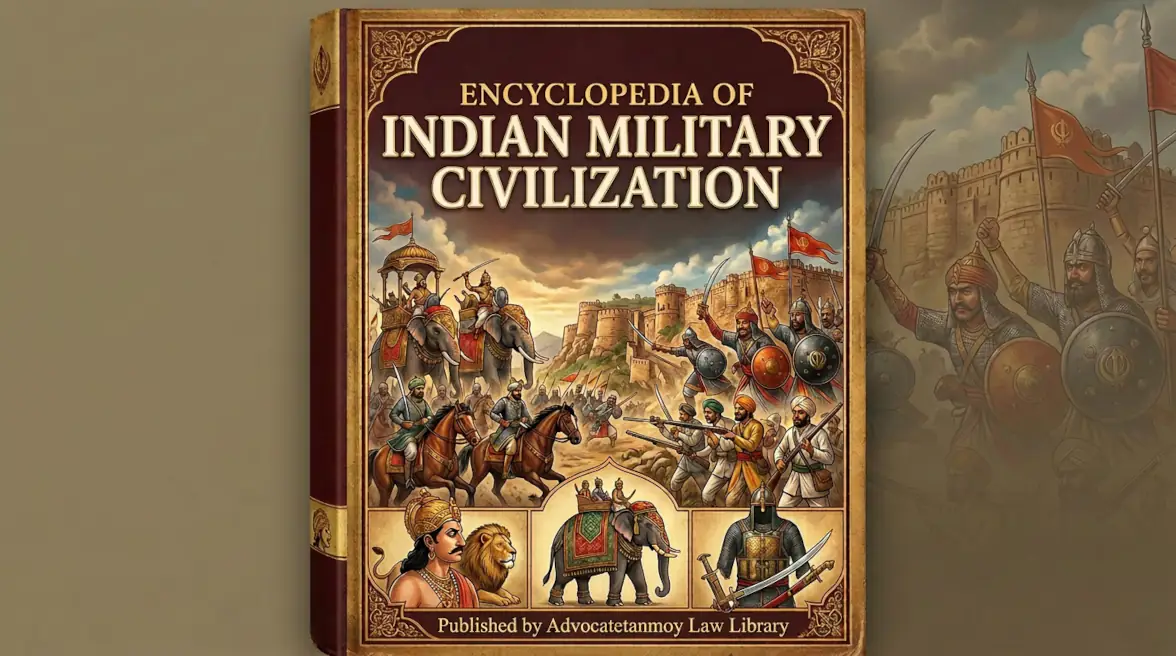
The history of the Indian subcontinent is inseparable from the history of organized force. Across more than three millennia, the lands stretching from the Hindu Kush and the Karakoram to Kanyakumari, and from the Arabian Sea to the Bay of Bengal, witnessed the rise and fall of kingdoms, republics, empires, confederacies, colonial regimes, and modern nation-states whose existence ultimately rested upon their ability to mobilize men, resources, technology, and ideas for war. The Encyclopedia of Indian Military Civilization proceeds from the premise that military history is not merely the record of battles and campaigns, but a study of the relationship between power, state formation, strategic culture, society, economy, and civilization. It seeks to examine the military experience of India not as a succession of isolated wars but as a continuous historical process that shaped the political destiny of one of the world’s oldest civilizations. (See Encyclopedia of Indian Economy)
The Neo-Vedic Age (c. 4500–600 BCE) witnessed the emergence of tribal polities whose military power rested upon chariot warfare, cattle wealth, and warrior lineages. The hymns of the Rigveda preserve some of the earliest references to conflict, alliances, and martial leadership, revealing a world in which political authority and military prowess were closely intertwined. Then the evidence of violence in the subcontinent emerges from the urban settlements of the Saraswati–Sindhu Valley (c. 2600–1900 BCE), centred upon Harappa, Mohenjo-daro, Dholavira, and Rakhigarhi. Although the archaeological record reveals comparatively limited evidence of militarization when contrasted with contemporary civilizations in Mesopotamia or Egypt, fortified citadels, defensive walls, and specialized administrative structures suggest an awareness of security and territorial control. (See Rig Veda (ऋग्वेदः) Shakala Samhita Scholastic Commentary)
In 650–550 BCE, the Bhagavad Gita came into its present form when it was incorporated into the Mahabharata’s Vaisampayana–Lomaharshana edition. The ancient Bhagavat Gita, a book of military ethics, was possibly part of the Dhanurveda in 4500 BCE, when Agni was recognized as the prime mover of Vedic civilization. Lord Krishna himself stated that this military ethic had been advised previously to older generations and had been transmitted through an ancient lineage before being lost over time. This military companion has no parallel throughout the global civilizational landscape. In the Bhagavad Gita, the central thesis is that war and battle are civilizational constituents, alongside the Ishabashya’s Karmic Constitution and Manu’s Dharmic Administration. (See also Deep Grammar of Civilization)
Manu Vaivaswata (5900–5800 BCE), who is believed to have faced the Great Flood in South-East Asia, is specifically mentioned by Lord Krishna in his sacred discourse. The Bhagavad Gita thus preserved and reaffirmed an ancient tradition of duty, governance, warfare, and ethical action. Over the centuries, it became the First Book of Hindu Dharma (within the greater framework of Sanatan Dharma) and remains an essential text for the understanding and practice of modern Hinduism.
Then, between the sixth and fourth centuries BCE, the rise of the Mahajanapadas transformed the military landscape of northern India. States such as Magadha, Kosala, Avanti, and Vatsa developed standing forces, fortified capitals, and increasingly sophisticated administrative systems. The campaigns of Bimbisara (c. 543–491 BCE) and Ajatashatru (c. 492–460 BCE), conducted from Rajagriha and later Pataliputra, marked a decisive stage in the emergence of territorial states. The invasion of north-western India by Alexander the Great in 326 BCE exposed the subcontinent to new military practices while simultaneously revealing the strategic importance of the Indus frontier.
The establishment of the Mauryan Empire under Chandragupta Maurya around 321 BCE represented one of the most significant military revolutions in Indian history. From the imperial capital of Pataliputra, the Mauryan state created a centralized administrative structure capable of sustaining vast armies composed of infantry, cavalry, chariots, and war elephants. The treatise known as the Arthashastra, traditionally associated with Kautilya, offered one of the ancient world’s most sophisticated analyses of statecraft, intelligence, diplomacy, espionage, logistics, and warfare. Many concepts articulated within its pages—alliances, balance of power, covert action, and strategic deception—continued to influence Indian political thought for centuries.
The centuries following the decline of the Mauryas witnessed the interaction of indigenous and foreign military traditions. Indo-Greek, Shaka, Parthian, and Kushan rulers introduced new cavalry systems, armour technologies, and methods of frontier governance. During the Gupta Age (c. 320–550 CE), often described as a classical period of Indian civilization, military institutions supported extensive political integration while defending northern India against external threats. Simultaneously, the kingdoms of southern India developed distinct military traditions linked to maritime trade and naval activity across the Indian Ocean.
From the eighth century onward, the military history of India became increasingly shaped by the movement of peoples, armies, and ideas across the north-western frontier. The campaigns of Mahmud of Ghazni between 1000 and 1027 CE and the victories of Muhammad Ghori in the late twelfth century paved the way for the establishment of the Delhi Sultanate in 1206. The introduction of mounted archery, Turkic military organization, slave-soldier institutions, and Persian administrative practices transformed the conduct of warfare in northern India. Successive dynasties—the Mamluks, Khaljis, Tughlaqs, Sayyids, and Lodis—governed through military power sustained by revenue extraction and strategic control of key communication routes.
The foundation of the Mughal Rule following the First Battle of Panipat in 1526 marked another decisive turning point. The victory of Babur over Ibrahim Lodi demonstrated the effectiveness of field artillery, gunpowder weapons, and disciplined manoeuvre. Under rulers such as Akbar, the Mughal state developed one of the largest military-administrative systems in the early modern world. Through the mansabdari system, imperial authority integrated diverse warrior groups into a centralized framework extending from Kabul to the Deccan. Yet the same empire would eventually confront powerful regional military formations, including the Maratha Confederacy, the Sikh misls, the kingdoms of Mysore, and numerous autonomous successor states.
The eighteenth century witnessed the fragmentation of Mughal authority and the rise of European military-commercial enterprises. The Battle of Plassey fought near Palashi in Bengal on 23 June 1757 initiated a profound transformation. What began as a trading corporation, the East India Company, evolved into a territorial military state. Through victories at Buxar (1764), Assaye (1803), Laswari (1803), Seringapatam (1799), and Sobraon (1846), Company armies recruited from the subcontinent conquered vast territories and created an unprecedented system of colonial military administration.
The Revolt of 1857, beginning at Meerut on 10 May 1857 and spreading across northern and central India, constituted both a military mutiny and a wider political upheaval. Its suppression led to the abolition of Company rule and the establishment of the British Raj in 1858. Thereafter, the British Indian Army emerged as one of the principal instruments of imperial power, serving in Afghanistan, China, East Africa, the Middle East, and Europe. During the First World War (1914–1918), more than one million Indian soldiers served overseas. During the Second World War (1939–1945), the Indian Army expanded into the largest volunteer force in history, exceeding 2.5 million personnel.
The transfer of power in August 1947 and the partition of British India created two successor military establishments amid violence, migration, and uncertainty. The armed forces of the Republic of India inherited traditions dating back to both indigenous and colonial institutions while confronting the immediate challenge of war in Jammu and Kashmir. Subsequent conflicts in 1962, 1965, 1971, and 1999, together with counterinsurgency operations, peacekeeping missions, maritime expansion, and nuclear deterrence, reshaped the strategic profile of the Indian state. By the early twenty-first century, India possessed one of the world’s largest armed forces, a nuclear triad, advanced missile capabilities, an expanding space infrastructure, and growing influence across the Indian Ocean Region.
This 55-Volume encyclopedia is therefore not a chronicle of warfare alone. It is an examination of how a civilization organize Intelligence and armed force, defended frontiers, governed territory, projected power, integrated diverse peoples, and responded to changing technologies across more than three thousand years. It treats military institutions as instruments of political authority, social mobility, economic development, cultural interaction, and civilizational continuity. By placing campaigns, commanders, armies, navies, technologies, doctrines, and strategic ideas within their broader historical contexts, the Encyclopedia of Indian Military Civilization seeks to provide a comprehensive account of the enduring relationship between war and civilization in the Indian experience, from the earliest fortified settlements of antiquity to the complex strategic realities of the year 2026. (See Encyclopedia of Ancient and Modern India)
Sarvarthapedia Conceptual Knowledge Web: Encyclopedia of Indian Military Civilization
Purpose
The Sarvarthapedia Knowledge Web is designed as a civilizational cross-reference architecture rather than a simple alphabetical encyclopedia. Every article is embedded within a network of related concepts, institutions, events, places, persons, technologies, and ideas. The objective is to allow readers to move horizontally across disciplines and vertically across time, tracing the evolution of knowledge, power, society, and civilization.
Rather than treating subjects as isolated entries, Sarvarthapedia organizes them into interconnected clusters. Every article contains:
Parent Concepts
The larger framework to which the topic belongs.
Related Concepts
Parallel or associated subjects.
Historical Antecedents
Earlier forms and precedents.
Historical Consequences
Later developments arising from the topic.
Associated Persons
Individuals connected to the topic.
Associated Institutions
Organizations and structures linked to the topic.
Associated Places
Geographical locations of significance.
Comparative References
Similar phenomena in other civilizations.
Cluster I: Civilization and Historical Development
Core Concept
Civilization
Connected Articles
Origins of Civilization
- Neolithic Revolution
- Urbanization
- State Formation
- Writing Systems
- Agriculture
- Trade Networks
Indian Civilization
- Indus Valley Civilization
- Vedic Civilization
- Mahajanapadas
- Mauryan Empire
- Gupta Empire
- Mughal Empire
- Republic of India
Comparative Civilizations
- Mesopotamian Civilization
- Egyptian Civilization
- Chinese Civilization
- Persian Civilization
- Roman Civilization
- Islamic Civilization
Related Concepts
- Culture
- Society
- Religion
- Economy
- Political Organization
- Warfare
Cluster II: State, Power and Governance
Core Concept
State
Connected Articles
Political Authority
- Kingship
- Empire
- Republic
- Federation
- Monarchy
- Constitutional Government
Governance
- Administration
- Bureaucracy
- Law
- Taxation
- Public Policy
Strategic Governance
- Diplomacy
- Intelligence
- National Security
- Defence Policy
Related Historical Systems
- Mauryan Administration
- Mughal Administration
- East India Company State
- British Raj
- Indian Republic
Cluster III: Military Civilization
Core Concept
Military Power
Connected Articles
Military Institutions
- Army
- Navy
- Air Force
- Strategic Forces
- Coast Guard
Military Functions
- Defence
- Deterrence
- Power Projection
- Internal Security
- Peacekeeping
Military Components
- Infantry
- Cavalry
- Artillery
- Armoured Forces
- Aviation
- Missile Forces
Related Concepts
- Strategy
- Tactics
- Logistics
- Intelligence
- Military Technology
Cluster IV: Strategic Thought
Core Concept
Strategy
Connected Articles
Classical Strategic Thought
- Arthashastra
- Nitisara
- Mahabharata
- Sun Tzu
- Clausewitz
Strategic Concepts
- Balance of Power
- Grand Strategy
- Deterrence
- Alliance Systems
- Geopolitics
Modern Strategic Studies
- Nuclear Strategy
- Maritime Strategy
- Air Power Theory
- Space Strategy
- Cyber Strategy
Related Concepts
- State
- War
- Diplomacy
- Intelligence
Cluster V: Warfare
Core Concept
War
Connected Articles
Forms of Warfare
- Conventional Warfare
- Irregular Warfare
- Guerrilla Warfare
- Naval Warfare
- Air Warfare
- Information Warfare
Historical Warfare
- Ancient Warfare
- Medieval Warfare
- Early Modern Warfare
- Industrial Warfare
- Modern Warfare
Related Concepts
- Military Technology
- Strategy
- Logistics
- Intelligence
Cluster VI: Military Technology
Core Concept
Military Technology
Connected Articles
Weapons
- Sword
- Spear
- Bow
- Firearm
- Artillery
- Missile
Platforms
- Chariot
- Horse
- Tank
- Aircraft
- Warship
- Submarine
Strategic Technologies
- Nuclear Weapons
- Ballistic Missiles
- Satellites
- Artificial Intelligence
- Autonomous Systems
Related Concepts
- Science
- Engineering
- Industry
- Warfare
Cluster VII: Intelligence and Security
Core Concept
Intelligence
Connected Articles
Intelligence Functions
- Collection
- Analysis
- Counterintelligence
- Covert Operations
Intelligence Types
- Human Intelligence
- Signals Intelligence
- Imagery Intelligence
- Open Source Intelligence
- Cyber Intelligence
Security Structures
- Military Intelligence
- Strategic Intelligence
- Internal Security
- National Security
Related Concepts
- Diplomacy
- Strategy
- Warfare
Cluster VIII: Economy and Military Power
Core Concept
Military Economy
Connected Articles
Economic Foundations
- Agriculture
- Trade
- Taxation
- Finance
Military Production
- Ordnance
- Shipbuilding
- Aviation Industry
- Defence Manufacturing
Strategic Resources
- Iron
- Coal
- Oil
- Rare Earth Elements
Related Concepts
- Industrialization
- Technology
- Logistics
Cluster IX: Geography and Geopolitics
Core Concept
Strategic Geography
Connected Articles
Physical Geography
- Mountains
- Rivers
- Deserts
- Forests
- Oceans
Indian Strategic Regions
- Himalayas
- Indo-Gangetic Plain
- Deccan Plateau
- Indian Ocean
- North-West Frontier
Geopolitical Concepts
- Heartland
- Rimland
- Maritime Power
- Frontier Systems
Related Concepts
- War
- State
- Trade
- Empire
Cluster X: Maritime Civilization
Core Concept
Sea Power
Connected Articles
Maritime Institutions
- Navy
- Merchant Marine
- Port Systems
Maritime Functions
- Trade Protection
- Power Projection
- Strategic Deterrence
Indian Maritime History
- Chola Navy
- Gujarati Maritime Networks
- East India Company Navy
- Indian Navy
Related Concepts
- Indian Ocean
- Commerce
- Empire
Cluster XI: Science, Technology and Innovation
Core Concept
Scientific Development
Connected Articles
Knowledge Systems
- Mathematics
- Astronomy
- Metallurgy
- Medicine
Military Applications
- Ballistics
- Rocketry
- Aviation
- Nuclear Science
- Space Technology
Modern Innovation
- Artificial Intelligence
- Robotics
- Quantum Computing
Related Concepts
- Industry
- Education
- Defence Research
Cluster XII: Religion, Ethics and Society
Core Concept
Civilizational Values
Connected Articles
Religious Traditions
- Hinduism
- Buddhism
- Jainism
- Sikhism
- Islam
- Christianity
Ethical Concepts
- Dharma
- Just War
- Jihad
- Rajdharma
Social Structures
- Family
- Community
- Caste
- Tribe
Related Concepts
- State
- Warfare
- Law
Cluster XIII: Knowledge Systems
Core Concept
Knowledge
Connected Articles
Intellectual Traditions
- Philosophy
- Science
- Literature
- Education
Knowledge Institutions
- Universities
- Libraries
- Archives
- Research Institutes
Historical Sources
- Inscriptions
- Manuscripts
- Chronicles
- Oral Traditions
Related Concepts
- Civilization
- Culture
- State
Biographical Network
Core Concept
Historical Actors
Connected Articles
Political Leaders
- Chandragupta Maurya
- Koutilya Chanakya
- Samudra Gupta
- Shivaji
- Indira Gandhi
Military Leaders
- Pushyamitra
- Rana Sanga
- General Sam Manekshaw
- K. M. Cariappa
Strategic Thinkers
- Krishna Vasudeva
- Kamandaka
- Abul Fazl
- Clausewitz
- Alfred Thayer Mahan
Related Concepts
- State
- Warfare
- Strategy
The Grand Integrative Network
Central Node
Human Civilization
First Ring
- State
- Society
- Economy
- Culture
- Knowledge
- Religion
- Geography
Second Ring
- Military Power
- Governance
- Diplomacy
- Technology
- Trade
Third Ring
- Warfare
- Intelligence
- Logistics
- Industry
- Maritime Power
- Air Power
- Space Power
Fourth Ring
- Global History
- Comparative Civilizations
- International Relations
- Strategic Studies
- Future Technologies
This structure transforms Sarvarthapedia from an encyclopedia into a living civilizational knowledge graph, where every article becomes a node within a vast interconnected web of historical, strategic, scientific, cultural, political, and intellectual relationships.