Political History of Bangladesh
The Rise and Fall of Fazlul Huq: Bengal’s Most Complex Political Leader
Abul Qasim Fazlul Haque (1873-1962) began his political rise in early 20th century Bengal—then the main center of Indian nationalism, but a province unstable due to the British’s strategic division. The partition of Bengal in 1905 was clearly a British plan; the aim was to divide Bengalis, increase Muslim separatism and weaken the nationalist movement. It was into this ambiguous situation that Haque emerged—a man of extraordinary talent, the first Muslim in the subcontinent to obtain an MA in mathematics and later a law degree from the University of Calcutta . Practicing law under Sir Ashutosh Mukherjee and working in the provincial civil service—all laid the groundwork for a major political journey. The anger and uncertainty that arose in the Muslim community after the revocation of the partition of Bengal in 1911 formed the first foundation for his political initiation.
Haque’s rise was rapid, varied, and largely the product of his own political acumen. Having won the Legislative Council from the Hindu-dominated Dhaka constituency in 1913, he immediately became known for his fiery oratory, his demand for compensation for the cancellation of the partition of Bengal, and his advocacy of expanding education and employment opportunities for Muslims. At the same time, he understood that the progress of the Muslim majority in Bengal was not possible alone; there was no way out without Bengali unity . This dual position—making strong demands for his own community and at the same time thinking about Bengali unification—became the main character of his politics. Thus, he was the President of the Muslim League (1916–21) on the one hand, and the General Secretary of the Congress (1918) on the other—equally influential in both camps. The Lucknow Pact (1916) would not have been possible without his important role, although the allocation of only 40% of the seats to Bengali Muslims sowed the seeds of future resentment.
The 1920s showed him both successes and limitations. The ‘Benga Pact’ (1923) he made with Chittaranjan Das was a bold compromise – 55% share of government jobs for Muslims and balanced representation in local bodies. Although it created a new wave in politics at the time, it could not survive due to the objections of the Hindu Mahasabha and the reluctance of the All India Congress leadership. His tenure as Education Minister in 1924 was also cut short by the Swarajist blockade. After that, he continued to raise the rights of Muslims, provincial autonomy, and the problems of the agricultural people as a single voice in a fractured political environment for a long time. Although he opposed the question of separate electorates in the Nehru Report (1928), his politics was rooted in the soil, rooted in the realities of Bengal. The Sarba Bangla Praja Samiti, formed in 1929, later became the main face of his mass base.
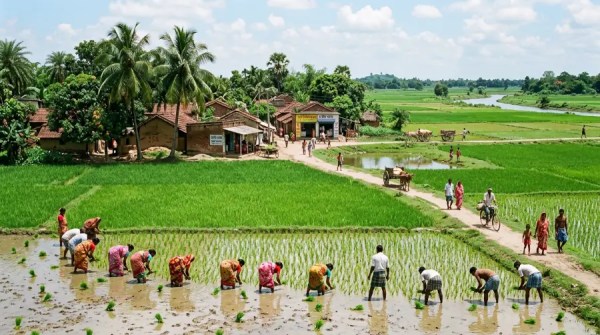
The Government of India Act of 1935 and the Communal Award gave him a historic opportunity. In the reality that Muslims had 119 seats in the 250-member council—more than enough, but not complete control—Haq transformed his Praja organization into the Krishak Praja Party (KPP). Exploitation of landlords, imprisonment of farmers in debt, oppression of moneylenders—all of these factors helped him build a strong peasant-based political platform. In the 1937 elections, the KPP won 36 seats while the Muslim League won 37; but the key to power lay with Huq. He became the first Prime Minister of Bengal under the leadership of the KPP-League alliance. Land reforms, expansion of primary education, establishment of Islamia College—his rule left its mark. However, the alliance was very tense—on one side, his peasant-centric Praja politics, on the other side, Jinnah’s central, all-India Muslim nationalism.
The Second World War brought that conflict to the fore. Although he felt it was his duty to join the Viceroy’s National Defence Council in 1941, the Muslim League saw it as a breach of discipline. Haque’s strong reaction to Jinnah’s resignation order pushed the two leaders on completely different paths. He accused Jinnah of using “Hitler methods” and criticized Muslim leaders in the minority provinces. He took a firm stand in defense of the interests of Bengal’s Muslims. His expulsion in December 1941 was a complete break in political terms. Haque then formed the ‘Progressive Coalition’ —with the support of Shyama Prasad Mukherjee of the Hindu Mahasabha and the Congress—which was a declaration of his belief: Bengali politics would be run through the combined strength of Bengal.
But in March 1943, the Governor’s move and the breakup of the League led to the fall of his cabinet. Then a League-led administration came to power – the victory of all-India Muslim nationalism over Bengal’s praja-based politics was confirmed. The defeat of the KPP in 1946 sealed his final political downfall. After the partition, Huq became the first Advocate General of East Bengal in Dhaka . Even then, he did not stop. He spoke out against discrimination in West Pakistan, took an active part in the 1952 language movement and even endured police beatings. In 1954, he led the United Front and defeated the Muslim League, although his chief ministership was quickly abolished by the Centre. He eventually became the Governor of East Pakistan and was placed under house arrest after the military rule of 1958.
Fazlul Haque’s journey—from one of the architects of Hindu-Muslim unity to the face of Bengali Muslim self-determination, and a fierce critic of Pakistani centralism until the end—is essentially a reflection of Bengal’s changing history. Behind his rise was higher education, humanity, and a deep understanding of the peasant’s plight. His downfall came under the pressure of a rigidly centralized politics of pan-India Muslim nationalism. He was a rare, multifaceted character—the founder of the Muslim League but an outcast, a Muslim but an alliance leader with the Hindu Mahasabha, a tireless defender of Bengali dignity despite being a citizen of Pakistan.
His legacy is the memory of that unknown path—where Bengaliness was built on language, land, and the just rights of the people; a path that is still incomplete today, but whose echoes in history are unfading. (See the Original Version In Bengali)
Fazlul Huq’s Political Journey: Cross-Referenced Conceptual Network for Sarvarthapedia
Core Concept
Fazlul Huq (1873–1962)
A Bengali Muslim statesman, lawyer, educator, and mass political leader whose career connected the major themes of twentieth-century Bengal: constitutional reform, Hindu-Muslim relations, peasant politics, provincial autonomy, Pakistan, Bengali nationalism, and East Pakistan’s struggle for rights.
Primary Clusters
Bengal Politics
Related Concepts:
- Bengal Presidency
- Partition of Bengal (1905)
- Annulment of Partition of Bengal (1911)
- Bengal Legislative Council
- Provincial Autonomy
- Bengal Premiership
- United Bengal Idea
- East Bengal
- East Pakistan
Connections:
- Closely linked to Bengali Identity
- Intersects with Peasant Politics
- Influenced by British Colonial Administration
- In tension with All-India Muslim Nationalism
Bengali Muslim Political Awakening
Related Concepts:
- Muslim Educational Advancement
- Muslim Representation
- Separate Electorates
- Muslim Political Consciousness
- Eastern Bengal Muslim Society
- Muslim Middle Class Emergence
Connections:
- Developed after the Partition of Bengal (1905)
- Strengthened through Muslim League Politics
- Influenced Pakistan Movement
- Later evolved into Bengali Muslim Self-Determination
Hindu-Muslim Cooperation
Related Concepts:
- Lucknow Pact (1916)
- Congress-League Collaboration
- Composite Nationalism
- Bengal Pact (1923)
- Inter-Communal Politics
Connections:
- Associated with Indian National Congress
- Connected to Chittaranjan Das
- Contrasted with Communal Polarization
- Preceded the rise of Pakistan Politics
Political Organizations Cluster
All-India Muslim League
Related Concepts:
- Muslim Political Representation
- Muhammad Ali Jinnah
- Pakistan Movement
- League Discipline
- Muslim Nationalism
Connections:
- Fazlul Huq served as President (1916–1921)
- Later entered conflict with Jinnah
- Connected to Lahore Resolution (1940)
- Opposed by Huq’s later Progressive Coalition
See also:
- Pakistan Movement
- Lahore Resolution
- Provincial Autonomy
- Bengal Politics
Indian National Congress
Related Concepts:
- Indian Nationalism
- Constitutional Reform
- Swaraj Movement
- Anti-Colonial Politics
Connections:
- Huq served as General Secretary (1918)
- Collaborated through Lucknow Pact
- Linked to Chittaranjan Das
- Sometimes conflicted with Muslim political demands
Krishak Praja Party (KPP)
Related Concepts:
- Peasant Mobilization
- Agrarian Reform
- Rural Bengal
- Anti-Landlord Politics
- Electoral Politics
Connections:
- Evolved from Sarba Bangla Praja Samiti
- Competed with Muslim League
- Formed government in 1937 Bengal Election
- Rooted in Peasant Rights
See also:
- Bengal Agrarian Society
- Debt Relief
- Bengal Premiership
Key Individuals Cluster
Muhammad Ali Jinnah
Related Concepts:
- Pakistan Movement
- Muslim Nationalism
- Muslim League Leadership
- Centralized Political Organization
Connections:
- Initially allied with Fazlul Huq
- Conflict emerged during Second World War
- Opposed Huq’s participation in National Defence Council
- Symbolized all-India Muslim politics versus Bengal regionalism
Chittaranjan Das
Related Concepts:
- Swaraj Party
- Bengal Pact
- Hindu-Muslim Cooperation
- Constitutional Nationalism
Connections:
- Major collaborator of Fazlul Huq
- Shared commitment to communal accommodation
- Influenced Bengal’s inter-communal politics
Sir Ashutosh Mukherjee
Related Concepts:
- University of Calcutta
- Higher Education
- Legal Profession
- Bengali Intellectual Tradition
Connections:
- Early mentor figure in Huq’s legal career
- Linked to Bengal’s educational modernization
Shyama Prasad Mukherjee
Related Concepts:
- Hindu Mahasabha
- Bengal Coalition Politics
- Wartime Bengal Administration
Connections:
- Supported Huq’s Progressive Coalition Ministry
- Demonstrated unusual cross-communal alliances in Bengal
Constitutional and Political Agreements Cluster
Lucknow Pact (1916)
Related Concepts:
- Congress-League Cooperation
- Separate Electorates
- Constitutional Negotiation
Connections:
- Supported by Fazlul Huq
- Important milestone in Hindu-Muslim cooperation
- Precursor to later constitutional debates
Bengal Pact (1923)
Related Concepts:
- Communal Accommodation
- Employment Quotas
- Local Representation
Connections:
- Negotiated by Huq and Chittaranjan Das
- Attempted to stabilize Bengal politics
- Ultimately undermined by communal opposition
Government of India Act (1935)
Related Concepts:
- Provincial Elections
- Self-Government
- Legislative Autonomy
Connections:
- Enabled rise of Krishak Praja Party
- Led to 1937 Bengal Election
- Opened path to Huq’s premiership
Lahore Resolution (1940)
Related Concepts:
- Pakistan Movement
- Muslim League
- Muslim Majority Provinces
Connections:
- Moved by Fazlul Huq at Lahore
- Later interpreted as foundation of Pakistan
- Became politically associated with Jinnah
See also:
- Pakistan
- Muslim Nationalism
- Provincial Autonomy
Agrarian Politics Cluster
Peasant Rights
Related Concepts:
- Debt Relief
- Tenant Protection
- Agricultural Economy
- Rural Society
Connections:
- Central theme of Huq’s political career
- Foundation of Krishak Praja Party
- Connected to Bengal’s Muslim majority population
Zamindari System
Related Concepts:
- Landlordism
- Permanent Settlement
- Agrarian Inequality
Connections:
- Opposed by Huq’s reform initiatives
- Major source of peasant grievances
Rural Bengal
Related Concepts:
- Agricultural Production
- Village Society
- Peasant Mobilization
Connections:
- Main electoral base of Fazlul Huq
- Crucial to understanding Bengal politics
Second World War Cluster
National Defence Council
Related Concepts:
- Wartime Administration
- British India
- Political Realignment
Connections:
- Huq’s participation triggered conflict with Jinnah
- Direct cause of his expulsion from Muslim League
Progressive Coalition Ministry (1941–1943)
Related Concepts:
- Coalition Politics
- Regional Autonomy
- Cross-Communal Governance
Connections:
- Included Hindu Mahasabha and Congress support
- Reflected Huq’s Bengal-centered political vision
- Ended in March 1943
Pakistan and East Pakistan Cluster
Partition of India (1947)
Related Concepts:
- Creation of Pakistan
- Division of Bengal
- Population Displacement
Connections:
- Marked end of colonial Bengal
- Changed Huq’s political environment completely
East Bengal
Related Concepts:
- East Pakistan
- Bengali Muslims
- Provincial Politics
Connections:
- Huq became first Advocate General
- Center of his post-partition political activity
East Pakistan
Related Concepts:
- Language Movement
- Provincial Rights
- Economic Disparity
- Bengali Nationalism
Connections:
- Huq criticized West Pakistani domination
- Became Governor of East Pakistan
- Linked to later Bangladesh movement
Language and Identity Cluster
Bengali Language Movement (1952)
Related Concepts:
- Linguistic Rights
- Bengali Nationalism
- Cultural Identity
Connections:
- Supported by Fazlul Huq
- Challenged Pakistani centralization
- Foundation of later Bengali political awakening
Bengali Nationalism
Related Concepts:
- Language
- Culture
- Regional Autonomy
- Self-Determination
Connections:
- Emerged from many ideas championed by Huq
- Developed beyond communal politics
- Influenced Bangladesh’s future emergence
Bengaliness
Related Concepts:
- Shared Language
- Regional Culture
- Historical Memory
- Social Justice
Connections:
- Core theme throughout Huq’s career
- Linked Hindu and Muslim Bengalis
- Alternative to rigid communal nationalism
Legacy Cluster
Sher-e-Bangla
Related Concepts:
- Popular Leadership
- Mass Politics
- Bengali Historical Memory
Connections:
- Honorific title of Fazlul Huq
- Symbol of peasant advocacy
- Represents democratic regional leadership
Provincial Autonomy
Related Concepts:
- Federalism
- Regional Rights
- Decentralization
Connections:
- Central principle throughout Huq’s life
- Opposed excessive central control
- Linked Bengal politics, Pakistan debates, and East Pakistani grievances
Historical Significance of Fazlul Huq
Interconnected With:
- Partition of Bengal (1905)
- Lucknow Pact (1916)
- Bengal Pact (1923)
- Krishak Praja Party
- Lahore Resolution (1940)
- Progressive Coalition Ministry
- Language Movement (1952)
- United Front Election (1954)
- East Pakistan Politics
- Bengali Nationalism
This network places Fazlul Huq at the intersection of Bengal Politics, Peasant Mobilization, Muslim Political Development, Hindu-Muslim Cooperation, Pakistan’s Formation, and the emergence of modern Bengali identity, making him one of the most interconnected figures in twentieth-century South Asian history.