Encyclopedia of Ancient and Modern India
Encyclopedia of Contemporary Indian Politics
Political History of Pakistan: Civil Governments, Military Rule, and Hybrid System
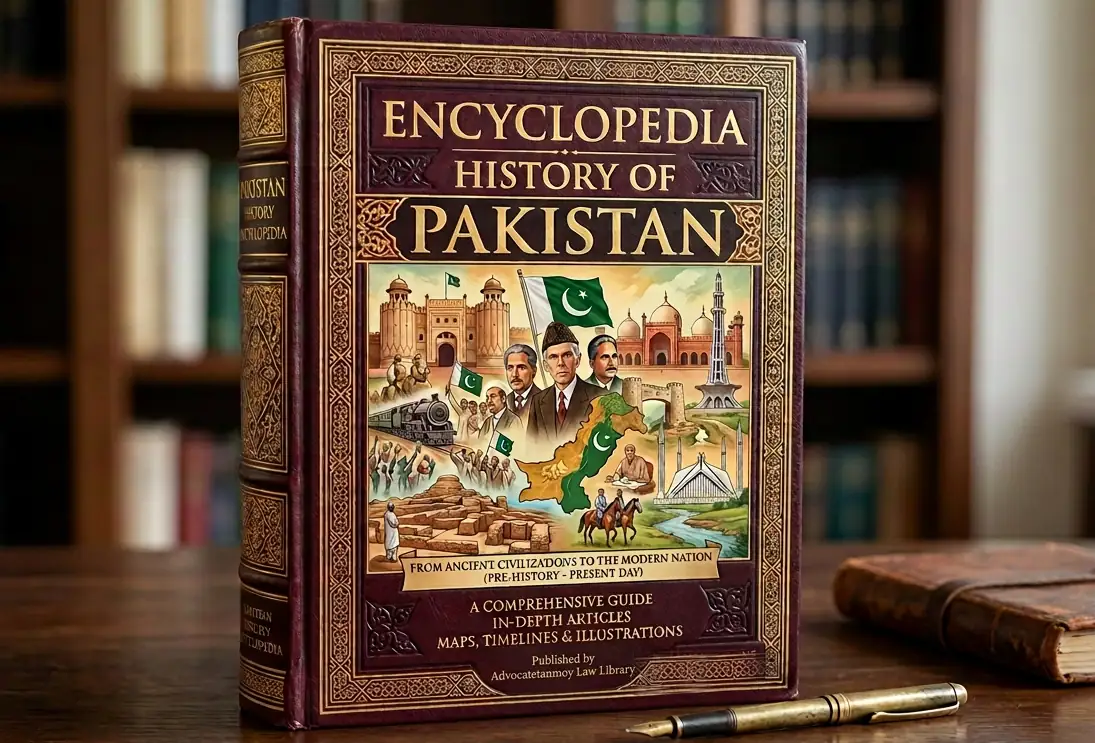
The Encyclopedia history of Pakistan begins in a formal and political sense on 14 August 1947, when the state emerged as an independent dominion following the end of British colonial rule in South Asia. Before this date, there was no separate political or national entity called Pakistan; rather, the territory that now constitutes Pakistan formed an integral part of the broader historical, cultural, and political landscape of the Indian subcontinent, often referred to historically as Hindustan or India. Almost all Pakistanis were Hindu at 900 CE. (See Hindu Indian Chronology) Therefore, any discussion of earlier periods must be understood as part of the shared history of India, which includes the Vedic Civilisation (4500 to 500 BCE), Sindhu-Saraswati Civilization, ancient empires, Islamic sultanates, and the Mughal Empire. The distinct identity of Pakistan arose not from ancient territorial continuity but from a modern political movement rooted in religious, ideological, and constitutional developments during the late colonial period.
The conception of Pakistan is one of the most important chapters in its history. This idea gradually took shape in the late 19th and early 20th centuries, particularly among Muslim intellectuals and political leaders who sought to safeguard the political rights, cultural identity, and religious autonomy of Muslims in a Hindu-majority colonial India. A crucial intellectual precursor was the philosophical vision articulated by Allama Muhammad Iqbal in 1930, who proposed the idea of a separate Muslim state in the northwestern regions of India during his presidential address at the Allahabad session of the All-India Muslim League. Although Iqbal did not use the name Pakistan, his ideas laid the groundwork for a separate Muslim polity.
The term “Pakistan” itself was coined in 1933 by Chaudhry Rahmat Ali, a student at Cambridge University, in his pamphlet “Now or Never”. The name was both an acronym and a symbolic expression: “P” for Punjab, “A” for Afghania (North-West Frontier Province), “K” for Kashmir, “S” for Sindh, and “Tan” for Balochistan. It also carried the meaning of “Land of the Pure” in Urdu and Persian. This articulation transformed the idea of Muslim autonomy into a clear territorial demand.
The political momentum for Pakistan gained strength under the leadership of Muhammad Ali Jinnah, who became the central figure of the Pakistan Movement. Initially a proponent of Hindu-Muslim unity and a member of both the Indian National Congress and the Muslim League, Jinnah gradually shifted his stance as communal tensions intensified and constitutional negotiations failed to guarantee adequate safeguards for Muslims. The turning point came with the Lahore Resolution of 23 March 1940, passed at the Muslim League’s annual session in Lahore, which called for “independent states” in Muslim-majority areas of northwestern and eastern India. Although ambiguously worded, it later came to be interpreted as a demand for a separate nation-state—Pakistan.
The decade of the 1940s was marked by intense political negotiations, constitutional debates, and communal violence. The failure of the Cabinet Mission Plan in 1946, which attempted to preserve a united India through a federal structure, further polarized the situation. The Direct Action Day on 16 August 1946, called by the Muslim League, led to widespread communal riots, particularly in Calcutta, signaling the breakdown of intercommunal harmony. By early 1947, the British government, under Prime Minister Clement Attlee, decided to expedite the transfer of power. Lord Mountbatten, the last Viceroy of India, announced a partition plan in June 1947, leading to the creation of two independent dominions: India and Pakistan.
Creation Of Pakistan
On 14 August 1947, Pakistan came into existence as a separate sovereign state, comprising two geographically and culturally distinct regions: West Pakistan (present-day Pakistan) and East Pakistan (present-day Bangladesh), separated by more than 1,600 kilometers of Indian territory. The partition was accompanied by one of the largest mass migrations in human history, with approximately 14–15 million people displaced and an estimated one million deaths due to communal violence. This traumatic birth deeply influenced Pakistan’s early political and social development.
In its initial years, Pakistan faced immense challenges, including administrative disorganization, refugee rehabilitation, economic instability, and the absence of a permanent constitution. Muhammad Ali Jinnah, as the first Governor-General, sought to establish a democratic and inclusive state, but his death on 11 September 1948 deprived the country of its founding leader. His successor, Liaquat Ali Khan, served as the first Prime Minister and attempted to provide ideological direction through the Objectives Resolution of 1949, which declared that sovereignty belongs to Allah and that the state would enable Muslims to live according to Islamic principles. This resolution became a cornerstone of Pakistan’s constitutional development.
The early 1950s were marked by political instability and frequent changes in government. The delay in constitution-making reflected deep disagreements over the distribution of power between East and West Pakistan, language issues, and the role of Islam in the state. Finally, Pakistan adopted its first constitution on 23 March 1956, declaring itself the Islamic Republic of Pakistan. However, this parliamentary system proved short-lived. On 7 October 1958, President Iskander Mirza abrogated the constitution and imposed martial law, shortly thereafter being ousted by General Ayub Khan, who became Pakistan’s first military ruler.
The era of Ayub Khan (1958–1969) introduced a period of relative stability and economic growth, often referred to as the “Decade of Development.” Ayub implemented administrative reforms, introduced a new constitution in 1962, and promoted industrialization. However, his regime also faced criticism for authoritarianism, political repression, and regional disparities, particularly in East Pakistan. The situation worsened after the Indo-Pak War of 1965, which ended in a stalemate but strained the economy and political legitimacy of the regime.
Ayub Khan resigned in March 1969, handing power to General Yahya Khan, who promised elections. The general elections of December 1970 were the first nationwide democratic elections in Pakistan’s history. The Awami League, led by Sheikh Mujibur Rahman, won a majority based on East Pakistan’s support, while the Pakistan People’s Party (PPP), led by Zulfikar Ali Bhutto, dominated in West Pakistan. The refusal to transfer power led to a political crisis, culminating in military action in East Pakistan in March 1971. This triggered a civil war and Indian military intervention, resulting in the creation of Bangladesh on 16 December 1971. This event marked a major turning point, significantly reshaping Pakistan’s identity and territorial boundaries.
Following the 1971 crisis, Zulfikar Ali Bhutto assumed leadership, first as President and later as Prime Minister under the new Constitution of 1973, which reintroduced a parliamentary system. Bhutto’s government implemented socialist-oriented reforms, nationalized industries, and pursued an independent foreign policy. However, political unrest and allegations of electoral fraud led to his overthrow by General Zia-ul-Haq in a military coup on 5 July 1977.
The Zia era (1977–1988) was characterized by Islamization policies, including the introduction of Sharia-based laws, Hudood Ordinances, and changes in the legal and educational systems. Zia’s regime also aligned closely with the United States during the Soviet-Afghan War (1979–1989), making Pakistan a frontline state in supporting Afghan resistance against Soviet forces. This period had long-term consequences, including the proliferation of weapons, drugs, and militant networks within Pakistan.
After Zia’s death in a plane crash on 17 August 1988, Pakistan returned to civilian rule. The subsequent decade saw alternating governments led by Benazir Bhutto and Nawaz Sharif, marked by political instability, corruption allegations, and economic challenges. Despite these issues, significant developments included Pakistan’s nuclear tests on 28 May 1998, making it the seventh nuclear-armed state in the world.
On 12 October 1999, General Pervez Musharraf seized power in another military coup, ushering in a new era of military rule. Musharraf’s regime (1999–2008) focused on economic reforms, decentralization, and cooperation with the United States after the September 11, 2001 attacks, positioning Pakistan as a key ally in the War on Terror. However, his rule also faced criticism for curbing judicial independence and suppressing political opposition.
The restoration of democracy in 2008 marked a new phase, with the Pakistan Peoples Party and later the Pakistan Muslim League (N) forming governments. The 18th Amendment in 2010 significantly strengthened parliamentary democracy by devolving powers to provinces and reducing presidential authority. The period also saw efforts to combat terrorism, particularly through military operations in tribal areas.
In 2018, the Pakistan Tehreek-e-Insaf (PTI), led by Imran Khan, came to power, promising anti-corruption reforms and economic revitalization. His tenure faced economic challenges, political opposition, and tensions with institutions. He was removed through a parliamentary vote of no confidence in April 2022, leading to a coalition government under Shehbaz Sharif.
From 2022 to 2026, Pakistan’s political landscape has remained dynamic, characterized by economic difficulties, political polarization, and ongoing debates over governance, constitutional authority, and civil-military relations. The country continues to navigate challenges related to inflation, debt, climate change impacts, such as the 2022 floods, and regional security dynamics.
The history of Pakistan is fundamentally a history of a modern nation-state carved out of the Indian subcontinent in 1947, shaped by the ideological vision of Muslim identity and the military establishment, the political struggle for autonomy, and the complex interplay of democratic and military governance under a written Pakistani Constitution.
The History of Pakistan (See Contemporary World History), beginning from the reign of Aurangzeb and moving systematically to the present political order under Shehbaz Sharif and Asim Munir:
VOLUME I: The Late Mughal Framework and the Memory of Muslim Sovereignty (1658–1857)
Chapter 1: Accession and Consolidation (1658–1666)
1.1 Coronation of Aurangzeb in Delhi (1658)
1.2 War of succession and elimination of rivals
1.3 Administrative restructuring of the Mughal court
Chapter 2: Imperial Expansion and Religious Policy
2.1 Deccan campaigns: Bijapur and Golconda
2.2 Reimposition of jizya (1679)
2.3 Relations with Rajputs and Deccan elites
Chapter 3: Resistance and Overextension
3.1 Rise of Maratha power under Shivaji
3.2 Fiscal strain and military exhaustion
3.3 Regional revolts and weakening authority
Chapter 4: Collapse after 1707
4.1 Death of Aurangzeb (Ahmednagar, 1707)
4.2 Successor conflicts and decentralization
4.3 Rise of provincial autonomy
Chapter 5: External Invasions and Final Decline
5.1 Sack of Delhi by Nadir Shah (1739)
5.2 Afghan invasions of Ahmad Shah Durrani
5.3 Prelude to colonial dominance
VOLUME II: Colonial Domination and Muslim Intellectual Response (1857–1906)
Chapter 1: The Revolt of 1857 and Its Aftermath
1.1 Causes and spread of rebellion
1.2 Role of Bahadur Shah II
1.3 British retribution and administrative overhaul
Chapter 2: End of Mughal Authority
2.1 Formal end of the Mughal Empire (1858)
2.2 Crown rule and restructuring of governance
Chapter 3: Muslim Decline and Reform
3.1 Socioeconomic displacement of Muslims
3.2 Reform movement of Sir Syed Ahmad Khan
3.3 Aligarh Movement and educational transformation
Chapter 4: Emergence of Political Consciousness
4.1 Muslim identity and minority politics
4.2 Early political organizations
4.3 Prelude to organized Muslim politics
VOLUME III: Rise of Muslim Political Organization (1906–1930)
Chapter 1: Formation of Muslim League
1.1 Birth of All-India Muslim League (Dhaka, 1906)
1.2 Objectives and early leadership
Chapter 2: Constitutional Politics
2.1 Morley-Minto Reforms (1909)
2.2 Lucknow Pact (1916) with the Indian National Congress
Chapter 3: Mass Movements
3.1 Khilafat Movement (1919–1924)
3.2 Non-cooperation and Muslim mobilization
Chapter 4: Intellectual Foundations
4.1 Philosophy of Allama Muhammad Iqbal
4.2 Allahabad Address (1930) and Muslim state concept
VOLUME IV: The Pakistan Movement and Partition (1930–1947)
Chapter 1: Ideological Articulation
1.1 Coining of Pakistan by Chaudhry Rahmat Ali (1933)
1.2 Evolution of Two-Nation Theory
- Iqbal’s letter to Jinnah: A civil war has been going on in the shape of Hindu-Muslim riots (28/05/1937)
- Iqbal’s letter to Jinnah: Partition of India on the lines of racial, religious and linguistic affinities (21/06/1937)
- Jinnah’s Letter to Subhas Chandra Bose – Muslim League is the only authoritative and representative political organization of Mussalmans of India (02/08/1938)
- Nehru’s letter to Jinnah -To make Hindustani, as written both in Nagri and Urdu scripts, as national language (06/04/1938)
- Jinnah’s letter to Nehru – Safeguarding rights and interests of Mussalmans with regard to their religion, culture, language (17/03/1938)
Chapter 2: Leadership of Jinnah
2.1 Political transformation of Muhammad Ali Jinnah
2.2 Reorganization of the Muslim League
Chapter 3: Lahore Resolution and After
3.1 Lahore Resolution (1940)
3.2 Elections of 1946
- Jinnah calls for establishing Pakistan in India-6/12/1945
- Letter from Jinnah to Stafford Cripps communicating the demand of the Muslim League-09/02/1946
- Jinnah’s Fourteen Points were rejected by Congress, ultimately pushing Jinnah to ask for Pakistan.
Chapter 4: Partition and Independence
4.1 Role of Lord Mountbatten
4.2 Communal violence and migration
4.3 Creation of Pakistan (14 August 1947)
- The Bloody Partition of India: Key Events of 1947
- American and Soviet Views of India’s 1947 Partition
- Muhammad Jinnah on the partition of Bengal and Punjab-Speech on 04/05/1947
- Speech of Muhammad Ali Jinnah on 03/06/1947 [Transfer of the Power]
- Pakistan and Afghanistan two sister nations-Speech of Muhammad Ali Jinnah on 03/12/1947
- A Bloody History of Betrayal, NCERT (India) Identified Partition’s Culprits
VOLUME V: Founding State and Early Civil Government (1947–1951)
Chapter 1: Establishment of the State
1.1 Karachi as capital
1.2 Administrative vacuum and refugee crisis
Chapter 2: Leadership of Jinnah
2.1 Governor-Generalship
2.2 Vision of governance and state ideology
- Address of Muhammad Ali Jinnah to 1st Constituent Assembly-11/08/1947
- Jinnah’s Vision for US-Pakistan Relations 1947
- Urdu Language: Jinnah’s Controversial Speech at Dhaka University
- East Bengal is one of Pakistan’s most powerful components- Martial Spirit of East Pakistan-Speech by Jinnah (20/03/1948)
- Student’s Role in Nation Building-Jinnah at Dhaka University 24/03/1948
- Message to the Nation by Jinnah on the occasion of the first Anniversary of Pakistan on 14/08/1948
- Jinnah’s Reply to the members of Quetta Parsi Community – Constitutional Position Baluchistan 13/06/1948
- Muhammad Ali Jinnah on the opening of the State Bank of Pakistan
- Fazlul Huq: From Hindu-Muslim Unity to Bengali Self-Determination
Chapter 3: Government of Liaquat Ali Khan
3.1 Policies of Liaquat Ali Khan
3.2 Objectives Resolution (1949)
Chapter 4: Leadership Crisis
4.1 Death of Jinnah (1948)
4.2 Assassination of Liaquat Ali Khan (1951)
VOLUME VI: Constitutional Crisis and Weak Civilian Rule (1951–1958)
Chapter 1: Political Instability
1.1 Frequent Prime Ministers and cabinet changes
1.2 Rise of bureaucratic elite
Chapter 2: Governor-General’s Authority
2.1 Role of Ghulam Muhammad
2.2 Dissolution of Constituent Assembly (1954)
Chapter 3: Constitution of 1956
3.1 Islamic Republic declared
3.2 Parliamentary structure
Chapter 4: Collapse of Civil Rule
4.1 Political fragmentation
4.2 Martial law (1958)
VOLUME VII: Military Governance and Controlled Democracy (1958–1971)
Chapter 1: Regime of Ayub Khan
1.1 Coup of 1958
1.2 Basic Democracies system
Chapter 2: Economic and Political Policies
2.1 Industrial growth
2.2 Constitution of 1962
Chapter 3: Conflict and Crisis
3.1 Indo-Pak War (1965)
3.2 Political opposition movements
Chapter 4: Disintegration of Pakistan
4.1 Rule of Yahya Khan
4.2 Elections of 1970
4.3 Creation of Bangladesh (1971)
- Pakistan-Bangladesh Relationship 2026
- Pakistan-Indian Relationship
- India and Pakistan’s Military Evolution Since Partition in 1947
VOLUME VIII: Civilian Reconstruction under Bhutto (1971–1977)
Chapter 1: Rise of Bhutto
1.1 Leadership of Zulfikar Ali Bhutto
1.2 Transition from military to civil rule
Chapter 2: Constitution and Governance
2.1 Constitution of 1973
2.2 Parliamentary democracy
Chapter 3: Economic and Foreign Policy
3.1 Nationalization policies
3.2 Islamic summit diplomacy
Chapter 4: Political Crisis
4.1 Opposition movements
4.2 Coup of 1977
VOLUME IX: Islamization and Military Control (1977–1988)
Chapter 1: Regime of Zia-ul-Haq
1.1 Coup and consolidation
1.2 Execution of Bhutto
Chapter 2: Islamization Policies
2.1 Hudood Ordinances
2.2 Sharia-based reforms
Chapter 3: Afghan War Context
3.1 Soviet invasion (1979)
3.2 Pakistan as frontline state
Chapter 4: Transition
4.1 Controlled elections (1985)
4.2 Death of Zia (1988)
VOLUME X: Civilian Governments and Institutional Conflict (1988–1999)
Chapter 1: Benazir Bhutto Era
1.1 Governance challenges
1.2 Dismissal of government
Chapter 2: Nawaz Sharif Era
2.1 Economic reforms
2.2 Political consolidation attempts
Chapter 3: Nuclearization
3.1 Nuclear tests (1998)
3.2 Strategic implications
Chapter 4: Military Intervention
4.1 Kargil conflict (1999)
4.2 Coup by Pervez Musharraf
VOLUME XI: Military-Led Hybrid Governance (1999–2008)
Chapter 1: Musharraf Regime
1.1 Military takeover
1.2 Governance reforms
Chapter 2: War on Terror
2.1 Post-9/11 alignment
2.2 Internal security challenges
Chapter 3: Political Engineering
3.1 Elections of 2002
3.2 Civil-military balance
Chapter 4: Democratic Transition
4.1 Judicial crisis (2007)
4.2 End of military rule (2008)
VOLUME XII: Contemporary Pakistan: Civil Authority and Military Influence (2008–2026)
Chapter 1: Democratic Restoration
1.1 Government of PPP (2008–2013)
1.2 18th Amendment (2010)
Chapter 2: Civilian Transitions
2.1 Government of Nawaz Sharif (2013–2017)
2.2 Rise of Imran Khan (2018–2022)
Chapter 3: Political Reconfiguration
3.1 Government of Shehbaz Sharif (2022– )
3.2 Coalition politics and governance challenges
Chapter 4: Military Leadership and State Structure
4.1 Institutional role of the armed forces
4.2 Leadership of Asim Munir
4.3 Evolution of hybrid governance model
Chapter 5: Pakistan up to 2026
5.1 Economic crises and reforms
5.2 Internal security and regional relations
5.3 Future trajectories of civil-military balance
- Income Tax Ordinance (ITO) 2001
- Government’s plan to create new provinces 2026
Structural Logic of This Series
- Starts with Mughal sovereignty → loss → colonial rule → Muslim political identity → Osama bin Laden’s 2001 Interview with Pakistan’s Hamid Mir → Assassination of former Pakistani Prime Minister Benazir Bhutto → Baloch Liberation Army attacked Pakistan Stock Exchange (2020)
- Moves into the creation of Pakistan as a state carved out of Hindustan (1947)→ Pakistan’s Political Turmoil Since 1947 → Jinnah’s Vision for US-Pakistan Relations → Salary hike of ministers (2025)
- Contemporary Indian Politics (1857–2026) → India and Pakistan Military History → Fundamental Analysis of Nuclear Threshold by India and Pakistan → Bilateral treaties/agreements between India and Pakistan
- Then tracks the continuous evolution of civil governments vs. military power
- Ends with the present political structure under Shehbaz Sharif and military leadership under Asim Munir → Constitution of Islamic Republic of Pakistan-1973 → Constitution of Pakistan 27th Amendment
Sarvarthapedia Conceptual Node: History of Pakistan
The History of Pakistan is a modern political-historical construct beginning formally on 14 August 1947, yet intellectually rooted in the longer continuum of the Indian subcontinent. It represents the transformation of a region within Hindustan into a separate nation-state shaped by ideology, colonial policy, and political leadership.
Cluster 1: Pre-Pakistan Historical Continuum (Shared Indian Past)
Sindhu-Saraswati Civilization
Connected to: Ancient Civilizations, Urbanization, Indus Basin Geography
See also: Vedic Civilization, Early South Asian Trade Networks
Vedic Civilization (c. 1500–500 BCE)
Connected to: Hindu Social Order, Early Religious Traditions, Aryan Migration Debate
See also: Sanskrit Culture, Early Political Formations
Classical and Medieval Empires
Connected to: Mauryan Empire, Gupta Empire, Regional Kingdoms
See also: State Formation, Cultural Synthesis
Islamic Sultanates and Mughal Empire
Connected to: Islamic Political Authority, Persianate Culture, Administrative Centralization
See also: Delhi Sultanate, Mughal Governance
Mughal Decline
Connected to: Imperial Fragmentation, Regionalization, Memory of Muslim Sovereignty
See also: Post-Mughal Successor States, Colonial Entry
Cluster 2: Colonial Transformation and Identity Formation
British Colonial Rule in India
Connected to: Colonial Administration, Economic Extraction, Legal Reforms
See also: British East India Company, Crown Rule (1858)
Indian Rebellion of 1857
Connected to: End of Mughal Authority, Colonial Consolidation
See also: Bahadur Shah II, Military Resistance
Muslim Reform Movements
Connected to: Educational Reform, Religious Modernism, Political Awareness
See also: Aligarh Movement, Muslim Identity Formation
Communal Politics
Connected to: Hindu-Muslim Relations, Electoral Representation, Separate Electorates
See also: Constitutional Reforms, Minority Safeguards
Cluster 3: Ideological Conception of Pakistan
Two-Nation Theory
Connected to: Religious Identity, Political Separation, Nationhood
See also: Muslim Nationalism, Communal Representation
Allahabad Address (1930)
Connected to: Philosophical Foundations, Territorial Muslim State Idea
See also: Intellectual Origins of Pakistan
Coining of Pakistan (1933)
Connected to: Territorial Definition, Symbolic Identity, Geopolitical Mapping
See also: Punjab, Sindh, Kashmir, Balochistan
Pakistan Movement
Connected to: Mass Mobilization, Political Negotiation, Colonial Transition
See also: Muslim League, Electoral Politics
Lahore Resolution (1940)
Connected to: Demand for Sovereignty, Constitutional Vision
See also: Federalism Debate, Separate Statehood
Cluster 4: Partition and State Formation (1947)
Partition of India
Connected to: Territorial Division, Communal Violence, Migration Crisis
See also: Punjab Partition, Bengal Partition
Creation of Pakistan (14 August 1947)
Connected to: State Formation, Dominion Status, British Withdrawal
See also: Independence Movements, Decolonization
Refugee Crisis
Connected to: Demographic Transformation, Urban Change, Economic Pressure
See also: Migration Studies, Human Displacement
Cluster 5: Early State and Constitutional Development
Founding Leadership
Connected to: Governor-General System, Parliamentary Beginnings
See also: Early Cabinet System
Objectives Resolution (1949)
Connected to: Islamic Ideology, Sovereignty Debate, Constitutional Framework
See also: Islamic Republic Concept
Constitution of 1956
Connected to: Parliamentary Democracy, Federal Structure
See also: Constitutional Development in Pakistan
Civil-Military Imbalance
Connected to: Institutional Weakness, Executive Dominance
See also: Bureaucratic Elite, Political Instability
Cluster 6: Military Intervention and Political Structure
Martial Law (1958)
Connected to: End of Civilian Rule, Centralized Authority
See also: Constitutional Suspension
Controlled Democracy
Connected to: Basic Democracies System, Limited Representation
See also: Political Engineering
Civil-Military Relations
Connected to: Power Sharing, Institutional Conflict, Hybrid Governance
See also: National Security State
Cluster 7: Territorial Crisis and National Reconfiguration
Elections of 1970
Connected to: Democratic Mandate, Regional Divide
See also: Electoral Politics
Bangladesh Creation (1971)
Connected to: State Disintegration, Civil War, International Intervention
See also: East Pakistan Crisis → Anti-Hindu Move in East Pakistan → Pakistan situation report from UK Govt and Bangladesh liberation → Mukti Bahini in Bangladesh (CIA Memo-1971)
Post-1971 Identity
Connected to: National Redefinition, Political Realignment
See also: Federal Restructuring
Cluster 8: Constitutionalism and Civilian Governance
Constitution of 1973
Connected to: Parliamentary Democracy, Islamic Framework
See also: Federal Governance
Civilian Governments (1970s–1990s)
Connected to: Party Politics, Institutional Instability
See also: Electoral Cycles, Governance Challenges → Pakistan Political Parties Rules 2002
Nuclearization (1998)
Connected to: Strategic Deterrence, National Security
See also: South Asian Geopolitics
Cluster 9: Islamization and Global Context
Islamization Policies
Connected to: Legal Transformation, Religious Governance
See also: Sharia Law, Hudood Ordinances
Soviet-Afghan War (1979–1989)
Connected to: Cold War Politics, Militarization, Refugee Influx
See also: Regional Conflict Dynamics → Lahore declaration (1999) → Pakistan’s principled position (2023)
Cluster 10: Hybrid Governance and Modern Pakistan
Military-Civil Hybrid System
Connected to: Shared Authority, Institutional Balance
See also: Deep State Debate
War on Terror (Post-2001)
Connected to: Security Policy, International Alliances
See also: Counterterrorism Operations
18th Amendment (2010)
Connected to: Decentralization, Provincial Autonomy
See also: Constitutional Reform
Democratic Transitions (2008–2026)
Connected to: Electoral Politics, Coalition Governments
See also: Political Polarization
Cluster 11: Contemporary Challenges (2022–2026)
Economic Crisis
Connected to: Debt, Inflation, IMF Programs
See also: Development Economics
Climate Crisis (2022 Floods)
Connected to: Environmental Vulnerability, Disaster Management
See also: Climate Change Impact
Civil-Military Balance (Modern Phase)
Connected to: Governance Structure, Institutional Authority
See also: Political Stability
Meta-Cluster: Conceptual Linkages
Nation-State Formation
Links: Failure of Mohandas Gandhi and Congress, Partition of India, Pakistan Movement, Colonial Exit, Theory Britishers Handed over Pakistan to America, American Colonialism in Pakistan
Identity Formation
Links: Two-Nation Theory, Islamic Ideology, Muslim Political Thought
Governance Evolution
Links: Constitutions (1956, 1962, 1973), Military Rule, Civilian Rule, Criminal Justice System (2024)
Continuity vs Discontinuity
Links: Pre-1947 Indian History vs Post-1947 Pakistani Identity
Cross-Link Summary (Network Flow)
- Pre-Colonial Past → Colonial Rule → Muslim Identity → Pakistan Movement → Jinnah calls for establishing Pakistan in India (1945) → Partition → State Formation → United State’s diplomatic relations with Pakistan-1947 → Message to the Nation by Jinnah (1948) → Indus river agreement between India and Pakistan (1955) → Indian Attacked Pakistan in 1965 → Indira Gandhi wanted military strike on Pakistan’s nuclear sites
- State Formation → Constitutional Crisis → Military Intervention → Civilian Revival → Hybrid Governance → Justice Iftikhar Muhammad Chaudhry vs President of Pakistan → Geo TV Pakistan bans Hamid Mir from hosting ‘Capital Talk’
- Ideology → Constitution → Governance → Crisis → Reform → Contemporary Challenges → China-Pakistan Economic Corridor (CPEC) → China and Pakistan Relationship (2024) → Contemporary World History
This structure functions as a Sarvarthapedia knowledge web, where each node can expand into a full article, and each cluster forms an interlinked conceptual ecosystem, rather than a linear narrative.
