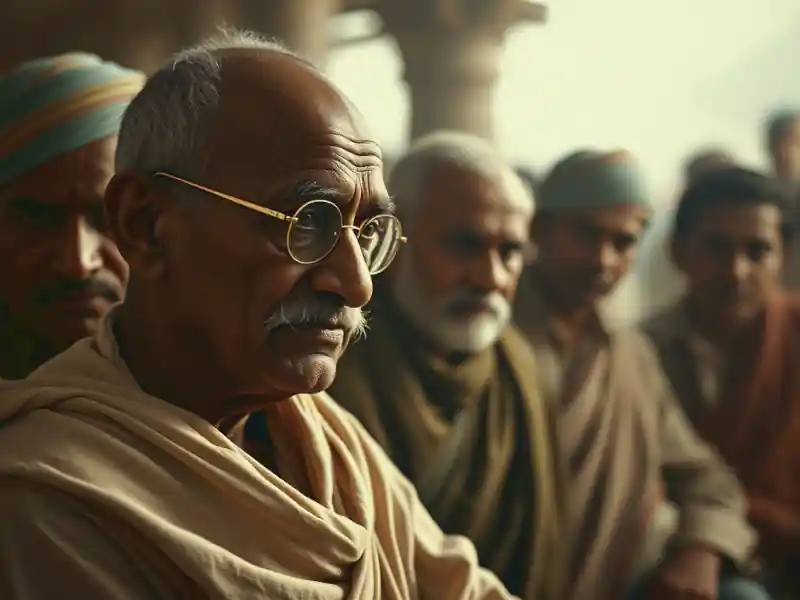
How weak leadership, fear, and British strategy carved disaster into the subcontinent for generations
Mahatma Gandhi once vowed that the partition of India would come “over my dead body.” Yet history’s cruel paradox is that he lived to watch the country he had nursed into political consciousness carved apart, like a surgeon’s “vivisection,” while he—fatigued, isolated, increasingly ignored—refused to hurl himself into one last, absolute act of resistance. His moral compass remained steadfast; his tactics softened into resignation. When Rajendra Prasad asked on June 3, 1947, whether he would fast unto death to stop partition, Gandhi’s reply was weary and devastating: “If the Congress commits to an act of madness, does it mean I should die?” In that melancholy question lies the tragedy of his final political season. He detested the idea of two nations, insisted Hindus and Muslims could coexist in a united India, and even contemplated audacities—such as offering Muhammad Ali Jinnah the prime ministership of an undivided India—to avert catastrophe. Yet when the machinery of power rolled past him, he stepped aside, urging unity behind a decision he believed to be wrong, and retreated into the infernos of Bengal and Delhi to put out communal fires rather than to stop the partition itself. He did not bless it; he simply refused to break the nation again in order to save it.
Jawaharlal Nehru traveled a different arc—less saintly, more pragmatic, no less tragic. He began as a champion of a secular, indivisible India, intellectually allergic to the idea that faith might define the state. But by early 1947 the arithmetic of bloodshed stared him in the face. The Muslim League’s implacability, the violence unleashed after Direct Action Day, the constant threat of civil war, and the looming British exit drove him toward the grim conclusion that unity imposed would be unity drowned in corpses. Partition, for Nehru, became not a choice but a “necessary evil”—a surgery without anesthetic, justified by the promise of survival. He pushed acceptance of the Mountbatten Plan, advocated fiercely within Congress, and helped draft and defend the resolution that would become the political hinge of South Asia’s modern history. Sometimes, he said, a nation must swallow what is unpalatable because the alternative is annihilation.
The political choreography was relentless. The Congress Working Committee, with Nehru and Sardar Patel at its heart, accepted the plan on June 2–3, 1947. The All-India Congress Committee gathered soon after, on June 14–15, in a special session drenched in grief yet steeled by fatalism. Govind Ballabh Pant moved the resolution; Sardar Patel seconded. Acharya J.B. Kriplani presided. Dissenters protested, abstainers trembled, and still the numbers—157 in favor, 29 against, dozens abstaining—closed the debate. Nehru stood before the AICC and confessed the wound he was about to help inflict: he had opposed division all his political life, yet he now urged acceptance. Certain decisions, he argued, however unbearable, must be taken. This partition, he suggested, might even be temporary; history, perhaps, would one day coax the divided lands back into cooperation, if not reunion. “We have often to go through the valley of the shadow,” he mused, “before we reach the sunlit mountain tops.” It was not triumphalism. It was resignation dressed as statecraft.
The text the AICC endorsed struck a tone of sorrowing resolve. It demanded immediate transfer of power, accepted dominion status, and acknowledged—almost with an air of apology—that partition was a tragedy, undesirable in every moral and national sense. Yet it also declared that in view of the alternatives—continued bloodshed, looming civil war—it represented the only conceivable path to peace and independence. The resolution urged that minorities be protected, disturbances minimized, and that the two new dominions live in amity, perhaps even reunite in some future kinder to dreams than to maps. It called upon Congress workers and ordinary Indians alike to accept the settlement and work for its success, as if administrative obedience might anesthetize historical heartbreak.
It is fashionable to claim Gandhi led India to the very brink and then, exhausted, stood aside; that Nehru, the realist in a hurry, chose nationhood over unity because the clock—and the British—would wait no longer. There is truth in that caricature, but it is only a fragment. Gandhi was not the architect of partition; he was the surrendered prophet rendered irrelevant by circumstances and colleagues who no longer believed that moral pressure could restrain communal tempests. He refused to fast, refused to ignite one final confrontation with his own party, and instead walked alone into riot zones, pleading for sanity while borders hardened. He never endorsed the division; he simply refused to die to prevent it.
Nehru, meanwhile, did not engineer partition with relish. He did what political survival demanded: he chose order over ideal, sovereignty over sentiment. He lobbied Mountbatten’s plan, shepherded Congress through its own agony, and delivered the arguments that made acceptance appear not merely permissible but rational. His fingerprints cover the decision, even though he did not formally move the resolution. In his speeches he admitted the pain but insisted on the necessity. The world, he implied, had become too dangerous for metaphysical purity.
Nehru addressed the AICC on 14 June 1947, acknowledging the deep pain of partition while arguing it was unavoidable to achieve swift independence and avert greater chaos/civil war amid escalating communal violence. Key excerpts from his speech (as recorded in historical accounts and Congress proceedings):
“The Congress was opposed to Pakistan and he [Nehru referring to himself in context] was one of those who had steadfastly opposed the division of India. Yet he had come before the A.I.C.C to urge the acceptance of the resolution on India’s division. Sometimes certain decisions, however unpalatable they might be, had to be taken.”
He emphasized that partition, though tragic, offered a path out of deadlock, allowing India to build a strong, secular future. Nehru also expressed hope that it might be temporary, stating in related contexts: “We have often to go through the valley of the shadow before we reach the sunlit mountain tops.”
The All-India Congress Committee (AICC) resolution accepting the Mountbatten Plan (3 June Plan) was passed at its special session in New Delhi on 14–15 June 1947.
Full Text of the Resolution
(As reproduced in historical records, including secondary sources drawing from Congress proceedings and the Transfer of Power documents):
“1. The AICC has given repeated and earnest consideration to all aspects of the political situation as it has developed during the past few months and is convinced that the larger interests of the country as well as the cause of peace demand that the British Government should transfer power immediately to the people of India.
- The proposal made by His Majesty’s Government in the statement of June 3, 1947, provides for the immediate transfer of power on a Dominion Status basis with the right to each Dominion to secede from the British Commonwealth if it so chooses.
- The AICC accepts this proposal as it provides for the immediate establishment of independent sovereign states in India, with the right to frame their own constitutions through Constituent Assemblies and to decide whether to remain in the British Commonwealth or not.
- The AICC regrets that this proposal involves the partition of India, which it has always considered undesirable and a tragedy for the country. However, in view of the alternatives presented and the prevailing communal situation, the Committee accepts it as the only way to secure immediate independence and to avoid further bloodshed and civil war.
- The AICC is of the opinion that partition should be effected in such a manner as to cause the least disturbance and to safeguard the interests of minorities in the respective areas.
- The Committee trusts that the two Dominions will live in peace and amity and cooperate with each other for the common good, and hopes that the present division may prove temporary and that the two states may come together again in the future.
- The AICC calls upon all Congressmen and the people of India to accept this settlement and work for its successful implementation, while striving to maintain communal harmony.”
(Note: Minor variations in wording exist across sources due to paraphrasing in historical accounts, but this is the standard verbatim reconstruction based on primary Congress records and the Constitutional Relations Between Britain and India: The Transfer of Power series, Volume XI.)
And so the Congress Working Committee’s assent, followed by the AICC’s somber ratification, opened the sluice gates. The Indian Independence Act became inevitable. Trains filled with refugees. Cities burned. Dreams disintegrated into statistics. Those who dissented—socialists, traditionalists, voices like Purushottam Das Tandon—were overwhelmed by the logic of crisis, tom-tommed by the Nehru lobby. Gandhi, the conscience of a generation, could not block it; Nehru, the statesman of the new republic, would not.
Partition was accepted not because it was inevitable, but because Gandhi and Nehru lacked the courage and discipline to resist it. Congress refused to build any real defense against the British line. Instead of leading, it submitted. Instead of fighting, it rationalized surrender as “pragmatism.”
Gandhi did not follow his own convictions. He followed the script the British had already written. When the time came to stand upright — independently, bravely, uncompromisingly — Nehru sold the nation the British formula: two hostile countries carved out of one wounded civilization. He knew perfectly well that partition solved nothing. He knew it would manufacture a permanent crisis — and he still agreed.
Gandhi, for all his mythic stature, behaved like an outdated village elder. He had neither the voice nor the will to confront the British decisively — in Delhi or in London. He thundered in slogans earlier, but when decisions were actually being made, he did not launch a serious campaign against partition. He did not mobilize the Congress or the streets. He did not fight.
He also knew that after 15 August, he would be politically irrelevant — to Congress, to divided India, and especially to a traumatized Hindu public that no longer responded to his sermons. And yet he refused to examine himself. He did not correct course. He simply faded, carrying a moral halo and an empty hand.
By this point, Gandhi had lost the moral strength to speak with authority about the Constitution or the future. He surrendered to Nehru — and Nehru did not protect him. Instead, Nehru advanced the very logic Britain wanted: division, rivalry, and permanent instability disguised as “statesmanship.”
Gandhi’s passive opposition and Nehru’s reluctant advocacy were not opposites. They were two faces of the same disaster: the breakdown of trust, the collapse of negotiation, and the brutal speeding-up of history by an empire desperate to leave — and a leadership too weak to stop it.
Sarvarthapedia Conceptual Network
Partition of India (1947): Leadership, Fear, and Imperial Strategy
Core Node: Partition as Systemic Collapse
The partition of the subcontinent emerges as a convergence point of three interacting forces:
- Weak leadership under crisis pressure
- Escalating communal fear and violence
- Strategic acceleration by the departing colonial power
This node links all sub-nodes and acts as the central rupture in modern South Asian history.
Cluster 1: Leadership Breakdown
Gandhi’s Moral Authority vs Political Withdrawal
Connected to: Moral Politics, Nonviolent Resistance, Leadership Fatigue
- Mahatma Gandhi represents the node of ethical absolutism weakened by tactical retreat.
- His refusal to escalate confrontation at the decisive moment links to:
- Collapse of Moral Leverage
- Shift from Political Resistance to Humanitarian Intervention
- His choice to not fast against partition connects to:
- Internal fragmentation within Congress
- Loss of coercive moral pressure
Cross-links:
- Connects to Communal Violence (he chose to address symptoms, not structural rupture)
- Connects to British Exit Strategy (failure to resist accelerated timelines)
Nehru’s Pragmatism and Strategic Acceptance
Connected to: Realpolitik, State Formation, Crisis Governance
- Jawaharlal Nehru anchors the transition from idealism to statecraft.
- His acceptance of partition as “necessary evil” links to:
- Fear of Civil War
- Urgency of Sovereignty
- Advocacy within Congress connects to:
- Institutional Legitimization of Division
- Political Consolidation
Cross-links:
- Connects to British Timetable Pressure
- Connects to Congress Decision Machinery
- Connects to Long-term India–Pakistan Rivalry
Congress Leadership Convergence
Connected to: Collective Decision Failure, Elite Consensus
- Sardar Vallabhbhai Patel → administrative realism
- Govind Ballabh Pant → procedural endorsement
- J. B. Kripalani → institutional stewardship
This cluster represents:
- Alignment under pressure rather than conviction
- Substitution of debate with urgency
Cross-links:
- Links to AICC Resolution Node
- Links to Weak Resistance Framework
Cluster 2: Fear and Communal Escalation
Direct Action and Breakdown of Trust
Connected to: Mass Violence, Identity Politics
- Direct Action Day serves as a trigger node.
- Generates:
- Mutual distrust between communities
- Perception of coexistence failure
Cross-links:
- Feeds Nehru’s “necessary evil” logic
- Weakens Gandhi’s united India vision
Civil War Imagination
Connected to: Political Psychology, Risk Amplification
- Fear becomes a governing variable:
- Anticipation of anarchy replaces negotiation
- Worst-case scenarios drive decision-making
Cross-links:
- Links to Congress Acceptance
- Links to British urgency narrative
Communal Violence Feedback Loop
Connected to: Social Fragmentation, Mass Migration
- Violence → fear → political concession → more violence
- Converts political debate into survival calculus
Cross-links:
- Links to Refugee Crisis
- Links to Legitimization of Partition
Cluster 3: British Strategic Acceleration
Imperial Exit Strategy
Connected to: Decolonization, Strategic Withdrawal
- Lord Louis Mountbatten anchors this node.
- Strategy elements:
- Rapid transfer of power
- Delegation of consequences to local actors
Cross-links:
- Links to Time Compression in Decision-Making
- Links to Congress Acceptance
Mountbatten Plan (3 June 1947)
Connected to: Institutional Structuring of Division
- Mountbatten Plan formalizes partition as policy.
- Introduces:
- Dominion status
- Legal pathway to division
Cross-links:
- Links to AICC Resolution
- Links to Indian Independence Act
Time Compression and Political Pressure
Connected to: Crisis Acceleration, Decision Fatigue
- Artificial urgency limits:
- Negotiation depth
- Alternative exploration
Cross-links:
- Links to Leadership Weakness
- Links to Acceptance without Resistance
Cluster 4: Institutional Decision Nodes
Congress Working Committee Approval
Connected to: Elite Decision Core
- Internal consensus overrides ideological conflict
Cross-links:
- Links to AICC Ratification
- Links to Nehru–Patel Alignment
AICC Resolution (June 1947)
Connected to: Democratic Legitimization
- All-India Congress Committee becomes the formal approval mechanism
- Resolution embodies:
- Regret + Acceptance paradox
- Peace over unity logic
Cross-links:
- Links to Public Acceptance Narrative
- Links to Future Reunion Hope
Indian Independence Act (1947)
Connected to: Legal Finalization
- Indian Independence Act 1947 transforms decision into irreversible reality
Cross-links:
- Links to Partition Implementation
- Links to State Formation
Cluster 5: Counterfactual Possibilities (Unrealized Paths)
Gandhi–Jinnah Proposal
Connected to: Radical Compromise
- Muhammad Ali Jinnah as potential PM of united India
- Represents:
- Last attempt to preserve unity
Cross-links:
- Links to Missed Negotiation Opportunities
- Links to Leadership Hesitation
Mass Resistance Scenario
Connected to: Revolutionary Mobilization
- Hypothetical:
- Nationwide agitation against partition
- Not realized due to:
- Leadership fatigue
- Fear of chaos
Cross-links:
- Links to Weak Leadership Thesis
- Links to British Strategy Advantage
Cluster 6: Outcome System
Partition Violence and Migration
Connected to: Humanitarian Catastrophe
- Mass displacement
- Collapse of social order
Cross-links:
- Links to Communal Fear Node
- Links to Long-term Hostility
India–Pakistan Rivalry
Connected to: Geopolitical Instability
- Permanent conflict structure
Cross-links:
- Links to Nehru’s Strategic Trade-off
- Links to British Strategic Legacy
Moral vs Political Failure Debate
Connected to: Historiography, Ideological Interpretation
- Competing interpretations:
- Inevitability Thesis
- Leadership Failure Thesis
Cross-links:
- Links to Gandhi Node
- Links to Nehru Node
- Links to Structural Forces
Meta-Connections (Cross-Cluster Synthesis)
Weak Leadership
Emerges from intersection of:
- Gandhi’s withdrawal
- Nehru’s compromise
- Congress consensus
Leads to:
- Acceptance without resistance
Fear as Decision Driver
Emerges from:
- Communal violence
- Civil war anticipation
Leads to:
- Rationalization of partition
British Strategic Advantage
Emerges from:
- Time pressure
- Divide-and-exit policy
Leads to:
- Controlled disengagement
- Delegated chaos
Systemic Insight Node
Partition was not a single decision but a network collapse where:
- Moral authority lost operational force
- Political pragmatism overrode ideological commitments
- Fear replaced negotiation
- External strategy exploited internal weakness
This network demonstrates how leadership fragmentation, mass psychology, and imperial design interacted to produce a self-reinforcing chain of irreversible decisions.
Read also:
American and Soviet Views of India’s 1947 Partition