Exploring Gandhi’s paradoxes, staged simplicity, and the tragic failures of Quit India, the Naval Mutiny, and Partition.
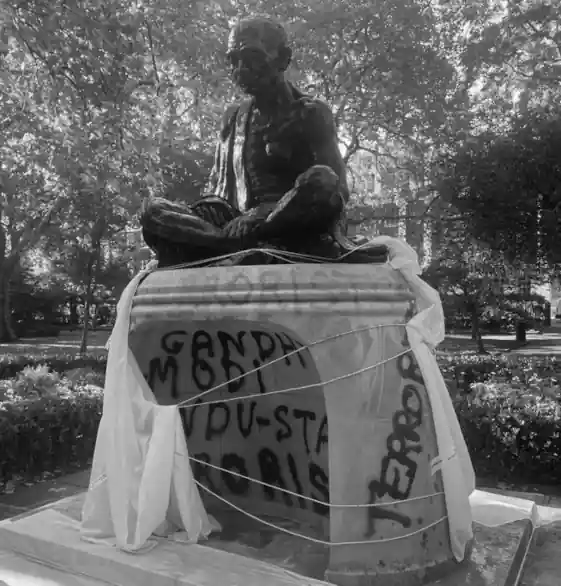
Following the vandalism of Gandhi’s London statue, debate arises over his ambiguous role in India’s partition, governance, and policies, highlighting why many view him as a relic rather than a relevant figure in modern Indian history.
Examining Mohandas Gandhi’s limited influence on India’s post-independence politics and why he remains a non-issue today.
Part I: Gandhi the Contradiction
Mohandas Karamchand Gandhi is remembered as a saint of non-violence, but his reputation rests on contradictions so deep that his legacy collapses under its own weight. He is called an apostle of peace, yet his life was shadowed by violence. He is praised as an ascetic, yet his simplicity was often staged for effect. He condemned untouchability, yet reinforced caste by branding Dalits as “Harijans,” a term drenched in condescension. He rejected modernity while relying on industrialists’ wealth to sustain him. Forever staging fasts and moral dramas, he was less a revolutionary leader than a political illusionist—always escaping responsibility by retreating into spectacle.
His beginnings reveal the farce. In London, the barrister in Bond Street suits floundered in Indian courts, deferential to colonial officials, until he discovered how to convert humiliation into moral theatre. South Africa offered him a stage; India, a pulpit. His dhoti, his sandals, his rides in third-class compartments—these were not organic acts of solidarity but contrived performances, rehearsed austerity designed to enthrall the masses and impress the press.
Even his most celebrated interventions—Champaran, Kheda, Ahmedabad—are less “miracles of mass mobilisation” than acts of negotiation, small concessions masquerading as revolutions. The Salt March, hailed as a shattering blow to empire, fizzled into yet another compromise once Gandhi agreed to parley with his colonial masters. Always he stirred excitement, then smothered it with moderation. He was not the spark of rebellion, but the valve that released its dangerous pressure.
His supposed philosophy in Hind Swaraj exposes the emptiness of his vision. In that pamphlet, he rails against railways, doctors, lawyers, and parliaments, condemning modern civilisation as if longing for medieval retreat. He denounces machinery, yet courts the patronage of industrialists. He champions trusteeship, which amounts to blessing the wealthy so long as they drip alms to the poor. What is praised as radical insight is, in fact, a prescription for passivity. His words functioned less as a path to liberation than as a narcotic, soothing people into inaction while empire endured.
Part II: The Epic Gandhian Tragedy
Gandhi’s moral crusades were steeped in paternalism. His outreach to untouchables was never solidarity but sanctimonious charity, reducing them to “children of God” under his patronising eye. When B. R. Ambedkar fought for Dalit political rights, Gandhi resisted, going so far as to blackmail him with a fast unto death—forcing Ambedkar into compromise rather than securing justice. His treatment of women was equally suffocating: he exalted them as noble martyrs but confined them to the roles of purity and domestic virtue.
His religiosity, presented as universal, carried the unmistakable mark of Hindu majoritarian smugness. His rhetoric of Hindu-Muslim unity could not prevent Partition, which erupted in bloodshed under his watch. His supposed inclusivity was undercut by the sectarian undertones of his worldview.
The tragic consequences of Gandhi’s approach were revealed in three decisive moments at the end of his life.
Quit India (1942). In August 1942, Gandhi introduced the Quit India resolution in Bombay, proclaiming that “Every Indian who desires freedom and strives for it must be his own guide” and uttering the mantra karenge ya marenge (“Do or die”). This was taken as a sharp departure from his pacifism. Arrested the next day along with Congress leaders, Gandhi left the movement in the hands of younger activists. For a time, north India erupted into rebellion. Parallel governments appeared, protests cut supply lines, and administration buildings were sabotaged. 208 police outposts, 332 railway stations, and 945 post offices were damaged or destroyed; 664 bomb explosions shook the country. The British response was brutal: 90,000 arrests, public floggings, torture (including rulers shoved into rectums of prisoners), and aerial bombings in Bihar. By mid-1944, resistance was crushed. From his Aga Khan jail cell, Gandhi called for an end to sabotage, helping dissipate momentum. To compound the tragedy, the Communist Party refused to support Quit India, following Stalin’s “people’s war” line, even defusing strikes in its own strongholds. The result was that Congress and the Muslim League survived intact and strengthened, while revolutionary energy was squandered.
The Naval Mutiny (1946). After the war, Britain was weakened, and nationalist feeling surged. In November 1945, three INA soldiers—a Hindu, a Muslim, and a Sikh—were tried for treason. The outrage over their trial set the stage for the mutiny of February 1946, when 20,000 sailors across 78 ships and 20 shore establishments revolted in Bombay, Karachi, Calcutta, and Madras. They raised the flags of Congress, the Muslim League, and the Communist Party together, symbolising unity across communities. Hindus and Muslims stood side by side, and even Gurkhas refused to fire on the strikers. Yet Gandhi condemned the mutiny, criticising it for lacking “guidance” from leaders and warning against unity at the barricade without constitutional agreement. Congress and the League followed his line, sabotaging the strike. The mutiny ended with none of its demands met, and the dismissed sailors were barred from post-independence navies. Here Gandhi’s philosophy of religiosity and moral restraint proved woefully inadequate, choking a rare moment of revolutionary unity.
Partition (1947). Gandhi’s final tragedy was his inability to prevent partition and the communal slaughter it unleashed. In August 1946, the Muslim Day of Action in Bengal left hundreds of thousands dead in riots. Gandhi toured Noakhali to witness the horror firsthand. When independence was announced, he refused to join the celebrations, declaring, “Let posterity know Gandhi was not party to the vivisection of India.” In September 1947, as Calcutta burned, Gandhi lodged in a Muslim home and fasted unto death, halting violence temporarily by sheer personal stature. But the partition tragedy remained beyond his power to stop. India and Pakistan emerged as capitalist states marked by the very features Gandhi detested: obscene poverty, vast inequality, wars, and nuclear weapons.
Taken together, these moments reveal Gandhi’s failure. In Quit India, he abandoned rebellion to moderation; in the Naval Mutiny, he condemned unity that threatened elite control; in Partition, he could not prevent the vivisection of the country. He proclaimed equality but left grotesque disparity. He preached unity but presided over bloodshed. He exalted the poor while depending on plutocrats. His life ended as a monument of contradictions.
Part III: Gandhi the Irrelevance
The tragedy is doubled by the hollowness of his afterlife. Today Gandhi is embalmed in textbooks, worshipped in speeches, stamped on currency—yet drained of vitality. His sainthood survives because it is easier to venerate a hollow saint than to admit he stalled revolution, comforted elites, and taught resignation to the oppressed. Gandhi’s relevance has evaporated; his legacy is a mausoleum of contradictions: imposing to look at, but empty at the core.
Again, for the present generation, Gandhi remains an enigma. Few truly grasp his actual contributions—or lack thereof—to the making of the Indian Constitution or the formulation of government policies.
If Gandhi were genuinely influential, why did he not decisively oppose the partition of India? Why, after partition, did his sympathies appear to side predominantly with Pakistan and Muslims, rather than with a united India? Most remain unaware whether he had any role in the Nehru government, or any meaningful influence over independent India’s economic policies, education systems, princely states, military, agriculture, or any serious governance.
In hindsight, Gandhi appears less as a nation-builder and more as a fulfiller of British will, detached from the pressing realities of Indian life. Today, he exists as a non-issue: a figure whose legacy is easier to avoid than to understand.
Latest News: On 1st October 2025, the Government of India demanded “immediate action” against unknown individuals who vandalised the statue of Gandhi in London. The bronze figure, erected in Tavistock Square in 1968, commemorates Gandhi’s years as a law student at University College London.
Advocatetanmoy
2nd October 2025
Read More
Gandhi’s Real Role: A Restraint, Not a Revolution in India