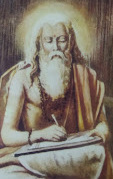
Biographical Dictionary of Essential Thinkers
Encyclopedia of Ancient and Modern India
The Neo-Vedic Civilization and the Legacy of Vyasa
Krishna Dvaipayana Vyasa occupies a central place in the intellectual and civilizational memory of ancient India. Traditional chronology places his life approximately between c. 3350–3050 BCE, during the closing phase of the Neo-Vedic Civilization, a period marked by political consolidation, military conflict, preservation of oral literature, and the transformation of sacred traditions into organized textual systems. He was remembered not merely as a sage, but as a historian of civilization, a compiler of knowledge, and a guardian of collective memory during the turbulent age surrounding the Kurukshetra War.
Vyasa was born to the sage Parashara of the Vasistha Gotra and Krishna-Satyavati, daughter of a river chief traditionally associated with the fisher communities near the confluence of the Ganga and Yamuna rivers. His mother possessed a dark complexion and was therefore called Krishna (कृष्णा), a common descriptive name for brown-skinned women of that period; similarly, Draupadi was also addressed as Krishna in later traditions. The child inherited the same complexion and became known as Krishna Dvaipayana.
The intellectual background of Vyasa cannot be understood without examining the work of Parashara. Around c. 3450–3400 BCE, Parashara is remembered for systematizing the ancient oral traditions of the Veda into four broad categories: Rig for poetry and hymns, Yajur for prose formulations, Sama for musical recitation, and Atharva for mystical and ritual knowledge. At that time, the divisions were fluid, and many mantras circulated freely across traditions. Earlier still, the Rigveda Shakala Samhita had begun taking shape around 4500 BCE, during the opening phase of what may be called the Neo-Vedic Civilization. During Parashara’s era, schools such as the Baskala tradition had already emerged, and prose as well as melodic compositions had entered the older Rigvedic corpus.
Approximately a thousand years later, Krishna Dvaipayana Vyasa expanded and refined his father’s project. He reorganized the older collections into multiple Samhitas, separating prose, song, and mystical sections from the ancient Rigvedic body. The older Shakala and Baskala recensions were revised according to pronunciation systems and pedagogical methods. Later works such as the Brihad-Devata preserved memory of some of these textual traditions. The presently known Shakala Samhita, containing 1028 hymns arranged in ten Mandalas, emerged much later, approximately between c. 2500–2000 BCE, but its roots were associated with the earlier efforts of Parashara and Vyasa. Thus Vyasa was not the inventor of the Vedas; rather, he became the great organizer and transmitter of already ancient traditions.
Krishna Dvaipayana travelled extensively throughout Jambudwipa, the ancient geographical name for Bharatvarsha and the surrounding cultural world of early Indian civilization. Traditional imagination compared the vast landmass stretching from the seas near Madagascar toward the Indian subcontinent to the shape of the Jamun (Jambu) fruit, from which the name Jambudwipa was believed to originate. During his journeys across kingdoms, forests, gurukulas, and sacred river regions, Krishna propagated the systematic division and preservation of the Vedas initiated earlier by his father Parashara. Because of his tireless movement across the riverine and island-like regions of the subcontinent, and because he carried Vedic knowledge from one center of learning to another, he became widely revered as Dvaipayana Vyasa, the sage who organized and explained the wisdom of the Vedic world.
The love story of Parashara and Krishna-Satyavati (कृष्णा) occupied a unique place in early Vedic memory because it combined desire, destiny, and intellectual continuity rather than formal royal marriage. Around c. 3400–3350 BCE, the sage Parashara, already renowned for his mastery over Vedic traditions and for dividing the oral mantras into the categories of Rig, Yajur, Sama, and Atharva, encountered the young Dhivar Princes Satyavati near the riverine regions around the confluence of the Ganga and Yamuna. Satyavati, daughter of a river-chief or Dhibara lord, possessed striking dark beauty and deep intelligence; because of her complexion she was affectionately called Krishna, a name commonly associated with dark-skinned women of that age.
Mahabharata traditions describe that Parashara, while crossing the river with her, became deeply attracted not merely to her beauty but also to her calm dignity and fearless speech. Their union did not follow the later institutional form of marriage; rather, it reflected the flexible yet disciplined customs of early Vedic society, where extraordinary unions involving sages and women of different social backgrounds were accepted under sacred legitimacy. From this union was born the child Krishna Dvaipayana (कृष्णः), later called Vyasa, who inherited the intellectual mission of his father and the resilience of his mother. After his birth, Parashara took the infant toward the sacred confluence later known as Prayag in present-day Uttar Pradesh, where the child received education under his father, while Satyavati later married King Shantanu of Hastinapura. The mother and son maintained secret communication throughout their lives, and the memory of Parashara remained alive within Vyasa’s lifelong project of preserving Vedic civilization and recording the history of the Mahabharata age.
The political atmosphere of Vyasa’s life was closely connected with the kingdom of Hastinapura and the dynasty of King Shantanu, who flourished around c. 3350 BCE according to traditional chronology. After the death of Shantanu’s sons, particularly Vichitravirya, succession crises emerged within the Kuru dynasty. Satyavati revealed to her foster son Devavrata Bhishma the existence of Krishna Dvaipayana, whose reputation as a sage had already spread across gurukulas and royal courts. Through the accepted institution of Niyoga, Vyasa fathered heirs upon the widows of Vichitravirya, thereby becoming the biological progenitor of both the Kuru and Pandava lineages without socially claiming paternal authority over them. Vedic society maintained strict discipline but also displayed flexibility in matters concerning lineage preservation and legal succession.
Vyasa’s lifetime coincided with the era associated with Vasudeva Krishna, traditionally born in 3227 BCE. Unlike later devotional traditions that elevated Krishna into supreme divinity, Vyasa’s approach appears primarily political and historical. His concern was the preservation of civilizational memory, military ethics, royal duty, and social decline. The massive Kurukshetra War, generally placed between c. 3162–3130 BCE, represented for Vyasa not merely a dynastic conflict but the collapse of an entire moral and political order. He witnessed the destruction of his descendants, disciples, and allies. The war devastated the Kuru aristocracy and reshaped the balance of power across northern India.
After the war, Krishna Dvaipayana composed an earlier form of the Mahabharata, known as the Jayakhya Samhita. This initial version focused upon victory, warfare, political ethics, and the tragedy of civilizational collapse. Later, when the sage Vaisampayana recited the text before King Janamejaya, great-grandson of Yudhishthira, additional sections such as the Mausala Parva and Svargarohana Parva were incorporated. The Mausala narrative held particular emotional importance because it described the destruction of the Yadu clan before the eyes of Vasudeva Krishna himself. At this earlier stage, the Bhagavad Gita had not yet become part of the epic narrative in its later philosophical form.
Vyasa’s historical vision differed sharply from that of Valmiki of the Bharadvaja Gotra, whose Ramayana, reaching near-present form around c. 1500–1450 BCE, celebrated the ideal Vedic king and the ethical order of governance. Vyasa, by contrast, concentrated upon the realities of military civilization, dynastic violence, diplomacy, inheritance, and the moral ambiguities of political life. His writing style preserved debates, contradictions, and tragic consequences rather than presenting perfect idealism.
Ancient Indian civilization may therefore be viewed in three broad phases: the Ancient Vedic Civilization before 4500 BCE, the Neo-Vedic Civilization from 4500–600 BCE, and the later Hindu Civilization from 600 BCE onward. Within this framework, the Rigvedic Shakala Samhita became one of the foundational texts of the Neo-Vedic age, while the Bhagavad Gita later emerged as a formative text of Hindu civilization. The lexicographical work Nirukta of Yaskacharya possibly represented one of the final intellectual products of the Neo-Vedic world.
Krishna Dvaipayana Vyasa never authored any of the later Hindu Puranas, despite traditional attributions connecting his name with them. The Vishnu Purana was originally associated with his father Parashara, although the present form of the text underwent repeated revisions and interpolations across many centuries; nevertheless, important philosophers such as Adi Shankaracharya extensively quoted from it, indicating the antiquity of at least parts of the tradition. Similarly, the commentary traditionally linked with Vyasa on the Yoga Sutras is considered by many scholars to be the work of later intellectual circles using the prestige of the Vyasa name. The Brahma Sutra, moreover, is attributed here not to Krishna Dvaipayana but to Badarayana, understood as a separate historical figure connected with Badarinath and remembered as the son of Badari. The philosophical “Jigyasa” or inquiry-based method of the Brahma Sutra reflects intellectual themes comparable to the speculative spirit of the Nasadiya Sukta of the Rigveda. Again the text known as Vyasa Smriti is likewise viewed as a much later composition produced anonymously and retrospectively attributed to Vyasa in order to grant it traditional authority.
The final years of Vyasa’s life were marked by withdrawal and instruction. Before the outbreak of the Kurukshetra conflict, he escorted his mother Satyavati and the widowed queens to a forest hermitage near the Ganga, where he taught yoga and the discipline of peaceful death. Following the destruction of the Yadavas and the death of Vasudeva Krishna, the age of Kali Yuga was believed to begin on 18 February 3102 BCE at approximately 6 AM, an epoch later referenced in astronomical traditions such as the Aryabhatiyam and symbolically associated with Lanka. Vyasa interpreted these catastrophes not with personal attachment but through the detached wisdom later associated with Sattvic consciousness.
Having transmitted his teachings to the sages gathered at Naimisaranya and before Emperor Janamejaya, Krishna Dvaipayana Vyasa is traditionally believed to have died around 3050 BCE at Kashi. His body was reportedly carried to the sacred confluence at Prayag during the season later connected with the Kumbha gathering, where kings, princes, ascetics, and common people assembled to honor him. Traditions maintain that his disciples carried his teachings throughout India and beyond, extending even toward regions near the Caspian Sea. In memory, Vyasa remained not merely an author, but a civilizational archivist, the sage who explained the rise and decline of an age while preserving its intellectual inheritance for the future.
Sarvarthapedia Conceptual Network: Krishna Dvaipayana Vyasa
Core Identity
- Sage of the late Neo-Vedic Civilization
- Compiler and organizer of Vedic traditions
- Political-historical thinker of the Mahabharata age
- Guardian of oral memory and civilizational continuity
- Associated chronology: c. 3350–3050 BCE
Central Linked Concepts
- Neo-Vedic Civilization
- Kurukshetra War
- Vedic Preservation
- Samhita Tradition
- Kuru Dynasty
- Jambudwipa
- Jayakhya Samhita
- Kali Yuga
- Civilizational Memory
- Military Ethics
Family and Lineage Network
Parashara
- Father of Krishna Dvaipayana
- Sage of the Vasistha Gotra
- Associated with early division of Vedic oral traditions
- Traditionally linked with Vishnu Purana
- Connected Concepts:
- Rigveda Categorization
- Oral Tradition
- Vishnu Purana
- Vasistha Lineage
- Neo-Vedic Intellectual Reform
Krishna-Satyavati
- Mother of Krishna Dvaipayana
- Daughter of a river-chief near the Ganga-Yamuna confluence
- Later queen of Hastinapura through marriage to Shantanu
- Connected Concepts:
- River Culture
- Hastinapura Dynasty
- Niyoga Institution
- Kuru Succession Crisis
King Shantanu
- Ruler of Hastinapura
- Husband of Satyavati
- Ancestor of Kuru and Pandava branches
- Connected Concepts:
- Kuru Kingdom
- Bhishma
- Dynastic Legitimacy
Devavrata Bhishma
- Foster son of Satyavati
- Guardian of Hastinapura
- Linked to succession crisis after death of Vichitravirya
- Connected Concepts:
- Royal Duty
- Celibacy Vow
- Political Stability
Vedic Knowledge System
Veda Division
- Early categorization attributed to Parashara around c. 3450–3400 BCE
- Expanded and systematized by Krishna Dvaipayana
- Four Categories:
- Rig: Hymns and poetry
- Yajur: Ritual prose
- Sama: Musical recitation
- Atharva: Mystical and ritual knowledge
Samhita Traditions
- Shakala Samhita
- Baskala Tradition
- Brihad-Devata references
- Oral recensional schools
- Pronunciation and pedagogical systems
Rigveda Shakala Samhita
- Associated origin around c. 4500 BCE
- Foundational text of Neo-Vedic Civilization
- Later standardized between c. 2500–2000 BCE
- Connected Concepts:
- Mandala Structure
- Oral Preservation
- Neo-Vedic Cultural Order
Geographical and Cultural Network
Jambudwipa
- Ancient geographical conception of Bharatvarsha
- Symbolically associated with the Jamun fruit
- Linked to cultural unity of early Indian civilization
- Connected Concepts:
- Bharatvarsha
- Sacred Geography
- Gurukula Networks
- River Civilizations
Prayag
- Confluence of Ganga and Yamuna
- Educational environment of Vyasa’s youth
- Later funerary and pilgrimage association
- Connected Concepts:
- Kumbha Tradition
- Sacred Rivers
- Intellectual Transmission
Hastinapura
- Political center of the Kuru dynasty
- Setting of succession crises and Mahabharata politics
- Connected Concepts:
- Kuru Lineage
- Royal Administration
- Kurukshetra Conflict
Naimisaranya
- Assembly place of sages
- Site of transmission of Vyasa’s teachings
- Connected Concepts:
- Oral Recitation
- Janamejaya
- Preservation of Epic Tradition
Kashi
- Traditional place of Vyasa’s death around c. 3050 BCE
- Linked with final transmission of knowledge
- Connected Concepts:
- Sacred Cities
- Ascetic Withdrawal
- Intellectual Legacy
Political and Historical Concepts
Kurukshetra War
- Traditional chronology: c. 3162–3130 BCE
- Massive dynastic conflict between Kuru and Pandava lineages
- Viewed as collapse of Neo-Vedic political order
- Connected Concepts:
- Military Ethics
- Dynastic Violence
- Social Decline
- Civilizational Transition
Niyoga Institution
- Legalized lineage-preservation mechanism
- Used by Vyasa to continue the Kuru dynasty
- Reflects social flexibility within Vedic discipline
- Connected Concepts:
- Succession Crisis
- Royal Legitimacy
- Biological vs Social Fatherhood
Vasudeva Krishna
- Traditional birth date: 3227 BCE
- Political ally and civilizational guardian
- Not originally presented as supreme divinity in Vyasa’s historical framework
- Connected Concepts:
- Yadu Clan
- Mausala Parva
- Statecraft
- Warrior Culture
Kali Yuga
- Traditional beginning: 18 February 3102 BCE
- Astronomically referenced in Aryabhatiyam
- Symbolic marker of civilizational decline
- Connected Concepts:
- Cosmic Chronology
- Post-War Collapse
- Yadava Destruction
Mahabharata Tradition Cluster
Jayakhya Samhita
- Earliest form of the Mahabharata
- Focused on war, victory, ethics, and dynastic tragedy
- Associated directly with Krishna Dvaipayana
Vaisampayana
- Disciple of Vyasa
- Recited Mahabharata before King Janamejaya
- Connected Concepts:
- Oral Transmission
- Epic Expansion
- Ritual Recitation
Janamejaya
- Great-grandson of Yudhishthira
- Royal patron of Mahabharata recitation
- Connected Concepts:
- Kuru Continuity
- Snake Sacrifice Tradition
- Epic Canonization
Mausala Parva
- Narrative of Yadu clan destruction
- Witnessed by Vasudeva Krishna
- Symbol of end of heroic age
Svargarohana Parva
- Final ascent narrative of the Pandavas
- Represents transition from history into sacred memory
Bhagavad Gita
- Considered in this interpretation a later insertion into the Mahabharata tradition
- Became foundational text of Hindu Civilization
- Connected Concepts:
- Dharma
- Yoga Philosophy
- Post-Vedic Theology
Comparative Intellectual Traditions
Valmiki
- Sage of the Bharadvaja Gotra
- Composer of the Ramayana tradition
- Connected Concepts:
- Ideal Kingship
- Poetic Literature
- Dharmic Governance
Ramayana
- Reached near-present form around c. 1500–1450 BCE
- Focused on moral kingship and social harmony
- Contrasts with Vyasa’s political realism
Yaskacharya
- Author of Nirukta
- Possibly among final intellectuals of Neo-Vedic Civilization
- Connected Concepts:
- Lexicography
- Vedic Interpretation
- Linguistic Analysis
Nirukta
- Important interpretative work on Vedic words
- Transitional text between Neo-Vedic and later Hindu intellectual culture
Philosophical Attribution Debates
Vishnu Purana
- Originally associated with Parashara
- Extensively revised over centuries
- Quoted by Adi Shankaracharya
- Connected Concepts:
- Puranic Redaction
- Sectarian Theology
- Textual Interpolation
Adi Shankaracharya
- Medieval philosopher
- Quoted portions of Vishnu Purana
- Important for textual continuity studies
Brahma Sutra
- Attributed in this interpretation to Badarayana, not Vyasa
- Reflects inquiry-based philosophical method
- Connected Concepts:
- Jigyasa
- Vedanta
- Nasadiya Sukta
Badarayana
- Separate historical figure associated with Badarinath
- Linked with speculative philosophical traditions
- Connected Concepts:
- Vedantic Inquiry
- Brahma Sutra
- Metaphysical Reasoning
Nasadiya Sukta
- Philosophical hymn of the Rigveda
- Explores cosmological uncertainty and inquiry
- Influential in later speculative traditions
Vyasa Smriti
- Regarded here as a later anonymous composition
- Retrospectively attributed to Vyasa for authority
- Connected Concepts:
- Smriti Literature
- Textual Attribution
- Intellectual Legitimization
Civilizational Framework
Ancient Vedic Civilization
- Before 4500 BCE
- Early oral and ritual foundations
Neo-Vedic Civilization
- c. 4500–600 BCE
- Era of Samhita formation, dynastic politics, and military states
- Core figures:
- Parashara
- Krishna Dvaipayana Vyasa
- Vasudeva Krishna
Hindu Civilization
- From c. 600 BCE onward
- Marked by emergence of devotional theology, Puranas, and philosophical synthesis
- Core texts:
- Bhagavad Gita
- Puranic Literature
- Smriti Traditions
Conceptual Identity of Vyasa
Historian of Civilization
- Recorded decline rather than divine perfection
- Preserved memory of political collapse
- Emphasized ethics under conditions of war
Compiler Rather Than Creator
- Did not invent the Vedas
- Reorganized older oral traditions into structured systems
Detached Witness
- Interpreted catastrophe through disciplined Sattvic consciousness
- Combined emotional restraint with historical observation
Civilizational Archivist
- Preserved intellectual continuity after the destruction of ruling lineages
- Transmitted knowledge through disciples, reciters, and gurukula systems