Society: The Structures We Create
Russia-China Partnership Expands as Putin Meets Xi Jinping in Beijing
The official visit of Russian President Vladimir Putin to Beijing concluded on 20 May, marking another significant milestone in the evolution of Russia–China relations in the early twenty-first century. Arriving in the Chinese capital on 19 May, Putin held extensive negotiations with Chinese President Xi Jinping, resulting in the adoption of two major political documents: a Joint Statement on Further Strengthening the Comprehensive Partnership and Strategic Interaction and a Joint Declaration on the Establishment of a Multipolar World and a New Type of International Relations. The visit occurred against a backdrop of geopolitical tensions involving the Ukraine conflict, intensifying competition between major powers, and instability in the Middle East, making the meeting one of the most closely watched diplomatic events of the year.
The gathering in Beijing was not merely ceremonial. According to Russian and Chinese analysts, the principal objective was to coordinate positions on international affairs, review bilateral cooperation, and maintain strategic alignment between two states that increasingly describe their relationship as a cornerstone of global stability. Annual meetings between the Russian and Chinese leadership have become an established practice since the beginning of the 2000s, particularly after the signing of the Treaty of Good-Neighborliness and Friendly Cooperation in Moscow on 16 July 2001 by Putin and then-Chinese leader Jiang Zemin. The treaty, which requires periodic extension and reaffirmation, has served as the legal and political foundation for the modern partnership between the two countries.
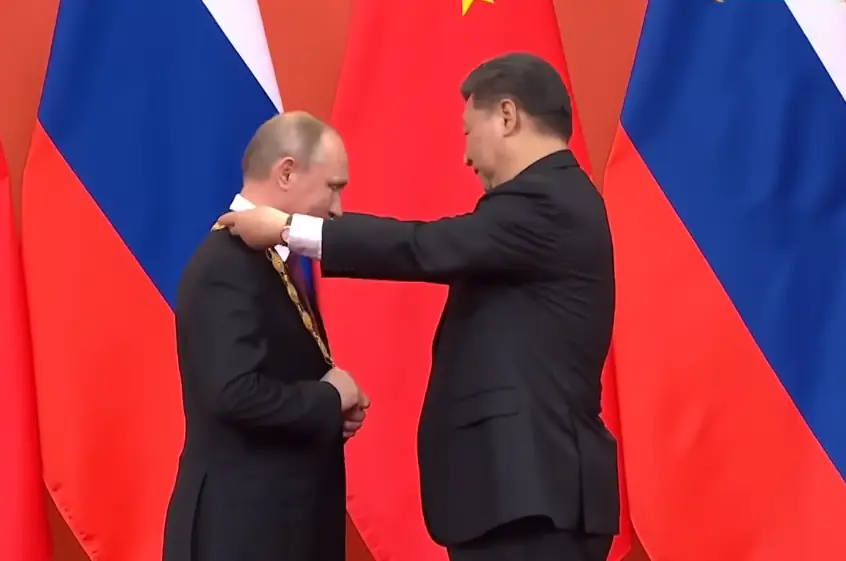
The talks began at the Great Hall of the People in central Beijing, where Xi Jinping welcomed Putin with full state honors. A formal ceremony was held in the square outside the building. The leaders greeted members of their delegations, listened to the national anthems of both countries, and inspected an honor guard. The Russian anthem was accompanied by ceremonial cannon fire, while Chinese children welcomed the Russian president in Mandarin. The orchestra performed “Moscow Nights,” one of the best-known Russian songs internationally, emphasizing the symbolic nature of the occasion.
A notable feature of the visit was the size of the Russian delegation. Approximately 39 senior officials and representatives participated in the expanded negotiations, including deputy prime ministers, ministers, presidential administration officials, executives from major corporations, and banking representatives. The composition of the delegation reflected the breadth of contemporary Russian-Chinese cooperation, which extends beyond diplomacy into energy, transportation, finance, science, education, and technology.
During the initial closed-door discussions, Xi Jinping emphasized that relations between the two countries are based on mutual respect, equality, and mutually beneficial cooperation. He argued that such principles contribute stability and predictability to an international environment increasingly characterized by uncertainty. Xi also criticized the growth of unilateralism and hegemonic practices, suggesting that many contemporary global challenges stem from attempts by individual powers to impose their will on others.
Putin responded by invoking a traditional Chinese proverb stating that a single day apart can feel like three autumns. He described bilateral relations as having reached an “unprecedentedly high level.” According to the Russian president, cooperation between Moscow and Beijing has become one of the principal stabilizing factors in international politics. He highlighted the rapid growth of economic exchanges, noting that annual trade turnover between Russia and China exceeds $200 billion, a figure unimaginable during the final decades of the Cold War.
Particular attention was devoted to energy cooperation, which remains a central pillar of bilateral economic relations. Since the 2010s, Russia has become one of China’s most important suppliers of oil, natural gas, and other energy resources. Projects such as the Power of Siberia gas pipeline, launched in December 2019, transformed the energy partnership into a strategic component of both countries’ long-term development plans. Putin reiterated that energy cooperation continues to drive broader economic integration between the two nations.
Following the talks, the leaders signed the joint documents that became the most significant outcome of the visit. The texts reflected a high degree of convergence between Russian and Chinese perspectives on world affairs. The documents emphasized support for a multipolar international order, a concept that has become increasingly prominent in Russian and Chinese foreign policy discourse since the early 2000s. Multipolarity refers to a system in which power is distributed among multiple influential states rather than concentrated in a single dominant actor.
The joint statement also addressed major contemporary security issues. Russia and China condemned what they described as provocative actions by certain nuclear-armed states against others, arguing that such behavior increases international tensions and undermines strategic stability. The declaration further called for addressing the root causes of the Ukraine crisis, reflecting the long-standing position of both governments that sustainable conflict resolution requires attention to broader political and security concerns rather than solely military developments.
Another significant aspect of the statement concerned the Middle East. Moscow and Beijing expressed the view that recent United States and Israeli military strikes against Iran contribute to regional instability and increase the risk of broader confrontation. The issue has gained prominence because of concerns surrounding the security of the Strait of Hormuz, through which a substantial portion of global oil exports passes. Russian and Chinese officials warned that escalating military actions could have consequences extending far beyond the region, affecting international energy markets and global economic stability.
The timing of the visit was also notable because it followed recent diplomatic engagement between China and the United States. However, analysts stressed that the nature of Russian-Chinese consultations differs fundamentally from Sino-American dialogue. Whereas discussions between Washington and Beijing are often focused on managing competition and preventing escalation, meetings between Moscow and Beijing are increasingly framed as consultations between strategic partners seeking to coordinate policy positions and deepen cooperation.
Experts such as Anna Kireyeva of MGIMO University and Alexander Lomanov of the Russian Academy of Sciences argued that the joint declarations illustrate the growing alignment of Russian and Chinese views on international developments. According to this interpretation, both countries increasingly support each other’s major diplomatic initiatives and seek greater coordination on regional and global issues, including Eurasian security, economic integration, and reform of international institutions.
The visit occurred amid broader debates concerning the future of international organizations and conflict resolution mechanisms. Russian officials have argued that attention to the Ukraine issue at the United Nations has declined compared with previous years, reflecting what some observers describe as growing fatigue within parts of the international community. At the same time, efforts to reach a negotiated settlement remain complicated by continuing disagreements between the parties involved and the broader geopolitical rivalry surrounding the conflict.
Beyond political symbolism, the Beijing meetings produced concrete results. In addition to the two major declarations, approximately 40 bilateral documents and agreements were signed, covering areas ranging from economic cooperation and transportation to scientific exchanges and cultural initiatives. Such agreements reflect a long-term trend toward institutionalization of Russian-Chinese cooperation, transforming what was once a largely political relationship into a multidimensional partnership.
By the conclusion of the visit on 20 May, both governments had reaffirmed their intention to deepen strategic coordination and continue promoting what they describe as a more balanced international order. Putin’s invitation for Xi Jinping to visit Russia in 2027 underscored the expectation that high-level engagement will remain a defining feature of bilateral relations. In historical perspective, the Beijing meetings represented another chapter in the steady expansion of a partnership that has evolved from post-Cold War rapprochement into one of the most consequential interstate relationships of the contemporary era, with implications extending across Eurasia, the Middle East, and the broader international system.
Read More
Sarvarthapedia Conceptual network: Putin and Xi Jinping Sign Multipolar World Declaration in Beijing
Russia–China Relations
Long-term diplomatic, economic, military, and strategic cooperation between Russia and China, formalized through treaties, high-level summits, and bilateral agreements.
Strategic Partnership
A comprehensive framework of cooperation encompassing foreign policy coordination, trade, energy, security, and international governance.
Multipolar World Order
A geopolitical concept advocating the distribution of global influence among multiple major powers rather than concentration in a single dominant state.
International Relations
The study and practice of interactions among states, international organizations, and transnational actors.
Great-Power Diplomacy
High-level engagement between major states aimed at shaping international affairs and managing global challenges.
Russia–China Relations Cluster
Vladimir Putin
President of Russia and a central architect of modern Russia–China strategic cooperation.
See also:
- Xi Jinping
- Russia–China Relations
- Strategic Partnership
- Treaty of Good-Neighborliness and Friendly Cooperation
- Multipolar World Order
Xi Jinping
President of China and key proponent of closer political and economic ties with Russia.
See also:
- Vladimir Putin
- China
- Russia–China Relations
- Strategic Partnership
- Global Governance
Treaty of Good-Neighborliness and Friendly Cooperation
Agreement signed in 2001 that established the legal foundation for contemporary Russia–China relations.
See also:
- Jiang Zemin
- Vladimir Putin
- Strategic Partnership
- Bilateral Agreements
- Eurasian Cooperation
Beijing Summit
High-level diplomatic meeting where Russian and Chinese leaders coordinated positions on global issues.
See also:
- Great Hall of the People
- Vladimir Putin
- Xi Jinping
- Joint Statement
- Multipolar World Order
Diplomacy and Governance
Joint Statement on Strategic Cooperation
Official document outlining shared positions on international security and bilateral cooperation.
See also:
- Multipolar World Order
- International Security
- Russia–China Relations
- Foreign Policy Coordination
Joint Declaration on the Establishment of a Multipolar World
Political declaration advocating reforms in global governance and greater balance in international affairs.
See also:
- Multipolar World Order
- Global Governance
- Strategic Partnership
- International Relations
Global Governance
Systems and institutions through which international affairs are managed and coordinated.
See also:
- United Nations
- Multipolar World Order
- International Organizations
- Great-Power Diplomacy
Foreign Policy Coordination
Process through which states align diplomatic positions on international matters.
See also:
- Strategic Partnership
- International Security
- Russia–China Relations
- Geopolitics
Security and Geopolitics Cluster
International Security
Framework concerning the prevention of conflict and maintenance of stability among nations.
See also:
- Nuclear Powers
- Ukraine Conflict
- Middle East Security
- Strategic Stability
Strategic Stability
Condition in which major powers avoid actions that could provoke large-scale military confrontation.
See also:
- Nuclear Deterrence
- Arms Control
- International Security
- Multipolar World Order
Nuclear Powers
States possessing nuclear weapons and significant strategic capabilities.
See also:
- Strategic Stability
- Arms Control
- International Security
- Great-Power Competition
Great-Power Competition
Political, economic, and military rivalry among major global actors.
See also:
- United States
- China
- Russia
- Multipolar World Order
Ukraine Conflict
Ukraine Conflict
Major international crisis shaping European and global security dynamics.
See also:
- Russia
- Ukraine
- United Nations
- International Security
- Peace Negotiations
Root Causes of the Ukraine Crisis
Concept emphasizing the broader political, security, and historical factors behind the conflict.
See also:
- Ukraine Conflict
- European Security
- NATO Expansion Debates
- Peace Settlement
Peace Negotiations
Diplomatic efforts aimed at achieving a political resolution to armed conflict.
See also:
- Ukraine Conflict
- Mediation
- United Nations
- Conflict Resolution
United Nations
Principal international organization responsible for maintaining peace and security.
See also:
- General Assembly
- Security Council
- International Diplomacy
- Global Governance
Middle East Cluster
Iran
Regional power whose relations with the United States and Israel have significant implications for Middle Eastern stability.
See also:
- Middle East Security
- Strait of Hormuz
- Nuclear Negotiations
- Energy Markets
Middle East Security
Regional security environment shaped by interstate rivalries, conflicts, and diplomatic initiatives.
See also:
- Iran
- Israel
- United States
- Energy Security
Strait of Hormuz
Strategic maritime chokepoint through which a significant share of global oil exports passes.
See also:
- Iran
- Energy Markets
- Global Trade
- Maritime Security
Energy Security
Reliable access to energy resources necessary for economic stability.
See also:
- Oil Markets
- Natural Gas
- Russia–China Energy Cooperation
- Strait of Hormuz
Economic Cooperation Cluster
Russia–China Trade
Economic relationship characterized by growing trade volumes and expanding commercial ties.
See also:
- Bilateral Trade
- Energy Exports
- Economic Integration
- Strategic Partnership
Bilateral Trade
Exchange of goods and services between two countries.
See also:
- Russia–China Trade
- International Commerce
- Economic Cooperation
- Trade Routes
Economic Integration
Process through which national economies become increasingly interconnected.
See also:
- Eurasian Cooperation
- Trade Agreements
- Infrastructure Development
- Energy Partnerships
Energy Cooperation
Joint activities in oil, gas, electricity, and energy infrastructure.
See also:
- Power of Siberia
- Natural Gas
- Energy Security
- Russia–China Trade
Power of Siberia
Major natural gas pipeline linking Russian energy fields to Chinese markets.
See also:
- Energy Cooperation
- Natural Gas
- Russia–China Relations
- Infrastructure Projects
Eurasian Cooperation Cluster
Eurasia
Geopolitical and economic space connecting Europe and Asia.
See also:
- Russia
- China
- Regional Integration
- Strategic Connectivity
Eurasian Security
Security framework focused on stability across the Eurasian continent.
See also:
- Multipolar World Order
- Strategic Partnership
- Regional Cooperation
- International Security
Regional Integration
Processes aimed at enhancing political, economic, and security cooperation among neighboring states.
See also:
- Eurasia
- Economic Integration
- Infrastructure Development
- Global Governance
Historical Figures Cluster
Jiang Zemin
President of China who co-signed the 2001 Treaty of Good-Neighborliness and Friendly Cooperation with Russia.
See also:
- Treaty of Good-Neighborliness and Friendly Cooperation
- China
- Russia–China Relations
- Vladimir Putin
Vladimir Putin
See also:
- Russia
- Xi Jinping
- Strategic Partnership
- Multipolar World Order
- Great-Power Diplomacy
Xi Jinping
See also:
- China
- Global Governance
- Russia–China Relations
- Multipolar World Order
Institutional Cluster
Great Hall of the People
State building in Beijing used for major political meetings and diplomatic ceremonies.
See also:
- Beijing
- Xi Jinping
- State Visits
- Beijing Summit
State Visit
Formal diplomatic visit by a head of state to another country.
See also:
- Diplomacy
- Bilateral Relations
- Beijing Summit
- Strategic Partnership
Intergovernmental Commissions
Joint governmental bodies responsible for coordinating cooperation in specific sectors.
See also:
- Economic Cooperation
- Bilateral Agreements
- Russia–China Relations
- Strategic Partnership
Related Overarching Topics
China
Connected to:
- Xi Jinping
- Russia–China Relations
- Multipolar World Order
- Global Governance
- Economic Integration
Russia
Connected to:
- Vladimir Putin
- Strategic Partnership
- Ukraine Conflict
- Energy Cooperation
- Eurasian Security
Multipolar World Order
Connected to:
- Russia–China Relations
- Global Governance
- Strategic Stability
- Great-Power Competition
- International Relations
Strategic Partnership
Connected to:
- Russia–China Relations
- Energy Cooperation
- Foreign Policy Coordination
- Eurasian Security
- Multipolar World Order
International Relations
Connected to:
- Diplomacy
- Global Governance
- Multipolar World Order
- International Security
- Great-Power Diplomacy
This conceptual network places the Beijing summit at the center of interconnected clusters involving diplomacy, security, economics, Eurasian integration, Middle Eastern affairs, and global governance, allowing readers to navigate the subject as a comprehensive knowledge web.