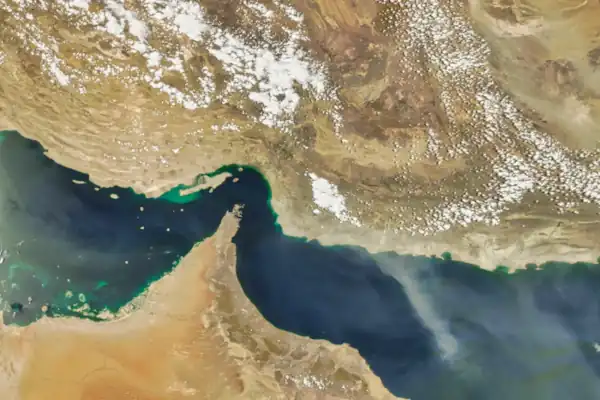
Joint statement from the leaders of the United Kingdom, France, Germany, Italy, the Netherlands, Japan, Canada and others on the Strait of Hormuz
Joint statement from the leaders of the United Kingdom, France, Germany, Italy, the Netherlands, Japan, Canada, Republic of Korea, New Zealand, Denmark, Latvia, Slovenia, Estonia, Norway, Sweden, Finland, Czechia, Romania, Bahrain, Lithuania, Australia, United Arab Emirates, Portugal, Trinidad & Tobago, Dominican Republic, Croatia, Bulgaria, Kosovo, Panama, North Macedonia, Nigeria, Montenegro and Albania on the Strait of Hormuz.
Published On 19 March 2026
We condemn in the strongest terms recent attacks by Iran on unarmed commercial vessels in the Gulf, attacks on civilian infrastructure including oil and gas installations, and the de facto closure of the Strait of Hormuz by Iranian forces.
We express our deep concern about the escalating conflict. We call on Iran to cease immediately its threats, laying of mines, drone and missile attacks and other attempts to block the Strait to commercial shipping, and to comply with UN Security Council Resolution 2817.
Freedom of navigation is a fundamental principle of international law, including under the United Nations Convention on the Law of the Sea.
The effects of Iran’s actions will be felt by people in all parts of the world, especially the most vulnerable.
Consistent with UNSC Resolution 2817, we emphasise that such interference with international shipping and the disruption of global energy supply chains constitute a threat to international peace and security. In this regard, we call for an immediate comprehensive moratorium on attacks on civilian infrastructure, including oil and gas installations.
We express our readiness to contribute to appropriate efforts to ensure safe passage through the Strait. We welcome the commitment of nations who are engaging in preparatory planning.
We welcome the International Energy Agency decision to authorise a coordinated release of strategic petroleum reserves. We will take other steps to stabilise energy markets, including working with certain producing nations to increase output.
We will also work to provide support for the most affected nations, including through the United Nations and the IFIs.
Maritime security and freedom of navigation benefit all countries. We call on all states to respect international law and uphold the fundamental principles of international prosperity and security.
Following publication, Canada, Republic of Korea, New Zealand, Denmark, Latvia, Slovenia, Estonia, Norway, Sweden, Finland, Czechia, Romania, Bahrain, Lithuania, Australia, United Arab Emirates, Portugal, Trinidad & Tobago, Dominican Republic, Croatia, Bulgaria, Kosovo, Panama, North Macedonia, Nigeria, Montenegro and Albania confirmed they also joined this joint leaders’ statement.
Core Node: Strait of Hormuz Crisis (March 2026)
Definition
A contemporary geopolitical and economic crisis centered on the disruption of maritime navigation and energy flows through a critical global chokepoint, triggered by state-led military and quasi-military actions.
Primary Conceptual Clusters
Maritime Security and Navigation
Freedom of Navigation
A foundational principle of international law ensuring that vessels may transit international waters without interference.
Strategic Chokepoints
Narrow maritime passages whose control influences global trade and security dynamics.
Naval Deterrence
Use of maritime military presence to prevent escalation and secure transit routes.
Commercial Shipping Security
Protection of civilian vessels from state and non-state threats.
International Law and Normative Order
United Nations Convention on the Law of the Sea (UNCLOS)
Legal framework governing maritime rights, responsibilities, and navigation freedoms.
UN Security Council Resolution 2817
Normative instrument framing maritime disruption as a threat to international peace.
Sovereignty vs Global Commons
Tension between national control and shared international rights over waterways.
Rules-Based International Order
System of norms regulating state behavior in global interactions.
Energy Security and Global Economy
Global Energy Supply Chains
Interconnected systems transporting oil and gas across regions.
Strategic Petroleum Reserves
Emergency stockpiles released to stabilize markets during disruptions.
Energy Market Stabilization
Coordinated international actions to prevent price shocks and shortages.
Resource Geopolitics
Political competition over control and distribution of energy resources.
Conflict Escalation and Security Dynamics
Hybrid Warfare
Combination of conventional, cyber, and proxy tactics affecting civilian and economic targets.
Drone and Missile Warfare
Technological means enabling remote disruption of infrastructure and shipping.
Economic Warfare
Use of trade and supply disruption as strategic tools.
Escalation Spiral
Cycle where retaliatory actions intensify conflict.
Humanitarian and Developmental Impact
Vulnerable Economies
States disproportionately affected by energy price volatility and supply disruption.
Global Inequality Amplification
Crisis-driven widening of economic disparities.
Civilian Infrastructure Targeting
Attacks on non-military assets with broad societal consequences.
Multilateral Aid Mechanisms
Support via international organizations and financial institutions.
Multilateral Cooperation and Diplomacy
Coalition Signaling
Joint statements as instruments of political pressure and unity.
Collective Security
Shared responsibility to maintain peace and stability.
International Energy Agency Coordination
Mechanism for collective energy response.
Preventive Diplomacy
Efforts to de-escalate before full-scale conflict.
Cross-Connections Between Clusters
Maritime Security ↔ International Law
Freedom of Navigation depends on UNCLOS legitimacy; violations trigger legal and diplomatic responses.
Maritime Security ↔ Energy Security
Disruption of chokepoints directly affects global energy supply chains.
Energy Security ↔ Humanitarian Impact
Energy shocks translate into inflation, affecting vulnerable populations globally.
Conflict Dynamics ↔ Maritime Security
Hybrid warfare tactics increasingly target shipping routes and infrastructure.
International Law ↔ Multilateral Cooperation
Legal frameworks enable coordinated global responses and legitimise coalition actions.
Multilateral Cooperation ↔ Energy Security
Strategic petroleum releases and production coordination stabilize markets.
Conflict Dynamics ↔ Humanitarian Impact
Escalation increases civilian vulnerability and infrastructure damage.
Secondary Nodes (Derived Concepts)
De Facto Blockade
Informal but effective restriction of maritime passage without formal declaration.
Global Interdependence
Mutual reliance of nations on shared systems like trade and energy.
Security Externalities
Actions by one state producing unintended global consequences.
Crisis Governance
Management of transnational emergencies through coordinated policy.
Network Summary Structure
Central Axis
Strait of Hormuz Crisis → Maritime Security → Energy Security → Global Stability
Supporting Axes
- Legal Legitimacy → International Law → Collective Response
- Conflict Mechanisms → Hybrid Warfare → Escalation
- Impact Layer → Humanitarian Effects → Economic Inequality
- Coordination Layer → Multilateral Institutions → Crisis Management
Conceptual Flow
Trigger
Military and strategic interference in maritime passage
Immediate Effects
Shipping disruption → Energy supply instability
Secondary Effects
Market volatility → Global economic stress
Systemic Response
International law invocation → Multilateral coordination
Long-Term Implications
Shift in global security architecture → Reinforcement or erosion of rules-based order
More Stories
Professional Indemnity Insurance UK: Legal Requirements, Costs and Cover
Encyclopedia of Constitution and Constitutional Law of the United Kingdom (10-Volume): History and Development
UK Biobank Data: From 2003 Foundation to Modern Data Infrastructure