Encyclopedia of Sanatan Dharma
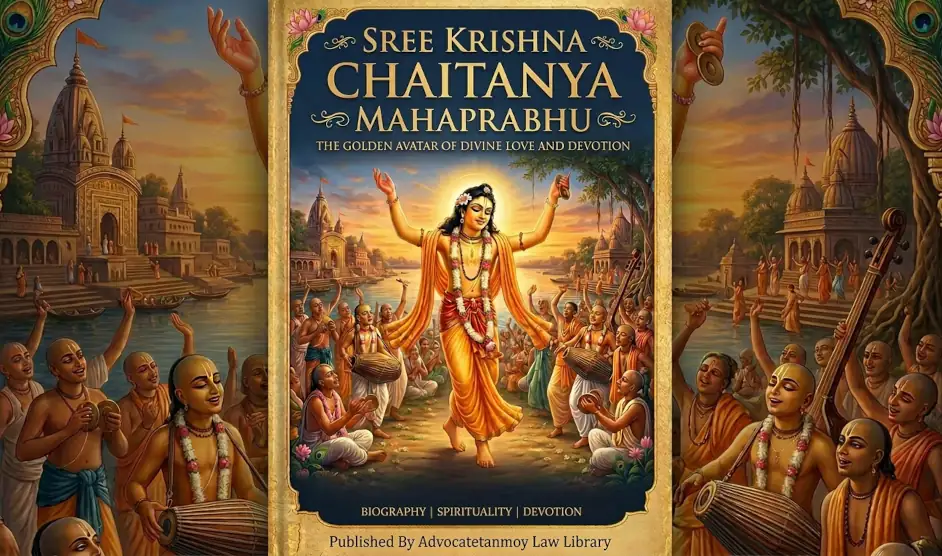
The Encyclopedia of Sree Krishna Chaitanya Bharti
A Comprehensive Reference on His Life, Philosophy, Literature, Devotees, and Legacy
Sree Krishna Chaitanya Bharati Mahaswamipad (1486 – 1533 CE) stands in the uninterrupted current of Vedic civilization. He did not appear as the founder of a new religion, nor as the leader of a sect, but as the renewed manifestation of an ancient spiritual consciousness that had shaped India for millennia. It is therefore significant that his contemporaries came to call him Mahaprabhu—a title which, in the sacred tradition of Odisha, was reserved almost exclusively for Lord Jagannatha. This was neither an act of Bengali sentimentality nor the exaggeration of an overzealous following. The people of Bengal, Odisha, and Braj (Mathura) saw in him something they could not adequately express in ordinary language. In his physical presence, in the gravity of his character, in the majesty of his conduct, and in the immeasurable compassion that radiated from him, they recognised the reflection of Lord Jagannatha Himself. To them, Chaitanya was not merely a Hindu ascetic (Sanyasi); he bore within him the very essence of Jagannatha.
What made this recognition extraordinary was that Chaitanya revealed how the highest divinity could shine through a human life. Throughout his earthly presence, he exemplified Daivattvam, Rishittvam, and Mantrattvam—the splendour of the divine, the wisdom of the seer, and the living power of sacred revelation. Yet this spiritual grandeur rested upon immense learning. He was a formidable scholar of Navya-Nyaya in the tradition of Gangesh Upadhyaya, trained in the Kalapa school of Sanskrit grammar, deeply grounded in the scriptural inheritance of India, and a profound exponent of the Bhagavad Gita and the Bhagavata Purana Kavya. (See also: Hindu Scriptures and Interpretation)
To understand Bengal, one cannot pass over Chaitanya. He became one of the great preservers of the Gauḍīya inheritance at a moment when its cultural and spiritual foundations demanded renewal. The Bengali that flowed from his lips and from the literature inspired by his movement gradually became the prestige dialect of Bengal. The intellectual roots of later Bengali Culture, which nurtured intellectuals like Bankim Chandra, Aurobinda, Rabindranath, and Bimalacharan Siddhanta Saraswati, its literary confidence, its public religious culture, and even the earliest stirrings of a shared Bengali political consciousness may all be traced, in varying degrees, to the movement he inspired.
If Adi Shankaracharya proclaimed the ontological unity of existence through Advaita, Chaitanya disclosed another dimension of reality—that at its deepest level, being is Prema, fulfilled in Mahabhava. Such truths cannot be exhausted by philosophical argument, for they lie beyond the full grasp of the human intellect; they are apprehended only in rare moments, and sometimes through the lives of extraordinary souls who embody them. Chaitanya Mahaprabhu was one such soul. See Vedanta Paribhasha (वेदान्तपरिभाषा)
To know him is to know Bengal more deeply; to study him is to recover one of the profoundest expressions of the Vedic spirit in Indian history. Therefore, Chaitanya is not merely to be remembered—he must be continuously studied, questioned, and rediscovered by every generation.
A 12-Volume Statement on Swami Sree Krishna Chaitanya Bharati
Volume I: The World Before Chaitanya (1200–1486)
This volume establishes the historical setting.
Topics include:
- Jagannath Mishra (1437 – 1498 CE)
- Sachi Devi, daughter of Nilambara Chakravarti (Belpukuria, Nadia) (1457-1537 CE)
- Vishvarup Mishra (Swami Shankararanya) (1478 – 1515 CE)
- Birth of Viswambhara Mishra (1486, Saturday, 27 February, 5.52 PM)
- Vedic Horoscope of Viswambhara Mishra
- Shri Chandrashekhara Mishra (1440 – )
- Murari Gupta (1436- 1537)
- The Meaning of His Name: Sree Krishna Chaitanya Bharati (Mahaswami)
- The political history of Bengal, Odisha, and North India
- The Delhi Sultanate and the Bengal Sultanate
- Religious movements before Chaitanya
- Decline of Buddhist institutions in eastern India
- The rise of devotional movements
- Society, economy, education, and caste
- Sanskrit and Bengali intellectual traditions
Utkala and Kalinga
- Vasudeva Krishna and Arjuna dedicated the whole world to Purusattam Jagannath (3100 BCE)
- Coronation of King Kharavela and Performance of Rasuya Yagna (177 BCE) and performed ‘Navakalebara’
- Sasanka, King of Gauda Desa, conquered Utkal (600 CE)
- Rakta Bahu attacked Puri and destroyed the Jagannath Temple (839 CE)
- Yayati-I, the Somavamsi king, rebuilt the Jagannath Temple in 975 CE
- Choda Ganga Dev, the Founder of the Ganga Dynasty in Kalinga (1078)
- Anantavarman Chodaganga Deva: United Utkala and Kalinga (1078–1150 CE)
- Renovation of Sri Jagannath Temple began at Puri (1115 CE)
- Anangabhima Deva III dedicated the kingdom to Lord Jagannath (1211–1238 CE)
- Narasimhadeva I and the building of the Sun Temple at Konark (1238–1264 CE)
- Invasion of the temple under the rule of Narasimhadeva III by Illias Shah, the Sultan of Bengal (1340 CE)
- Feroz Shah Tughluq, the Muslim ruler of Delhi, attacked the Temple in 1360 CE (Bhanudeva III’s rule)
- Bhanudeva IV, the last and weak Ganga ruler (1434–1435 CE)
- Kapilendra Deva Routaraya (1435 – 1466 CE), first Gajapati king of Odisha
- Purushottama Deva (1466 – 1497 CE)
- Ismail Ghazi, the commander of Allauddin Hussain Shah, the Sultan of Bengal, attacked the Temple in the year 1509 A.D
- Todarmal divided Orissa into Moghulbandi and Garhjat (1611 – 1617)
- Dutch founded their first settlement at Pipli of Balasore District (1625 CE)
- East India Company was granted free trade in Orissa during the reign of Aurangzeb (1671)
- Maratha Rule began in Orissa (1751 CE)
- Bihar-Orissa separated from Bengal province (1911 CE)
- Rabindranath Tagore visited Puri Jagannath (1939 CE)
- Madala Panji edited by Prof. Artaballav Mohanty (1940 CE)
- Foundation stone for the new capital of Orissa laid at Bhubaneswar (1948 CE)
- Sri Jagannath Sanskrit University established at Puri (1971 CE)
- Maharaja Krushna Chandra Gajapati Narayan Dev passed away (1974 CE)
- Tanmoy Bhattacharyya at Puri (1992 CE): Meeting with Bhaktivedanta Trivikram Maharaj and Bhaktivedanta Narayan Maharaj.
Advanced Topics
- Bengali Literature Before Chaitanya (1000–1485 CE)
- Hussein Shah’s ministers Dabir Khas and Sakar Mallik
- Jayadeva’s Gita Govinda and the Fall of Orissa’s Political Power in 1568 CE
- Purushottama Kshetra
- Govardhana Matha of Adi Sankaracharya
- Chaitanya as a Maithil Brahman
Volume II: Life of Krishna Chaitanya Bharati (1486–1534)
Topics
- From Acharya Gouranga Mishra to Sree Krishna Chaitanya Bharati (Mahaswami)
- From Krishna Chaitanya Bharati to Chaitanya ‘Mahaprabhu’
- From Chaitanya Mahaprabhu to The Reflection of Lord Jagannatha
- Jagannath Mahaprabhu, the Purusattam
- Krishna Chaitanya Bharati and Claim of Avatarhood
- Material for writing Chaitanya’s Authentic Biography
- Chaitanya Consortium
- Sikhi Mahiti’s sister Madhavi Devi
- Chaitanya’s Sanyas Ashram: Real vs Fake
- Chaitanya and His Mantra Disciples
- The Secret Book of Sreekrishna Chaitanya Bharati Mahaswamipad
Sections on:
- Mishra Family of Sree Hatta
- Education
- Navadvipa years
- Lakshmi Priya
- Bangladesh Visit
- Vishnu Priya (1496 – 1560)
- Gaya and the Footprint of Vishnu (1508)
- Meeting with Iswar Puri
- Sankirtana revolution
- Hussain Shahi dynasty of Bengal
- Kesavananda Bharati
- Viraja Homa and Sannyasa (1510, February 2nd week)
- Allauddin Hussain Shah, the Sultan of Bengal (1494 to 1519 CE)
- King Prataprudradeva kicked Hussain Shah away to the Hooghly
- Chaitanya’s Arrival at Puri (1510 CE/916 Bangabda, Falguna, Saturday)
- Sarvabhouma Bhattacharyya
- Ramananda Roy (1470 – 1580 CE)
- Tota Gopinath Temple, Puri
- South India
- Meeting with Gajapati Maharaja Prataprudra (1512 CE)
- Krishnadevaraya captures the Udayagiri Fort (1513 CE)
- Vrindavan
- Chaitanya’s visitation of Navadwip (1514)
- House of Kashi Mishra
- Final years (1533)
- His Mahasamadhi Before Lord Jagannatha (4 PM, 27th April, Thursday, Akshaya Tritiya, 1533 Gregorian Cal)
- The Mystery of Tota Gopinath Temple (28th April 1433 at 2.00 AM)
- Swarup Damodar (Purusattam Acharya) 1480- 1535: Chaitanya Tattva
- Suicide of Gadadhara
- Kashi Mishra
- Ananta Pratihari, Kanai Khuntiya, bodyguard Govinda
- Death of Prataparudra Deva (1497 to 1540 CE)
- Kalua Deva (Ramachandra Deva) 1540 CE and his Assassination
- Kakharua Deva 1541 CE and his murder by Govinda Vidyadhar
- Govinda Vidyadhara launching the Bhoi Dynasty in 1541 CE (Royal Title Gajapati Suvarnakesari)
- Chakrapratap of the Bhoi Dynasty (1549–1557 CE)
- Mukunda Harichandan (Chalukya) killed the last Bhoi King and captured Utkal in 1559 CE
- Sulaiman Khan Karrani (Bengal Sultan) launches a massive invasion of Odisha in 1568 CE
- Kalapahad (died 12 July 1576) plunders the Jagannath Temple (1568 CE), desecrates the sacred deities, and sets fire to them on the banks of the Ganges. Odisha under Bengal Afghan rule)
- Raja Man Singh (Akbar’s general), defeats the Afghans and annexes Odisha under Mughal rule (1590–1592 CE)
- Raja Man Singh recognizes Ramachandra Deva I (the son of the former Bhoi minister Janardan Vidyadhara) in 1592 CE (Khurda as capital)
- The Re-establishment of Jagannath: Ramachandra Deva I recovers the hidden remnants of the sacred deities, reinstalls them in the Puri temple, and revives the Ratha Yatra ( May 1592).
- Total Cessation of Sankirtana Movement of Chaitanya (1540-1600 CE)
Additional Topics
- Chaitanya Mahaprabhu: His Last Days as per Krishnadas Kaviraja
- Nityananda Alias Kuber Das (1474 – 1550)
- Adwaitacharya (1434-1558)
- Poet Vrindavan Das (1507 – 1589 CE)
- Decline of the Ganga dynasty
- Gajapati Kapilendra Deva, the King of Utkala (1434–1467 CE)
- The Attack of Shah Ismail Ghazi (a general of Bengal Sultan Alauddin Hussain Shah) 1509
- Krishnadevaraya ascends the throne of the Vijayanagara Empire (1510–1511 CE)
- Battle of Kondavidu (1515 CE)
- Plague in the Oria Army (1516–1519 CE) and betrayal by army general Govinda Vidyadhara
- Princess Jaganmohini (Tukka’s) marriage to Krishnadevaraya.
Volume III: Sources and Historiography
A scholarly analysis of the evidence.
Topics:
- Manuscript traditions
- Textual criticism
- Chronology
- Reliability of sources
- Bengali, Sanskrit, Odia, Persian, and early European accounts
- Modern academic scholarship
- Traditional Gaudiya narratives
Historiography
- Early hagiographies
- Sectarian histories
- Colonial interpretations
- Marxist scholarship
- Nationalist readings
- Postcolonial studies
- Current academic debates
Volume IV: The Theology of Gaudiya Vaishnavism
Everything relating to doctrine.
- Achintya Bhedabheda
- Krishna theology
- Perverted Gopi theology
- Bhakti
- Nama Japa
- Haridas Thakur (Hassam Ali) (1450 – 1530 CE)
- Rupa Goswami
- Sanatan Goswami
- Guru Diksha
- Prema (Nirvikalpa)
- Ramananda Ray
- Prema (Raganuga)
- Mahabhava, the crown of Vedanta
- Cosmology
- Eschatology
- Place of the Bhagavad Gita and the Bhagavad Mahapuran
Advanced Topics
- Indradyumna’s 457.2-meter Jagannath Temple
- Nilamadhava
- Radha Tattva: Should We Know About Fake Radha?
- Brahma Samhita (ब्रह्मसंहिता) of Goudiya School
- Six Sandarvas of Jiva Goswami
- Narada Bhakti Sutam
- Narada Pancha Ratra Samhita: A Fake Book
Volume V: Philosophy
A philosophical treatment rather than a theological one.
Comparison with:
- Adi Shankaracharya
- Ramanuja
- Madhvacharya
- Krishna Chaitanya Bharati (Swami) and Achintya Vedaveda Doctrine
- Sarbavouma Bhattacharyya, disciple of Pakshadhar Mishra
- Vallabhacharya
- Buddhist philosophy
- Jain philosophy
- Nyaya (Gautama)
- Mimamsa
- Chaitanya Bharati, Bhakti and the Sannyasi Army of Anandamath
Navya Naya of Gangesh Upadhya (4th Century)
Volume VI: Society, Politics and Civilization
This is one of the most original volumes.
Subjects:
- Chaitanya and political authority
- Hindu-Muslim relations
- The social effects of sankirtana
- Community formation
- Religious identity
- The bhakti movement as a social force
- Caste and inclusion
- Women’s participation
- Urban and rural religious life
- Puri Shri Jagannath Temple Act, 1955
Chaitanya and the Transformation of Society (Advanced Topics)
- The Bengal Sultanate and the Religious Landscape
- Social and Political Conditions in Fifteenth-Century Bengal
- The Expansion of Bhakti under Chaitanya
- Chaitanya’s Relations with Muslim Officials
- The Conversion and Reconversion Question: Evidence from Primary Sources
- Hindu-Muslim Interaction in the Chaitanya Movement
- Bhakti as a Response to Political and Religious Change
- The Long-term Impact of Gaudiya Vaishnavism on Eastern India
- Historiographical Debates: Nationalist, Colonial, Marxist, and Modern Interpretations
Reshaping of Eastern Indian Civilization by Chaitanya
Topics
- Education
- Family life
- Village organization
- Pilgrimage networks
- Temple economies
- Literary patronage
- Sacred geography
- Social ethics
- Public festivals
Volume VII: Chaitanya Literature
Everything written by and about Chaitanya.
- Murari Gupta Karcha (1534-1540)
- Chaitanya Charitamrita (1615)
- Chaitanya Mangal/Bhagavata (1555-1560)
- Chaitanya Mangal of Lochan Das (1555-56)
- Chaitanya Mangal of Jayananda (1560)
- Sanskrit poetry
- Bengali literature
- Odia literature
- Brajabuli
- Commentaries
- Manuscripts
Volume VIII: Associate Vaishnava Ideas
- Vaishnavism (500 BCE)
- Bhāgavata movement (200 BCE)
- Alvars ( Vaishnava ) and Nayanārs (Shaiva ) 1000 CE
- Rāmānujāchārya (eleventh century)
- Kings
- Scholars around Chaitanya
- Muslim officials
- Chaitanya’s Pilgrims
- Opponents
- Family members
Additional Topics (Gajapati Kings)
- Abhinab Indradyumna (1568-1600) of the Bhoi Dynasty
- Gajapati Purusottam Deva (1600-1621)
- Gajapati Narasingha Deva (1621-1647)
- Gajapati Balabhadra Deva (1647-1657)
- Gajapati Mukunda Deva I (1657-1689)
- Gajapati Divyasingha Deva I (1689-1716)
- Gajapati Harekrushna Deva (1716-1720)
- Gajapati Gopinath Deva (1720-1727)
- Gajapati Ramchandra Deva (1727-1736)
- Birakeshari Deva I (1736-1793)
- Gajapati Divyasingha Deva II (1793-1798)
- Gajapati Mukunda Deva II (1798-1817)
- Gajapati Ramchandra Deva III (1817-1854)
- Gajapati Birakeshari Deva II (1854-1859)
- Gajapati Divyasingha Deva III (1859-1882)
- Gajapati Mukunda Deva III (1882-1926)
- Gajapati Ramchandra Deva IV (14 FEB 1926-15 NOV 1956)
- Gajapati Birakishore Deva III (15 NOV 1956–08 JUL 1970)
- Gajapati Divyasingha Deva IV (08 JUL 1970- Present) of the Bhoi Dynasty
Volume IX: Sacred Geography
Every known place connected with Chaitanya.
Including
- Navadvipa
- Shantipura
- Puri
- Varanashi
- Vrindavan
- South India
- Bangladesh
- Nepal
Volume X: Devotional Culture
Subjects:
- Sankirtana
- Music
- Dance
- Theatre
- Festivals
- Temple rituals
- Food
- Dress
- Iconography
- Art and iconography
- Musicology and performance traditions
- Temple architecture
- Pilgrimage geography
- Social history
- Economic history of Gaudiya institutions
- Reception in Europe and America
- Modern historiography
- Archaeology
- Genealogy of lineages
- Chronology and documentary evidence
Volume XI: The Chaitanya Movement after 1534
This volume addresses the period after his disappearance.
- The Final Years in Puri: Accounts of His Disappearance
- Political Conditions in Odisha after His Passing
- The Murder of Swarup Damodar and Goudiya Vaishnava by Govinda Vidyadhara
- Hiding of Kesavananda Bharati’s Disciples from Puri District
- The Decline of the Organized Sankirtana Movement
- The Vacuum in Odisha and Bengal Leadership after Chaitanya
- Vishnupriya Devi filled the vacuum in Bengal
- Ineffective Ministry of Advaita
- Advaita Prakash by Ishan Nagar (1568 CE)
- Ineffective Ministry of Nityananda
- The Rise of the Six Goswamis of Vrindavan
- Rise of Fraudulent Radha-Sakhi Upasana
- Fragmentation into Different Lineages
- Preservation and Codification of His Teachings
- The Evolution of Gaudiya Institutions from the Sixteenth Century Onward
- Emergence of Gaudiya Vaishnavism in Manipur and Its Impact on Nat Sankirtan
- Siddhanta Saraswati Branch of Gaudiya Vaishnavism
- Sri Brahma Madhva Gaudiya Guru Parampara by Siddhanta Sarasvati
Volume XII: Global Legacy
Spread into:
- India
- Europe
- America
- Russia
- Africa
- Southeast Asia
Chaitanya and Education
Topics
- Gaudiya Vaishnava Literatures (Core Documents)
- Nabadwipa as a center of learning
- Sanskrit pedagogy
- Logic
- Sanskrit Grammar
- Public debate
- Memorization techniques
- Abhay Charan Bhaktivedanta: An Anointed Apostle in America
- The emergence of Global ISKCON