Encyclopedia of European Invasions in India
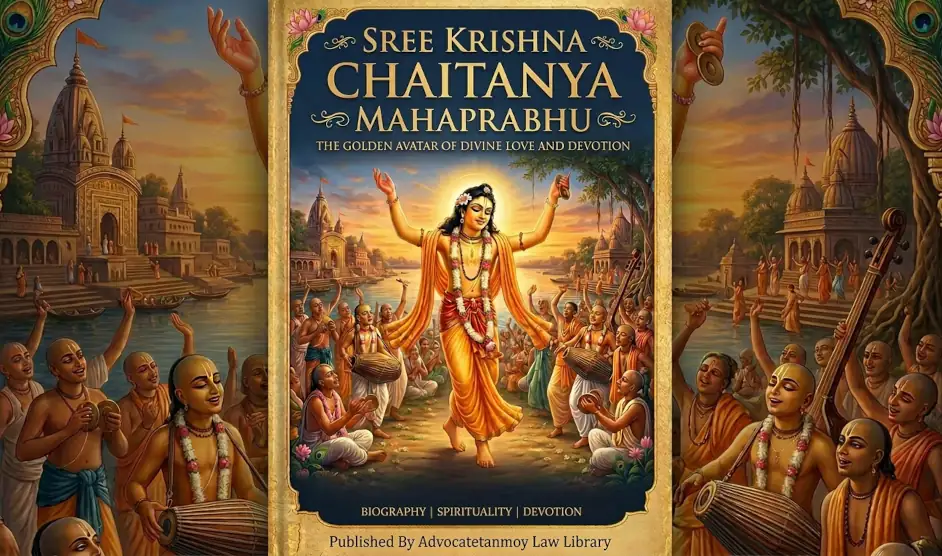
Encyclopedia of Sree Krishna Chaitanya Bharati
Krishna Chaitanya Mahaswami to Anandamath: The Evolution of Hindu Civilizational Consciousness
Krishna Chaitanya’s bhakti was itself a form of civilizational preparation, and Bankim’s Anandamath can be read as the later historical continuation of that preparation into knowledge, organisation and shakti. The important point is not to make Chaitanya an armed revolutionary retrospectively, but to recognise that his method of winning, absorbing and transforming human beings through bhakti created a moral-cultural field in which a later generation could conceive civilizational resistance differently.
The conclusion of Bankim Chandra Chattopadhyay’s Anandamath (1883) should be understood within a longer civilizational sequence in which Sri Krishna Chaitanya Bharati Mahaswami’s bhakti constituted the preparation of the moral and spiritual field, while Bankim’s Sannyasi Army and Santans represented a later stage in which that prepared field acquired the forms of organised shakti, knowledge and civilizational action.
Chaitanya’s method was fundamentally different from armed political resistance. He did not establish his religious movement through military conquest; his principal instrument was bhakti, through which he transformed individuals and communities and drew people into the Sanatana fold without the sword. The tradition surrounding Chaitanya preserves numerous instances of Muslims and people outside the established Brahmanical social order entering the devotional world created by the movement. The significance of this process is not merely numerical conversion. It was the creation of a new moral community, in which religious identity could become a living force of social integration without requiring political violence.
In this sense, Chaitanya’s achievement may be understood as the preparation of the civilizational ground upon which later forms of resistance could become possible. He awakened the society before asking it to become powerful. Bankim’s Anandamath begins from a later historical condition in which that spiritual awakening has to be translated into organised historical agency. The Mahapurusha of Anandamath is therefore intelligible, within this interpretative framework, as the literary embodiment of the continuing spirit of Sri Krishna Chaitanya Mahaswami: not Chaitanya as a military commander, which he historically was not, but Chaitanya as the spiritual principle that awakens a dormant civilisation and prepares it for a subsequent stage of responsibility. Bankim does not make bhakti weak by allowing it to precede shakti; he gives bhakti a historical consequence.
The emotional and devotional transformation associated with Chaitanya is not presented as the terminus of civilizational life but as its preparation. Once the moral field has been awakened, the subsequent generation may acquire education, knowledge, organisation, economic strength and, where historical circumstances demand it, military power. This is why Bankim’s Santans cannot be understood merely as an unrelated eighteenth-century band of rebels. In the conceptual architecture of Anandamath (the blissful abbot), they represent the emergence of shakti from a previously prepared spiritual consciousness. Their struggle against Muslim political authority is therefore not identical with Chaitanya’s method, but it may be interpreted as a later historical manifestation of a civilizational energy whose earlier form was bhakti. Chaitanya sought to transform human beings without the sword; Bankim’s Santans seek to transform the political condition of the country through organised resistance. The methods differ because the historical stages differ. Bhakti prepares the field; shakti acts upon the field. Yet Bankim deliberately prevents this progression from ending in mere militarism.
The Mahapurusha (the spirit of Chaitanya Bharati) ultimately stops Satyananda from continuing the cycle of bloodshed and teaches him that the destruction of Muslim political authority is not itself the completion of the national task. The deeper work is education, external knowledge, internal knowledge, agriculture, prosperity, social strength and the recovery of civilizational capacity. Here the Chaitanya and Bankim traditions meet at a deeper level: neither is satisfied with the mere possession of political power. Chaitanya’s method seeks transformation of the human person and community through devotion; Bankim’s conclusion seeks transformation of the nation through knowledge and disciplined strength. The movement is therefore not Bhakti versus Shakti, but Bhakti as preparation for Shakti and Shakti as the protector and executor of a civilizational consciousness already awakened by Bhakti.
The apparent contradiction between Chaitanya’s non-military method and Bankim’s martial Santans consequently disappears when the two are placed in a sequential rather than identical historical framework. Chaitanya does not need to have raised an army for Bankim’s Sannyasis to represent a later continuation of the spiritual awakening associated with him. The essential continuity lies in the awakening of the Motherland’s civilizational consciousness. Chaitanya awakened through love, devotion, congregational worship and spiritual identification; Bankim awakened through the image of the Mother, discipline, sacrifice, organised resistance and finally knowledge.
In both cases, the sleeping society is called back to a consciousness of its larger civilizational duty. That duty, however, cannot be reduced to the destruction of Islamic political rule. Bankim’s Mahapurusha makes this unmistakable: after the political enemy has been defeated, the Santans must cease killing because civilizational regeneration has a second and more difficult stage. A people must become knowledgeable, capable, prosperous and strong. The sword may remove an obstacle; it cannot by itself create a civilisation. Thus the conclusion of Anandamath completes rather than negates the martial symbolism of the Sannyasis.
Chaitanya’s bhakti prepared the moral field; Bankim’s Santans expressed its militant historical potential; the Mahapurusha redirected that potential toward knowledge and reconstruction. The sequence may therefore be expressed as Bhakti → Moral Awakening → Civilizational Consciousness → Shakti → Resistance → Knowledge → Reconstruction → Civilizational Capacity. Bankim’s profound contribution lies in refusing to regard devotional emotion as a politically useless feminine virtue. His bhakti is capable of becoming shakti (Bhakti in Action), but shakti must ultimately become jnana and constructive national capacity.
The final lesson of Anandamath is consequently neither that the sword is the highest instrument of national regeneration nor that devotion should remain detached from worldly power. It is that spiritual awakening, organised power and knowledge belong to successive dimensions of the same civilizational process. Chaitanya prepared the human and moral field without arms; the Santans, in Bankim’s historical imagination, represent the later emergence of armed and organised resistance; and the Mahapurusha finally teaches that even victory must yield to the higher work of educating and strengthening the nation. In this interpretation, the Chaitanya legacy does not end with devotional ecstasy. It becomes a civilizational inheritance capable of passing from bhakti to shakti and from shakti to jnana, until the awakened civilisation possesses the intellectual, moral, economic and political capacity to determine its own destiny.
Sarvarthapedia Cross-Referenced Conceptual Network: Chaitanya, Bhakti, Shakti and Anandamath
Core Concept: Civilizational Regeneration
The central concept connecting Sri Krishna Chaitanya Mahaprabhu, Bankim Chandra Chattopadhyay, and Anandamath is civilizational regeneration. The relevant sequence is not a simple transition from religion to politics, but a layered historical process:
Bhakti → Moral Awakening → Civilizational Consciousness → Shakti → Organised Action → Knowledge → Economic Reconstruction → Civilizational Capacity → Political Self-Determination
In this architecture, each stage prepares the conditions for the next. Bhakti transforms the human subject; civilizational consciousness transforms the collective; shakti converts consciousness into organised capacity; knowledge disciplines power; and economic and social reconstruction provides the material foundation for durable civilization.
Chaitanya Bharati as Sannyasi
Sri Krishna Chaitanya Bharati, a sannyasi as per Sankara`s Vedic tradition, occupies the first major node in this conceptual network. His historical method was not military conquest but bhakti, through which religious consciousness was intensified, communities were reorganised and individuals were incorporated into a wider devotional order.
The significance of Chaitanya for this network therefore lies in preparation rather than political conquest.
Chaitanya’s method may be conceptually linked to:
Bhakti → Individual Transformation → Moral Community → Cultural Integration → Civilizational Awakening
This creates the foundational distinction between awakening a civilization and politically controlling a state.
Bhakti as Civilizational Preparation
In the Sarvarthapedia framework, bhakti should not be reduced to passive emotion or a politically powerless devotional sentiment. Its significance lies in its capacity to transform allegiance, identity, social relationships, and moral consciousness.
Chaitanya’s method demonstrates a form of civilizational expansion that does not depend upon military force. The incorporation of people into the devotional community becomes part of the creation of a broader Sanatana moral-cultural field.
The conceptual relationship is:
Bhakti → Conversion of Consciousness → Formation of Community → Expansion of Civilizational Identity
This is the foundation upon which the later Bankimian conception of shakti can be placed.
Chaitanya’s Non-Military Method
The distinction between Chaitanya’s method and the later Sannyasi method must remain explicit.
Chaitanya did not establish his religious movement through an armed campaign. His principal instrument was devotion, spiritual attraction, congregational practice, and transformation of the individual.
Therefore:
Chaitanya ≠ Military Conquest
But equally:
Chaitanya ≠ Political Passivity
- Samkirtana Brigade
- Hare Krishna Army
His civilizational importance can instead be located in the preparation of the moral field from which later forms of collective agency could emerge.
Bhakti and Shakti
The central conceptual relationship is not:
Bhakti versus Shakti
but:
Bhakti → Shakti
Bhakti creates the moral motive; Shakti creates the capacity for action.
Bhakti answers:
Why should the civilization act?
Shakti answers:
How can the civilization act?
Knowledge subsequently answers:
Toward what end should that power be directed?
This produces the three-part architecture:
Bhakti = Motive
Shakti = Capacity
Jnana = Direction
Bankim Chandra Chattopadhyay
Bankim Chandra Chattopadhyay represents the next major node. His contribution is to transform devotional and civilizational consciousness into a literary theory of organised national action.
In Anandamath, Bankim does not simply reproduce Chaitanya’s method. He places the inherited spiritual consciousness into a substantially different historical situation and asks what happens when civilizational consciousness encounters political domination.
Thus:
Chaitanya → Spiritual Awakening
Bankim → Historical Organisation of Awakening
Anandamath
Anandamath functions as the principal literary bridge between spiritual consciousness and political action.
Its conceptual structure can be represented as:
Motherland → Bhakti → Sacrifice → Organisation → Armed Resistance → Political Transformation → Knowledge → Reconstruction
The crucial point is that the novel does not allow the sequence to terminate at armed resistance.
The battlefield is only an intermediate stage.
The Motherland
The Motherland is the symbolic centre connecting Chaitanya’s devotional consciousness with Bankim’s nationalist imagination.
In Chaitanya’s devotional universe, divine love provides the emotional and spiritual centre of collective identity.
In Bankim’s Anandamath, the Mother transforms that devotional structure into a civilizational and territorial symbol.
Thus:
Divine Devotion → Motherland Devotion → Civilizational Duty
The Mother therefore becomes more than territory. She represents civilization, culture, society, knowledge, prosperity and collective historical existence.
Vande Mataram
Vande Mataram occupies a crucial connecting node between Motherland, Bhakti and National Consciousness.
Its conceptual significance lies in transforming the relationship between the individual and the country from an administrative relationship into a devotional relationship.
The conceptual chain becomes:
Motherland → Sacred Identification → Devotion → Sacrifice → Collective Consciousness
This provides the emotional foundation for the Santan movement.
The Santans
The Santans represent the transition from devotional consciousness to organised historical action.
They are not simply soldiers. Within the conceptual structure of Anandamath, they represent a generation that has converted devotion into discipline and sacrifice into collective action.
Their position is therefore:
Bhakti → Devotion to Mother → Sacrifice → Organisation → Shakti
The Santans embody the martial potential of a previously awakened civilizational consciousness.
Sannyasi Army
The Sannyasi Army constitutes the organisational expression of this transition.
Its conceptual importance lies in combining apparently different categories:
Asceticism + Discipline + Devotion + Organisation + Military Capacity
The Sannyasi is therefore no longer merely the renouncer of worldly existence. In Bankim’s imagination, the ascetic becomes capable of sacrificing personal existence for a larger civilizational objective.
This creates the conceptual transformation:
Sannyasa → Self-Discipline → Collective Discipline → Civilizational Service
Shakti
Shakti (Vimala is the proper name in the Gaudiya tradition) forms the central bridge between Chaitanya’s spiritual preparation and Bankim’s militant historical imagination.
Shakti is not merely physical strength. It includes:
Moral Power
Collective Power
Organisational Power
Military Power
Intellectual Power
Economic Power
This broader meaning becomes especially important in the final conclusion, where military power is subordinated to knowledge and reconstruction.
Islamic Political Rule
The struggle against Muslim political authority constitutes the immediate political context of the Santan movement in the novel.
Within the conceptual network, however, the destruction of Muslim political rule cannot be treated as the final objective.
The progression is:
Political Enemy → Military Resistance → Political Transformation → Termination of Violence → Civilizational Reconstruction
This distinction is essential because Bankim’s Mahapurusha explicitly prevents the Santan struggle from becoming an endless programme of warfare.
The Mahapurusha
The Mahapurusha is the decisive intellectual node in the network.
He represents the principle that power must ultimately be governed by knowledge.
If the Santans embody shakti, the Mahapurusha embodies the higher ordering principle through which shakti receives its historical direction.
The relationship is:
Santans = Power
Mahapurusha = Direction of Power
Knowledge = Principle governing Power
This is why the Mahapurusha stops Satyananda after the political objective has been achieved.
The Mahapurusha and Chaitanya
Within this interpretative framework, the Mahapurusha may be read as the symbolic continuation of the Chaitanya principle.
This does not mean identifying the fictional Mahapurusha literally with the historical Chaitanya.
The connection is conceptual:
Chaitanya awakens
Mahapurusha directs
Santans act
Knowledge reconstructs
The Mahapurusha therefore carries forward the deeper principle of spiritual awakening while redirecting its historical expression from warfare toward knowledge and reconstruction.
Satyananda
Satyananda represents the stage at which bhakti has already become shakti but has not yet been fully subordinated to jnana.
He possesses:
Devotion
Courage
Sacrifice
Military Capacity
But he has not yet accepted the necessity of intellectual reconstruction.
His internal conflict therefore represents:
Shakti without sufficient Jnana
The Mahapurusha’s task is to resolve that imbalance.
Satyananda’s Transformation
Satyananda’s trajectory can be mapped as:
Bhakti → Martial Devotion → Political Victory → Resistance to Withdrawal → Encounter with Knowledge → Renunciation of Warfare → Civilizational Duty
His transformation is therefore not a rejection of devotion.
It is the education of devotion.
Knowledge
Knowledge becomes the decisive principle in the final conclusion of Anandamath.
Bankim’s Mahapurusha distinguishes between:
External Knowledge
and
Internal Knowledge
External knowledge concerns the apprehension and mastery of the material and observable world.
Internal knowledge concerns the deeper dimensions of existence, consciousness and religious understanding.
The relationship is explicitly sequential:
External Knowledge → Capacity for Internal Knowledge
The principle is:
The subtle cannot be adequately understood without first understanding the gross.
External Knowledge
External knowledge represents the knowledge of the world that the Mahapurusha believes India has lost or neglected.
It includes the broader field of:
Education → Science → Practical Knowledge → Administration → Material Understanding → Productive Capacity
This is the knowledge that, in the novel’s argument, must first be recovered.
Internal Knowledge
Internal knowledge represents the deeper intellectual and spiritual dimension of Sanatana Dharma.
It cannot be revived merely through ritual.
The sequence becomes:
External Knowledge → Intellectual Capacity → Internal Knowledge → Religious Regeneration
Thus Bankim connects education with religious regeneration rather than treating them as separate spheres.
British Rule as Historical Instrument
The controversial proposition concerning British rule belongs to this specific conceptual chain.
Within the narrative:
British Rule → English Education → External Knowledge → Intellectual Development → Internal Knowledge → Civilizational Regeneration
The British are therefore represented within the Mahapurusha’s argument as a historical instrument, not as the ultimate destiny of India.
This is why the conclusion should not be reduced either to colonial endorsement or to immediate Hindu sovereignty.
British Rule and Political Sovereignty
The conceptual distinction is:
Political Sovereignty ≠ Civilizational Capacity
The possession of political power without knowledge and social strength would remain incomplete.
The Mahapurusha therefore places:
Knowledge before Sovereignty
Capacity before Self-Government
Civilizational Strength before Political Establishment
Education
Education is the bridge between external knowledge and national regeneration.
The Sarvarthapedia network can therefore connect:
British Educational Encounter → Indian Learning → Intellectual Development → Scientific Knowledge → Civilizational Self-Capacity
The ultimate purpose is not permanent dependence but the creation of a population capable of becoming knowledgeable, virtuous and strong.
Agriculture and Economic Prosperity
The Mahapurusha’s command that the people return to agriculture introduces the economic dimension of civilizational regeneration.
The sequence is:
End of War → Agricultural Production → Food Security → Prosperity → Social Stability → Civilizational Strength
This prevents the concept of nationalism from becoming exclusively military.
The Motherland must not merely be liberated.
She must become productive and prosperous.
War and Reconstruction
The conclusion establishes a decisive boundary:
War can destroy political obstacles.
War cannot by itself build civilization.
Therefore:
Military Power → Political Change
but:
Knowledge + Agriculture + Education + Organisation → Civilizational Reconstruction
This is the reason the Mahapurusha terminates Satyananda’s military mission.
Bhakti, Shakti and Jnana
The entire network can be condensed into the triad:
Bhakti → Shakti → Jnana
Bhakti provides devotion.
Shakti provides capacity.
Jnana provides direction.
But the sequence does not end with knowledge alone:
Jnana → Reconstruction → Civilizational Capacity
The complete model is therefore:
Bhakti → Shakti → Jnana → Reconstruction
Chaitanya and Bankim as Sequential Civilizational Stages
The relationship between Chaitanya and Bankim should not be constructed as historical identity.
It is better understood as civilizational succession.
Chaitanya’s historical method: transform consciousness through bhakti.
Bankim’s literary method: transform awakened consciousness into organised civilizational action.
Thus:
Chaitanya prepares the moral field.
Bankim dramatises its political and civilizational consequences.
Conversion and Civilizational Expansion
The tradition of Muslims entering Chaitanya’s devotional world is relevant to this network because it demonstrates a form of civilizational expansion without military conquest.
The conceptual contrast is:
Chaitanya → Winning persons through Bhakti
Sannyasi Army → Resisting political domination through Shakti
This distinction prevents the two historical methods from being confused while allowing their civilizational relationship to be explored.
Moral Field
The concept of the moral field is one of the most important additions to the Sarvarthapedia architecture.
Before a civilization can act collectively, it must possess a shared conception of:
Sacred Duty
Moral Identity
Collective Belonging
Civilizational Responsibility
Chaitanya’s bhakti can therefore be positioned as a process of moral-field formation.
Bankim’s Santans subsequently operate within a literary representation of an awakened field.
Civilizational Duty
The concept of civilizational duty connects Chaitanya, Bankim and the Motherland.
Civilizational duty progresses through several stages:
Awakening → Preservation → Resistance → Education → Reconstruction → Renewal
The destruction of an opposing political order is therefore only one possible stage of civilizational duty.
Masculine Power and Bhakti
Within this framework, bhakti should not be categorised as a gendered or politically passive virtue.
Its apparent emotionality does not eliminate power.
The Sarvarthapedia conceptual distinction should instead be:
Bhakti = Devotional Energy
Shakti = Organised Energy
Jnana = Directed Energy
The transition from one to another is therefore a transformation of form, not a rejection of the original spiritual energy.
Sannyasa and Political Action
The Sannyasi represents another important conceptual intersection.
Traditional renunciation might appear to imply withdrawal from worldly action. Bankim reverses that assumption by transforming renunciation into discipline for collective service.
Thus:
Renunciation of Self → Discipline of Self → Service to Motherland
The Sannyasi’s detachment from personal interest becomes the basis for extraordinary commitment to collective purpose.
Motherland and Civilization
The Motherland in Anandamath must be connected simultaneously to:
Territory
Culture
Religion
People
Agriculture
Knowledge
Economic Prosperity
Political Destiny
The Mother is therefore not merely a geographical metaphor. She becomes the integrating concept of civilizational existence.
Political Power and Civilizational Power
The network requires a distinction between two forms of power.
Political Power means control over the state.
Civilizational Power means the accumulated capacity of a society to produce knowledge, wealth, institutions, culture, social order and collective purpose.
The final conclusion of Anandamath gives priority to the second.
The Unintended Historical Consequence
Another major conceptual node is historical unintended consequence.
The Santans fight with one objective but produce a different historical result.
Their intention:
Resist Political Domination
Their consequence within the Mahapurusha’s explanation:
Facilitate British Political Consolidation
This creates a broader Sarvarthapedia principle:
Historical Action ≠ Historical Outcome
Civilizations often enter historical transformations through consequences that their actors did not consciously intend.
Renunciation
Renunciation is the final corrective principle.
It does not mean:
Abandonment of the Motherland
It means:
Abandonment of an obsolete or premature method of serving the Motherland
Satyananda must renounce:
Continuous Warfare
so that he can undertake:
Knowledge and Reconstruction
Establishment
Establishment represents the political objective Satyananda seeks.
But Bankim’s conclusion establishes a hierarchy:
Establishment without Capacity = Premature
Capacity without Knowledge = Unstable
Knowledge without Moral Purpose = Incomplete
Knowledge + Moral Purpose + Strength + Prosperity = Civilizational Capacity
The Final Formula
The complete Sarvarthapedia conceptual network may therefore be represented as:
Chaitanya Mahaprabhu
↓
Bhakti
↓
Moral and Spiritual Field
↓
Civilizational Consciousness
↓
Motherland Consciousness
↓
Bankim Chandra
↓
Anandamath
↓
Sannyasi Army
↓
Santans
↓
Shakti
↓
Resistance
↓
Political Transformation
↓
Mahapurusha
↓
Renunciation of Continuous Warfare
↓
External Knowledge
↓
Education
↓
Internal Knowledge
↓
Moral and Intellectual Regeneration
↓
Agriculture and Economic Prosperity
↓
Social Strength
↓
Civilizational Capacity
↓
Future Political Self-Determination
Core Sarvarthapedia Proposition
The entire network can ultimately be reduced to one proposition:
Chaitanya’s bhakti awakened the moral field; Bankim’s Santans represented the later emergence of organised shakti from that awakened field; and the Mahapurusha’s final teaching transformed shakti into knowledge-directed civilizational reconstruction.
The historical and conceptual sequence is therefore not Bhakti versus Power, but:
Bhakti → Awakening → Shakti → Knowledge → Reconstruction → Civilizational Self-Capacity.
See Also: Primary Knowledge Cluster
Chaitanya Mahaprabhu
Connects to Bhakti, Gaudiya Vaishnavism, Moral Community, Spiritual Awakening, Religious Integration, Civilizational Consciousness, and Bankim Chandra’s reinterpretation of devotional energy.
Bankim Chandra Chattopadhyay
Connects to Anandamath, Vande Mataram, Motherland, Sannyasi Army, Santans, Sanatana Dharma, National Regeneration, External Knowledge, and Civilizational Nationalism.
Anandamath
Connects to Chaitanya Legacy, Sannyasi Rebellion, Motherland, Vande Mataram, Satyananda, Mahapurusha, British Rule, Knowledge, Civilizational Regeneration, and Political Sovereignty.
Satyananda
Connects to Bhakti, Shakti, Sannyasa, Military Resistance, Motherland, Sacrifice, Political Establishment, and the transition from Action to Knowledge.
Mahapurusha
Connects to Chaitanya Principle, Jnana, Renunciation, Civilizational Strategy, External Knowledge, Internal Knowledge, Education, Reconstruction, and Future Capacity.
Sannyasi Army
Connects to Sannyasa, Discipline, Shakti, Organised Resistance, Civilizational Duty, Motherland, and Anandamath.
Bhakti
Connects to Chaitanya, Moral Transformation, Civilizational Awakening, Community Formation, Motherland Consciousness, Shakti, and Jnana.
Shakti
Connects to Sannyasi Army, Santans, Political Resistance, Military Capacity, Organisation, Economic Strength, Knowledge, and Civilizational Power.
Jnana
Connects to External Knowledge, Internal Knowledge, Education, Science, Moral Reason, Civilizational Regeneration, and the final transformation of Shakti into constructive capacity.
Civilizational Regeneration
Connects all principal clusters:
Chaitanya → Bhakti → Moral Awakening
Bankim → Anandamath → Shakti
Mahapurusha → Jnana → Reconstruction
Motherland → Economic Prosperity → Civilizational Capacity
Civilizational Capacity → Political Self-Determination
This makes Civilizational Regeneration the central Sarvarthapedia node from which the Chaitanya, Bankim, Anandamath, Bhakti, Shakti, Jnana, Motherland, Education, Economy, and Political Sovereignty clusters can be cross-referenced as parts of a single conceptual architecture.