The Law of Manu in Ancient India
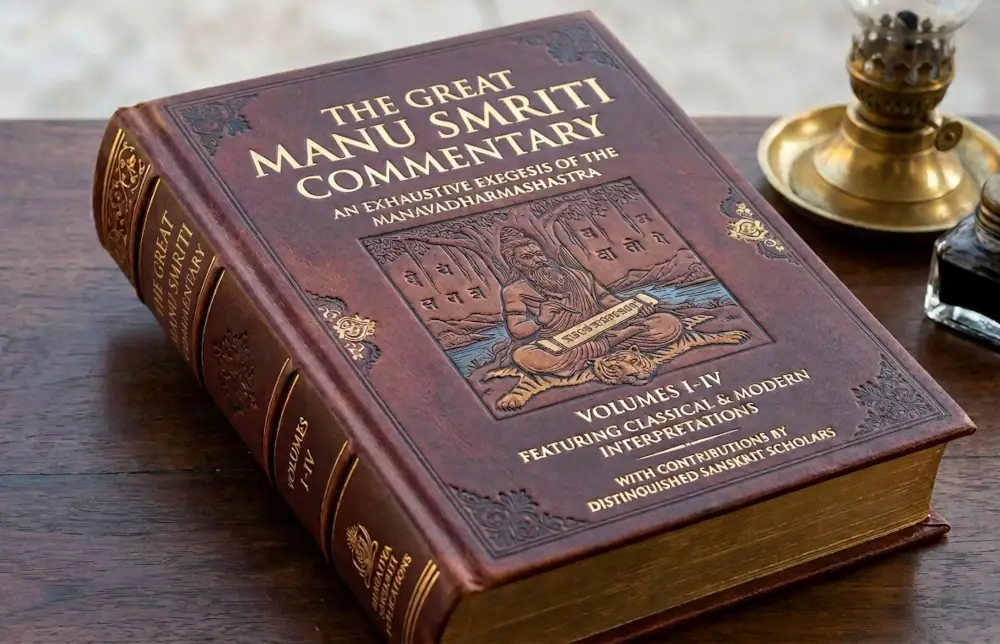
The Law of Manu, commonly known as Manu Smriti or Manusmriti (12-Volume), is one of the most well-known ancient texts associated with legal, social, and moral principles in early Indian civilization. Traditionally attributed to the ancient sage Manu, who is considered the progenitor of humankind in Hindu tradition, the text has long been discussed in relation to Dharma, or the moral and social duties that guide human life. The Manusmriti occupies an important place within the broader body of Dharmashastra literature, which attempted to explain the ethical, legal, and social responsibilities of individuals within society. Although its historical interpretation has been debated among scholars, the concept of dharma and the idea of social regulation through moral principles remain central themes associated with the tradition of Manu.
According to ancient Indian tradition, Manu is regarded as the first lawgiver of humanity, much like legendary lawgivers in other civilizations. In Hindu cosmology, Manu is described as the wise ruler who survived a great flood (6000 BCE) and later organized or remodeled human society by establishing principles of governance, justice, and ethical conduct. The earliest ideas connected with Manu appear in ancient Vedic literature, especially in texts composed between 1500 BCE and 1000 BCE, where Manu is portrayed as a Prajapati and a teacher of social order. Over time, traditions associated with Manu developed into a body of teachings on law, morality, and social organization.
The text known today as Manu Smriti is generally believed to have been compiled sometime between 200 BCE and 200 CE, although its exact date remains debated among historians and philologists. It belongs to the Dharmashastra tradition, which attempted to systematize legal and ethical norms for society. These texts were not statutory law codes in the modern sense but rather guidelines describing ideal social behavior, moral duties, and principles of governance. They discussed subjects such as family life, property rights, inheritance, marriage, education, and punishment for wrongdoing.
The Manusmriti presents a vision of society organized around the concept of Dharma, which can be understood as a combination of moral duty, social responsibility, and ethical conduct. According to this framework, each person was expected to perform duties appropriate to their stage of life and social responsibilities. The emphasis on duty rather than individual rights distinguished ancient Indian legal thought from many later legal traditions. The goal was to maintain harmony within society by encouraging individuals to follow ethical principles. The same principle has been adopted by the Koutilya Chanakya in the Artha Shastra.
The text also discusses the responsibilities of rulers and the administration of justice. It describes how a king should govern his kingdom with fairness and discipline, ensuring that law and order are maintained. The ruler was expected to protect citizens, collect taxes responsibly, and punish crimes in a manner consistent with moral and social order. The king was seen as the guardian of dharma, responsible for maintaining balance within the kingdom.
Many ancient cities and regions in India were associated with the development and interpretation of the Dharmaśāstra literature. Important centers of learning and intellectual debate included Kashi (Varanasi), Ujjain, Pataliputra, Takshashila, Kanchipuram, and Mithila. These cities were known for their scholarly traditions, where Brahmin scholars studied scriptures, philosophy, law, and grammar. Over centuries, scholars in these centers analyzed and commented on texts like the Manusmriti, interpreting them in relation to changing social conditions.
For example, Kashi (Varanasi) became one of the most important centers for the study of Dharmashastra and Hindu law. Scholars there produced numerous interpretations of ancient legal texts and influenced later traditions of Hindu jurisprudence. Similarly, Mithila in present-day Bihar became known for its scholars who specialized in interpreting classical Sanskrit texts. These centers helped preserve and transmit the intellectual traditions associated with Manu and other lawgivers.
The Manusmriti also inspired a long tradition of scholarly commentaries. Over the centuries, many scholars wrote explanations and interpretations of the text in order to clarify its meaning. Among the most influential commentators was Medhatithi around the 9th century CE, whose commentary remains one of the earliest surviving interpretations of the Manusmriti. Medhatithi analyzed the verses in detail and attempted to reconcile them with broader philosophical ideas about dharma.
Another important commentator was Govindaraja, who lived around the 11th century CE and wrote explanations emphasizing legal and social interpretations. Later scholars such as Kulluka Bhatta in the 15th century CE produced influential commentaries that became widely circulated in manuscript form. Kulluka Bhatta’s interpretation eventually became one of the most commonly printed versions of the Manusmriti in later centuries. These commentaries demonstrate that the text was never static but constantly interpreted and reinterpreted by scholars over time.
The Manusmriti also contains discussions about ethics, education, family relations, and moral discipline. It describes the importance of self-control, truthfulness, respect for teachers, and compassion toward others. Students were expected to study under the guidance of a teacher in a traditional gurukula system, where education emphasized both intellectual knowledge and moral development. The goal was to create individuals who would contribute positively to society.
Another major theme in the text is the concept of stages of life, known as the ashrama system. According to this idea, human life was divided into four stages: student life, household life, retirement, and spiritual renunciation. Each stage had specific duties and responsibilities. This system reflected the belief that human life should progress through stages of learning, family responsibility, social service, and spiritual reflection.
The Manusmriti also contains legal provisions related to inheritance, contracts, and dispute resolution. Courts were expected to consider evidence, witness testimony, and customary practices when deciding cases. Punishments were described as a means to maintain social stability and discourage harmful behavior. The ultimate goal of justice in this system was to preserve social harmony rather than simply impose penalties.
Modern scholars have also debated the historical authenticity of the text and its various versions. Over centuries, the Manusmriti survived through handwritten manuscripts copied by scribes in different regions of India. Because manuscripts were copied repeatedly, variations and modifications could occur over time. Some scholars argue that the earliest version of the Manu Samhita may have been different from the text available today, and that later additions and interpolations could have changed certain passages.
It has also been suggested by some writers that the original ancient Manu Samhita may have been lost, and that the present versions of Manusmriti are based on manuscripts that were edited, interpolated and interpreted during later historical periods. During the colonial period in India, European scholars and administrators studied Sanskrit texts in order to understand Indian society and law. Some critics argue that certain colonial adulterations and interpretations of the Manusmriti discovered divisions within Hindu society, particularly in relation to caste and social hierarchy. According to these viewpoints, later editions and translations may have highlighted or interpreted specific passages in ways that influenced social perceptions during the colonial era.
Because of these debates, historians and scholars today often approach the Manusmriti with careful analysis, comparing multiple manuscripts and commentaries in order to understand its historical development. The text is therefore studied both as a historical document and as part of a larger tradition of evolving legal and philosophical thought.
The influence of the Manusmriti also extended beyond India in intellectual comparisons with other ancient legal systems. Scholars often compare it with legal traditions such as the Code of Hammurabi around 1754 BCE in ancient Babylon. Both systems attempted to regulate social behavior and establish guidelines for justice. However, the approaches differed in emphasis. The Code of Hammurabi focused on explicit legal penalties and administrative law, while the Manusmriti placed stronger emphasis on moral duty and social ethics within the framework of dharma. These comparisons illustrate how different civilizations developed their own approaches to law and social organization.
Despite controversies and debates surrounding its interpretation, the Manusmriti remains an important historical text for understanding the intellectual and social history of ancient India. It reflects the efforts of early scholars to define principles of justice, governance, and ethical behavior within a complex and evolving society. The text also shows how law, religion, philosophy, and social norms were closely interconnected in ancient Indian thought.
The Law of Manu or Manusmriti, lastly edited by someone from the Bhrigu clan much before 600 CE, the last part of the Neo-Vedic Civilization, represents one of the most discussed texts within the Dharmashastra tradition of ancient India. Centers of learning such as Kashi, Ujjain, Mithila, Pataliputra, Takshashila, and Kanchipuram played important roles in preserving and interpreting the Smriti Tradition. Influential commentators, including Medhatithi (9th century CE), Govindaraja (11th century CE), and Kulluka Bhatta (15th century CE) contributed to the understanding of the text across centuries. Debates continue about the authenticity of different versions, with some scholars suggesting that the original Manu Samhita may have been lost and that surviving manuscripts contain later interpolations and reinterpretations.
Who was King Manu?
The concept of Smriti, meaning the remembrance of Dharma (धर्म) from time immemorial, reflects the deep-rooted nature of ancient Indian social and moral principles. The sophistication of ancient societies cannot always be measured by modern standards, and therefore, the age of King Manu remains an enduring mystery in Indian tradition.
The historical period of King Manu and other ancient rulers, such as King Mandhata, continues to inspire interest among scholars and believers alike. According to traditional accounts, Manu belonged to a period much earlier than Krishna Dvaipayana Vyasa, the illustrious son of Satyavati and compiler of the Vedas. In the Bhagavad Gita, Lord Krishna speaks of the ancient transmission of spiritual wisdom through Manu and other royal sages, thereby recognizing Manu’s position as a great teacher of Dharma and a knower of Brahma. A few Vedic texts also remember Manu as one of the earliest lawgivers and founders of civilization.
It is possible to consider that Manu was not merely a single individual, but a symbol representing generations of sages and lawmakers who established laws and equitable systems for society. Through centuries of social change, different classes and communities participated in shaping civilization. Therefore, the Manusmriti cannot be viewed solely as the work of any single social group; rather, it may be understood as a text that evolved through changing historical circumstances while preserving the ideals of order and duty.
The influence of the Manusmriti on Indian society is undeniable. Many rulers from diverse backgrounds accepted Manu (आर्षं धर्मोपदेशं) as an authority on law and governance. Historical traditions mention rulers such as Sivaji, Avanti Varman, Raja Chintamoni Dhoba, Raja Mayurdhwaj, Raja Suheldev, Raja Satan Pasi, Raja Niladhwaj, Maharaja Laxmi Narayan, and Malharrao Holkar I, who are said to have governed according to principles associated with Manu and Dharma.
By following these principles, generations of rulers contributed to the continuity of Vedic civilization. The preservation of Vedic chants and the practice of Vedanta ensured that this civilization survived through centuries, distinguishing it from many ancient civilizations that gradually disappeared. The enduring influence of the Manusmriti is therefore often seen as one of the factors behind the continuity of India’s intellectual and spiritual traditions.
Ironically, some neo-Buddhists may not love Manu, or some perverted (झल्ला मल्ला नटाश्चैव पुरुषाः) may burn a copy of Manusmriti, but they would not get a single sudra or Dalit in Pakistan, Afghanistan, Kazakhstan, Kyrgyzstan, Maldives, Malaysia, and Indonesia. When Buddhist people forgot the rule of Manu, they lost forever.
It is also acknowledged that, unlike the Vedas, the Manu Smriti has not survived entirely in its original form. The present Bhrigu recension (600 BCE) has undergone modifications, interpolations, and re-editions over centuries. Yet, despite these textual changes, the central ideals associated with Manu have endured (शृणु कर्मयोगस्य निर्णयम्). The spirit of कर्मयोग, righteous conduct, and the principle expressed in the verse, “यः सर्वभूतेषु पश्यत्यात्मानमात्मना, स सर्वसमतामेत्य ब्रह्माभ्येति परं पदम्”—he who sees himself in all beings attains equality and reaches the Supreme Brahman—continues to symbolize the enduring philosophical legacy associated with King Manu. (See the Sanskrit Text of Manu Smriti).
मनुस्मृति (The Ancient Code of Manu): Commentary by Tanmoy Bhattacharyya
भृगुप्रोक्त मानवं धर्मशास्त्रम्
Chapter -1
Chapter -2
Chapter -3
Chapter -4
Chapter -5
Chapter -6
Chapter -7
Chapter -8
Chapter -9
Chapter -10
Chapter -11
Chapter -12
See also
Sarvarthapedia Conceptual Network: The Law of Manu and the Dharmic Knowledge Web
Core Concept
Manu
- Connected to: Dharma
- Connected to: Yagyavalka Smriti
- Connected to: Smriti Tradition
- Connected to: Social Order
- Connected to: Kingship
- Connected to: Flood Tradition
- Connected to: Prajapati
- Connected to: Brahma Knowledge
See also: Dharma, Manusmriti, Smriti, Vedic Civilization, Prajapati, Rajadharma
Manusmriti
The central Dharmashastra text traditionally associated with Manu.
Connected to:
- Dharma
- Dharmashastra
- Social Ethics
- Rajadharma
- Ashrama System
- Justice
- Inheritance Law
- Education
- Family Ethics
- Moral Discipline
See also: Dharma, Dharmashastra, Ashrama, Gurukula, Rajadharma, Justice
Dharma
The organizing principle of moral duty, social responsibility, righteousness, and ethical conduct.
Connected to:
- Manu
- Manusmriti
- Rajadharma
- Karma Yoga
- Ashrama System
- Social Harmony
- Justice
- Vedanta
See also: Karma Yoga, Rajadharma, Vedanta, Social Ethics, Ashrama
Smriti Tradition
The body of remembered teachings that explain Dharma in practical life.
Connected to:
- Manu
- Manusmriti
- Dharmashastra
- Bhrigu Tradition
- Sanskrit Literature
- Jurisprudence
See also: Shruti, Dharmashastra, Manusmriti, Sanskrit Literature
Dharmashastra
The classical body of texts concerning law, ethics, duties, and governance.
Connected to:
- Manusmriti
- Yajnavalkya Smriti
- Narada Smriti
- Dharma
- Jurisprudence
- Rajadharma
See also: Manusmriti, Smriti Tradition, Rajadharma, Dharma
Rajadharma
The duties and responsibilities of rulers according to Dharma.
Connected to:
- Manu
- Kingship
- Justice
- Taxation
- Protection of Citizens
- Governance
- Arthashastra
See also: Arthashastra, Dharma, Justice, Kingship
Arthashastra
The science of governance and statecraft associated with Kautilya.
Connected to:
- Rajadharma
- Manu
- Governance
- Taxation
- Justice
- Statecraft
See also: Rajadharma, Kingship, Justice, Political Philosophy
Justice
The preservation of order through law, ethics, and social responsibility.
Connected to:
- Dharma
- Rajadharma
- Manusmriti
- Courts
- Witness Testimony
- Punishment
- Social Harmony
See also:
Law, Dharma, Rajadharma, Social Order
Social Order
The harmonious functioning of society through duties and moral conduct.
Connected to:
- Dharma
- Manu
- Manusmriti
- Justice
- Family Ethics
- Ashrama System
See also:
Dharma, Justice, Family Ethics, Ashrama
Ashrama System
The four stages of life designed to harmonize personal and social development.
Student life devoted to education and discipline.
Connected to:
- Gurukula
- Education
- Self-Control
- Teachers
See also: Gurukula, Education
Grihastha
The householder stage emphasizes family and social responsibility.
Connected to:
- Marriage
- Family Ethics
- Inheritance
- Social Order
See also: Family Ethics, Inheritance
Vanaprastha
Gradual retirement from worldly duties.
Connected to:
- Reflection
- Spiritual Development
- Dharma
See also:
Sannyasa, Vedanta
Sannyasa
The stage of renunciation and spiritual realization.
Connected to:
- Vedanta
- Brahman
- Self-Knowledge
- Dharma
See also:
Vedanta, Brahman
Gurukula
Traditional educational institution emphasizing knowledge and character.
Connected to:
- Vedic Civilization
- Aryas
- Dharma
- Moral Discipline
- Sanskrit Learning
See also: Education, Ashrama, Dharma
Moral Discipline
Cultivation of ethical virtues.
Connected to:
- Truthfulness
- Self-Control
- Compassion
- Dharma
- Education
See also:
Ethics, Dharma, Gurukula
Family Ethics
Principles governing family responsibilities and relationships.
Connected to:
- Marriage
- Inheritance
- Grihastha
- Dharma
- Social Order
See also:
Inheritance, Grihastha, Social Order
Inheritance Law
Rules governing succession and property.
Connected to:
- Family Ethics
- Justice
- Courts
- Dharma
See also:
Justice, Family Ethics
Courts and Jurisprudence
Institutions responsible for dispute resolution.
Connected to:
- Justice
- Witness Testimony
- Evidence
- Punishment
- Dharma
See also:
Justice, Rajadharma, Law
Karma Yoga
The philosophy of righteous action performed according to Dharma.
Connected to:
- Dharma
- Manu
- Duty
- Selflessness
- Social Harmony
See also:
Vedanta, Dharma, Moral Discipline
Vedanta
The philosophical tradition emphasizing ultimate reality and self-knowledge.
Connected to:
- Brahman
- Sannyasa
- Dharma
- Karma Yoga
- Manu
See also:
Brahman, Karma Yoga, Sannyasa
Brahman
The supreme reality in Indian philosophical thought.
Connected to:
- Vedanta
- Self-Knowledge
- Sannyasa
- Manu
See also:
Vedanta, Self-Knowledge
Bhrigu Tradition
The recension and transmission lineage associated with Manusmriti.
Connected to:
- Manusmriti
- Smriti Tradition
- Sanskrit Manuscripts
- Commentarial Tradition
See also:
Manusmriti, Smriti, Sanskrit Literature
Commentarial Tradition
The scholarly interpretation and preservation of Manusmriti.
Medhatithi
Connected to:
- Manusmriti
- Dharma
- Philosophy
- Jurisprudence
Govindaraja
Connected to:
- Manusmriti
- Law
- Social Ethics
Kulluka Bhatta
Connected to:
- Manusmriti
- Bhrigu Tradition
- Sanskrit Manuscripts
See also:
Bhrigu Tradition, Manusmriti, Dharmashastra
Centers of Learning
Kashi
Connected to:
- Dharmashastra
- Hindu Law
- Sanskrit Scholarship
Mithila
Connected to:
- Jurisprudence
- Sanskrit Commentaries
Takshashila
Connected to:
- Education
- Philosophy
- Statecraft
Ujjain
Connected to:
- Astronomy
- Philosophy
- Dharmashastra
Pataliputra
Connected to:
- Governance
- Political Thought
Kanchipuram
Connected to:
- Sanskrit Learning
- Vedanta
See also:
Education, Dharmashastra, Vedanta, Jurisprudence
Comparative Ancient Law
Code of Hammurabi
Connected to:
- Justice
- Legal Codes
- Social Regulation
- Comparative Law
Compared with:
- Manusmriti
- Dharmashastra
See also:
Manusmriti, Justice, Ancient Law
Vedic Civilization
The broader civilizational framework within which Manu and Dharma evolved.
Connected to:
- Manu
- Dharma
- Smriti
- Vedanta
- Gurukula
- Rajadharma
- Karma Yoga
See also:
Dharma, Vedanta, Manusmriti, Smriti Tradition, Gurukula, Rajadharma.