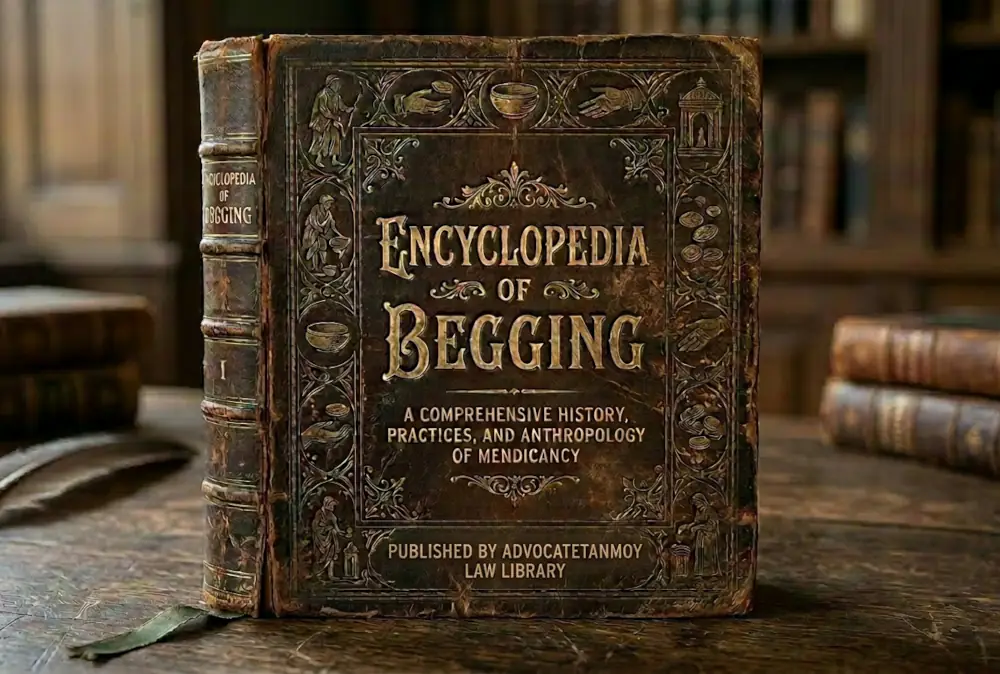
A study of dependency systems, resource extraction systems, and civilizational decline mechanisms.
Why do individuals, institutions, religions, corporations, and states become dependent on extracting resources from others instead of generating them through productive capacity?
A civilizational pathology
The Encyclopedia of Begging: A Global History of Asking, Giving, and Resource Acquisition begins from a simple observation that has been hidden in plain sight throughout human history: every society develops institutions, rituals, professions, and systems whose central function is the acquisition of resources from others. The conventional image of the beggar—a poor individual extending a hand in a marketplace, at a temple gate, or beside a road—captures only one small and highly visible part of a much larger phenomenon. This encyclopedia, therefore, adopts a broader analytical framework in which begging is understood not merely as the solicitation of money by the poor, but as the universal human practice of obtaining resources through appeal, persuasion, obligation, influence, authority, emotion, belief, law, or power.
The first task of such an inquiry is to challenge a deeply rooted assumption. Modern societies typically reserve the word begging for those who possess little power, little wealth, and little social prestige. The street beggar is recognized immediately because his request is direct, visible, and often stripped of social ornament. Yet when similar acts are performed by institutions endowed with authority, prestige, or legitimacy, different vocabularies emerge. The church receives an offertory; the charity conducts a fundraising campaign; the university seeks alumni support; the politician requests campaign contributions; the corporation promotes subscriptions; the state collects taxes; the nation negotiates foreign aid; the debtor government appeals to international lenders. The language changes, the social status changes, and the degree of compulsion changes, yet the fundamental process remains recognizable: resources are being transferred from one party to another.
Human civilization is built not only on production and exchange, but also on organized systems of asking. Every society develops institutions that persuade, compel, inspire, shame, reward, or obligate others to transfer resources.
The encyclopedia does not claim that all forms of asking are morally equivalent. To equate taxation with alms-seeking, or philanthropy with extortion, would be analytically careless. Rather, the objective is to study the entire spectrum of resource acquisition without allowing conventional labels to obscure structural similarities. A person seeking a coin, a religious institution seeking donations, and a government seeking revenue operate within different legal and moral frameworks, yet all participate in what may be called the economy of solicitation.
The historical roots of this economy extend far beyond recorded civilization. In biological terms, solicitation precedes humanity itself. Young animals signal their need to their parents. Dependent organisms develop mechanisms for attracting support. Human infants arrive in the world incapable of survival without continuous appeals directed toward caregivers. Long before the invention of money, taxation, charity, or religion, there existed the primordial act of asking. From this perspective, begging is not an aberration of civilization but one of its foundational conditions.
As societies grew more complex, solicitation became institutionalized. Ancient temples accumulated wealth through offerings. Priestly classes were supported by contributions from believers. Monarchs demanded tribute. Empires established taxation systems. Merchant organizations sought patronage. Religious traditions developed elaborate doctrines concerning charity, almsgiving, tithes, and donations. The sacred and the economic became deeply intertwined. Whether in monasteries, mosques, temples, churches, or pilgrimage centers, the transfer of resources was frequently represented as a moral, spiritual, or communal obligation rather than a simple financial transaction.
The modern world did not diminish these processes; it multiplied them. The rise of democratic politics created vast systems of electoral fundraising. Political campaigns learned to transform ideology into revenue streams. Public figures appeal not only for votes but also for contributions, memberships, and recurring financial support. Simultaneously, corporations refined the science of persuasion through advertising, subscription models, loyalty programs, and brand communities. In the digital age, solicitation has become nearly continuous. Websites request donations. Content creators seek subscriptions. Influencers ask for engagement. Crowdfunding platforms transform personal appeals into global campaigns. The internet has not eliminated begging; it has democratized and technologized it.
Particularly significant is the emergence of what this encyclopedia terms the begging of the powerful. Traditional discourse assumes that begging is an activity of the weak. Yet history repeatedly demonstrates that powerful institutions are often among the most sophisticated practitioners of resource acquisition. Governments seek taxes and loans. International organizations seek contributions. Corporations seek subsidies and bailouts. Universities seek endowments. Religious organizations seek donations. Celebrities seek attention. Nations seek strategic assistance. The distinction between the powerless petitioner and the powerful solicitor becomes increasingly difficult to sustain.
This observation introduces one of the central themes of the encyclopedia: the relationship between need and power. Some forms of solicitation arise from genuine necessity. Others emerge from ambition, expansion, or strategic calculation. The poor person requesting food seeks survival. The state seeking revenue may seek governance, infrastructure, military strength, or administrative continuity. The corporation seeking investment seeks growth. The political movement seeks influence. The religious institution seeks permanence. Each case involves resource acquisition, yet the motives, methods, and consequences differ substantially.
Equally important is the recognition that money represents only one category of resource. Human beings constantly seek intangible forms of wealth. Individuals ask for love, attention, recognition, forgiveness, admiration, companionship, knowledge, prestige, and meaning. Social media has revealed the scale of attention-seeking behavior in contemporary societies, but the phenomenon itself is ancient. Courts, salons, universities, academies, and religious communities have long functioned as arenas in which individuals competed for recognition and approval. Many forms of emotional life may be interpreted as exchanges of symbolic resources rather than material goods.
Thus, the encyclopedia expands its scope beyond economic transfers to include emotional begging, intellectual begging, status begging, bureaucratic begging, artistic patronage, and existential solicitation. Students seek knowledge. Scholars seek citations. artists seek patrons. Lovers seek affection. Citizens seek permits. Believers seek divine intervention. Prayer itself may be understood as a specialized form of appeal directed toward a transcendent authority. In each case, a desired resource is requested from another source believed capable of providing it.
The significance of this project lies not merely in cataloguing examples but in constructing a general theory of resource acquisition. Such a theory must explain why people give, why institutions ask, why some requests are celebrated while others are stigmatized, and how power transforms perceptions of legitimacy. It must examine the psychological mechanisms of sympathy, guilt, reciprocity, obligation, hope, fear, admiration, and trust. It must analyze the technologies of persuasion employed by religions, governments, charities, businesses, and individuals. Above all, it must investigate the social processes through which certain forms of asking become honorable while others become shameful.
This Sarvarthapedia Introduction suggested by this encyclopedia is neither cynical nor sentimental. Human civilization is not merely a system of production and exchange. It is also a system of requests. Every person alternates between giver and receiver. Every institution depends upon support from others. Every society develops mechanisms through which resources move from one set of hands to another. The history of civilization may therefore be read, in part, as the history of humanity’s evolving methods of asking, persuading, collecting, contributing, funding, taxing, donating, sponsoring, subsidizing, and believing. The humble beggar at the roadside and the powerful institution commanding vast revenues occupy different positions within this history, yet both participate in a universal and enduring human activity: the pursuit of resources through appeal.
Having said so, Sarvarthapedia does not place The Encyclopedia of Begging: A Global History of Asking, Giving, and Resource Acquisition within Area 1, where the foundational architecture of reality, knowledge, civilization, and human existence is established. Nor does Sarvarthapedia classify the subject under its Systemic and Systematic domains, for begging neither constitutes an ontological category nor provides an epistemic foundation within the Sarvarthapedia framework. It is not a first principle, a civilizational constant, or a foundational explanatory structure comparable to those examined in Architects of Civilization: 100 Foundational Minds Behind Human Society or Good Life (3-Volume): An Encyclopedia of Everything Humanity Seeks When It Speaks of “a Better Life.” Rather, Sarvarthapedia approaches the subject as a derivative and historical phenomenon, to be studied in conjunction with Encyclopedia of Historical Critiques of Christianity and Christian Theology and within the broader analytical framework of Meta-Civilizational Architecture.
From this perspective, begging is not treated as a constitutive force of civilization but as a symptom of imbalance, dependency, institutional extraction, and declining self-sufficiency. Whether manifested in street-level alms-seeking, religious fundraising, political solicitation, corporate subsidy-seeking, international debt dependence, or the perpetual appeals of modern attention economies, begging represents, in Sarvarthapedia’s judgment, not the architecture of civilization but one of the indicators of its civilizational decay, revealing the extent to which individuals, institutions, and even states become dependent upon the resources, sentiments, obligations, or coercive capacities of others rather than upon productive, creative, and self-sustaining foundations. (See also The Atlas of Self-Sabotage)
Sarvarthapedia thesis: Every civilization requires mechanisms of support, but civilizations begin to decay when the institutions of extraction grow faster than the institutions of creation.
Volume I – The Anatomy of Begging
What is begging?
Distinguishing:
- Need
- Exchange
- Production
- Gift
- Donation
- Taxation
- Extraction
- Dependency
Core Thesis: Begging begins where self-sufficiency ends.
Historical Development
- Tribal societies
- Ancient kingdoms
- Religious institutions
- Medieval orders
- Modern welfare systems
Outcome
Creation of a Grand Taxonomy of Begging.
Not all requests are begging.
Not all dependence is pathological.
Not all giving is charity.
Advanced Studies
Origins of Begging: Biology, Psychology, and Anthropology
Part I: Begging Before Humanity
- Begging behavior in animals
- Parent-offspring resource solicitation
- Evolutionary roots of asking
- Signals of need
Part II: The Birth of Human Begging
- Hunter-gatherer societies
- Sharing and reciprocity
- Gift economies
- Ritualized requests
Part III: Psychology of Asking
- Sympathy
- Guilt
- Fear
- Obligation
- Reciprocity
- Social pressure
Part IV: Philosophy
- Is asking natural?
- Dignity and dependence
- Freedom versus need
- The ethics of receiving
Volume II – Sacred Begging and the Theology of Dependency
Religious Revenue Systems
- Offerings
- Tithes
- Donations
- Pilgrimage economies
The Institutionalization of Sacred Extraction
How spiritual authority becomes economic authority.
Salvation and Revenue
- Fear
- Hope
- Reward
- Guilt
as mechanisms of resource transfer.
Comparative Study
- Christianity
- Islam
- Hindu traditions
- Buddhism
- New religious movements
Relation to:
Encyclopedia of Historical Critiques of Christianity and Christian Theology
Key Question: Can a sacred request ever be separated from financial necessity?
Advanced Studies
Sacred Begging: Religion, Faith, and Divine Finance
Part I: Ancient Religious Economies
- Temple donations
- Sacrificial systems
- Priesthood support
Part II: Organized Religions
- Catholic Church and tithes
- Hindu temple donations
- Buddhist alms traditions
- Islamic zakat
- Sikh langar funding
- Jewish charity traditions
Part III: Holy Men and Holy Money
- Monastic orders
- Ascetics
- Gurus
- Televangelists
Part IV: The Business of Salvation
- Pilgrimage economies
- Indulgences
- Prosperity theology
- Religious fundraising techniques
Part V: God and the Collection Plate
- Why do religions ask for money
- Spiritual and economic incentives
Volume III – Political Begging: States, Empires, and Organized Extraction
From Tribute to Tax
Historical evolution.
The State as Solicitor
- Revenue systems
- Public finance
- Taxation
Democratic Begging
- Campaign finance
- Political fundraising
- Electoral solicitation
International Begging
- IMF loans
- Bailouts
- Aid dependence
- Debt diplomacy
Powerful Beggars
States are seeking resources while possessing immense authority.
Central Question
- At what point does taxation become extraction?
- At what point does assistance become dependency?
Advanced Studies
Political Begging: Power, Taxation, and Democracy
Part I: Kings and Tribute
- Ancient empires
- Feudal obligations
- Tribute systems
Part II: The Invention of Taxation
- Tax history
- Revenue systems
- State finance
Part III: Democracy and Fundraising
- Election campaigns
- Political action committees
- Lobbying
- Grassroots donations
Part IV: The Celebrity Fundraiser
- Political galas
- Endorsements
- Concerts and fundraising events
Part V: Modern Leaders and Resource Appeals
Case studies including:
- Donald Trump
- Barack Obama
- Narendra Modi
- wartime fundraising leaders
- revolutionary movements
Part VI: International Begging
- Foreign aid
- Debt relief
- IMF lending
- World Bank programs
- Bailouts
Key Question: At what point does asking become governing?
Volume IV – The Marketplace of Begging
Commercial Solicitation
- Advertising
- Subscription economies
- Influencer economies
- Crowdfunding
Attention Begging
Modern social media.
Corporate Begging
- Subsidies
- Bailouts
- Government protection
Prestige Begging
Universities
Think tanks
Awards
Cultural institutions
Celebrity Economies
How attention itself becomes a resource.
Central Argument: Modern capitalism often transforms consumers into perpetual targets of solicitation.
Advanced Studies
Commercial Begging: Markets, Media, and Persuasion
Part I: Advertising as Institutionalized Asking
- Marketing psychology
- Consumer persuasion
Part II: Subscription Civilization
- Newspapers
- Streaming services
- Software subscriptions
Part III: Corporate Appeals
- Membership programs
- Loyalty schemes
- Donations at checkout counters
Part IV: Digital Begging
- Influencers
- Patreon
- Crowdfunding
- Livestream gifts
- Online creators
Part V: The Attention Economy
- Likes
- Followers
- Engagement
- Data extraction
Key Question: When does selling become asking?
Volume V – Begging and Civilizational Decay
Dependency as a Civilizational Indicator
When societies cease producing and begin extracting.
The Culture of Entitlement
Individual level.
Institutional Dependency
Organizational level.
National Dependency
State level.
Civilizations That Declined
Historical case studies.
Meta-Civilizational Analysis
Relationship between:
- Productivity
- Creativity
- Self-sufficiency
- Dependency
- Extraction
Final Thesis
A healthy civilization maximizes:
- Creation
- Production
- Knowledge
- Innovation
- Responsibility
A declining civilization increasingly relies upon:
- Extraction
- Debt
- Subsidy
- Manipulation
- Permanent solicitation
Advanced Studies
The Grand Theory of Begging
Part I: A Taxonomy
Classification of all forms:
- Survival begging
- Religious begging
- Charitable begging
- Political begging
- Corporate begging
- Governmental begging
- International begging
- Digital begging
- Emotional begging
- Intellectual begging
Part II: Technologies of Extraction
- Persuasion
- Authority
- Guilt
- Hope
- Fear
- Social status
- Legal compulsion
Part III: Great Case Studies
- Medieval monks
- Imperial tax collectors
- Modern charities
- Election campaigns
- Social media creators
- International debt negotiations
Part IV: Critics of Begging
- Libertarian critiques
- Anarchist critiques
- Religious critiques
- Economic critiques
Part V: Defenders of Begging
- Charity as social glue
- Taxation as civilization
- Fundraising as collective action
- Mutual aid
Appendix
It is a civilization that has gradually forgotten how to create and has become increasingly skilled at obtaining resources from others through authority, sentiment, prestige, ideology, debt, taxation, or institutional power.
What happens when resource acquisition becomes more developed than resource creation?
Economists study taxation. Theologians study offerings and tithes. Political scientists study campaign finance. Historians study tribute and imperial revenue. Sociologists study charity and philanthropy. Media scholars study subscriptions and attention economies.
Resource dependence in civilization
| Productive Civilization | Extractive Civilization |
|---|---|
| Creates value | Seeks transfers |
| Generates wealth | Redistributes wealth |
| Innovates | Solicits |
| Builds capacity | Builds dependency |
| Encourages self-sufficiency | Encourages reliance |
| Expands productivity | Expands extraction |
Sarvarthapedia Conceptual Network: A Global History of Asking, Giving, and Resource Acquisition
Central Question:
Why do individuals, institutions, religions, corporations, and states become dependent on extracting resources from others instead of generating them through productive capacity?
Immediate Parent Concepts
Dependency
See also:
- Dependency Systems
- Institutional Dependency
- Welfare Structures
- Resource Dependence in Civilization
- Learned Helplessness
- Patronage Systems
- Debt Cultures
Resource Acquisition
See also:
- Economic Exchange
- Redistribution
- Tribute Systems
- Taxation
- Fundraising
- Donations
- Subsidies
- Patronage
Extraction
See also:
- Political Extraction
- Economic Extraction
- Religious Extraction
- Attention Extraction
- Psychological Extraction
- Data Extraction
- Rent-Seeking
Civilizational Decay
See also:
- Decline of Civilizations
- Institutional Corruption
- Social Parasitism
- Dependency Cultures
- Entitlement Systems
- Loss of Productive Capacity
- Meta-Civilizational Failure
Core Companion Works
The Atlas of Self-Sabotage
Connection:
Begging represents collective and institutional forms of self-sabotage when societies increasingly depend upon extraction rather than creation.
Shared Themes:
- Dependency
- Dysfunction
- Decline
- Failure of self-correction
Meta-Civilizational Architecture
Connection:
Provides the higher-order framework within which begging is interpreted as a symptom rather than a foundation.
Shared Themes:
- Civilizational Design
- Structural Resilience
- Social Sustainability
- Historical Trajectories
Encyclopedia of Historical Critiques of Christianity and Christian Theology
Connection:
Volume II draws heavily from critiques of religious fundraising, ecclesiastical wealth accumulation, and sacred economies.
Shared Themes:
- Tithes
- Offerings
- Religious Revenue Systems
- Institutional Religion
Architects of Civilization: 100 Foundational Minds Behind Human Society
Connection:
Contrastive relationship.
Begging is not recognized as a foundational civilizational principle but as a derivative consequence of deeper institutional arrangements.
Good Life (3-Volume)
Connection:
The Good Life investigates what humanity seeks.
The Encyclopedia of Begging investigates how humanity seeks it.
Shared Themes:
- Desire
- Need
- Fulfillment
- Scarcity
- Human Motivation
Major Conceptual Clusters
Cluster A: Need, Scarcity, and Survival
Need
See also:
- Hunger
- Poverty
- Vulnerability
- Dependence
- Welfare
Scarcity
See also:
- Resource Constraints
- Competition
- Economic Systems
- Survival Strategies
Survival Begging
See also:
- Homelessness
- Almsgiving
- Social Assistance
- Humanitarian Relief
Cluster B: Sacred Economies
Sacred Begging
See also:
- Temple Economies
- Pilgrimage Economies
- Religious Donations
- Clerical Revenue
Theology of Dependency
See also:
- Salvation Economics
- Divine Reciprocity
- Religious Authority
- Faith and Finance
Sacred Extraction
See also:
- Tithes
- Offerings
- Prosperity Theology
- Indulgence Systems
Cluster C: Political Solicitation
Political Begging
See also:
- Campaign Finance
- Electoral Fundraising
- Political Patronage
- Lobbying
Taxation
See also:
- State Revenue
- Public Finance
- Fiscal Systems
- Tribute
International Begging
See also:
- Foreign Aid
- IMF Dependency
- Debt Diplomacy
- Bailouts
- Sovereign Debt
The Begging of the Powerful
See also:
- State Power
- Elite Solicitation
- Institutional Authority
- Coercive Extraction
Cluster D: Commercial Solicitation
Advertising
See also:
- Consumer Persuasion
- Marketing Psychology
- Brand Loyalty
Subscription Civilization
See also:
- Membership Economies
- Recurring Revenue
- Platform Capitalism
Corporate Begging
See also:
- Bailouts
- Subsidies
- Government Protection
- Corporate Welfare
Attention Economy
See also:
- Influencers
- Followers
- Engagement Metrics
- Data Capitalism
Cluster E: Psychological and Symbolic Begging
Emotional Begging
See also:
- Validation Seeking
- Recognition
- Sympathy
- Affection
Status Begging
See also:
- Prestige
- Awards
- Social Ranking
- Symbolic Capital
Intellectual Begging
See also:
- Citations
- Academic Patronage
- Research Grants
- Knowledge Dependency
Existential Solicitation
See also:
- Prayer
- Meaning
- Hope
- Transcendence
Cluster F: Technologies of Extraction
Persuasion
See also:
- Rhetoric
- Advertising
- Ideology
- Narrative Control
Guilt
See also:
- Moral Pressure
- Religious Appeals
- Charitable Campaigns
Fear
See also:
- Apocalyptic Narratives
- Security Politics
- Risk Mobilization
Hope
See also:
- Salvation
- Progress
- Prosperity
- Future Rewards
Authority
See also:
- State Power
- Religious Authority
- Institutional Legitimacy
Legal Compulsion
See also:
- Tax Enforcement
- Regulatory Compliance
- State Coercion
Cluster G: Resource Dependence in Civilization
Productive Civilization
Characteristics:
- Creates Value
- Generates Wealth
- Innovates
- Builds Capacity
- Encourages Self-Sufficiency
- Expands Productivity
See also:
- Civilization Building
- Entrepreneurship
- Knowledge Creation
- Human Flourishing
Extractive Civilization
Characteristics:
- Seeks Transfers
- Redistributes Existing Wealth
- Solicits Continuously
- Builds Dependency
- Encourages Reliance
- Expands Extraction
See also:
- Rent-Seeking
- Predatory Institutions
- Civilizational Decline
- Structural Dependency
Cluster H: Grand Sarvarthapedia Questions
What happens when resource acquisition becomes more developed than resource creation?
See also:
- Civilizational Stagnation
- Economic Decline
- Institutional Bloat
- Dependency Traps
At what point does asking become governing?
See also:
- Taxation
- State Power
- Public Finance
- Legitimacy
At what point does assistance become dependency?
See also:
- Welfare Systems
- Aid Economies
- International Development
- Patronage Structures
Can a civilization survive by extraction alone?
See also:
- Historical Collapse
- Imperial Decline
- Economic Sustainability
- Meta-Civilizational Architecture
Final Integrative Node
Civilizational Decay Through Dependency
Every civilization requires mechanisms of support, but civilizations begin to decay when the institutions of extraction grow faster than the institutions of creation.
This node connects:
- Encyclopedia of Begging
- The Atlas of Self-Sabotage
- Meta-Civilizational Architecture
- Encyclopedia of Historical Critiques of Christianity and Christian Theology
- Good Life
- Architects of Civilization
- Resource Dependence in Civilization
- Decline of Civilizations
- Institutional Pathologies
It functions as the primary cross-reference hub for the entire encyclopedia.