Encyclopedia of Sanatan Dharma
Dhumkuriya (धुमकुड़िया) and Sal (शाल) Tree: A Cultural Study of Oraon Youth and Knowledge
Dhumkuriya (धुमकुड़िया), also found in the forms Dhumkuria and Dhumkudiya, denotes an indigenous Oraon (Kurukh) centre of youth-formation, knowledge-transmission and communal life, historically associated with the villages of Chhotanagpur, particularly in present-day Jharkhand, and with related traditions among neighbouring communities of Bihar, Chhattisgarh, Odisha and West Bengal. The name has been interpreted through the Indic concepts Dharma and Kendra, with a linguistic development through Prakrit and Apabhraṃśa into Dhumkuriya (धुमकुड़िया). The essential character of the Dhumkuriya lay not in the structure of the building but in the formation of the young generation within the inherited order of the ancestors. The Kudia (Kutiya/kutir)—the traditional house or dwelling associated with the Dhumkuriya—served as its physical centre, while its wider life extended into the Akhra, village, fields, forest and sacred places. Here the young generation encountered the inherited Vidyā, customs, songs, dances, ritual practices, communal duties and knowledge of life. Its existence was therefore closely connected with Prakṛti, ancestral memory and the sacred order governing community life.
A Dhumkuriya (Dharma Kendra) belonged principally to the unmarried youth. Boys and girls, according to the local custom of the settlement, entered the institution during adolescence and remained associated with it until marriage. The younger learnt from the older; the older became custodians of knowledge and discipline. Through this arrangement, knowledge did not remain confined to an individual elder or a written manuscript. It moved continuously from generation to generation through speech, song, movement, work, ritual, story, memory and participation.
Dhumkuriya is not a Hindu temple, because its primary institutional function is not the installation or daily worship of a Deity. It is also not a Church, because it is not organised around baptism, sacrament, congregation or ecclesiastical authority. It is not a monastery, although discipline and collective living may invite superficial comparison. It is not a Freemasonic lodge, despite the existence of initiation-like age and membership structures. Nor is it properly equivalent to a modern college, hostel or dormitory. These comparisons become misleading when they substitute the foreign institution for the indigenous one.
The Dhumkuriya therefore represented a form of living Śikṣā. Its field was not confined to reading and writing. The young learnt the way of living of the community: agricultural work, forest knowledge, customary conduct, marriage customs, collective labour, village obligations, ancestral narratives, songs, dances, musical instruments, seasonal observances and the boundaries of permissible conduct. Knowledge was inseparable from Karma. What was learnt had to be performed.
This is the point at which the Dhumkuriya connects within the larger Indian vocabulary of Dharma and Karma. Dharma was not merely a word for “religion” in the modern European sense. It could signify order, duty, right conduct, obligation, custom, and the principle by which life remains properly aligned. Karma was its operative side—the doing, labouring, acting and fulfilling of obligation. The Dhumkuriya was consequently a place where the young learnt not merely what the ancestors knew, but how that knowledge was to become conduct.
In this respect, the Dhumkuriya may be compared, cautiously and by function rather than by historical derivation, with the Gurukula principle known elsewhere in India. The comparison does not mean that the Oraon institution was copied from a Vedic Gurukula. Rather, both reveal an older Indian possibility in which Śikṣā was a mode of forming the whole person, not merely a process of obtaining information. The young generation was trained for life itself.
The Dhumkuriya existed within the sacred geography of the village. Its relationship with the Sarna was particularly important. The Sarna is the sacred grove, commonly associated with Sal (Śāla, शाल; Shorea robusta) trees, where the village’s sacred powers are approached through the Pahan, the ritual custodian. The grove is not merely a forest patch. It constitutes a sacred territory in which Dharmesh, ancestral powers and village deities are remembered and invoked according to local tradition.
Among the Oraon, Dharmesh occupies a supreme position in the sacred vocabulary. He is understood as the creator and sustaining divine power and is frequently associated with the Sun, light and the ordering of the world. In some communities and contexts, the supreme deity is also addressed as Bhagwan. The precise theological vocabulary differs from locality to locality, and therefore the traditions should not be artificially compressed into a single formula.
The Sal tree is uniquely favored by Lord Vishnu. Its towering, perfectly straight upward growth (reaching up to 35 meters) was seen as a terrestrial mirror of Vishnu’s axis mundi—the cosmic pillar that holds the sky apart from the earth. Just as Vishnu acts as the Preserver who protects cosmic law (Dharma), the Sal tree acts as the ultimate physical preserver for the forest ecosystem, stabilizing the soil, regulating microclimates, and protecting biodiversity. Whether called Dharmesh by the Oraon seniors or Aditya-Vishnu in the Vedic tongue, the core realization is identical: the sun’s energy, filtered through the sacred Sal tree, is what preserves human society.
The Dhumkuriya transmitted the knowledge necessary for participation in this sacred order. The young learnt the Binti, the invocatory tradition associated with ritual prayer; they learnt the songs connected with the seasons; they learnt the proper movements of the communal dances; they learnt the rhythm of the Mandar, Nagara, Dhol and Turhi; and they learnt when the village should gather for particular observances.
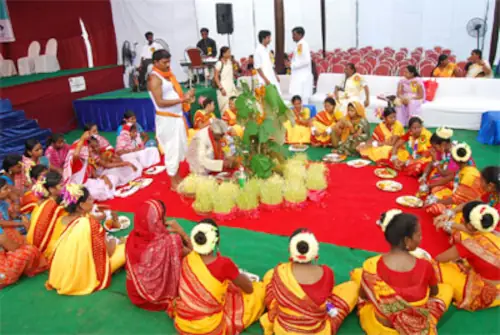
The great spring observance of Sarhul (known natively as Khaddi by the Oraons) provides one of the clearest examples. Sarhul occurs during Chaitra, when the Sal begins to flower. The flowering of the Sal marks the renewal of the natural world and the beginning of a new agricultural and seasonal cycle. In many Oraon traditions, the ritual expresses the relationship between Dharti/Earth and Dharmesh/Sun, fertility and rain, human settlement and the living forest.
The Pahan (Purohit) performs the central village rites. Sal blossoms are brought into the ritual field; prayers are offered for rain, cattle, crops, health, protection and village welfare. In the well-known water-pot observance, two earthen vessels are placed with water before the principal rite, and their condition is examined subsequently as a traditional indication concerning the coming rains. Such practices reveal a conception in which agriculture, weather, divinity and collective welfare form one chain of existence.
O Dharmesh, Supreme Provider, look down upon us. Let the rains fall in perfect time. Let our cows and bullocks remain free of disease. Let the seeds we sow sprout with strength. Keep our village safe from the tigers, the snakes, and natural storms. We offer you this pure white sacrifice and fresh Sal blossoms; keep your eye of light upon us.
The Dhumkuriya prepares the youth for this annual renewal. The songs and dances are practised beforehand. The rhythm of the Mandar is learnt by repetition. The circular movement of the dancers is transmitted from elder to younger. The stories connected with Sarhul are remembered not as literary compositions but as oral inheritance. The young thus become the performers and future custodians of the rite.
The same principle becomes visible in Karma or Karam Parba, generally observed on the Ekādaśī of the bright fortnight of Bhādra. The festival is associated with Karam Devata, the Karam tree and the vitality of youth, agriculture, labour and prosperity. Young men and women have a prominent role in collecting the Karam branch, bringing it to the village Akhra, installing it and participating in the night-long singing and dancing.
The Akhra and Dhumkuriya must be distinguished. The Akhra is the open communal ground—the place of gathering, dance, public interaction and collective performance. The Dhumkuriya is the institution of youth formation associated with the transmission and disciplined practice of knowledge. Together they formed complementary parts of village life: the Dhumkuriya formed the youth; the Akhra displayed the living strength of the community.
Karam tradition also preserves a remarkable moral vocabulary. The word Karam is associated in popular interpretation with deed, action and work. The stories of Karam and Dharma, and of the brothers who disregard Karam Devata and subsequently experience hardship, express a principle familiar throughout Indian thought: fortune cannot be separated from conduct. Labour, restraint, respect for nature and fulfilment of obligation sustain prosperity.
The Dhumkuriya was therefore also an institution of Karma-śikṣā in the broadest sense—not a Sanskrit technical term necessarily used by the Oraon themselves, but a useful civilisational description of its function. Youthful strength was not allowed to remain merely physical. It was directed toward field, forest, family, festival and village.
Other seasonal observances similarly entered the inherited knowledge of the young. Tusu, associated with the end of Pausha, preserves a rich corpus of songs, particularly among young women. Sohrai, associated with the agricultural cycle and especially with cattle, honours the animals whose labour sustains cultivation. Cows and bullocks are washed, decorated and treated ceremonially. In such observances the boundary between agriculture, household, animal, forest and sacred order becomes extremely thin.
The Dhumkuriya also possessed an important Śrama dimension. When a house was constructed, a field required collective labour, a marriage required preparation, or another substantial village task arose, the youth could act collectively. Their labour was therefore not merely an economic resource. It was a practical education in mutual obligation.
The institution also possessed an internal age-order. Exact names and divisions differed among Oraon localities and should not be treated as universally fixed. Ethnographic descriptions nevertheless record a movement from younger membership toward seniority and increasing responsibility. The younger learnt service and discipline; the middle group acquired greater practical knowledge; the senior unmarried youth became guides and custodians for those beneath them.
Thus the Dhumkuriya produced a hierarchy of experience rather than a hierarchy of wealth. Seniority was accompanied by responsibility. The older youth had obligations toward the younger just as the younger had obligations toward the older. Through this mechanism, knowledge survived without requiring a permanent written archive.
The Sal tree (शाल) occupies a particularly profound place in this structure. The Sarna grove provides the sacred landscape; Sarhul provides the seasonal renewal; the Sal blossom provides the visible sign of regeneration; and the youth constitute the human generation that must itself regenerate the community. The relationship between Sal, Sarna, Sarhul and Dhumkuriya therefore forms a coherent civilisational pattern: nature renews itself, and society must renew itself through its youth.
During the principal Pūjā at the Sarna Sthal, the Pahan performs a traditional sacrificial rite in which three young roosters of different colours are offered according to the sacred order of the Oraon cosmology: the white rooster is offered to Dharmesh, the supreme divine power associated with the Sun, light and the sustaining order of life; the black or dark-coloured rooster is offered to Chala Pacho, understood in the ritual tradition as a Mother-earth or village protective power; and the red or speckled rooster is offered to the ancestors, seeking their continuing protection and welfare of the community. White occupies a particularly sacred place in Oraon ritual symbolism, representing purity and the radiant solar principle. During the offering to Dharmesh, the Pahan faces the Sun and recites the traditional Kurukh Binti, invoking the divine power responsible for rain, fertility, crops, cattle, health and the continuity of the village, thereby joining Dharmesh, Sūrya, Sarna, Earth, ancestors and the living community within a single ritual order.
This also permits a comparative reading with wider Indian symbolism. The Sun as Āditya, the principle of light and life, and the sacred tree as a vertical link between earth and sky have long occupied important places in Indian religious imagination. Such comparisons, however, should not be converted into claims that Oraon traditions are merely disguised forms of a later Sanskritic theology. The proper historical approach is to recognize regional continuity, convergence and parallel symbolism without erasing indigenous terminology.
The same caution applies to the category “religion”. The modern division between religion, society, education, law, culture and recreation is not sufficient to describe the Dhumkuriya. These categories are products of particular intellectual histories. The Dhumkuriya belonged to a world in which Dharma, community, nature, work, ritual, song and social obligation were interwoven.
Nor was the Dhumkuriya equivalent to a Hindu temple. The Devasthāna or sacred grove, the Sarna, the Akhra, the Pahan’s ritual sphere and the Dhumkuriya performed different functions. The Dhumkuriya was a place where the young prepared themselves to become responsible members of the community. Its sacred character arose from the knowledge and order preserved within it, not because it was simply a temple building.
The historical decline of the Dhumkuriya followed the transformation of village life during the colonial and post-colonial periods. Missionary education, government schooling, formal employment, migration, urbanisation, changing marriage patterns and the expansion of modern institutional education weakened the old youth-house system. By the late twentieth and early twenty-first centuries, many traditional Dhumkuriya structures had disappeared or survived principally in memory and modified cultural institutions.
Yet the idea itself remains powerful. The Dhumkuriya represents a civilisational technology of continuity. It solved a fundamental problem faced by every traditional society: how does the knowledge of the ancestors survive when the ancestors are gone? The answer was not a book alone. It was the disciplined formation of the next generation.
The young entered as Jokhar, as learners within an age-ordered community; they listened, worked, sang, danced, served, observed and gradually assumed responsibility. At marriage they left the youth-order and entered another stage of life. What they had received did not disappear with them. It entered their households, fields, festivals and children.
The Oraon religious world contains concepts and practices expressed through terms such as Dharmesh, Bhagwān, Biri, Chando, Dharti Aayo, Pahan, Pūjā, Bhagat, Karam, Sarhul, Sarna and Mahādeo. The Jharkhand Tribal Welfare Research Institute records that Oraon religious traditions include Dharmesh as the supreme deity, worship of the Sun as Biri, the Moon as Chando, and Earth as Dharti Aayo. It also records the development of Hindu-style Sarna sects such as Bishnu Bhagat, Bacchinda Bhagat, Karmu Bhagat and Tana Bhagat.
The deepest significance of Dhumkuriya therefore lies in the continuity between Jana, Jāti, Yuva, Dharma, Karma, Sarna, Sal, Pahan, Akhra, Sarhul and Karam. It was through such institutions that an indigenous community reproduced not merely its population but its way of knowing the world. The Dhumkuriya was the place where youthful energy was transformed into inherited wisdom and where the knowledge once entrusted to the ancestors was kept alive until another generation was ready to receive it.
The spiritual symbolism of the Sal tree adds another layer. Sarhul marks the flowering and renewal of the Sal; Dhumkuriya prepares the renewal of the human community. The forest renews through blossom; the village renews through youth. Sal–Sarna–Sarhul–Yuva therefore forms a meaningful indigenous chain of symbolism. A Sal tree branch in Dhumkuriya represents the Divinity of the Sun God (Aditya Vishnu), as a wooden Cross represents the Christian God.
A comparative Vedic reading may extend this symbolism toward Āditya, Sūrya, Viṣṇu and Dharma, but this must remain a comparative interpretation rather than a claim that Oraon theology is simply Vedic theology under another name. The Indian civilisational field has historically permitted assimilation, identification, parallelism and regional reinterpretation.
Finally, Dhumkuriya (धुमकुड़िया) may be understood as a growth-centre of the young generation under the presence of the Youth Deity, where human youth was placed within the sacred order of inherited knowledge. In the traditional conception, the Devatā of youth had once bestowed upon the ancestors the sacred knowledge of life, and that knowledge was thereafter preserved, practised and transmitted through successive generations within the Dhumkuriya. Thus the Dhumkuriya was not merely a dwelling-place for unmarried boys and girls, nor simply a school for acquiring practical skills; it was a custodial centre of ancestral Vidyā, where the young encountered the accumulated knowledge of their people concerning Dharma, Karma, nature, agriculture, ritual, music, dance, social conduct, marriage, protection of the community and the sacred order of existence. The youth entered as inheritors of the ancestral tradition and gradually became its custodians; what had been received from the Devatā, preserved by the ancestors, and guarded by successive generations was transmitted onward through Śruti-like oral instruction, memory, practice and collective observance. In this sense, the Dhumkuriya represented a continuous chain of Devatā → Ancestors → Elders → Youth → Future Generation, through which sacred knowledge was kept alive within the community.
Sarvarthapedia Conceptual Network: Dhumkuriya and Sal Tree
Core Node
Dhumkuriya (धुमकुड़िया)
Central Concept: Oraon/Kurukh institution of youth-formation, communal education, knowledge transmission, discipline and cultural continuity.
Primary conceptual chain:
Dhumkuriya → Youth → Śikṣā → Vidyā → Karma → Dharma → Community → Ancestors → Prakṛti → Sacred Geography → Cultural Continuity
The Dhumkuriya should therefore function in Sarvarthapedia not merely as an article on a traditional building, but as a civilizational institution of knowledge reproduction.
Dhumkuriya Knowledge Cluster
Dhumkuriya → Youth Formation
Adolescence → Unmarried Youth → Collective Life → Senior-Junior Transmission → Discipline → Preparation for Adult Community Life
See also:
- Youth Institutions
- Age-Grade Institutions
- Initiation and Social Formation
- Community Education
- Indigenous Education Systems
- Oraon Society
- Kurukh Culture
- Knowledge System
Dhumkuriya → Śikṣā
Śikṣā → Learning by Participation → Oral Transmission → Memory → Practice → Embodied Knowledge
The important conceptual distinction is:
Information → Knowledge → Practice → Conduct
The Dhumkuriya belongs principally to the latter three.
See also:
- Śikṣā
- Vidyā
- Oral Tradition
- Indigenous Knowledge Systems
- Traditional Education
- Experiential Learning
- Intergenerational Knowledge Transmission
- Cultural Memory
Knowledge Transmission Network
Elder → Youth → Next Generation
Elder Knowledge → Senior Youth → Junior Youth → Repetition → Practice → Preservation → Transmission
This creates a self-reproducing knowledge system in which the community does not depend entirely upon:
Book → Manuscript → School → Teacher
but can operate through:
Memory → Speech → Song → Dance → Work → Ritual → Story → Participation
See also:
- Oral Culture
- Mnemonic Culture
- Collective Memory
- Traditional Knowledge
- Cultural Transmission
- Intergenerational Learning
Dharma–Karma Cluster
Dhumkuriya → Dharma
Dharma → Order → Custom → Duty → Right Conduct → Social Obligation
The Dhumkuriya becomes a particularly useful Sarvarthapedia node for examining Dharma as lived order, rather than reducing Dharma to the modern category of “religion”.
Dhumkuriya → Karma
Knowledge → Action → Labour → Conduct → Responsibility
Its educational principle may therefore be represented as:
Śikṣā → Vidyā → Karma → Dharma
What is known must become what is done.
See also:
- Dharma
- Karma
- Ācāra
- Kartavya
- Śikṣā
- Vidyā
- Community Duty
- Customary Law
Comparative Education Cluster
Dhumkuriya ↔ Gurukula
This should be a functional comparison, not a claim of historical derivation.
Dhumkuriya: community-centred youth formation
Gurukula: teacher-centred residential learning tradition
Common conceptual field:
Youth → Discipline → Knowledge → Practice → Character → Social Responsibility
But the institutional histories, ritual structures and cultural contexts remain distinct.
See also:
- Gurukula
- Āśrama System
- Indigenous Education
- Traditional Indian Education
- Śikṣā in Indian Civilization
- Education as Character Formation
Negative-Identification Cluster
Dhumkuriya ≠ Temple
Temple → Deity → Worship → Ritual Institution
Dhumkuriya → Youth → Education → Social Formation → Community
Dhumkuriya ≠ Church
Church → Congregation → Ecclesiastical Institution → Sacrament
Dhumkuriya → Age Group → Custom → Knowledge → Communal Life
Dhumkuriya ≠ Monastery
Monastery → Religious Renunciation → Monastic Discipline
Dhumkuriya → Youth → Household Preparation → Community Participation
Dhumkuriya ≠ Freemasonic Lodge
Lodge → Fraternal Association → Formal Membership Structure
Dhumkuriya → Indigenous Age-Based Social Formation
Dhumkuriya ≠ College / Hostel
College → Formal Curriculum → Institutional Certification
Hostel → Accommodation
Dhumkuriya → Formation of the Person within Community
This comparative network prevents Sarvarthapedia from interpreting an indigenous institution merely through the categories of modern European institutions.
Spatial Network
Dhumkuriya → Kudia
Kudia / Kutiya / Kutir → Physical Centre → Dwelling → Youth Institution
But:
Kudia ≠ Entire Dhumkuriya
The institution extends beyond the building.
Dhumkuriya → Akhra
Dhumkuriya → Akhra → Dance → Music → Youth → Collective Performance → Social Memory
The Akhra represents the public and performative dimension of communal youth culture.
See also:
- Akhra
- Village Institution
- Community Space
- Traditional Dance
- Folk Music
- Collective Performance
Ecological-Civilizational Cluster
Dhumkuriya → Village → Field → Forest → Sacred Grove
Dhumkuriya
↕
Village
↕
Agricultural Field
↕
Forest
↕
Sarna
This indicates that knowledge is geographically distributed across the community’s inhabited and sacred landscape.
See also:
- Oraon Village
- Sarna
- Sacred Grove
- Forest Knowledge
- Agricultural Knowledge
- Traditional Ecology
- Sacred Geography
- Prakṛti
Sal Tree Cluster
Sal (शाल) → Shorea robusta
Sal Tree → Forest → Sarna → Sacred Geography → Ritual → Community Memory
The Sal tree should therefore operate as a separate Sarvarthapedia node rather than merely as botanical information appended to the Dhumkuriya article.
See also:
- Śāla
- Shorea robusta
- Sal Forests
- Sarna
- Sacred Grove
- Sacred Trees of India
- Indian Forest Civilization
Sal → Sarna
Sarna Sacred Grove
Sarna → Sal Trees → Sacred Territory → Ritual → Pahan → Dharmesh → Ancestors → Community
The relationship can be represented as:
Sal → Grove → Sarna → Ritual Territory → Community
rather than:
Tree → Object of Worship
This preserves the broader ecological and territorial meaning of the sacred grove.
Pahan Network
Pahan → Sarna → Ritual Order
Pahan → Ritual Custodian → Sarna → Seasonal Observance → Community → Sacred Powers
See also:
- Pahan
- Sarna Puja System
- Oraon Ritual System
- Village Priesthood
- Sacred Grove Institutions
- Ritual Authority
Dharmesh Cluster
Dharmesh → Sacred Order
Dharmesh → Creation → Sustenance → Light → Cosmic Order → Community Order
The article’s theological vocabulary can connect:
Dharmesh → Dharma → Order → Nature → Community
while preserving the fact that Oraon theological terminology and practices vary by locality and historical context.
See also:
- Dharmesh
- Oraon Theology
- Kurukh Religious Traditions
- Creator Deity Concepts
- Sun and Sacred Light
- Cosmic Order
Ancestor Network
Ancestors → Memory → Institution
Ancestors → Custom → Memory → Dhumkuriya → Youth → Transmission → Future Generation
This is one of the strongest conceptual links in the entire network.
The Dhumkuriya can consequently be treated as a mechanism of ancestral continuity:
Past → Institution → Youth → Future
See also:
- Ancestor Veneration
- Ancestral Memory
- Cultural Continuity
- Tradition
- Collective Memory
- Lineage and Community
Prakṛti Network
Prakṛti → Forest → Sal → Sarna → Village
The ecological structure can be represented as:
Prakṛti → Forest → Sal → Sacred Grove → Community
while the educational structure becomes:
Dhumkuriya → Forest Knowledge → Agricultural Knowledge → Seasonal Knowledge → Ritual Knowledge
The two networks intersect at the village landscape.
Seasonal Knowledge Cluster
Season → Agriculture → Ritual → Song → Dance → Memory
Seasonal Change → Agricultural Cycle → Communal Labour → Ritual Observance → Song/Dance → Knowledge Transmission
This creates a direct connection between:
Ecology ↔ Economy ↔ Ritual ↔ Education
See also:
- Agricultural Calendar
- Seasonal Festivals
- Oraon Festivals
- Traditional Agriculture
- Ecological Knowledge
- Folk Songs
- Folk Dance
Music and Dance Network
Song → Dance → Memory
Song → Rhythm → Movement → Collective Participation → Memory
Because oral knowledge can be encoded in performance, the Dhumkuriya connects naturally with:
Music → Dance → Oral Tradition → Mnemonic System
See also:
- Oraon Music
- Oraon Dance
- Kurukh Folk Tradition
- Akhra
- Oral Literature
- Traditional Musical Instruments
Social Regulation Cluster
Youth → Discipline → Custom → Marriage → Community
The Dhumkuriya’s social function can be mapped as:
Youth Formation → Conduct → Custom → Social Responsibility → Marriage → Adult Membership
This creates a bridge between the Dhumkuriya and:
- Oraon Family
- Marriage Customs
- Kinship
- Village Governance
- Customary Law
- Social Norms
- Community Discipline
Customary Law Network
Dhumkuriya → Ācāra → Customary Law
Knowledge of Conduct → Collective Practice → Custom → Social Expectation → Community Regulation
This provides an important bridge to Sarvarthapedia’s broader legal architecture:
Custom → Ācāra → Community Norm → Customary Law → Dispute Regulation
See also:
- Customary Law
- Ācāra
- Tribal Legal Traditions
- Indigenous Jurisprudence
- Village Council
- Community Justice
Gender and Youth Network
Young Men ↔ Young Women
Youth Institution → Gendered Responsibilities → Collective Participation → Socialisation → Marriage Preparation
Because arrangements differ between communities and localities, the network should preserve regional variation rather than construct a single uniform Dhumkuriya model.
See also:
- Oraon Women
- Oraon Men
- Youth Institutions
- Marriage Customs
- Gender Roles in Indigenous Communities
Civilizational Continuity Cluster
Dhumkuriya as Cultural Reproduction
Knowledge → Youth → Practice → Community → Transmission → Continuity
This can become the higher conceptual node:
Cultural Reproduction
with links to:
Language → Ritual → Law → Agriculture → Ecology → Music → Kinship → Memory
Dhumkuriya therefore occupies the intersection of several knowledge systems rather than belonging exclusively to one discipline.
Sarvarthapedia Master Cross-Reference
Dhumkuriya ↔ Kurukh
Dhumkuriya → Oraon/Kurukh Society → Kurukh Language → Oral Tradition → Community Institutions
Dhumkuriya ↔ Sarna
Dhumkuriya → Village → Sarna → Sacred Grove → Sal → Pahan → Ritual
Dhumkuriya ↔ Akhra
Dhumkuriya → Youth → Akhra → Dance → Music → Collective Memory
Dhumkuriya ↔ Dharma
Dhumkuriya → Śikṣā → Conduct → Dharma → Social Order
Dhumkuriya ↔ Karma
Knowledge → Labour → Practice → Karma → Responsibility
Dhumkuriya ↔ Prakṛti
Village → Field → Forest → Sal → Sarna → Ecological Knowledge
Dhumkuriya ↔ Ancestors
Ancestors → Tradition → Memory → Youth → Transmission → Future
Dhumkuriya ↔ Gurukula
Youth Formation → Discipline → Knowledge → Practice → Social Responsibility
Dhumkuriya ↔ Customary Law
Custom → Conduct → Obligation → Community Regulation
Sal Tree Master Cross-Reference
Sal ↔ Sarna
Sal → Sacred Grove → Ritual Territory
Sal ↔ Prakṛti
Sal → Forest Ecology → Biodiversity → Human Settlement
Sal ↔ Oraon
Sal → Sarna → Oraon Sacred Geography → Community
Sal ↔ Dhumkuriya
Sal → Sarna → Village Sacred Landscape → Dhumkuriya
Sal ↔ Indian Sacred Trees
Sal → Śāla → Sacred Trees → Indian Religious and Cultural Traditions
Any specifically Vaiṣṇava association of Śāla/Sal should be treated as a separate theological-comparative node and sourced independently, rather than assumed to explain the Oraon meaning of the tree.
Higher-Order Sarvarthapedia Node
Indigenous Institution as Knowledge Architecture
Dhumkuriya
→ Youth
→ Śikṣā
→ Vidyā
→ Memory
→ Practice
→ Karma
→ Dharma
→ Custom
→ Community
→ Sacred Geography
→ Prakṛti
→ Ancestors
→ Cultural Continuity
This makes Dhumkuriya a gateway node connecting education, anthropology, sociology, law, ecology, religion, oral literature, music, dance, kinship and civilizational memory.
See Also: Knowledge Web
Core Nodes
Dhumkuriya
→ Oraon / Kurukh
→ Kurukh Language
→ Oraon Society
→ Akhra
→ Sarna
→ Pahan
→ Dharmesh
→ Sal / Śāla
→ Prakṛti
→ Ancestors
→ Śikṣā
→ Vidyā
→ Dharma
→ Karma
→ Customary Law
→ Oral Tradition
→ Indigenous Knowledge
→ Traditional Education
→ Sacred Geography
→ Cultural Memory
→ Cultural Continuity
Regional Web
Chhotanagpur → Jharkhand → Bihar → Chhattisgarh → Odisha → West Bengal → Oraon/Kurukh Settlements → Related Indigenous Institutions
Conceptual Web
Youth Formation ↔ Education ↔ Knowledge Transmission ↔ Socialisation ↔ Custom ↔ Dharma ↔ Community Order
Ecological Web
Prakṛti ↔ Forest ↔ Sal ↔ Sarna ↔ Sacred Grove ↔ Agriculture ↔ Seasonal Cycle ↔ Ritual
Cultural Web
Language ↔ Song ↔ Dance ↔ Akhra ↔ Story ↔ Memory ↔ Ancestors ↔ Identity
Institutional Web
Dhumkuriya ↔ Kudia ↔ Akhra ↔ Village ↔ Sarna ↔ Pahan ↔ Community
Comparative Civilizational Web
Dhumkuriya ↔ Gurukula ↔ Indigenous Education ↔ Oral Civilization ↔ Age-Grade Institutions ↔ Communal Learning
Ultimate Sarvarthapedia Concept
Dhumkuriya as a Civilizational Memory Institution
Dhumkuriya is best positioned in the Sarvarthapedia architecture as a node for the study of how a community converts inherited knowledge into living social continuity.
Ancestor → Knowledge → Youth → Practice → Community → Territory → Nature → Ritual → Memory → Next Generation
Dhumkuriya (Dharma Kutiya) is not simply a youth house; it is an institutional mechanism through which knowledge, conduct, ecology, memory and community order are reproduced across generations.