Encyclopedia of Contemporary World History
Encyclopedia of Contemporary Indian Politics
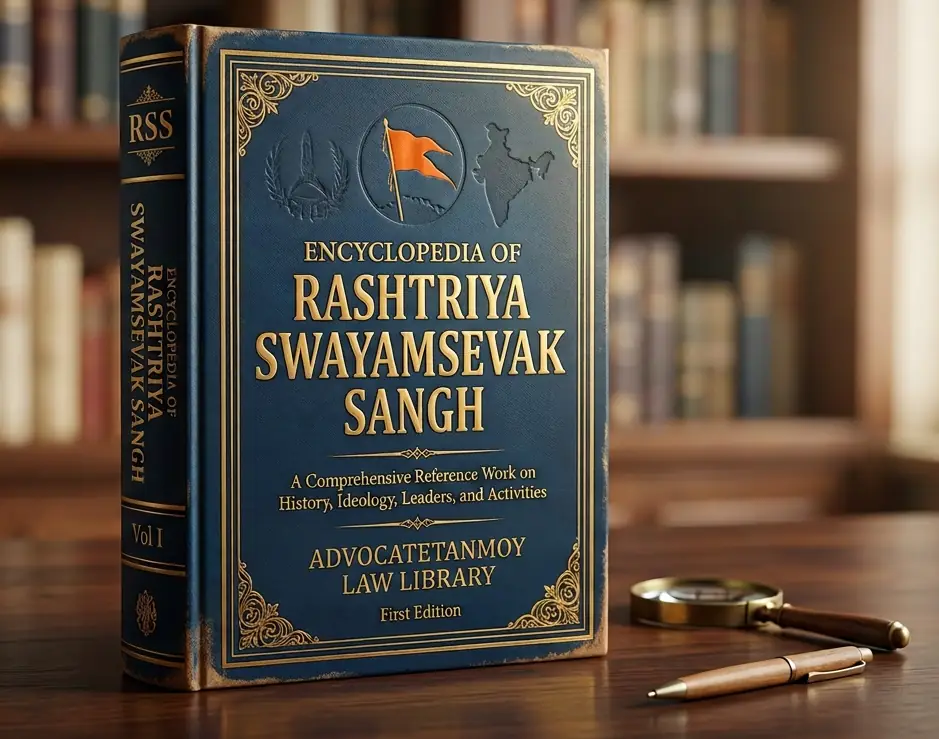
The Rashtriya Swayamsevak Sangh: A Comprehensive Encyclopedia of History, Civilisational Thought, Organisation, Institutions, Movements and Global Influence
Introduction
The Master Architecture
Volume I — Civilisational and Intellectual Genealogy of the RSS
Scope: Ancient Indian Civilisation to 1925
This volume answers the fundamental question:
What intellectual, civilisational and historical traditions became the background against which the RSS formulated its conception of Hindu society and Indian nationhood?
Major domains
- Indian civilisation and the idea of Rashtra
- Vedic conceptions of society and polity
- History of Ancient and Modern India
- Dharma and social order
- Janapada, Mahajanapada and territorial consciousness
- Bharatavarsha
- Dharmic Administration of Vaivaswata Manu (5900-5800 BCE)
- Dharmic Administration of Solar Dynasty and Lord Ram
- The Tradition of Krishna Dvaipayana Vyasa
- Samrat Yudhisthira`s Dharmic Administration (3130-3155 BCE)
- Bhagavad Gita and political ethics
- Kautilya and statecraft
- Hindu political thought
- Buddhist and Jain contributions to Indian civilisation
- Classical Indian conceptions of kingship
- Swami Krishna Chaitanya Bharati (Mahaswami)
- European Invasions in India
- Creation and Termination of Islamic Rule in Delhi (1206-1757)
- Siraj-ud-Daulah of Bengal: Fall of Islam and Rise of Hindu Politics (1757)
- Sikh Religious and Military Movement
- Maratha political civilisation
- Rajput traditions
- Vijayanagara
- Sikh resistance and political organisation
- Indian resistance to Islamic polities
- Colonial transformation
- Orientalism
- British construction of Indian communities
- Census and communal classification
- Macaulay and colonial education
- Christian missionary expansion
- Islamic reform movements
- Arya Samaj and reclaiming Vedic heritage
- Brahmo Samaj
- Bankim Chandra Chattopadhyay
- Sri Aurobindo
- Bal Gangadhar Tilak
- Dayananda Saraswati
- Vinayak Damodar Savarkar (1883 – 1966)
- Shyamaprasad Mukherjee
- Hindu Mahasabha
- Indian National Congress
- Revolutionary nationalism
- Bengal Nationalism
- Maharashtra nationalism
- Punjab nationalism
- Cultural nationalism
- Nationalism versus territorial nationalism
- Hindu identity
- Hindu society
- Civilisational nationalism
- Hindu Indian Chronology (Vedic Timeline)
The volume culminates in Nagpur, 1925.
Volume II — Hedgewar and the Creation of the RSS
1925–1940
A monumental institutional history of the founding generation.
Major domains
- Keshav Baliram Hedgewar
- Hedgewar’s childhood and education
- Nagpur political environment
- Congress and Hedgewar
- revolutionary networks
- Non-Cooperation movement
- Hindu Mahasabha
- founding of the RSS
- 27 September 1925
- early shakhas
- organisational principles
- Bhagwa Dhwaj
- Guru concept
- physical training
- intellectual training
- games and discipline
- daily shakha
- weekly shakha
- utsavs
- Sangh education
- officers’ training
- pracharak system
- local organisation
- district organisation
- provincial organisation
- central organisation
- RSS terminology
- organisational culture
- uniform
- drill
- route marches
- songs
- prayers
- biographies of early workers
- expansion outside Nagpur
- Maharashtra
- Central Provinces
- Berar
- United Provinces
- Punjab
- Bengal
- Madras Presidency
- Sindh
- princely states
- RSS and Congress
- RSS and Hindu Mahasabha
- RSS and revolutionary organisations
- RSS and British administration
- RSS during the 1930s
- Hedgewar’s political philosophy
- Hedgewar’s conception of Hindu society
- Hedgewar’s conception of national reconstruction
- Hedgewar’s final years
- Death of Hedgewar, 1940
This volume establishes the RSS organisational DNA.
Volume III — Guruji Golwalkar and the Construction of the Sangh
1940–1973
This should be substantially larger than the previous proposal because this period contains the RSS’s fundamental ideological and organisational consolidation.
Part I: Golwalkar
- M. S. Golwalkar
- early life
- education
- spiritual influences
- relationship with Hedgewar
- succession in 1940
Part II: Ideological Corpus
- We, or Our Nationhood Defined
- Bunch of Thoughts
- Hindu Rashtra
- nation
- society
- culture
- civilisation
- territory
- race
- religion
- state
- minority
- citizenship
- national unity
- social organisation
- individual and society
- dharma
- freedom
- discipline
- character
- national regeneration
Part III: RSS and Independence
- Second World War
- British India
- Quit India
- Subhas Chandra Bose
- revolutionary nationalism
- independence
- Partition
- refugee crisis
- communal violence
- RSS relief work
Part IV: Gandhi Assassination and the Ban
- Gandhi assassination
- Nathuram Godse
- RSS allegations
- Government action
- arrest of RSS workers
- ban of 1948
- negotiations
- constitutional reform
- lifting of ban in 1949
Part V: Reconstruction
- expansion after 1949
- Jana Sangh
- Deendayal Upadhyaya
- organisational training
- student work
- labour work
- social service
- education
- religious mobilisation
- Golwalkar’s travels
- speeches
- correspondence
- relationship with political organisations
Part VI: Deoras and Succession
- Golwalkar’s later years
- social questions
- caste
- untouchability
- social harmony
- Balasaheb Deoras
- Golwalkar’s death, 1973
Volume IV — The Sangh Network: Organisation, Institutions and Social Reconstruction
It maps the RSS’s institutional universe.
Core architecture
RSS itself
- Sangh structure
- Akhil Bharatiya Pratinidhi Sabha
- Sarkaryavah
- Sarsanghchalak
- Pracharak
- Kshetra
- Pranta
- Vibhag
- Zila
- Mandal
- Shakha
- training institutions
Sangh-associated organisations
- Bharatiya Jana Sangh
- Bharatiya Janata Party
- Vishwa Hindu Parishad
- Bajrang Dal
- Akhil Bharatiya Vidyarthi Parishad
- Bharatiya Mazdoor Sangh
- Bharatiya Kisan Sangh
- Vidya Bharati
- Seva Bharati
- Vanvasi Kalyan Ashram
- Rashtriya Sevika Samiti
- Sanskar Bharati
- Pragya Bharati
- Swadeshi Jagran Manch
- Laghu Udyog Bharati
- Sanskrit Bharati
- Vijnana Bharati
- Sahakar Bharati
- Sewa International
- Deendayal Research Institute
- other affiliated, associated and ideologically aligned organisations
RSS → organisational relationship → institutional autonomy → ideological affinity → personnel overlap → historical interaction.
Volume V — RSS, Democracy, State and Political Power
1947–2026
Major domains
- RSS and Constitution
- RSS and parliamentary democracy
- RSS and electoral politics
- RSS and political parties
- Jana Sangh
- BJP
- RSS–BJP relationship
- Congress–RSS relationship
- RSS and socialism
- RSS and communism
- RSS and secularism
- RSS and liberalism
- RSS and nationalism
- RSS and federalism
- RSS and Centre–State relations
- RSS and judiciary
- RSS and bureaucracy
- RSS and civil society
- RSS and elections
- RSS and political mobilisation
- RSS and coalition governments
- Janata Party
- 1977
- 1980
- 1989
- 1991
- 1996
- 1998
- 1999
- 2004
- 2014
- 2019
- 2024
- BJP governments
- Narendra Modi and RSS
- political influence
- ideological influence
- policy influence
- institutional autonomy
- opposition to RSS
- allegations of political control
- debates over the RSS and the state
Volume VI — Hindu Society, Social Transformation and Cultural Nationalism
Major domains
- Hindu society
- caste
- varna
- untouchability
- social harmony
- Dalit outreach
- tribal communities
- Vanvasi question
- social integration
- Hindu religious institutions
- temples
- pilgrimage
- religious conversion
- reconversion
- minority relations
- Muslims
- Christians
- Sikhs
- Buddhists
- Jains
- Parsis
- tribal religions
- inter-community relations
- women
- family
- marriage
- youth
- children
- elderly
- disability
- rural society
- urban society
- workers
- farmers
- entrepreneurs
- professional communities
- migrants
- diaspora
- social service
- disaster relief
- healthcare
- education
- sanitation
- poverty
- self-help
- community organisation
Cultural domains
- Sanskrit
- Indian languages
- literature
- music
- theatre
- art
- architecture
- temple culture
- festivals
- national symbols
- historical memory
- archaeology
- civilisational geography
- pilgrimage geography
- cultural heritage
Volume VII — Education, Knowledge, Economy, Science and National Reconstruction
This volume examines the constructive programme of the Sangh ecosystem.
Education
- Vidya Bharati
- Saraswati Shishu Mandirs
- schools
- higher education
- teacher training
- curriculum
- history education
- Sanskrit education
- value education
- vocational education
- tribal education
- educational philosophy
Economy
- Swadeshi
- economic nationalism
- Integral Humanism
- Deendayal Upadhyaya
- labour
- Bharatiya Mazdoor Sangh
- agriculture
- Bharatiya Kisan Sangh
- cooperative movement
- small industries
- entrepreneurship
- indigenous industry
- economic self-reliance
- globalisation
- liberalisation
- privatisation
Science and technology
- Vijnana Bharati
- indigenous knowledge
- modern science
- technology
- scientific temper
- Ayurveda
- traditional knowledge
- environment
- ecology
- water
- agriculture technology
- space and strategic technology debates
Rural reconstruction
- village development
- Gram Vikas
- rural self-government
- community development
- tribal development
- sustainable development
Volume VIII — Movements, Conflicts, Controversies and Critical Historiography
This volume systematically documents the major controversies.
Major subjects
- Gandhi assassination controversy
- First RSS ban
- RSS and Partition
- Golwalkar controversies
- constitutional questions
- Emergency
- Ayodhya
- Ram Janmabhoomi movement
- Babri Masjid demolition
- communal violence
- Gujarat 2002
- conversion controversies
- minority questions
- caste debates
- cow protection
- Hindutva
- majoritarianism
- nationalism
- secularism
- fascism comparisons
- Nazism comparisons
- authoritarianism debates
- constitutional democracy debates
- academic criticism
- journalistic criticism
- left-wing criticism
- liberal criticism
- Dalit criticism
- minority perspectives
- feminist criticism
- international scholarship
- RSS responses to criticism
- historiographical disputes
Methodological principle
Event → primary documents → government position → RSS position → opposing position → judicial record → academic scholarship → subsequent historiography.
Volume IX — Regional RSS and the Global Sangh
This volume should destroy the assumption that the RSS is adequately understood through Nagpur–Delhi–Uttar Pradesh–Gujarat alone.
India by region
- Maharashtra
- Madhya Pradesh
- Chhattisgarh
- Gujarat
- Rajasthan
- Uttar Pradesh
- Uttarakhand
- Bihar
- Jharkhand
- West Bengal
- Odisha
- Assam
- Northeast India
- Punjab
- Haryana
- Himachal Pradesh
- Jammu and Kashmir
- Delhi
- Karnataka
- Kerala
- Tamil Nadu
- Andhra Pradesh
- Telangana
- Goa
- Telangana
- Andaman and Nicobar Islands
For each region:
Entry → foundation → pioneers → organisational growth → shakha network → affiliated institutions → social work → political interaction → local controversies → contemporary position.
Global Sangh
- United Kingdom
- United States
- Canada
- Australia
- New Zealand
- Africa
- Middle East
- Southeast Asia
- Europe
- Japan
- Latin America
And:
- Hindu Swayamsevak Sangh
- overseas shakhas
- diaspora organisations
- global Hindu conferences
- diaspora political influence
- cultural diplomacy
- international criticism
- international academic studies
Volume X — The RSS Knowledge Treasury
Part I — Sarsanghchalaks
- Hedgewar
- Golwalkar
- Deoras
- Rajendra Singh
- K. S. Sudarshan
- Mohan Bhagwat
Part II — Major Sangh Personalities
Hundreds of biographies.
Part III — Pracharaks
A major biographical and organisational register.
Part IV — Women and the Sangh
A separate reference corpus.
Part V — Organisations
Complete organisational directory.
Part VI — Shakhas and Institutional Centres
Important centres, headquarters, training institutions and historical locations.
Part VII — Texts
- books
- speeches
- resolutions
- letters
- journals
- newspapers
- pamphlets
- organisational documents
- government documents
Part VIII — Terminology
A Sangh Lexicon:
- Sangh
- Shakha
- Swayamsevak
- Pracharak
- Sarsanghchalak
- Sarkaryavah
- Hindu Rashtra
- Hindutva
- Sanskriti
- Seva
- Samaj
- Samrasta
- Swadeshi
- Dharma
- Rashtra
- Sangathan
- Ekatmata
- Seva karya
- Vanvasi
- and hundreds of organisational and philosophical terms.
Part IX — Master Chronology
1820–2026
with particular density from 1925 onward.
Part X — Documentary Atlas
- organisational charts
- leadership succession
- geographical expansion
- institutional relationships
- major movements
- bans
- government actions
- electoral chronology
- major judicial proceedings
- organisational milestones
Part XI — Bibliography
Separate bibliographies for:
- RSS publications
- primary sources
- biographies
- academic books
- journal articles
- government documents
- parliamentary records
- court judgments
- newspapers
- oral histories
- memoirs
- foreign scholarship
- critical literature
RSS and the Indian Prime Ministers
The encyclopedia should systematically examine the RSS in relation to every Prime Minister of India, from Jawaharlal Nehru to Narendra Modi, including periods when the Prime Minister’s relationship with the RSS was indirect, adversarial, administrative, cooperative, or institutionally significant.
Jawaharlal Nehru, 1947–1964
This should cover:
- Nehru’s conception of Indian nationalism
- Nehru’s conception of secularism
- RSS and the new Republic
- Partition and refugee mobilisation
- Gandhi assassination and the 1948 RSS ban
- Government allegations against the RSS
- RSS negotiations with the Government
- RSS constitutional undertaking
- lifting of the ban in 1949
- Nehru’s subsequent political assessment of the RSS
- Congress–RSS ideological conflict
- Hindu Mahasabha and Jana Sangh
- RSS and the Kashmir question
- RSS and national integration
- China war of 1962
- RSS participation in national mobilisation
- Golwalkar and Nehru
- Nehru-era intelligence and administrative perceptions of the RSS
Lal Bahadur Shastri, 1964–1966
A short premiership, but historically important.
- Shastri’s relationship with the Sangh
- RSS during the 1965 India–Pakistan War
- national mobilisation
- food crisis
- national discipline
- RSS and patriotism
- Golwalkar and Shastri
- Congress–RSS relations after Nehru
Indira Gandhi, 1966–1977
This needs considerable treatment.
- Indira Gandhi and the RSS
- Congress centralisation
- ideological conflict
- RSS and opposition politics
- 1967 political transformation
- 1971 war
- Bangladesh
- RSS and national mobilisation
- JP Movement
- Jayaprakash Narayan
- RSS participation in the anti-Emergency movement
- declaration of Emergency, 25 June 1975
- arrests of RSS workers
- underground organisation
- censorship
- civil liberties
- RSS and opposition parties
- 1977 election
Morarji Desai, 1977–1979
This is particularly important because it introduces the RSS–Janata Party experiment.
- RSS and Janata Party
- former Jana Sangh members
- dual membership controversy
- organisational autonomy
- government and Sangh relationship
- internal conflict
- fall of the Janata government
Charan Singh, 1979–1980
- political transition
- Jana Sangh faction
- RSS relationship
- collapse of Janata politics
- formation of the BJP
Indira Gandhi, 1980–1984
The second Indira period needs separate treatment.
- formation of BJP
- RSS–BJP relationship
- opposition politics
- Punjab crisis
- national integration
- assassination of Indira Gandhi
Rajiv Gandhi, 1984–1989
This is a critical transition period.
- 1984 election
- BJP’s electoral collapse
- RSS organisational expansion
- Shah Bano controversy
- Ayodhya
- unlocking of the Babri Masjid/Ram Janmabhoomi site
- Ram Shila mobilisation
- Hindu mobilisation
- Congress response
- RSS–VHP–BJP relationship
V. P. Singh, 1989–1990
- Mandal Commission
- Mandal versus Kamandal
- Ram Janmabhoomi movement
- BJP’s political expansion
- RSS mobilisation
- social justice versus cultural nationalism
- political realignment
Chandra Shekhar, 1990–1991
- Ayodhya negotiations
- RSS and political instability
- BJP opposition
- Ram Janmabhoomi mobilisation
P. V. Narasimha Rao, 1991–1996
This deserves an entire major section.
- liberalisation
- Congress–RSS relationship
- Ayodhya
- Babri Masjid demolition, 6 December 1992
- central government response
- RSS ban
- VHP and Bajrang Dal
- investigations
- communal violence
- judicial proceedings
- Rao’s political strategy
- RSS reconstruction after the 1992 ban
Atal Bihari Vajpayee, 1996
Even the 13-day government matters.
- RSS and Vajpayee
- Vajpayee’s political philosophy
- BJP’s first Union government
- RSS expectations
- coalition constraints
H. D. Deve Gowda, 1996–1997
- United Front
- RSS and non-BJP government
- coalition politics
- secular coalition
- Sangh opposition
I. K. Gujral, 1997–1998
- United Front
- RSS and coalition politics
- BJP’s return to power
Atal Bihari Vajpayee, 1998–2004
This should become one of the largest Prime Ministerial studies.
- RSS–BJP relationship in government
- NDA coalition
- coalition constraints
- Ram Mandir
- Article 370
- Uniform Civil Code
- education
- cultural policy
- nuclear tests
- Pokhran
- Kargil
- Pakistan policy
- RSS expectations versus government policy
- economic liberalisation
- disinvestment
- Swadeshi movement
- Sangh criticism of Vajpayee government
- Gujarat 2002
- Vajpayee, Modi and Gujarat
- 2004 election
Manmohan Singh, 2004–2014
Another major section.
- RSS in opposition
- UPA government
- Congress–RSS ideological conflict
- Hindutva debates
- terrorism and national security
- minority policy
- Sachar Committee
- communal violence legislation debates
- education policy
- civil society
- RSS social expansion during the UPA period
- Anna movement
- corruption controversies
- emergence of Narendra Modi
- RSS and BJP’s 2014 transformation
Narendra Modi, 2014–2026
This should probably be the largest Prime Ministerial section in the encyclopedia.
But it must be studied in layers:
Modi and the RSS before 2014
- RSS membership and early formation
- pracharak background
- Gujarat organisation
- relationship with Sangh leadership
- BJP organisation
Modi as Prime Minister
- 2014
- 2019
- 2024
- RSS–BJP relationship
- government–organisation relationship
- organisational autonomy
- policy influence
- social policy
- education
- culture
- citizenship
- Article 370
- Ram Mandir
- Uniform Civil Code
- national security
- foreign policy
- economic nationalism
- Atmanirbhar Bharat
- Swadeshi
- labour
- agriculture
- tribal policy
- welfare
- demographic debates
- civilisational diplomacy
- diaspora
- RSS and the Modi government after 2019
- RSS and the 2024 political transition
- RSS after the 2024 election
- relationship between RSS leadership and the Union government through 2026
Volume XI — RSS Institutional Anatomy
Leadership
- Sarsanghchalak
- Sarkaryavah
- Sah-Sarkaryavah
- Akhil Bharatiya Prachar Pramukh
- senior functionaries
- regional leadership
Territorial organisation
Kendra → Kshetra → Pranta → Vibhag → Zila → Khand → Mandal → Basti → Shakha
Each level should have its own encyclopedia entry.
Cadre system
- Swayamsevak
- Gatanayak
- Mukhya Shikshak
- Karyavah
- Pracharak
- Vistarak
- senior functionaries
Training system
- Sangh Shiksha Varg
- primary training
- advanced training
- leadership formation
- physical training
- intellectual sessions
- organisational training
RSS and the Production of the Cadre
Individual → Swayamsevak → disciplined participant → organiser → full-time worker → Pracharak → institutional leader
Questions
- How is organisational loyalty formed?
- How is leadership identified?
- How are workers transferred geographically?
- How is time devoted to the organisation?
- What is the relationship between family and organisational commitment?
- How does the organisation transmit memory?
- How are senior workers remembered?
- How are ideological disagreements handled?
- How does succession operate?
Volume XII — RSS Institutional Anatomy
Topics
- Gandhi assassination
- Partition
- First ban of RSS
- Emergency
- Ayodhya
- Gujarat
- Hindutva
- caste
- minorities
- conversion
- constitutionalism.
RSS and the Indian Constitution
Subjects
- Constituent Assembly
- Constitution-making
- citizenship
- fundamental rights
- directive principles
- secularism
- minority rights
- religious freedom
- personal law
- uniform civil code
- federalism
- language
- national symbols
- emergency powers
- preventive detention
- freedom of association
- freedom of speech
- judicial review
- constitutional amendments
- RSS bans
- constitutional litigation
RSS Statistical History
shakha numbers
geographical expansion
training camps
participating workers
affiliated institutions
schools
service projects
publications
organisational centres
membership/participation estimates
regional growth
RSS in the Digital Age
Topics
- RSS websites
- digital publications
- social media
- online archives
- digital shakhas
- video
- podcasts
- digital propaganda debates
- online political mobilisation
- misinformation controversies
- digital historical narratives
- youth outreach
- technology
- artificial intelligence
- cybersecurity
- digital education
- diaspora communication
Comparative Organisations Framework
Compare the RSS with:
- YMCA
- Young Men’s Christian Association movements
- Catholic lay organisations
- Muslim Brotherhood
- Jewish youth movements
- Zionist organisations
- Buddhist organisations
- Sikh organisations
- Scout movements
- socialist cadre organisations
- communist party structures
- nationalist youth organisations
Volume XIII — The RSS in the World: Foreign Powers, International Organisations, Diaspora and Global Networks
Major subjects
- British Indian Empire
- British administrative perception of Hindu organisations
- Colonial intelligence
- Criminal Investigation Department
- Surveillance of nationalist organisations
- RSS and colonial political movements
- RSS and revolutionary nationalism
- RSS and Congress
- RSS and Hindu Mahasabha
- RSS during the First World War’s aftermath
- RSS during the Second World War
- British intelligence reports
- provincial governments
- Central Provinces and Berar administration
- colonial restrictions
- British assessments of RSS organisational activity
- RSS and the transfer of power
- British withdrawal
- Partition
2. RSS and the British Commonwealth
After 1947, the British relationship changes from colonial rule to inter-state relations.
Study:
- United Kingdom
- Commonwealth
- Indian diaspora in Britain
- British Hindu organisations
- Hindu Swayamsevak Sangh
- British political parties
- British Parliament
- British media
- academic institutions
- British government assessments
- controversies involving Hindu nationalism
- diaspora political mobilisation
- Universal Oneness Celebration 2026, at Madison Square Garden
3. RSS and Pakistan
1947–1949
- The History of Pakistan
- Partition
- Pakistan’s creation
- refugee crisis
- RSS relief activities
- communal violence
- Kashmir
- Hyderabad
- East Pakistan
- West Pakistan
Subsequent decades
- Indo-Pakistan war 1971
- India–Pakistan wars and RSS
- Kashmir
- Bangladesh
- Pakistan’s interpretation of RSS
- Pakistani state discourse
- Pakistani media
- intelligence assessments
- cross-border political narratives
- Hindu minorities in Pakistan
- RSS and Partition memory
1971
RSS → East Pakistan → refugee crisis → Bangladesh Liberation War → India
4. RSS and China
Subjects
- China before 1949
- Communist Revolution
- Golwalkar and communism
- Chinese Communist Party
- Sino-Indian relations
- 1962 war
- RSS mobilisation during the war
- Tibet
- Dalai Lama
- border question
- communism and cultural nationalism
- Maoist China
- post-Mao China
- contemporary China
- Chinese perceptions of Hindu nationalism
- India–China strategic competition
5. RSS and the Soviet Union / USSR
Subjects
- Soviet Union
- Communist International
- Indian Communist movement
- RSS anti-communism
- Golwalkar and communism
- Cold War
- Indo-Soviet relations
- Soviet perception of Hindu nationalism
- Indian Left and RSS
- Marxism versus cultural nationalism
- Soviet collapse, 1991
- post-Soviet Russia
- RSS and Russia
6. RSS and the United States
Historical phases
1947–1960s
- American perception of India
- Cold War
- Hindu organisations
- anti-communism
1970s
- Emergency
- Indian diaspora
- civil liberties
- anti-Emergency mobilisation
1980s–1990s
- Hindu organisations in America
- Ram Janmabhoomi
- diaspora mobilisation
- American media coverage
2000–2014
- Gujarat
- Narendra Modi
- diaspora politics
- U.S. political institutions
- academic debates
2014–2026
- Indian-American organisations
- Hindu diaspora
- U.S. Congress
- American universities
- human-rights organisations
- religious freedom reports
- Modi and the U.S.
- RSS-related controversies in America
7. RSS and Europe
- United Kingdom
- France
- Germany
- Italy
- Netherlands
- Belgium
- Scandinavia
- Eastern Europe
Subjects:
- European colonial history
- European scholarship on Hinduism
- European perceptions of Hindutva
- Hindu diaspora
- RSS-related organisations
- European Parliament debates
- human-rights organisations
- academic controversies
- far-right comparisons
- fascism comparisons
- Nazi comparison debates
- European media representations
8. RSS and Israel
Hindu nationalism → Zionism → Jewish nationalism → civilisational nationalism → India–Israel relations.
Subjects:
- pre-1948 Jewish communities in India
- Zionism
- RSS perceptions of Zionism
- Israel’s creation
- India’s early Israel policy
- 1992 India–Israel diplomatic relations
- BJP and Israel
- RSS intellectual perceptions
- terrorism
- defence cooperation
- agriculture
- technology
- contemporary strategic partnership
9. RSS and Islamic States
Major country studies
- Saudi Arabia
- Iran
- Iraq
- Afghanistan
- Bangladesh
- Indonesia
- Malaysia
- Turkey
- UAE
- Qatar
- Egypt
- other Muslim-majority states
Topics:
- RSS and Islam
- Hindu–Muslim relations
- Islamic political movements
- Organisation of Islamic Cooperation
- Kashmir
- conversion
- minority rights
- global Muslim opinion
- Gulf Indian diaspora
- contemporary India–Gulf relations
10. RSS and International Hindu Organisations
Subjects
- Hindu Swayamsevak Sangh
- Vishwa Hindu Parishad International
- overseas Hindu organisations
- temple networks
- Hindu student organisations
- Hindu cultural organisations
- diaspora foundations
- religious conferences
- World Hindu Congress
- global Hindu advocacy
- cultural diplomacy
- Hindu education
- Sanskrit promotion
11. RSS and International Political Organisations
- Communist parties
- socialist organisations
- Christian democratic movements
- Zionist organisations
- Muslim Brotherhood
- Buddhist nationalist movements
- Sikh political organisations
- Jewish organisations
- conservative movements
- nationalist movements
- civil-society organisations
- youth organisations
- scouting movements
12. RSS and International Intelligence Agencies
- British intelligence
- colonial CID
- Indian intelligence
- U.S. intelligence assessments
- Soviet intelligence material
- Pakistani intelligence assessments
- other government archives
13. RSS and International Academia
Universities and research
- South Asian studies
- Hindu studies
- political science
- sociology
- anthropology
- religious studies
- nationalism studies
- political psychology
- diaspora studies
Academic debates
- Hindutva
- Hindu nationalism
- ethnic nationalism
- cultural nationalism
- majoritarianism
- civilisational nationalism
- democratic nationalism
- fascism comparisons
- populism
- religious nationalism
14. RSS and International Media
Major media ecosystems
- British media
- American media
- European media
- Pakistani media
- Middle Eastern media
- East Asian media
- international news agencies
Event → international reporting → RSS response → Indian government response → academic assessment → later historical evaluation.
15. RSS and International NGOs
Particularly:
- human-rights organisations
- religious-freedom organisations
- civil-liberties organisations
- development organisations
- humanitarian organisations
- diaspora advocacy organisations
16. RSS and the Indian Diaspora
Geography
- United Kingdom
- United States
- Canada
- Australia
- New Zealand
- East Africa
- South Africa
- Mauritius
- Fiji
- Caribbean
- Southeast Asia
- Middle East
- Europe
Institutional network
RSS → HSS → Hindu organisations → temples → cultural associations → educational organisations → diaspora political activity
17. RSS and International Crises
- Partition
- 1962 Sino-Indian War
- 1965 India–Pakistan War
- 1971 Bangladesh War
- 1975 Emergency
- 1991 Gulf War
- Kashmir crises
- 1998 nuclear tests
- Kargil War
- 2001 Parliament attack
- 2008 Mumbai attacks
- COVID-19
- natural disasters
- humanitarian emergencies
- international conflicts involving Indian citizens
18. RSS and International Law / International Institutions
- United Nations
- UNESCO
- international human-rights law
- religious freedom
- diaspora rights
- citizenship
- refugees
- international terrorism
- international sanctions
- genocide discourse
- minority rights
- international courts and tribunals where relevant
- foreign parliamentary resolutions
Sarvarthapedia Knowledge Architecture
Dimension I — Time
Ancient background → colonial India → 1925 → independence → Partition → Republic → Emergency → Ayodhya → 2014 → 2024 → 2026
Dimension II — Space
Nagpur → India → regions → districts → villages → diaspora → global Sangh
Dimension III — Institution
RSS → shakha → cadre → pracharak → affiliated organisations → educational/social/economic institutions → political relationship
Dimension IV — Ideas
Dharma → Hindu society → Rashtra → Sanskriti → Hindutva → nationalism → social harmony → seva → swadeshi → national reconstruction
Dimension V — Interpretation
RSS self-understanding ↔ government records ↔ political opponents ↔ minority perspectives ↔ academic scholarship ↔ critical historiography ↔ contemporary debate
Cross-Referenced Conceptual Network
Hindu Rashtra
→ Hindu civilisation
→ cultural nationalism
→ nation
→ Hindutva
→ Golwalkar
→ Savarkar
→ Hedgewar
→ RSS ideology
→ constitutional nationalism
→ secularism debate
→ minority question
→ BJP
→ Ram Janmabhoomi
→ Indian nationalism
Similarly:
Shakha
→ organisational discipline
→ physical training
→ character formation
→ cadre
→ pracharak
→ organisational expansion
→ Sangh Parivar
→ social service
→ political mobilisation
RSS and the Republic of India
RSS and the President
RSS and the Prime Minister
RSS and Parliament
RSS and Supreme Court
RSS and Union Cabinet
RSS and Civil Services
RSS and Intelligence Agencies
RSS and Armed Forces
RSS and State Governments
RSS and Governors
RSS and Election Commission
RSS and political parties
RSS and constitutional institutions
- RSS → Prime Minister → Foreign Policy
- RSS → BJP → Government → United States
- RSS → Hindu diaspora → United Kingdom
- RSS → Hindu nationalism → Israel
- RSS → Anti-communism → Soviet Union/China
- RSS → Partition → Pakistan/Bangladesh
- RSS → Civilisational nationalism → Global Hindu organisations
- RSS → Human-rights criticism → International NGOs
- RSS → International scholarship → Global academic discourse
RSS Prime Ministerial Relationship Matrix.
| Prime Minister | Period | RSS Relationship | Major Issues |
|---|---|---|---|
| Jawaharlal Nehru | 1947–1964 | Adversarial / state-regulatory | Ban, nationalism, secularism |
| Lal Bahadur Shastri | 1964–1966 | Complex/national mobilisation | War, national unity |
| Indira Gandhi | 1966–1977 | Adversarial | Opposition, Emergency |
| Morarji Desai | 1977–1979 | Institutional interaction | Janata, dual membership |
| Charan Singh | 1979–1980 | Transitional | Janata collapse |
| Indira Gandhi | 1980–1984 | Adversarial | Opposition, national crisis |
| Rajiv Gandhi | 1984–1989 | Competitive | Ayodhya, Shah Bano |
| V. P. Singh | 1989–1990 | Conflictual | Mandal, Ram Janmabhoomi |
| Chandra Shekhar | 1990–1991 | Transitional | Ayodhya |
| P. V. Narasimha Rao | 1991–1996 | Adversarial/complex | Ayodhya, liberalisation |
| Atal Bihari Vajpayee | 1996 | Sangh-linked | First BJP government |
| H. D. Deve Gowda | 1996–1997 | Adversarial | United Front |
| I. K. Gujral | 1997–1998 | Adversarial | United Front |
| Atal Bihari Vajpayee | 1998–2004 | Sangh–government negotiation | NDA, Ram Mandir, economy |
| Manmohan Singh | 2004–2014 | Adversarial | UPA, Hindutva, civil society |
| Narendra Modi | 2014–2026 | Sangh–government partnership with institutional distinctions | National reconstruction, culture, state policy |