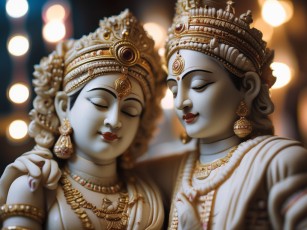
Introducing White Marble
It’s fascinating to learn about the unique history and creative vision of Keshava Maharaja in introducing white marble Radha-Krishna idols at the Nilachala Gaudiya Math in Puri. The innovative foresight of Keshava Maharaja (9 February 1898 – 6 October 1968) indeed led to significant cultural and artistic development, especially considering the initial opposition from his godbrothers. The global presence of Italian white marble Radha-Govinda installations stands as a testament to the impactful legacy of Keshava Maharaja’s vision through A.C. Bhakti Vedanta of ISKCON.
The discussion on the representation of Krishna in different forms, whether white or black, carries deep spiritual and philosophical significance. It’s intriguing to contemplate the various perspectives on this topic, especially in the context of spiritual studies such as the Sat Sandarva of Jiva Goswami (1513-
Died: 1598). It’s clear that these discussions hold great importance and can offer valuable insights into the diverse interpretations of Krishna’s divine manifestations.
The establishment of Radha (राधा) idols alongside Krishna idols in temples is an intriguing aspect of the development of Krishna worship. It appears that the physical representation of Radha alongside Krishna began to gain prominence after 1700 CE (When Aurangzeb attacked Vrindavana and Mathura, there were no Radha Idols)
The presence of Radha with Krishna seems to have become more prevalent after 1350 CE (Madavendra Puri was aware of It), with the concept receiving spiritual significance through the works of Chaitanya Mahaprabhu and later being propagated by Rupa-Sanatana in Vrindavana around 1520. This timing aligns with the emergence and popularization of the worship of Radha-Krishna in temples.
It’s intriguing to delve into the historical and philosophical aspects of Yugal Upasana (युगल उपासना), especially in relation to prominent figures such as Madhyacharya (1238-1317 CE), Ramanuja (1017-1137), and Shankara. The absence of the idea and idol of Radha in their worship practices as well as the presence of multiple depictions of Krishna without Radha in certain temples (Govardhana Mutt, Puri etc) sparks further contemplation on the evolution of Krishna worship.
The dissemination of the “Klim Krishnaya Gopijana Ballavaya” (क्लीं कृष्णाय गोपीजन वल्लभाय) diksha mantra from Iswar Puri to Chaitanya, and its subsequent discussion with Swarup Damodar and Rai Ramananda in Jagannath Puri, sheds light on the transmission and sharing of knowledge of महाभाव within the Nabadwip Circle. It’s fascinating to explore the interconnected web of spiritual teachings and practices that shaped the understanding of Yugal Upasana and the worship of Radha in conjugation with Krishna.
The influence and exchange of ideas between Chaitanya, Swarup Damodara, Rai Ramananda, Rupa, and Sanatana offer a glimpse into the dynamic nature of spiritual evolution and the adaptation of philosophical concepts over time. These discussions and interactions contributed to the broader dissemination of the Yugal Upasana (अचिन्त अद्वय) tradition, enriching the spiritual landscape with diverse perspectives and interpretations. We shall discuss it later.
It’s fascinating to explore the diverse sources that contribute to our knowledge of Krishna, such as the Gopala Tapani Upanisad, Bhagavata Purana, Visnu Purana, Mahabharata, Harivamsa Purana, and Gautamiya Tantra. These texts provide valuable insights into the historical significance of Krishna and his influence on Indian history, as well as his identification as an Avatara. But these books never mention Radha as a character.
The concept of Avatara may not be directly available in the Vedas, but the benevolent activities of Vishnu in preserving the universal order are evident in the Samhitas. Vishnu’s role as the Supreme Purusha in the Purusha Suktam and as the receiver of Yagna (यज्ञ) highlights his significance in sustaining and progressing the universe. The self-sacrifice of Vishnu for the greater good and his manifestation with his Saktis in the Yajurveda further contribute to the rich characterization of Vishnu.
Krishna Dvaipayana, the son of Parashara and Satyavati, recognized Krishna as an Avatara who, despite being in human condition, embodies divinity. This aspect of adhyatma (अध्यात्म), or spirituality, is fully manifested in the Bhagavad Gita.
While the above-mentioned texts do not specifically mention Radha, the historical and philosophical dimensions of Radha alongside Krishna have evolved over time, reflecting the dynamic nature of religious practices and beliefs. The representation of Radha alongside Krishna and the development of Radha-Krishna worship gained prominence after 1450 CE.
The exchange of ideas between prominent figures such as Madhyacharya, Ramanuja, and Shankara, in relation to the absence of the idea and idol of Radha in their worship practices, as well as the presence of multiple depictions of Krishna without Radha in Madhyacharya`s writing, sparks contemplation on the evolution of Krishna worship and the diverse interpretations of Krishna’s divine manifestations.
Discussing the Mention of Radha-Krishna in Gatha Saptasati and Gita Govinda
It’s interesting to note the mention of Radha-Krishna in ancient texts such as Gatha Saptasati and Gita Govinda. These texts provide valuable insights into the early references to the relationship between Radha and Krishna.
The Gatha Saptasati, also known as the Gatha Sapta Sati, is a significant poetic work attributed to the legendary poet Hala, from the first century CE mentioning Radha and Krishna in one poetry.
Similarly, the Gita Govinda, a lyrical poetic work composed by the renowned poet Jayadeva in the 12th century, is a timeless masterpiece that delves into the love affairs of Radha and Krishna. The Gita Govinda vividly describes the passionate and tumultuous love between Radha and Krishna, capturing the essence of their material bond through enchanting verses and lyrical narratives.
We will explore the depiction of Radha and Krishna by regional poets in subsequent discussions, further enriching our understanding of their timeless love and spiritual significance.
Misinterpretation of Gatha Saptasati and Gita Govinda
It seems there was a misunderstanding regarding the depiction of Radha and Krishna in the Gatha Saptasati and Gita Govinda. While the Gatha Saptasati presents Prakrit love poems reflecting emotions of separation and longing, the representation of Radha and Krishna holds a village depiction rather than a divine significance. Such as the case with other Kavyas.
As for the Gita Govinda, it’s important to note that while it vividly describes the sexual amore between Radha and Krishna, it is presented poetically and metaphorically. Jayadeva intended to capture the essence of their bond through enchanting verses, focusing on the emotional and material dimensions rather than a spiritual interpretation. The case is the same with Chandi Dasa`s poetry.
While these poetic works may contain elements of sensuality, it’s essential to appreciate them within their cultural and literary contexts, acknowledging their contribution to the rich tradition of Indian poetry and the exploration of human emotions and nothing more. It is to be remembered that our purpose is adhyatma and not Kavya. Our purpose is mokhya (मोक्ष) and not moha (मोह).
On Bramha Vaivarta Purana, Padma Purana, and Devi Bhagavat Purana
The Bramha Vaivarta Purana, Padma Purana, Garga Samhita, Devi Bhagavat Purana, etc. are commonly regarded as late and interpolated fraudulent texts, with disputed authorship and questionable veracity. These texts are believed to have been composed long after 1500 CE, and their linguistic and philosophical quality has been a subject of criticism or without any merit.
It’s important to note that the representation of Radha in these texts has been viewed with skepticism, and scholarly analysis suggests that the portrayal may not align with historical or philosophical accuracy. The relationship between Radha and Krishna, as depicted in these texts, has been met with skepticism due to the questionable nature of these texts.
Furthermore, it’s imperative to approach these texts with a critical lens, considering the historical context and the emergence of these works in relation to the broader tradition of Vedic and Puranic literature. The interpretations and representations of characters in these texts have been subject to critical scrutiny, and it’s essential to approach them with scholarly discernment and awareness of potential interpolations and alterations over time. In simple language, Radha of Bramha Vaivarta Purana is Muhammad (Islam) in disguise. This Radha is a fake construction and below the standard of discussion. Some idiots of Vrindavana love this Radha, who can whip Krishna if he defaults.
Resource from Chaitanya Charitamrita and Pure Tattva
Krishnadas in his Chaitanya Charitamrita (Adi lila) mentioned the following Slokas in bengali
রাধা কৃষ্ণপ্রণয়বিকৃতিহর্লাদিনীশক্তিরস্মা-
দেকাত্মানাবপি ভুবি পুরা দেহভেদং গতৌ তৌ
চৈতন্যাখ্যং প্রকটমধুনা তদ্দ্বয়ঞ্চৈক্যমাপ্তং
রাধাভাবদ্যুতিসুবলিতং নৌমিক কৃষ্ণস্বরূপম্॥ ৫
“The loving affairs of Śrī Rādhā and Kṛṣṇa are transcendental manifestations of the Lord’s internal pleasure-giving potency. Although Rādhā and Kṛṣṇa are one in Their identity, They separated Themselves eternally. Now these two transcendental identities have again united, in the form of Sri Kṛṣṇa Chaitanya. I bow down to Him, who has manifested Himself with the sentiment and complexion of Śrīmatī Rādhārāṇī although He is Kṛṣṇa Himself.” (Translation by AC Bhaktivedanta Swami)
Exploring the Nature of Radha and Krishna in Samkhya Philosophy
In the Samkhya philosophy, Radha and Krishna can be perceived as the Purusha (पुरुष) and Prakriti respectively, representing the divine masculine and feminine aspects. Radha, as the Hladini Shakti of Purusha Krishna, embodies the pleasure-giving potency, symbolizing the eternal union of the divine masculine and feminine energies.
Furthermore, the Jiva, or the individual soul, is considered the Tatastha Shakti of Krishna, existing as an intermediary energy between the conscious (Chit) and inert (Jada) energies. This intermediate energy facilitates the transformation of inert matter into conscious energy with the assistance of the Hladini Shakti, leading to the evolution of the Jiva’s relationship with the Purusha through Bhakti, or devotional love.
The concept of Prema, signifying the intimate loving relationship between the Purusha and Hladini Shakti, parallels the idea of Bhakti, representing the devotion of the Jiva towards the Purusha. These profound philosophical aspects are eloquently elucidated in the Narada and Sandilya Bhakti Sutras, offering spiritual seekers a deeper understanding of the divine dynamics between Radha, Krishna, and the individual soul.
The appearance of Chaitanya Mahaprabhu is seen as the tangible manifestation of the Hladini Shakti (ह्लादिनी शक्ति), serving as a compassionate guide for devotees to directly comprehend the essence of divine bliss and love. Through his exemplary life and teachings, Chaitanya Mahaprabhu illuminates the path of devotion and divine love, nurturing a profound connection with the Hladini Shakti within the hearts of all sincere seekers.
The Eternal Bond of Radha and Krishna in Devotional Literature and Theological Discourse
The concept of Radha and her profound relationship with Krishna holds a significant place in devotional literature and theological discussions, particularly within the context of Bhakti traditions. While historical accounts may not explicitly mention Radha in conjunction with Krishna, the spiritual and symbolic significance attributed to her transcends the boundaries of historical validation. Radha is revered as the embodiment of divine love and devotion, symbolizing the eternal union and the ecstatic exchange of love between the individual soul and the Supreme Being.
Krishna’s multifaceted role in upholding Dharma, guiding humanity, and manifesting his divinity through various actions is indeed a prominent aspect of his narrative, as depicted in ancient scriptures and epics. The emphasis on his responsibilities as a warrior, king, and propagator of righteousness aligns with his portrayal in historical and mythological accounts. Historical Krishna did not know, who is Radha. He died at the age of 125 and merged with his Divinity.
The understanding of Krishna’s divine manifestations and his association with the Hladini Shakti (ह्लादिनी शक्ति), as manifested through Chaitanya Mahaprabhu, adds depth to the spiritual exploration of his transcendental nature. Chaitanya Mahaprabhu’s embodiment of the Hladini Shakti further emphasizes the eternal dynamics of love and devotion exemplified by Radha and Krishna, offering profound insights into the spiritual realm.
Understanding the Nature of Radha from a Devotional Perspective
In the context of devotional traditions, it’s important to recognize that the perception of Radha is deeply rooted in spiritual interpretations and devotion rather than historical or empirical validation. Devotees who revere Radha do so from a lens of divine love, symbolizing the eternal union and the ecstatic exchange of love between the individual soul and the Supreme Being.
The portrayal of Radha as the Hladini Shakti of Purusha, as mentioned in Vedic scriptures and expounded upon through the teachings of Chaitanya Mahaprabhu, signifies her divine essence and profound role in the spiritual realm. Devotees understand Radha as a transcendental manifestation of the Lord’s internal pleasure-giving potency, representing the eternal union of the divine energies.
Furthermore, the devotional understanding acknowledges that Radha’s divine nature transcends earthly limitations and human experiences. The invocation and worship of Radha are perceived as a deeply spiritual and internal process, symbolizing the intrinsic divine inquiry and the elevation of human consciousness to connect with the divine.
In essence, the devotional perspective views Radha as a symbol of divine love and spiritual union with Krishna, representing the pinnacle of devotion and the embodiment of transcendental bliss. It’s within this sacred context that the reverence for Radha is cultivated, emphasizing the profound spiritual significance she holds in the hearts of devotees.
It is true that without Chaitanya we shall never be able to know the Radha.
যদি, গৌর না হ’ত তবে কি হইত
কেমনে ধরিতাম দে ।
রাধার মহিমা প্রেম-রসসীমা
জগতে জানাত কে ? ॥
মধুর বৃন্দা বিপিন-মাধুরী
প্রবেশ চাতুরী সার ।
বরজ-যুবতী ভাবের ভকতি
শকতি হইত কার ? ॥
(Without Goura Chaitanya it was impossible to know about Prema-Bhakti and the secret of Radha)
The status of Radha is aptly depicted in the above Kirtana.
Clarification on the Worship and Reverence of Radha (बरसाने वाली राधे)
The concept of Radha and the associated reverence in spiritual traditions is deeply rooted in the realm of transcendental devotion and the exploration of divine love. It’s essential to acknowledge that the perception and worship of Radha transcend mundane consciousness and worldly considerations. Radha’s essence is revered within the realm of Yoga Bhumi (योगस् चित्त वृत्ति निरोधोस्तु), representing a profound state of consciousness that transcends worldly desires and material pursuits.
The true significance of Radha lies in the spiritual understanding of her divine nature, symbolizing the eternal union and the ecstatic exchange of love (दिव्य उन्मादन) between the individual soul and the Supreme Being (ईश्वर परम कृष्ण सत्चिदानन्द बिग्रह). The reverential exploration of Radha’s essence (रस वै सह:) is intricately intertwined with the path of devotion and the elevation of human consciousness to connect with the divine at a transcendental level.
In this context, the worship of Radha’s idol serves nothing and the act of chanting Radha’s name is a waste of time and stupidity. ‘राधे राधे बरसाने वाली राधे’ ( or बरसाने वाली तेरी महिमा न्यारी) is a fradulent invention for earning money and fame.
Therefore, it’s imperative to approach the reverence of Radha with a deep understanding of its spiritual significance as a means to transcend the worldly consciousness and embrace the Yogabhumi (योग भूमि) of divine love and devotion. The true essence of Radha’s worship lies in the profound metaphysical inquiry (अथातो ब्रह्म जिज्ञासा) and the elevation of consciousness (तत् तं असि, the तटस्थ शक्ति of Krishna), transcending the limitations of worldly desires and attachments. Entering into the ह्लादिनी is the object of भाव साधन.
Tanmoy Bhattacharyya (BHU)
28/07/2024