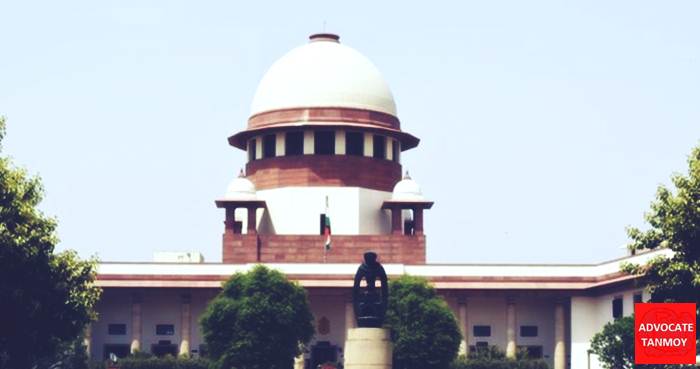
SUPREME COURT OF INDIA
Ashim @ Asim Kumar Haranath Bhattacharya @ Asim Harinath Bhattacharya @ Aseem Kumar Bhattacharya Vs. National Investigation Agency
[Criminal Appeal No(s). 1525 of 2021 arising out of S.L.P. (Criminal) No(s). 6858 of 2021]
ACTS: Under Sections 120B, 121, 121A, 122 of the IPC, Section 25(1A) of the Arms Act, 1959 and Section 5 of the Explosive Substances Act, 1908 READ WITH Section 19 of the National Investigation Agency Act, 2008
DATE: 01/01/2021
Rastogi, J.
1. Leave granted.
2. We have heard learned counsel for the parties.
3. The instant appeal has been filed on behalf of accused no. 6(Ashim @ Asim Kumar Haranath Bhattacharya) out of the total number of 14 accused persons seeking post arrest bail which came to be rejected by the learned trial Court by Order dated 25th February, 2020 and also by the High Court by Order dated 15th March, 2021.
4. The FIR No. 138/2012 dated 1st March, 2012 was initially lodged under Sections 120B, 121, 121A, 122 of the IPC, Section 25(1A) of the Arms Act, 1959 and Section 5 of the Explosive Substances Act, 1908 against five accused persons by a defacto complainant who is an Inspector, Special Task Force. Later, the National Investigation Agency took over the investigation.
The said case was reregistered as RC No. 01/2012/NIA/DLI at PS NIA Headquarters, New Delhi for offences under Sections 120B, 121, 121A, 122 IPC, Section 25(1A) of the Arms Act 1959, Section 5 of the Explosive Substances Act, 1908 and Sections 18,20,40(1)(b)(c) of the Unlawful Activities(Prevention) Act, 1967(hereinafter being referred to as “UAP Act”) on 12th April, 2012.
5. After investigation, the charge sheet was initially filed against A1 to A5 on 23rd August, 2012 and thereafter the first supplementary charge sheet was filed on 27th December, 2012 against A6 to A9 in which the appellant was named as A6 and the second supplementary charge sheet was filed on 3rd July, 2017 against another 5 accused persons.
The said accused persons are presently absconding. The charges later came to be framed on 20th June, 2019 for offences under Sections 121, 121A, 122, 120B IPC and under Sections 25(1)(a), 25(1A), 25(1AA) of Arms Act, 1959 and under Sections 18 and 20 of the UAP Act. At this stage, PW 1 who is the defacto complainant, his crossexamination has been going on for quite a long time and still it has not been completed.
6. The appellant was arrested on 6th July, 2012 on the basis of a production warrant sent to Nagpur Central Jail, Maharashtra. The appellant was in jail earlier in connection with another case(FIR No. 28/2007 dated 11th May, 2007)in which he was acquitted by the competent Court of jurisdiction by a judgment dated 15th February, 2014.
7. It has come on record that there are 298 prosecution witnesses in the calendar of witnesses as referred to in the charge sheet but it has been stated in the counter affidavit filed by the respondent that the prosecution in all likelihood may examine only 100 to 105 prosecution witnesses.
8. The charges against the accused appellant are undoubtedly serious but the charges will have to be balanced with certain other factors like the period of incarceration which the appellant has undergone and the likelihood period within which the trial can be expected to be finally concluded. That apart, the appellant is 74 years of age.
9. Learned counsel for the respondent vehemently opposed the appeal filed by the accused appellant seeking post arrest bail and submits that the delay is in no manner be attributable to the prosecution and this Court may direct the trial Court to take up the case on daytoday basis and conclude the trial at the earliest.
10. That the requirement of law as being envisaged under Section 19 of the National Investigation Agency Act, 2008(hereinafter being referred to as “Act 2008”) mandates that the trial under the Act of any offence by a Special Court shall be held on daytoday basis on all working days and have precedence over the trial of any other case and Special Courts are to be designated for such an offence by the Central Government in consultation with the Chief Justice of the High Court as contemplated under Section 11 of the Act 2008 but the ground realities are totally different as in the instant case, after the chargesheets came to be filed way back in 2012, the charges have been framed after 7 years of filing of the chargesheet on 20th June, 2019.
11. We have to balance the nature of crime in reference to which the appellant is facing a trial. At the same time, the period of incarceration which has been suffered and the likely period within which the trial can be expected to be completed, as is informed to this Court that the statement of PW1/ defacto complainant has still not been completed and there are 298 prosecution witnesses in the calendar of witness although the respondent has stated in its counter affidavit that it may examine only 100 to 105 witnesses but indeed may take its own time to conclude the trial. This fact certainly cannot be ignored that the appellant is in custody since 6th July, 2012 and has completed nine and half years of incarceration as an undertrial prisoner.
12. This Court has consistently observed in its numerous judgments that the liberty guaranteed in Part III of the Constitution would cover within its protective ambit not only due procedure and fairness but also access to justice and a speedy trial is imperative and the undertrials cannot indefinitely be detained pending trial. Once it is obvious that a timely trial would not be possible and the accused has suffered incarceration for a significant period of time, the Courts would ordinarily be obligated to enlarge him on bail.
13. Deprivation of personal liberty without ensuring speedy trial is not consistent with Article 21 of the Constitution of India. While deprivation of personal liberty for some period may not be avoidable, period of deprivation pending trial/appeal cannot be unduly long. At the same time, timely delivery of justice is part of human rights and denial of speedy justice is a threat to public confidence in the administration of justice.
14. The three Judge Bench of this Court in Union of India Vs. K.A. Najeeb 2021(3) SCC 713 had an occasion to consider the long incarceration and at the same time the effect of Section 43D( 5) of the UAP Act and observed as under:
17. It is thus clear to us that the presence of statutory restrictions like Section 43D( 5) of the UAPA per se does not oust the ability of the constitutional courts to grant bail on grounds of violation of Part III of the Constitution. Indeed, both the restrictions under a statute as well as the powers exercisable under constitutional jurisdiction can be well harmonised.
Whereas at commencement of proceedings, the courts are expected to appreciate the legislative policy against grant of bail but the rigours of such provisions will melt down where there is no likelihood of trial being completed within a reasonable time and the period of incarceration already undergone has exceeded a substantial part of the prescribed sentence. Such an approach would safeguard against the possibility of provisions like Section 43D( 5) of the UAPA being used as the sole metric for denial of bail or for wholesale breach of constitutional right to speedy trial.
15. In the above circumstances, we are of the view that the appellant accused has made out a case for grant of postarrest bail pending trial.
16. Before parting with the order, we would like to observe that under the scheme of the Act 2008, the power is vested with the Central Government in consultation with the Chief Justice of the High Court, for the trial of scheduled offences, designate one or more Courts of Session as Special Courts, by notification in the Official Gazette, with the place of jurisdiction of special Courts and its jurisdictional power has been defined under Sections 13 and 14 of the Act 2008.
At the same time, it has been mandated under Section 19 of the Act 2008 that the trial under the Act of any offence by a Special Court shall be held on daytoday basis on all working days and shall be concluded in preference to the trial of such other case and accordingly the trial of such other case shall, if necessary, remain in abeyance. The power of State Government to designate one or more Courts as Special Courts for the trial of offences under any or all the enactments specified in the Schedule is provided under Section 22 of the Act, 2008.
17. It has been informed to this Court that only one such Special Court has been designated by the State of West Bengal to try such cases under the Act 2008. Before us, the order sheets have been placed for perusal of the instant case and it indicates that hearing is taking place only one day in a month and if this procedure is being followed in conducting the trial under Act 2008, it frustrates the very purpose with which the special Courts are designated.
18. It is clearly demonstrated from the instant case that after the chargesheet came to be filed in the year 2012, charges have been framed in June 2019 and looking to the voluminous record and number of the prosecution witnesses which are to be examined, it may take its own time to conclude and indeed the undertrial prisoner cannot be detained for such a long period of incarceration noticed by us in the instant case. The correspondence which has taken place between the Central Government and the State of West Bengal from time to time is placed for our perusal but nothing elicits from the record.
19. In the given circumstances, we consider it appropriate to direct that the State of West Bengal shall take up the issue and designate more dedicated courts of Sessions as Special Courts for the trial of offences specified in the schedule appended to the Act 2008.
At the same time, the Central Government may also, in consultation with the Chief Justice of the High Court, Calcutta may exercise its power and take up the issue at the earliest so that such trials which are pending under the Act 2008 may go ahead speedily and the mandate, as intended by the legislature in its wisdom, reflected from Section 19 of the Act, is being complied with in its letter and spirit.
20. We accordingly direct that the accused appellant be produced before the trial Court within three days and shall be released on postarrest bail by the learned trial Court. We also make it clear that the learned trial Court will be at liberty to consider and impose appropriate conditions subject to which the appellant accused will be released on bail so as to ensure that the appellant accused is available for trial in terms of the present order.
21. Consequently, in light of the above, the appeal is allowed and the judgment and order of the High Court is set aside.
22. Pending application(s), if any, stand disposed of.
23. Copy of this order be sent to Chief Secretary, State of West Bengal and Registrar of the High Court of Calcutta for necessary compliance.
J. (AJAY RASTOGI)
J. (ABHAY S. OKA)
NEW DELHI
DECEMBER 01, 2021