Encyclopedia of Ancient and Modern India
Encyclopedia of Sanatan Dharma
Supreme Court Orders Lighting of Karthigai Deepam at Thiruparankundram Deepathoon
Deepathoon Temple Controversy (Hindu Dharma Parishad v Union of India)
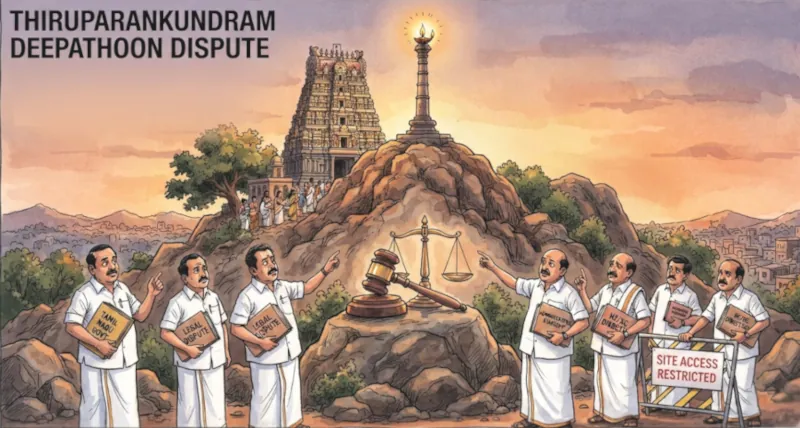
The Karthigai Deepam dispute at Thiruparankundram Hill, Madurai, Tamil Nadu, became the subject of significant constitutional and judicial intervention on 27 November 2026, when the Supreme Court of India (Writ Petition(s)(Civil) No(s). 1280/2025) directed that the ceremonial lamp be lit at the disputed Deepathoon stone pillar on 28 November 2026. The order, delivered by a Bench comprising Justice Aravind Kumar and Justice Vipul M. Pancholi in Hindu Dharma Parishad v. Union of India, Writ Petition (Civil) No. 1280 of 2025, also suspended the Board of Trustees of the Arulmigu Subramaniaswamy Temple, appointed two retired High Court judges as joint receivers to administer the temple, and transferred security arrangements for the temple and the hill to the Central Reserve Police Force (CRPF). The proceedings arose from the failure to implement an earlier Supreme Court direction dated 20 November 2026, which had permitted the lighting of Karthigai Deepam at Deepathoon on 24 November as a one-time interim arrangement.
A. Rule of Law Prevails: State administrations cannot bypass Supreme Court orders using Section 163 BNSS or administrative excuses.
B. Balanced Coexistence: Upholding temple land rights (1931 Privy Council) while strictly protecting the 50-metre Dargah perimeter with CRPF security.
C. Judicial Caution: Respecting traditional customs while ensuring peaceful religious freedom under Articles 25–28.
Thiruparankundram, situated approximately eight kilometres south-west of Madurai city, is among the most important religious centres associated with Lord Murugan, the Hindu deity traditionally worshipped as the son of Shiva and Parvati. The hill is particularly significant in Tamil religious history because Thiruparankundram is recognised as the first of the six sacred abodes of Murugan (Arupadai Veedu). The Arulmigu Subramaniaswamy Temple, located on the hill, is an ancient rock-cut temple whose religious and architectural history is associated with the early Pandya period. The hill also contains a Muslim place of worship, commonly referred to as the Sikandar Badusha Dargah, situated in proximity to the location identified as Deepathoon. The coexistence of these religious institutions has made the question of access, religious observance and administrative control particularly sensitive.
The immediate controversy concerns the location at which the annual Karthigai Deepam, also known as Karthigai Mahadeepam, should be illuminated. Karthigai Deepam is an important Tamil Hindu festival observed during the Tamil month of Karthigai, generally corresponding to November and December. The festival is associated with the illumination of oil lamps and the worship of Shiva, Murugan and the divine manifestation of light. The ceremonial lighting of a large lamp at an elevated location is an important feature of its observance in several Tamil temples. At Thiruparankundram, the temple administration had traditionally conducted the principal lighting ceremony at the Deepa Mandapam, near the Uchipillaiyar Temple on the hill. Hindu organisations and devotees, however, sought permission to light the ceremonial lamp at Deepathoon, a stone pillar situated at a higher elevation, approximately 50 metres from the Dargah.
The dispute is not confined to the physical location of an oil lamp. It involves questions concerning historical usage, customary religious practices, temple administration, statutory authority, access to religious sites and the constitutional obligation to obey judicial orders. The parties have advanced competing positions regarding the historical and religious character of the Deepathoon. The temple trustees have relied upon the continuity of the established ritual at Deepa Mandapam, together with references to Agamic traditions, historical documents and the opinions of the temple’s sthanikars, or hereditary ritual functionaries. Hindu organisations have sought recognition of the Deepathoon as the appropriate location for the ceremonial lighting.
The litigation has a considerably longer judicial history. The Supreme Court’s order dated 27 November 2026 specifically referred to a decree in Original Suit No. 4 of 1920, which was subsequently affirmed by the Judicial Committee of the Privy Council on 12 May 1931. The existence of this historical decree has been an important feature of the subsequent proceedings concerning the religious and administrative status of the hill. Nevertheless, successive rounds of litigation continued, eventually bringing the matter before the Madras High Court and subsequently the Supreme Court. The Supreme Court’s November 2026 proceedings arose from an impugned judgment dated 6 January 2026 passed by the jurisdictional High Court. The apex court stayed the relevant observations contained in paragraphs 1 to 141 of that judgment while considering the appeals and interim applications.
On 20 November 2026, the Supreme Court issued an interim direction permitting the ceremonial lamp to be lit at Deepathoon on 24 November 2026. The permission was expressly described as a temporary arrangement for that year’s festival, rather than recognition of an established customary, proprietary or religious entitlement. The Court prescribed several safeguards. The lighting ceremony was to be conducted by a restricted team authorised by the Devasthanam, with the District Collector of Madurai acting as the nodal officer. The Collector was required to coordinate with the Temple Executive Officer, the Archaeological Survey of India (ASI) and the Commissioner of Police, Madurai. The authorities were also required to regulate access, protect the archaeological site and prevent public gatherings, demonstrations, processions and activities unrelated to the ceremony.
The order further protected the existing religious observances at the customary temple locations and expressly prohibited interference with the lawful religious activities, access and enjoyment of the Dargah. No excavation, construction, permanent installation or structural alteration was permitted. The Court clarified that the temporary arrangement would not establish a precedent for subsequent years or determine questions of title, possession, customary usage or essential religious practice. The District Collector was directed to submit a compliance report within three days after the festival.
However, the ceremony on 24 November 2026 did not take place at Deepathoon. Instead, the temple administration illuminated the traditional lamp at Deepa Mandapam near the Uchipillaiyar Temple. According to the preliminary report subsequently placed before the Supreme Court, the Board of Trustees had passed Resolution No. 1 on 24 November, deciding that the Karthigai Mahadeepam should be lit at its customary location. The resolution referred to the temple’s historical traditions, Agamic practices and the continuity of religious observances. It also stated that these traditions should subsequently be brought to the notice of the Court.
The District Collector, Nishant Krishna, IAS, submitted a preliminary report dated 25 November 2026, explaining that the direction could not be implemented because the temple administration had not authorised a team to light the lamp at Deepathoon. The Collector tendered an apology and maintained that the administration had taken steps to comply with the Supreme Court’s order. The State Government also apologised before the apex court. The temple authorities, however, maintained that the Executive Officer could not override a resolution adopted by the Board of Trustees concerning religious matters.
The Supreme Court considered these explanations insufficient. Its order dated 27 November 2026 recorded that the failure to light the lamp at Deepathoon, coupled with the trustees’ resolution to continue the customary ceremony elsewhere, prima facie constituted wilful and flagrant disobedience of the order dated 20 November. The Bench also took note of an undertaking reportedly given before the Madras High Court that the Supreme Court’s direction would be implemented. The judges observed that the subsequent conduct of the temple administration and the authorities raised serious questions regarding compliance with judicial orders.
In its discussion of constitutional principles, the Court relied upon its earlier judgment in T.N. Godavarman Thirumulpad v. Ashok Khot (2006) 5 SCC 1, emphasising the supremacy of law and the obligation of every individual and institution to comply with judicial directions. It specifically referred to Article 144 of the Constitution of India, which requires all civil and judicial authorities within the territory of India to act in aid of the Supreme Court. The Bench also invoked Article 129, under which the Supreme Court is a Court of Record with the power to punish for contempt, and referred to the Contempt of Courts Act, 1971. It emphasised that an order of the Supreme Court cannot be treated as an invitation to negotiate or as a direction whose implementation may be decided independently by subordinate authorities.
The Court consequently directed the Chief Secretary of Tamil Nadu to submit an affidavit detailing communications, including emails, telephone calls, messages and relevant call detail records exchanged between officials before the scheduled lighting ceremony. Notices were issued to senior State officials, including the Chief Secretary, Director General of Police, senior officials of the Hindu Religious and Charitable Endowments Department, Madurai District Collector, police officers and members of the temple’s Board of Trustees. They were required to explain why contempt proceedings should not be initiated for the alleged wilful disobedience. The concerned officials were directed to file their replies within ten days of service of notice and appear personally before the Supreme Court on 15 December 2026 at 2 p.m.
A further and consequential direction concerned the administration of the temple. Finding a prima facie failure on the part of the Board of Trustees to discharge its responsibilities, the Supreme Court ordered the suspension and supersession of the Board. It appointed Justice S. Vaidyanathan, former Chief Justice of the Meghalaya High Court, and Justice V. Parthiban, former Judge of the Madras High Court, as joint receivers. They were directed to assume immediate charge of the temple administration and manage its affairs in accordance with established traditions, applicable legislation, rules and regulations. The State Government was instructed to provide the necessary administrative and logistical assistance.
The Court also ordered the CRPF to take over security of the temple and the entire Thiruparankundram Hill. The Commandant of the CRPF in Chennai was directed to assume responsibility for the peaceful conduct of religious activities at both the temple and the Dargah. The Tamil Nadu Police were required to facilitate the transfer of security arrangements, while continuing to provide protection to the surrounding area. The Court expressly directed that devotees visiting either place of worship must not be obstructed or prevented from offering prayers.
Regarding the ceremonial lighting, the Supreme Court directed the joint receivers to ensure that Karthigai Deepam was lit at Deepathoon on 28 November 2026, during the Tamil month of Karthigai. The Court initially directed that the flame used at Uchipillaiyar Mandapam on 24 November be used, provided it remained alight. After being informed that the flame had extinguished, the Bench clarified that the receivers could arrange a fresh flame in accordance with the earlier judicial direction. The timing was to be fixed in consultation with the temple’s sthanikars.
The 27 November order also expanded the arrangement concerning participation. Unlike the restricted team contemplated in the order of 20 November, the receivers were directed to permit devotees to light lamps at Deepathoon and other designated locations, subject to appropriate security arrangements. The Court stipulated that the lamp at the disputed site must remain at least 50 metres from the Dargah on all sides, thereby seeking to preserve access and religious observances at both institutions.
The Supreme Court’s directions of 27 November 2026 represent an important development in the continuing Thiruparankundram litigation. Although the immediate dispute concerns the location of Karthigai Deepam, the proceedings have also raised wider questions concerning constitutional supremacy, judicial authority, religious customs, public administration and the protection of competing places of worship. The Court expressly maintained that its temporary directions would not create equities in favour of either party or finally determine the underlying rights. The matter was listed for further consideration on 15 December 2026, when the replies of the officials and the questions arising from the alleged disobedience were scheduled to be examined.
Sarvarthapedia: Cross-Referenced Conceptual Network
Central Node: Karthigai Deepam Dispute at Thiruparankundram Hill
Primary subject: The Supreme Court proceedings in Hindu Dharma Parishad v. Union of India, W.P. (C) No. 1280 of 2025, concerning the lighting of the Karthigai Deepam at Deepathoon, a stone pillar on Thiruparankundram Hill, Madurai, Tamil Nadu.
Core themes: Religious custom, temple administration, judicial authority, constitutional governance, contempt of court, public order, heritage protection and the administration of religious institutions.
Cluster 1: Historical and Religious Background
Node 1.1: Karthigai Deepam
- Tamil Hindu festival observed during the Tamil month of Karthigai.
- Associated with the lighting of lamps as a religious observance.
- The 24 November 2026 observance coincided with the Krittika (Karthigai) nakshatra and Pournami (full moon).
- Central to the dispute over the appropriate location for lighting the ceremonial lamp.
See also: Deepa Mandapam; Deepathoon; Murugan Worship; Temple Rituals; Religious Custom.
Node 1.2: Arulmigu Subramaniaswamy Temple
- Tamilnadu
- Hindu Dharma
- Sanatan Dharma
- Vedic Dharma
- Lord Murugan
- Historic Hindu temple situated on Thiruparankundram Hill, Madurai.
- Dedicated to Lord Murugan.
- The temple administration and its Board of Trustees became central to the proceedings concerning the implementation of the Supreme Court’s directions.
See also: Hindu Temple Administration; Tamil Nadu Hindu Religious and Charitable Endowments Department; Temple Board of Trustees; Thiruparankundram Hill.
Node 1.3: Thiruparankundram Hill
- Religious and historically significant hill in Madurai, Tamil Nadu.
- Contains the Subramaniaswamy Temple, Deepathoon and a Dargah.
- The coexistence of religious institutions and the need to protect access and worship became important considerations in the judicial proceedings.
See also: Subramaniaswamy Temple; Sikandar Badusha Dargah; Deepathoon; Religious Coexistence; Heritage Protection.
Node 1.4: Deepa Mandapam
- Traditional location identified by the Temple Board for lighting the Karthigai Deepam.
- Situated near Uchipillaiyar Temple on the hill.
- The ceremonial lamp was lit at this location on 24 November 2026, rather than at Deepathoon.
See also: Karthigai Deepam; Uchipillaiyar Temple; Deepathoon; Temple Rituals; Temple Board Resolution of 24 November 2026.
Node 1.5: Deepathoon
- Stone pillar on Thiruparankundram Hill, approximately 50 metres from the Dargah.
- The proposed location for lighting the Karthigai Deepam.
- Became the central geographical and religious focus of the dispute.
- The Supreme Court’s order dated 27 November 2026 directed that the lamp be lit at Deepathoon on 28 November 2026, subject to specified safeguards.
See also: Karthigai Deepam Dispute; Supreme Court Order of 20 November 2026; Supreme Court Order of 27 November 2026; Dargah Protection; Religious Custom.
Cluster 2: Historical Litigation and Judicial Proceedings
Node 2.1: Civil Suit O.S. No. 4 of 1920
- Earlier litigation concerning the rights and religious interests associated with the hill.
- The decree was subsequently affirmed by the Privy Council on 12 May 1931.
- Forms part of the historical legal background referred to in the later proceedings.
See also: Privy Council Judgment of 12 May 1931; Thiruparankundram Property and Religious Dispute; Madras High Court Judgment of 6 January 2026.
Node 2.2: Privy Council Judgment of 12 May 1931
- Affirmed the decree in O.S. No. 4 of 1920.
- An important historical judicial reference in the Thiruparankundram dispute.
See also: O.S. No. 4 of 1920; Historical Litigation; Madras High Court Judgment of 6 January 2026.
Node 2.3: Madras High Court Judgment of 6 January 2026
- Earlier judicial decision concerning the dispute.
- Its observations in paragraphs 1–141 were subsequently stayed by the Supreme Court’s order dated 20 November 2026.
See also: Supreme Court Order of 20 November 2026; Hindu Dharma Parishad v. Union of India; Judicial Review; Interim Judicial Relief.
Node 2.4: Supreme Court Order of 20 November 2026
- Permitted a one-time lighting of the lamp at Deepathoon on 24 November 2026.
- Prescribed safeguards concerning the authorised team, public access, law and order, archaeological protection and non-interference with Dargah activities.
- Appointed the District Collector, Madurai, as nodal officer.
- Clarified that the temporary arrangement did not recognise any customary, proprietary or religious right and left questions of title, possession and entitlement open.
See also: Deepathoon; District Collector, Madurai; Archaeological Protection; Public Order; Supreme Court Order of 27 November 2026.
Node 2.5: Supreme Court Order of 27 November 2026
- Passed in Hindu Dharma Parishad v. Union of India, W.P. (C) No. 1280 of 2025.
- Examined the events surrounding the non-implementation of the 20 November order.
- Issued show-cause notices for alleged contempt.
- Appointed two former High Court judges as Joint Receivers.
- Directed CRPF to assume security responsibilities for the temple and the entire hill.
- Directed that the lamp be lit at Deepathoon on 28 November 2026, subject to safeguards.
See also: Contempt of Court; Joint Receivers; CRPF Deployment; Temple Administration; Judicial Enforcement.
Cluster 3: Constitutional Principles and Judicial Authority
Node 3.1: Rule of Law
- Fundamental constitutional principle requiring every person and public authority to act according to law.
- The Supreme Court emphasised that disobedience of judicial orders strikes at the foundation of the rule of law.
- The Court relied on the principle that no individual or institution is above the law.
See also: Article 144; Article 129; Contempt of Courts Act, 1971; Judicial Authority; T.N. Godavarman Thirumulpad v. Ashok Khot.
Node 3.2: Article 144 of the Constitution of India
- Requires all civil and judicial authorities in the territory of India to act in aid of the Supreme Court.
- Relevant to the responsibility of State authorities to implement Supreme Court directions.
See also: Rule of Law; Judicial Compliance; Executive Accountability; Supreme Court Order of 27 November 2026.
Node 3.3: Article 129 of the Constitution of India
- Declares the Supreme Court to be a Court of Record.
- Recognises its power to punish for contempt of itself.
See also: Contempt of Court; Judicial Authority; Contempt of Courts Act, 1971; Constitutional Powers of the Supreme Court.
Node 3.4: Contempt of Courts Act, 1971
- Statutory framework governing contempt of court.
- Relevant to the Supreme Court’s examination of alleged wilful disobedience of its earlier directions.
See also: Article 129; Civil Contempt; Wilful Disobedience; Show-Cause Notice; Judicial Enforcement.
Node 3.5: T.N. Godavarman Thirumulpad v. Ashok Khot (2006) 5 SCC 1
- Supreme Court precedent cited in the 27 November 2026 proceedings.
- Emphasises the supremacy of the rule of law and the importance of protecting the dignity and authority of courts.
- Supports the principle that disobedience of court orders undermines the administration of justice.
See also: Rule of Law; Contempt of Court; Judicial Authority; Article 129; Article 144.
Cluster 4: Contempt Allegations and Executive Accountability
Node 4.1: Alleged Wilful Disobedience
- The petitioners alleged that the Supreme Court’s 20 November directions had not been implemented.
- The Supreme Court considered the circumstances surrounding the lighting of the lamp at Deepa Mandapam instead of Deepathoon.
- The Court found a prima facie case of wilful and flagrant disobedience requiring responses from the concerned officials and trustees.
See also: Temple Board Resolution; District Collector’s Report; Contempt Proceedings; Supreme Court Order of 27 November 2026.
Node 4.2: Temple Board Resolution No. 1 of 24 November 2026
- Adopted by the Temple Board on the date of the Karthigai Deepam observance.
- Favoured lighting the lamp at the traditional Deepa Mandapam.
- Stated that the relevant traditions should be brought to the Court’s notice.
- The Supreme Court expressed serious concern over the resolution and its implications for compliance with the earlier order.
See also: Deepa Mandapam; Deepathoon; Temple Administration; Alleged Wilful Disobedience; Joint Receivers.
Node 4.3: District Collector’s Preliminary Report of 25 November 2026
- Reported that the 20 November order could not be implemented because the temple administration had not appointed the authorised team.
- Included an apology.
- The Supreme Court found the report unsatisfactory and recorded that it was being taken on record only for statistical purposes.
- The Court directed the Collector to explain the circumstances surrounding the failure to implement the order.
See also: District Collector, Madurai; Executive Accountability; Contempt Proceedings; Article 144.
Node 4.4: Chief Secretary of Tamil Nadu
- Directed to file an affidavit detailing communications, including emails, calls, messages and call detail records, between relevant officials before the proposed lighting.
- Required to appear personally before the Supreme Court.
- The direction concerned the Court’s prima facie concern regarding possible executive and political interference.
See also: Executive Accountability; State Government; Contempt Proceedings; Police Administration.
Node 4.5: Show-Cause Notices
- Issued to concerned government officials, police officers, temple administrators and trustees.
- Required the recipients to explain why contempt proceedings should not be initiated against them.
- Replies were directed within an outer limit of 10 days from service.
- Personal appearance was directed for 15 December 2026 at 2 PM.
See also: Civil Contempt; Article 129; Contempt of Courts Act, 1971; Supreme Court Order of 27 November 2026.
Cluster 5: Temple Administration and Judicial Supervision
Node 5.1: Board of Trustees
- The body responsible for the administration of the temple.
- Its conduct and resolution of 24 November 2026 were examined by the Supreme Court.
- The Court ordered the suspension or supersession of the Board, citing its complete failure in administration.
See also: Temple Administration; Hindu Religious and Charitable Endowments Department; Joint Receivers; Judicial Supervision.
Node 5.2: Joint Receivers
- Appointed by the Supreme Court to take immediate charge of the temple administration.
- Comprising:
- Justice S. Vaidyanathan, former Chief Justice of the Meghalaya High Court.
- Justice V. Parthiban, former Judge of the Madras High Court.
- Directed to maintain religious traditions and rituals, preserve the sanctity of the temple and ensure compliance with applicable laws and regulations.
See also: Board of Trustees; Judicial Supervision; Temple Administration; Religious Autonomy; Supreme Court Order of 27 November 2026.
Node 5.3: Hindu Religious and Charitable Endowments Department
- Tamil Nadu’s statutory administrative framework for Hindu religious institutions and endowments.
- Its officials and the temple’s administrative structure were relevant to the question of implementing the Supreme Court’s directions.
See also: Temple Board of Trustees; Executive Officer; Joint Receivers; State Government; Religious Institution Administration.
Node 5.4: Temple Executive Officer
- The temple’s administrative officer.
- Stated that he could not overrule the Board’s resolution.
- His role became relevant to the Supreme Court’s examination of institutional responsibility for non-implementation.
See also: Temple Board Resolution; Joint Receivers; Contempt Proceedings; Temple Administration.
Cluster 6: Security, Public Order and Religious Coexistence
Node 6.1: CRPF Deployment
- The Supreme Court directed the CRPF Commandant, Chennai, to take over security of the temple and the entire hill.
- The direction followed the Court’s assessment that the local police administration had failed to implement its earlier order.
- The CRPF was directed to protect both the temple and the Dargah and ensure that devotees could worship without obstruction.
See also: Public Order; Dargah Protection; Temple Security; Tamil Nadu Police; Supreme Court Order of 27 November 2026.
Node 6.2: Tamil Nadu Police
- Responsible for maintaining law and order in the area.
- Directed to facilitate the transition of security responsibilities to the CRPF.
- Local police were to secure the surrounding area.
See also: CRPF Deployment; Public Order; District Administration; Executive Accountability.
Node 6.3: Sikandar Badusha Dargah
- A Muslim religious site situated on Thiruparankundram Hill.
- Its proximity to Deepathoon was a central consideration in the Supreme Court’s safeguards.
- The Court directed that Dargah activities and access should not be obstructed.
See also: Deepathoon; Religious Coexistence; CRPF Deployment; Public Order; Heritage Protection.
Node 6.4: Religious Coexistence
- The coexistence of the Hindu temple and the Dargah on Thiruparankundram Hill.
- The Supreme Court’s directions sought to protect the worship rights and access of devotees of both religious institutions.
- The Court prescribed security arrangements to prevent obstruction and disturbance.
See also: Sikandar Badusha Dargah; Subramaniaswamy Temple; CRPF Deployment; Public Order; Constitutional Religious Freedom.
Node 6.5: Fifty-Metre Safeguard
- The Supreme Court directed that the lamp-lighting location should remain at least 50 metres from the Dargah on all sides.
- The safeguard was intended to protect the Dargah and its religious activities while permitting the lighting of the lamp at Deepathoon.
See also: Deepathoon; Dargah Protection; Religious Coexistence; CRPF Deployment.
Cluster 7: Heritage Protection and Religious Custom
Node 7.1: Archaeological Protection
- The 20 November order included safeguards to prevent damage to archaeological structures and heritage features.
- The authorised team was required to act in coordination with the Archaeological Survey of India and relevant authorities.
See also: Archaeological Survey of India; Thiruparankundram Hill; Deepathoon; Heritage Conservation.
Node 7.2: Agamic Rules
- Religious prescriptions and ritual principles relevant to temple worship.
- Cited by the Temple Board as part of its stated basis for maintaining the traditional location of the lamp.
See also: Temple Rituals; Religious Custom; Sthanikars; Deepa Mandapam.
Node 7.3: Sthanikars
- Traditional temple functionaries whose views were referred to in the temple administration’s account of religious practice.
- The Supreme Court directed that the timing of the 28 November lamp-lighting should be settled in consultation with the sthanikars.
See also: Agamic Rules; Temple Rituals; Karthigai Deepam; Religious Custom.
Node 7.4: Customary Religious Practice
- The body of established religious observances and traditions associated with a temple.
- The Temple Board relied on customary practice to support lighting the lamp at Deepa Mandapam.
- The Supreme Court’s temporary directions did not finally determine questions of customary entitlement or religious rights.
See also: Agamic Rules; Deepa Mandapam; Deepathoon; Historical Litigation; Judicial Review.
Cluster 8: Operative Directions of 27 November 2026
Node 8.1: Lighting of Karthigai Deepam on 28 November 2026
- The Supreme Court directed that the lamp be lit at Deepathoon.
- The timing was to be settled in consultation with the sthanikars.
- The Court initially directed the use of the flame lit at Uchipillaiyar Mandapam on 24 November, if it was still burning.
- After being informed that the flame had been extinguished, the Court directed that a fresh flame be lit.
See also: Deepathoon; Karthigai Deepam; Sthanikars; Uchipillaiyar Mandapam; Supreme Court Order of 27 November 2026.
Node 8.2: Participation of Devotees
- The Court permitted devotees to light lamps at Deepathoon and other designated locations, subject to security arrangements.
- The directions were subject to the specified distance safeguard and protection of the Dargah.
See also: Religious Freedom; Deepathoon; Fifty-Metre Safeguard; CRPF Deployment.
Node 8.3: Preservation of Existing Safeguards
- The safeguards contained in the Supreme Court’s 20 November 2026 order continued to apply.
- The directions did not create equities in favour of either party.
- Questions of title, possession, custom and entitlement remained open for appropriate adjudication.
See also: Supreme Court Order of 20 November 2026; Interim Relief; Judicial Restraint; Religious Custom; Property Rights.
Node 8.4: Next Hearing on 15 December 2026
- The matter was listed for further consideration.
- The concerned officials and other notice recipients were directed to appear as specified by the Court.
- The contempt proceedings remained at the show-cause stage; the notices did not amount to a final finding of contempt.
See also: Show-Cause Notices; Contempt Proceedings; Chief Secretary’s Affidavit; Joint Receivers.
Cluster 9: Core Legal Concepts
Node 9.1: Civil Contempt
- Concerns wilful disobedience of a judgment, decree, direction, order, writ or other process of a court, or wilful breach of an undertaking given to a court.
- Relevant to the Supreme Court’s examination of the alleged non-implementation of its 20 November directions.
See also: Contempt of Courts Act, 1971; Wilful Disobedience; Article 129; Judicial Enforcement.
Node 9.2: Interim Judicial Relief
- Temporary directions issued pending final adjudication of disputed rights.
- The 20 November order permitted a one-time arrangement without deciding underlying questions of title, possession, custom or entitlement.
See also: Supreme Court Order of 20 November 2026; Supreme Court Order of 27 November 2026; Judicial Restraint; Final Adjudication.
Node 9.3: Executive Accountability
- The obligation of government officials to comply with judicial directions and discharge their statutory duties.
- Central to the Court’s scrutiny of the Collector, Chief Secretary, police administration and temple authorities.
See also: Article 144; Rule of Law; Contempt Proceedings; District Collector’s Report; Chief Secretary’s Affidavit.
Node 9.4: Judicial Enforcement
- The mechanisms through which courts ensure compliance with their orders.
- In this case, included contempt notices, personal appearance directions, appointment of Joint Receivers and transfer of security responsibilities to the CRPF.
See also: Article 129; Article 144; Contempt of Courts Act, 1971; Joint Receivers; CRPF Deployment.
Cross-Cluster Knowledge Connections
Connection A: Religious Custom and Judicial Authority
Karthigai Deepam → Deepa Mandapam → Deepathoon → Temple Board Resolution → Supreme Court Order of 27 November 2026
This connection traces the dispute from the traditional location of the ceremonial lamp to the proposed lighting at Deepathoon and the Supreme Court’s directions.
Connection B: Historical Litigation and Contemporary Adjudication
O.S. No. 4 of 1920 → Privy Council Judgment of 12 May 1931 → Madras High Court Judgment of 6 January 2026 → Supreme Court Order of 20 November 2026 → Supreme Court Order of 27 November 2026
This sequence connects the historical litigation to the contemporary proceedings without treating the later interim directions as a final determination of all underlying rights.
Connection C: Judicial Authority and Constitutional Compliance
Article 129 → Contempt of Courts Act, 1971 → Civil Contempt → Article 144 → Rule of Law → Executive Accountability
This legal network explains the constitutional and statutory basis for the Supreme Court’s scrutiny of alleged disobedience.
Connection D: Administrative Failure and Judicial Supervision
Temple Board Resolution → District Collector’s Report → Executive Officer’s Explanation → Show-Cause Notices → Joint Receivers
This connection maps the institutional events that led to the Supreme Court’s intervention in temple administration.
Connection E: Public Order and Religious Coexistence
Deepathoon → Fifty-Metre Safeguard → Sikandar Badusha Dargah → CRPF Deployment → Protection of Devotees → Religious Coexistence
This network links the physical location of the lamp to the security arrangements intended to protect both religious institutions.
Connection F: Heritage and Religious Practice
Thiruparankundram Hill → Archaeological Protection → ASI Coordination → Agamic Rules → Sthanikars → Customary Religious Practice
This cluster connects heritage conservation with the preservation of temple rituals and religious observances.
Connection G: Interim Directions and Unresolved Rights
Supreme Court Order of 20 November 2026 → One-Time Lighting Arrangement → Supreme Court Order of 27 November 2026 → No Equities Created → Questions of Title, Possession and Custom Remain Open
This connection distinguishes immediate judicial enforcement from the final determination of substantive rights.
Principal Sarvarthapedia Hub Pages
Primary Hub
Thiruparankundram Karthigai Deepam Dispute
Legal Hubs
- Hindu Dharma Parishad v. Union of India
- Supreme Court of India
- Contempt of Courts Act, 1971
- Article 129 of the Constitution of India
- Article 144 of the Constitution of India
- Rule of Law in India
- Civil Contempt and Wilful Disobedience
Historical and Religious Hubs
- Karthigai Deepam
- Arulmigu Subramaniaswamy Temple
- Thiruparankundram Hill
- Deepathoon
- Deepa Mandapam
- Sikandar Badusha Dargah
- Tamil Hindu Temple Traditions
Governance and Institutional Hubs
- Tamil Nadu Hindu Religious and Charitable Endowments Department
- Temple Board of Trustees
- Joint Receivers in Temple Administration
- District Collector and Executive Accountability
- Central Reserve Police Force in Judicially Directed Security
Recommended See Also Links
- See also: Karthigai Deepam
- See also: Thiruparankundram Hill
- See also: Deepathoon
- See also: Hindu Dharma Parishad v. Union of India
- See also: Supreme Court Order dated 20 November 2026
- See also: Supreme Court Order dated 27 November 2026
- See also: Contempt of Court in India
- See also: Rule of Law and Constitutional Governance
- See also: Religious Coexistence and Public Order
- See also: Temple Administration in Tamil Nadu
Editorial note: The contempt allegations and the Supreme Court’s prima facie observations should be distinguished from a final adjudication. The proceedings described here had been listed for further hearing on 15 December 2026.
More Stories
Zelenskyy and Hungary’s PM Discuss Security, Energy and EU Ties (25.11.2026)
Donald Trump’s Financial Empire: Illegal Income, Hidden Wealth and Business Scandals
US Midterm Election Results 2026: Democratic Victory and Republican Political Collapse