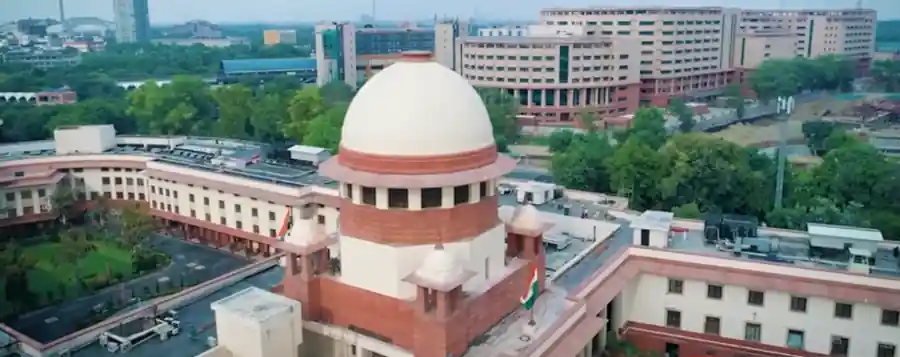
Detailed Demands for Grants, 2025-2026 and Expenditure during Financial Year 2024-2025
Financial Year 2024-2025 (All figures in ₹ thousands)
2025-2026 Detailed Demands For Grants
माँग संख्या DEMAND NO.67
भारत का उच्चतम न्यायालय SUPREME COURT OF INDIA
Overall Expenditure Summary
| Category | Total Amount |
|---|---|
| Revenue Expenditure (A) | ₹45,65,400 |
| Capital Expenditure (B) | ₹6,89,500 |
| Grand Total (A + B) | ₹52,54,900 |
This shows the total funds utilized by the Supreme Court during the financial year 2024-25 across both ongoing operations (revenue) and fixed assets (capital).
Revenue vs Capital
Capital costs (13.1%) are for long-term assets that support improvements and efficiency.
Revenue costs (86.9% of total) are for day-to-day functioning.
For the financial year 2024-25, the Supreme Court of India prepared its finances using standard government accounting categories. The appropriation of funds was first presented as Budget Estimates (BE) when the fiscal year began. These estimates represented the planned allocation for each expenditure head based on expected requirements. As the year progressed, Revised Estimates (RE) were prepared to reflect updated expectations, accounting for changes in need or unforeseen adjustments. At mid-year or later points, the government presented a Second Supplementary Demand for Grants, which adjusted allocations further by seeking additional appropriation for some items beyond what was already available. After the financial year closed and accounts were finalized, Actual Expenditure figures were recorded to show how much was actually spent under each head.
The statement is presented in two broad categories: Revenue Expenditure and Capital Expenditure, with totals also shown for combined spending.
In the Revenue Expenditure category, salaries were initially budgeted at 9,47,900 but revised upward significantly to 20,10,400 in the Revised Estimates. The Second Supplementary Demand did not show any further change under salaries, and the final Actuals recorded were 9,57,002, indicating that actual salary expense was substantially lower than the revised estimate but slightly higher than the original budget. Rewards were budgeted at 10,000, with a small increase to 12,500 in the Revised Estimates, and actual spending at 12,964. Medical treatment, another routine revenue item, was budgeted at 1,40,000 and revised up to 1,83,000 before actuals of 2,10,584 were recorded, showing higher utilization than originally anticipated. Allowances show a similar pattern: the initial estimate was 1,38,960, the Revised Estimate rose to 15,70,000, and actual allowances paid were 6,07,472, far less than the revised figure and much higher than the original budget, implying significant under-utilization of the revised resources. Leave Travel Concession had a budget of 25,000, a Revised Estimate of 25,000, and actual spend of 6,713, revealing very limited utilization. Training expenses were modest with a BE of 1,000 and RE of 3,000, and actual expenditures came in at 2,566, close to the revised estimate.
Domestic travel was budgeted at 25,000 with no revision, and actuals were 17,225. Foreign travel was budgeted at 60,000 with a Revised Estimate of 70,000, and the actual expenditure was 45,907. Office expenses were initially provisioned at 8,00,000 and left unchanged in Revised Estimates; actual office costs were reflected at 8,69,897, showing overspend within the same ballpark. Printing and publication were budgeted at 4,000, revised to 6,400, and actual costs were 7,161. Rent for others had a minimal budget of 80, with actuals of 851. Digital equipment was budgeted at 60,000 with no revision and actual utilization was 60,331. Items such as materials and supplies were unchanged at zero throughout. Fuel and lubricants were budgeted at 16,000 and revised to 21,200; actuals were 17,207. Professional services were budgeted at 60,000 with no revision; actuals were 59,738. Repair and maintenance was budgeted at 20,000 with a Revised Estimate of 16,600; actual spending was 9,888. Other revenue expenditure saw a budget of 5,500 with a Revised Estimate of 5,500, and actuals of 4,989. Combined across all revenue heads, the total revenue budget estimate was 45,65,400; the Revised Estimate was 49,04,600; and the recorded actual revenue expenditure stood at 45,65,400, showing that overall actual revenue outlays equalled the original budget provision despite fluctuations in individual items.
Capital Expenditure reflects longer-term investment and asset creation items. Motor vehicles were budgeted at 13,500 with a Revised Estimate of 36,000, and actual expenditure was 65,441, indicating a larger real investment than both the original and revised figures. Machinery and equipment had a BE of 25,600 and RE of 30,000; actuals were 37,946. Information, computer and telecommunications (ICT) equipment had a BE of 4,59,700; the Revised Estimate was 5,00,000; and actual spending was 4,31,442, slightly below the original estimate and below the revised level. Furniture and fixtures were budgeted at 12,200 and revised to 2,000; actuals were 11,107. Expenditure on upgradation or procurement of heritage assets and other not elsewhere classified fixed assets was budgeted at 1,68,500 and left unchanged in the Revised Estimate; actuals were 3,48,778, showing substantial additional outlay that exceeded the initial provision. Other fixed assets were budgeted at 10,000, revised to 10,000, and actuals were 11,206. Summed together, capital expenditure was budgeted at 6,89,500; the Revised Estimate was 9,80,900; and actual capital outlay was 6,89,500, indicating that although authorities had planned for higher capital spending in the Revised Estimates, the eventual recorded spending returned to the original budget level.
When revenue and capital Expenditure are combined, the total actual expenditure for the year was 52,54,900. The relationship between budget, revised estimates, and actual expenditure illustrates the differences between planned allocations, mid-year adjustments, and final utilization of funds. Some items were significantly underutilized compared to revised figures, while others, especially capital items such as vehicles and fixed assets, saw actual spending exceed original estimates. This comparison of demand (budget and revisions) against actuals provides a clear accounting picture of how financial resources were authorized and used for the Supreme Court’s operations and investment during the year.
Demand and Expenditure Account for Demand No. 67: Supreme Court of India
(All figures are in ₹ thousands)
| Head of Account | Actuals 2023-2024 | Budget Estimate 2024-2025 | Revised Estimate 2024-2025 | Budget Estimate 2025-2026 |
|---|---|---|---|---|
| A. REVENUE EXPENDITURE | ||||
| 01. Establishment | ||||
| 01. Salaries | 19,19,976 | 19,47,900 | 20,10,400 | 20,42,100 |
| 02. Rewards | 12,438 | 10,000 | 12,500 | 12,500 |
| 03. Medical Treatment | 1,76,639 | 1,40,000 | 1,83,000 | 1,40,000 |
| 04. Allowances | 13,06,552 | 13,89,600 | 15,70,000 | 16,00,000 |
| 05. Leave Travel Concession | 30,165 | 25,000 | 25,000 | 25,000 |
| 06. Training Expenses | 870 | 1,000 | 3,000 | 3,000 |
| 07. Domestic Travel Expenses | 16,263 | 25,000 | 25,000 | 20,000 |
| 08. Foreign Travel Expenses | 65,734 | 60,000 | 70,000 | 70,000 |
| 09. Office Expenses | 8,33,459 | 8,00,000 | 8,00,000 | 8,00,000 |
| 10. Printing and Publication | 6,355 | 3,000 | 4,000 | 6,400 |
| 11. Rent for Others | 738 | 400 | 800 | 400 |
| 12. Digital Equipment | 76,108 | 44,000 | 60,000 | 1,00,000 |
| 13. Fuels and Lubricants | 16,636 | 24,200 | 16,000 | 21,200 |
| 14. Advertising and Publicity | 3,421 | 600 | 600 | 600 |
| 15. Professional Services | 72,662 | 70,000 | 60,000 | 60,000 |
| 16. Repair and Maintenance | 17,183 | 15,300 | 20,000 | 16,600 |
| 17. Other Revenue Expenditure | 5,459 | 5,700 | 5,500 | 5,500 |
| Total Revenue Expenditure | 45,59,993 | 45,65,400 | 49,04,600 | 49,05,800 |
| B. CAPITAL EXPENDITURE | ||||
| 18. Motor Vehicles | 13,500 | 2,06,920 | 36,000 | 10,000 |
| 19. Machinery and Equipment | 25,600 | 14,880 | 30,000 | 23,200 |
| 20. ICT Equipment | 4,59,700 | 3,35,841 | 5,00,000 | 5,00,000 |
| 21. Furniture & Fixtures | 12,200 | 11,621 | 12,000 | 15,000 |
| 22. Upgradation/Procurement of Heritage Assets | 3,92,900 | 1,68,500 | 3,92,900 | 5,500 |
| 23. Other Fixed Assets | 10,000 | 10,738 | 10,000 | 12,000 |
| Total Capital Expenditure | 6,89,500 | 5,80,000 | 9,80,900 | 5,65,700 |
| GRAND TOTAL (A + B) | 52,54,900 | 51,39,993 | 58,85,500 | 54,71,500 |
Analysis of the Demand and Expenditure
1. Overall Budget Trends
- The total budget for the Supreme Court has increased from a Revised Estimate (RE) of ₹58,85,500 thousand in 2024-2025 to a Budget Estimate (BE) of ₹54,71,500 thousand in 2025-2026. This represents a decrease of approximately 7% from the previous year’s revised estimates.
- The Actuals for 2023-2024 were ₹52,54,900 thousand, which was very close to the original BE for 2024-2025.
2. Revenue Expenditure Analysis
- Dominance of Establishment Costs: The largest portion of the budget is consumed by establishment costs, specifically Salaries and Allowances. For 2025-2026, these two heads alone account for over ₹36,42,100 thousand, which is about 66% of the total budget.
- Key Increases (BE 2025-26 vs. RE 2024-25):
- Salaries: Increased by ₹31,700 thousand (from ₹20,10,400 to ₹20,42,100).
- Allowances: Increased by ₹30,000 thousand (from ₹15,70,000 to ₹16,00,000).
- Digital Equipment: A significant increase of ₹40,000 thousand (from ₹60,000 to ₹1,00,000), indicating a push for digital infrastructure.
- Key Decreases (BE 2025-26 vs. RE 2024-25):
- Medical Treatment: Reduced by ₹43,000 thousand (from ₹1,83,000 to ₹1,40,000).
- Domestic Travel: Reduced by ₹5,000 thousand (from ₹25,000 to ₹20,000).
3. Capital Expenditure Analysis
- Volatility in Capital Outlay: Capital expenditure shows significant fluctuation. The RE for 2024-2025 (₹9,80,900 thousand) is much higher than the BE for 2025-2026 (₹5,65,700 thousand).
- Major Reduction in Asset Procurement: The most dramatic cut is in the “Upgradation/Procurement of Heritage Assets,” which drops from a RE of ₹3,92,900 thousand in 2024-2025 to just ₹5,500 thousand in the BE for 2025-2026.
- Sustained Focus on ICT: The budget for ICT Equipment remains stable at a high level (₹5,00,000 thousand in both RE 2024-25 and BE 2025-26), confirming a continued focus on technology.
4. Charged vs. Voted Expenditure
- The document clearly marks all items as “भारित (Charged)”. This means the entire expenditure of the Supreme Court is a charged expenditure on the Consolidated Fund of India. This is constitutionally significant as it implies the expenditure is not submitted to the vote of Parliament, ensuring the judiciary’s financial independence.
5. Monthly Expenditure Projection (Page 8)
- The monthly expenditure pattern for 2025-2026 is provided, projecting a total of ₹5,471,500 thousand.
- A clear seasonal trend is visible, with the highest expenditure in the first quarter (April-June: ₹1,668,259 thousand) and the lowest in the last quarter (January-March: ₹1,061,239 thousand). March, in particular, shows a very low projection of ₹1,51,405 thousand.
6. Comparison of 2024-2025 Estimates
- The document includes a supplementary table for 2024-2025, which shows that the Revised Estimates (₹58,85,500) were supplemented by an additional ₹1,00,000 thousand.
- The Actuals for 2024-2025 (₹59,85,500) ended up being higher than the Revised Estimates, indicating some additional spending or re-appropriation during the fiscal year. A notable variance is in “Office Expenses,” where the actuals (₹8,69,979) exceeded the RE (₹8,00,000).
Notes
- All figures are in thousands of rupees (e.g., ₹9,57,002 = ₹9.57 crore approx.).
- The statement is an audited financial record used by the Government of India for budget oversight and public transparency.
SUPREME COURT OF INDIA
Cash & Accounts – I
Details of Expenditure During the Financial Year 2024–25
(All figures are in thousands of Rupees)
A. Revenue Expenditure
| S. No. | Object Head | Budget Estimates 2024–25 | Revised Estimates 2024–25 | Second Supplementary Demand 2024–25 | Actuals 2024–25 |
|---|---|---|---|---|---|
| 1 | Salaries | 19,47,900 | 20,10,400 | 95,700 | 21,05,638 |
| 2 | Rewards | 10,000 | 12,500 | – | 12,964 |
| 3 | Medical Treatment | 1,40,000 | 1,83,000 | – | 2,10,584 |
| 4 | Allowances | 13,89,600 | 15,70,000 | 45,600 | 16,07,472 |
| 5 | Leave Travel Concession | 25,000 | 25,000 | – | 36,713 |
| 6 | Training Expenses | 1,000 | 3,000 | – | 2,566 |
| 7 | Domestic Travel Expenses | 25,000 | 20,000 | – | 17,225 |
| 8 | Foreign Travel Expenses | 60,000 | 70,000 | – | 45,907 |
| 9 | Office Expenses | 8,00,000 | 8,00,000 | 33,700 | 8,69,979 |
| 10 | Printing and Publication | 4,000 | 6,400 | – | 7,161 |
| 11 | Rent for Others | 800 | 400 | – | 851 |
| 12 | Digital Equipment | 60,000 | 1,00,000 | – | 60,331 |
| 13 | Materials and Supplies | – | – | – | – |
| 14 | Fuels and Lubricants | 16,000 | 21,200 | – | 17,207 |
| 15 | Advertising and Publicity | 600 | 600 | – | 387 |
| 16 | Professional Services | 60,000 | 60,000 | – | 59,738 |
| 17 | Repair and Maintenance | 20,000 | 16,600 | – | 19,888 |
| 18 | Other Revenue Expenditure | 5,500 | 5,500 | – | 4,989 |
Total – A (Revenue Expenditure): 45,65,400 (BE) · 49,04,600 (RE) · 1,75,000 (SSD) · 50,79,600 (Actuals)
B. Capital Expenditure
| S. No. | Object Head | Budget Estimates 2024–25 | Revised Estimates 2024–25 | Second Supplementary Demand 2024–25 | Actuals 2024–25 |
|---|---|---|---|---|---|
| 19 | Motor Vehicles | 13,500 | 36,000 | – | 65,441 |
| 20 | Machinery and Equipment | 25,600 | 30,000 | – | 37,946 |
| 21 | Information, Computer & Telecommunications (ICT) Equipment | 4,59,700 | 5,00,000 | –75,000 | 4,31,422 |
| 22 | Furniture and Fixtures | 12,200 | 12,000 | – | 11,107 |
| 23 | Upgradation/Procurement of Heritage Assets and n.e.c. | 1,68,500 | 3,92,900 | – | 3,48,778 |
| 24 | Other Fixed Assets | 10,000 | 10,000 | – | 11,206 |
Total – B (Capital Expenditure):
6,89,500 (BE) · 9,80,900 (RE) · –75,000 (SSD) · 9,05,900 (Actuals)
Grand Total (A + B)
52,54,900 (BE) · 58,85,500 (RE) · 1,00,000 (SSD) · 59,85,500 (Actuals)
Data Source: Principal Accounts Office, Ministry of Law & Justice