
Gross domestic product (GDP) as an indicator of a countries economic progress, but not wealth—the assets such as infrastructure, forests, minerals, and human capital that produce GDP.
The wealth of a country or a Nation can be estimated as the sum of three major components:
Natural capital or Resources- It is calculated as the sum of the stock value of the renewable and non – renewable resources (pasture land, agricultural land, protected areas, oil, coal, natural gas, minerals). Renewable resources—agricultural land and forests and protected areas—can produce benefits in perpetuity if managed sustainably.
In low- and middle-income countries, the monetary value of renewable assets more than doubled, keeping up with population growth on average, which is good news, with greater gains in value of agricultural land than forests.
Produced assets – It represents the sum of the value of a country’s stock of machinery and equipment, structures and urban land.
Human resources- They consist of “raw labor,” determined mainly by the number of people in a country’s labor force; human capital and an important element known as social capital. The concept of human capital wealth differs from that of human development or human capabilities. The term “capital” denotes a resource that can be used for economic production. A good education has an intrinsic value apart from the fact that it helps workers be better paid. Good health also is beneficial in itself, independent of its impact on production and wages. The estimation of the human capital wealth of countries is based on wage regressions used to compute expected earnings for individuals over their lifetimes by gender, age, and education level. Labor force and household surveys are used to measure the number of workers according to age, sex, and education level, as well as their earnings.
World Bank published a project to measure economies by wealth, to get a more complete picture of a nation’s health, both in the present and the future. The Changing Wealth of Nations analyzes the wealth of 141 countries, from 1995 to 2014. “A country’s level of economic development is strongly related to the composition of its national wealth,” the report states.
It is said, for most countries GDP is strongly correlated to wealth.
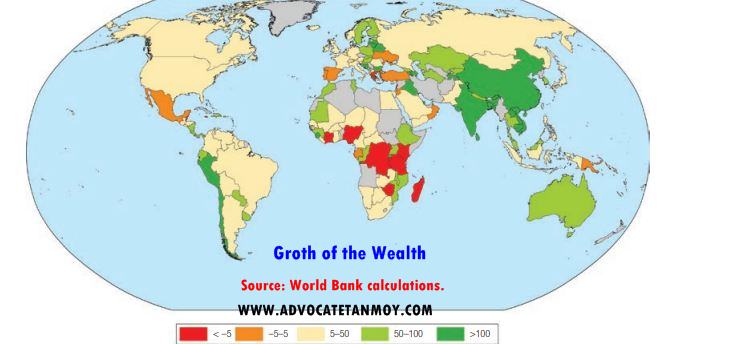
Between 1995 and 2014, global wealth grew by two-thirds (66 percent), but population grew by 27 percent, so that the net increase in per capita wealth was only 31 percent (figure 2.7 and map 2.1).
It is observed that a business is always evaluated by both its income statement and its balance sheet1 (assets and liabilities, or wealth). Similarly, a prospective homeowner can obtain a mortgage only by demonstrating both his or her income and net assets— income in any given year can always be made to look good by selling off assets, but liquidating assets undermines the ability to generate income in the future; the true picture of economic health requires looking at both income and wealth. The economic performance of countries, however, is only evaluated based on national income; wealth has typically been ignored. Indeed, one of the primary motivations for the early natural capital accounting efforts in the mid-1980s was concern that rapid GDP growth in resource-rich countries was achieved through liquidation of natural capital—a temporary boost to consumption that created no basis for sustained advances in wealth and human well-being (for example, Repetto et al. 1989). Monitoring wealth, including natural capital, was part of the solution to the challenge of long-term sustainability.

More Stories
Civilization As Organized Intelligence (Volume-19): Intelligence Civilization Meta-Theory
Volume III: Dalit Theology in Dialogue
Ethnic Groups in United Kingdom: England, Scotland, Wales and Northern Ireland