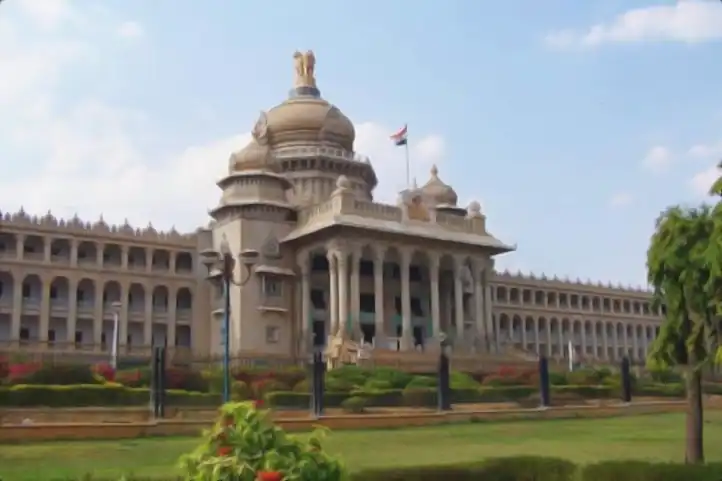
KARNATAKA LEGISLATIVE ASSEMBLY
SIXTEENTH LEGISLATIVE ASSEMBLY
EIGHTH SESSION
The Karnataka Hate Speech and Hate Crimes (Prevention) Bill, 2025
(LA Bill No. 79 of 2025)
A Bill to curb and prevent dissemination, publication or promotion of hate speech and crimes, which cause disharmony, hatred in the society, against the person or group of persons, organisations and provide punishment to such crimes and to provide adequate compensation to the injured victims.
Whereas it is expedient to curb and prevent dissemination, publication or promotion of hate speech and crimes, which cause disharmony, hatred in the society, against the person or group of persons, organisations and provide punishment to such crimes and to provide adequate compensation to the injured victims and for matters connected therewith for the purposes hereinafter appearing.
Be it enacted by the Karnataka State Legislature in the seventy sixth year of the Republic of India, as follows:—
1. Short title and commencement.—(1) This Act may be called the Karnataka Hate Speech and Hate Crimes (Prevention) Act, 2025.
(2) It shall come into force on such date as the State Government may appoint, by notification in the Official Gazette.
2. Definitions.— (1) In this Act, unless the context otherwise requires,—
(i) ‘Hate Speech’ includes any expression which is made, published, or circulated, in words either spoken or written or by signs or by visible representations or through electronic communication or otherwise, in public view, with an intention to cause injury, disharmony or feelings of enmity or hatred or ill-will against person alive or dead, class or group of persons or community, to meet any prejudicial interest;
(ii) ‘Prejudicial interest’ means and includes, the bias on the grounds of,—
(a) religion,
(b) race,
(c) caste or community;
(d) sex,
(e) gender,
(f) sexual orientation,
(g) place of birth,
(h) residence,
(i) language,
(j) disability, or
(k) tribe;
(iii) ‘Hate Crime’ means communication of hate speech, by making, publishing or circulating or any act of promoting, propagating, inciting or abetting or attempting, such hate speech, to cause disharmony or feelings of enmity or hatred or ill-will against any person dead or alive or group of persons or organisation; and
(iv) ‘Communication’ means and includes communication of expression, made in public view, by way of verbal, print, publication, electronic means, or other means to convey such expression.
(2) The words and expressions used and not defined in this Act but defined in the Bharatiya Nyaya Sanhita, 2023 (Central Act 45 of 2023) or the Bharatiya Nagarik Suraksha Sanhita, 2023 (Central Act 46 of 2023) or the Information Technology Act, 2000 (Central Act 21 of 2000) shall have meaning respectively assigned to them in those Acts.
3. Punishment for hate crime.— (1) Whoever,—
(i) commits hate crime shall be punished with imprisonment for a term which shall not be less than one year, which may extend to seven years with a fine of Rs.50,000/-; and
(ii) for any subsequent or repetetive offences the punishment shall not be less than two years, which may extend to ten years with fine of Rs.1,00,000/-.
(2) The Court may award adequate compensation to the victim by calculating the injury caused due to hate crime, depending upon the gravity of the impact of the crime.
(3) The offences under this Act shall be cognizable, non-bailable and triable by the Judicial Magistrate First Class.
(4) The said provisions shall not extend to any book, pamphlet, paper, writing, drawing, painting representation or figure in electronic form or otherwise the publication of which is proved to be justified as being for the public good on the ground that such book, pamphlet, paper, writing drawing, painting representation or figure is in the interest of science, literature, art or learning or other objects of general concern; or which is kept or used for bona fide heritage or religious purposes.
4. Preventive action to be taken by the law and order machinery.— (1) Executive Magistrate or Special Executive Magistrate or any police officer not below the rank of a Deputy Superintendent of Police may, on receiving information and after such inquiry as he may think necessary, has reason to believe that a person or a group of persons within the local limits of his jurisdiction is likely to commit an offence or has threatened to commit any offence under this Act and is of the opinion that there is sufficient ground for proceeding, take necessary preventive action for keeping the peace and good behaviour and maintenance of public order and tranquillity.
(2) The provisions of Chapter-IX of the Bhartiya Nagarik Suraksha Sanhita, 2023 (Central Act 46 of 2023) so far as may be, apply for the purposes of sub-section (1).
5. Offences by Organisation or Institution.— If the person, committing an offence under this Act, is an Organisation or Institution, every person who, at the time of the offence committed, was in charge of, and was responsible to, such organisation or institution for the conduct of the business of the same , as well as such Organisation or Institution, shall be deemed to be guilty of the offence and shall be liable to be proceeded against and punished accordingly:
Provided that nothing contained in this section shall render any person liable to punishment if he proves that the offence was committed without his knowledge, or that he had exercised all due diligence to prevent the commission of such offence.
Explanation: For the purpose of this section ‘Organisation or Institution’ means and includes association of persons whether registered or not.
6. Power to block or remove the hate crime materials.— The Designated officer, as notified by the State Government, shall have the power to direct any service provider, intermediaries, person or entity to block or remove the hate crime materials from its domain including electronic media.
7. Application of other laws not barred.— (1) The provisions of this Act shall be in addition to, and not in derogation of, the provisions of any other law for the time being in force.
(2) The definitions of the terms in the Bhartiya Nyaya Sanhita, 2023 (Central Act 45 of 2023) and the Information Technology Act, 2000 (Central Act 21 of 2000) are mutatis-mutandis applicable to this Act.
8. Protection of action taken in good faith.— No suit, prosecution or other legal proceedings shall lie against public servants for anything which is done in good faith or intended to be done under this Act, or the rules made thereunder.
9. Power to remove difficulties.— If any difficulty arises in giving effect to the provisions of this Act, the State Government may, by order published in the Official Gazette, make such provisions, to remove such difficulty:
Provided that no such order shall be made under this section after the expiry of three years from the commencement of this Act.
10. Power to make rules.— (1) The State Government may, by notification, after previous publication, make rules to carry out the purposes of this Act.
(2) Every rule made under this Act shall be laid as soon as may be after it is made before each House of the State Legislature while it is in session for a total period of thirty days which may be comprised in one session or in two or more successive sessions, and if, before the expiry of the session in which it is so laid or the session immediately following, both Houses agree in making any modification in the rule or both Houses agree that the rule should not be made, the rule shall thereafter have effect only in such modified form or to be of no effect as the case may be; so, however, that any such modification or annulment shall be without prejudice to the validity of anything done under that rule.
STATEMENT OF OBJECTS AND REASONS
It is considered necessary to enact a legislation to,—
(i) curb and prevent dissemination, publication or promotion of hate speech and crimes, which cause disharmony, hatred in the society, against the person or group of persons, organisations;
(ii) provide punishment to such crimes; and
(iii) provide adequate compensation to the injured victims.
Hence, the Bill.
FINANCIAL MEMORANDUM
There is no extra expenditure involved in the proposed legislative measure.
MEMORANDUM REGARDING DELEGATED LEGISLATION
Clause-10 Empowers the State Government to make rules regarding to carry out the purposes of the Act.
The proposed delegation of legislative power is normal in character.
Dr. G. PARAMESHWARA
Minister for Home
M.K. VISHALAKSHI
Secretary
Karnataka Legislative Assembly