Summary: The Article addresses the functioning of the Indian court system, the impact of pending cases on the economy, the need for efficient case resolution, and the implications of not passing adverse orders. It also includes legal biometrics and specific examples related to not passing adverse orders.
Rational
The functioning of the court is the signature mark of living democracy. Access to justice is the pillar of civilisation. Having an intelligent active District Judge is the fortune of the Judicial system. The judiciary exists not to generate jobs (Judges/lawyers) but to provide public service. In the British era, Courts were appointed not only to settle disputes but also to generate revenue for public purposes. Courts were not a burden to the Government like today, but they were like any other organisation, which could earn revenue indirectly and contributes to the public economy.
Huge pending cases are symptomatic of the poor economy. A money suit must not run more than 12 months, and a maintenance petition should not run more than six months. In the same way, if a Land Acquisition case remains pending for five years, the Government project will not be completed in time, and overhead costs will break the budget. A litigant must have other valuable business than attending court or spending the lawyer’s chamber for the next steps.
In India, Arbitration Law is not successful due to frequent granting of adjournment( like ordinary courts) or too much reference to the civil courts. If an Arbitration matter reaches the District or High Court, it takes years to dispose of the same and return the file to the lower court or arbitration tribunal.
Now we may consider another issue of Judges’ numbers vs. courts’ working hours. Whether we need more judges? Not at all. Whether we need more High Court judges? Not at all. The High Court Judges’ number should not be more than 50 % of the Council of Ministers in the State. A court must work 6 hours (250 days) a day with 30 minutes break.
Not to pass an adverse order means that the conducting court shall not pass an Order that affects the Opposite Party in his/her absence and any of the following orders in the public interest:
- Not to dismiss the case for default.
- Not to issue a warrant
- Not to hear Evidence
- Not to grant an injunction
- Not to vacate an Order of Injunction
- Not to issue show cause to the litigant
- Not to hear any Application Ex-party and proceed with the case.
Legal Biometrics
- CJI: Dr. Justice D.Y. Chandrachud
- Chief Justice of Calcutta High Court: Justice T. S. Sivagnanam
- President of India: Draupadi Murmu
- Prime Minister: Narendra Modi
- Ordinarily working days in Courts in West Bengal: 200 days (minus Local Holy Days +/- 4 days)
- Not to pass adverse Order: At least 10 days
- Not to attend Court after 3.00 PM: At least 5 days
Adverse Order/action
News Reader
SC Bar Association writes to CJI requesting ‘no adverse order be passed’ today (Indian Express)
In a letter to the Chief Justice of India, Supreme Court Bar Association President Adish C Aggarwala said simultaneous ceremonies will take place in temples not only in India but throughout the world for the event (The Hindu)
NDBA requests judges not to pass adverse orders for non appearances of lawyers on Jan 22
What is the Reason for “not to pass adverse order”?
- An Advocate died (If the Ex-president/Secretary ..Consecutive two days morning period)
- Local Religious Observation
- Cricket Football Match
- Blood Donation/Medical Checkup Camp
- Pen down by Court Karmachari
- Central/State/Panchayat election (Road jam/ Rail not available)
- Layers agitation
- Too much hot (Day/s)
- Miscellaneous
What do people do in “Not to Pass Adverse Order Day”?
- Litigants are confused, and lawyers are absent.
- The witness/expert returned
- Judges are in a relaxing mood or do not attend court.
- Bench Clerks post the next dates according to the cost received from a party.
If prosecuted who shall be held responsible for the charge of TREASON and Desh Droha?
- The District Judge
- The service book of the District Judge should be marked for granting Illegal Chutti.
Whether Calcutta High Court grants concession or in any way consulted by the concerned Dist Judge/s?
- Never
- No documentation
- No Public Order
- No displeasure from the side of Calcutta High Court
- In 2004, a 45-day strike by lawyers to protest the steep hike in stamp duty paralysed Calcutta High Court
- The lawyers’ strike in Calcutta High Court set a record 59-day run with the High Court Bar Association deciding to continue till April 18, 2018, for non-appointing additional judges.
Whether Public Prosecutor and APPs are duty bound to attend and appear before the court?
Calcutta High Court through acting Chief Justice TS Sivagnanam and Justice Hiranmay Bhattacharyya said:
“If a PP participates in a pen-down then he must be removed from his post. Please advice your (to counsels) clients accordingly, some adverse orders will come then nobody can save them. He has taken an oath of office after he became a lawyer. He owes a duty to the State…you don’t have a vested right, you are working as APP/PP based on government orders” (Sri Shibsankar Mahato vs State Of West Bengal & Ors – April, 2023)
“If your customers don’t follow orders, you kick everyone out. Since all of these positions are prestigious, you should work to improve your entire bio and resume. The most crucial thing is how you conduct yourself when you first enter the office. You must live up to the appointment.”
The petition stated that “the common litigants, like the petitioner, have been victims of unfavorable circumstances without any fault of their own and their matters are going unrepresented in the Court of Law.”
Burdwan Bar Association conducted a meeting in this regard.
“By this public interest litigation the petitioner, who claims himself to be a law abiding citizen of India and frequent visitor of the district Courts of Purba Bardhaman for his pending matters, has filed this writ petition to resolve the impasse, which is going on in the District and Sessions Courts of Purba Bardhaman. Essentially the matter got precipitated on account of an alleged incident, which took place between the Public Prosecutor and the Additional Public Prosecutors and certain ugly scenes took place in the Courts of the District and Sessions Judge. The Court is aware that the Hon’ble Zonal Judge was apprised of the situation and certain steps were taken. However, the issue or the dispute is between the Public Prosecutors, who were appointees of the State and, therefore, the State was responsible to ensure that normalcy is restored and the Court starts functioning in a smooth manner and the litigant public in no manner be affected. At this juncture, we are not inclined to issue any positive direction but would direct the learned Government Pleader to speak with the concerned authority and ensure that the dispute is resolved and the Court/Courts start functioning in a smooth manner.
An action taken report in this regard be submitted before this Court on the next hearing date. List this matter higher on board on 24th April,2023.”[WPA (P) 170 OF 2023]
Pending Cases in West Bengal
Total Pending Cases: 30,34378 in the State of West Bengal as on 26/02/2024 (Judicial Data Grid)
| Particulars | Civil | Criminal | Total |
|---|
| Pending Cases | |||
| 0 to 1 Years | 144011(23.01%) | 473545(19.66%) | 617556(20.35%) |
| 1 to 3 Years | 150717(24.08%) | 484014(20.1%) | 634731(20.92%) |
| 3 to 5 Years | 80128(12.8%) | 254264(10.56%) | 334392(11.02%) |
| 5 to 10 Years | 148656(23.75%) | 678132(28.15%) | 826788(27.25%) |
| 10 to 20 Years | 87092(13.92%) | 445282(18.49%) | 532374(17.54%) |
| 20 to 30 Years | 11711(2.31%) | 58321(2.31%) | 70032(2.31%) |
| Above 30 Years | 3492 (0.56%) | 15013(0.62%) | 18505(0.61%) |
| Total | 625807 | 2408571 | 3034378 |
Not to Pass Any Adverse Order
Samples
District Bar Association & District Advocates Bar Association, Barasat,
Respected all Learned Executives and Members of both the District Bar Association & District Advocates Bar Association, Barasat,
Due to sad demise of our Respected Ld. Member Mr. Amal Kumar Sadhukha on the 21st day of February 2024 and Mr. Jugal Kishore Mondal on 22 nd day of February 2024 a Condolence Meeting will be held on 26 th day of February 2024, at the ground floor of District Bar Association premises on 12:30 PM as per our convention.
All Ld. Members of both the Bar Association are cordially requested to attend the same on time positively.
On the said day, i.e., on Monday, the 26th day of February 2024, we shall refrain from attending Courts as per our convention.
With Regards,
Alok Samajpati
General Secretary of DBA.
&
Uttam Kumar Paul,
Secretary,
Not to Pass Any Adverse Order
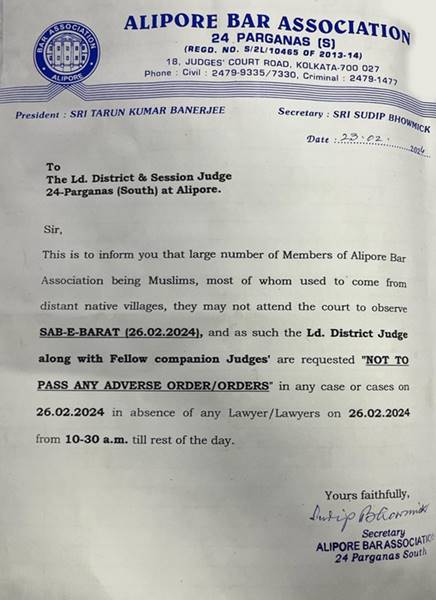
Not to Pass Any Adverse Order
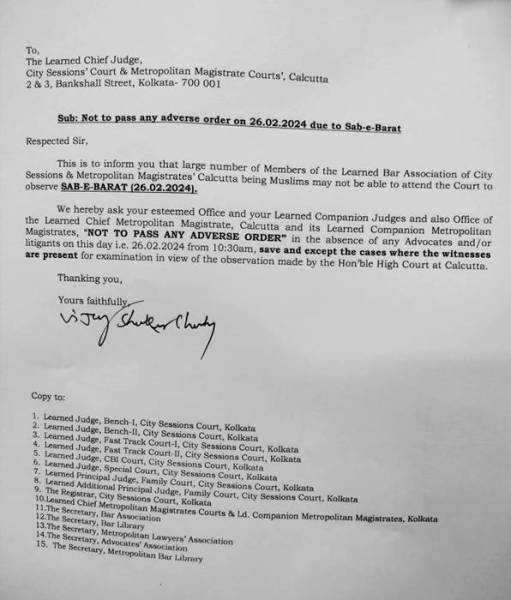
Lawyers will not Attend the Court
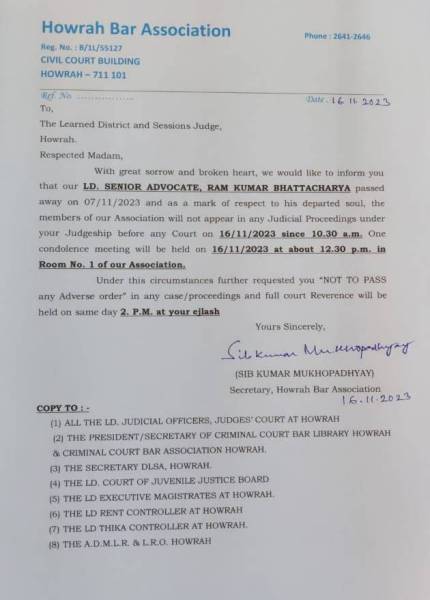
- In the year 2023 the Ld Dist Judge of Howrah Judiciary Celebrated at least 15 Not to Pass Adverse Order.
- Two Not to pass adverse order for two ‘Pendown’ Karmasuchi.
- Two Not to pass adverse order for attending a certain Case pending before the Calcutta High Court.
A legal and reasonable Not to Pass Adverse Order
HIGH COURT FOR THE STATE OF TELANGANA: HYDERABAD
ROC No.1333/S0/2022 Date:11.07.2022
CIRCULAR No.10/2022
Sub: High Court for the State of Telangana – Heavy rains in
the State of Telangana – As directed, not to pass
adverse orders i.e., Interim Orders, Interlocutory
Applications etc., when advocates or parties do not
appear in the courts during these two days i.e.,
11.7.2022 (Monday) and 12.7.2022 (Tuesday)
Instructions – Issued.
In view of incessant rains in the State of Telangana, as directed by the Hon’ble Chief Justice, all the Judicial Officers in the State are hereby directed not to pass any adverse Orders, when advocates or
parties are unable to appear before the courts and to extend the interim orders, if they are unable to represent during these two days i.e., 11.7.2022 (Monday) and 12.7.2022 (Tuesday). Therefore, as directed, all the Presiding Officers in the State shall follow the above instructions.
To
- The Prl. Secretary to the Hon’ble the Chief Justice, High Court for the State of Telangana. (with a request to place before the Hon’ble the Chief Justice for His Lordship’s kind perusal)
- All the Personal Secretaries to all the Hon’ble Judges (with a request to place the same before Hon’ble Judge for kind perusal)
- All the Unit Heads in the State of Telangana. {with a request to communicate the circular instructions to all the Judicial Officers working in their unit}
- All the Registrars, High Court for the State of Telangana. {for information}
- The Director, Telangana State Judicial Academy, Secunderabad.
- The Member Secretary, Telangana State Legal Services Authority, Hyderabad.
Delhi High Court (Covid Period)
The Delhi High Court on Thursday asked its subordinate courts not to pass adverse orders in non-urgent/routine matters where the concerned advocate/litigant is unable to join the proceedings through video conferencing, till normal functioning of courts is resumed.
Delhi-Not-to-pass-adverse-order-2022No “not to pass an adverse order’ request would be accepted, adopted, or acted upon by the District Judiciary if such a request had not been made to protect the Public Interest or without the sanction of the High Court.