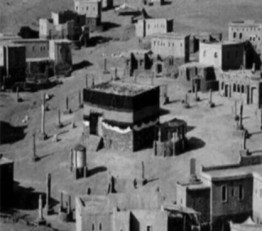
Photo of Old Kaaba 1880
Muhammad was a Ummi !
Prophet Muhammad and Linguistic Context
Prophet Muhammad, recognized as Ummi (meaning he had no formal alphabetic knowledge), spoke the native Arabic of his time. The earliest known specimens of Arabic writing date back to roughly 500 CE.
Family Background and Education
It is noted that Abu Talib, Muhammad’s uncle, adopted him and cared for him as a son. Abu Talib was committed to educating all of his sons, which raises the question of why he did not provide the same formal education to his favored nephew, Muhammad. This question remains unanswered in historical contexts. Therefore it could be said that Muhammad never studied anything in written form including Tohat, Jubur-Injil, etc!
Contributions of Ali ibn Abi Talib
Ali ibn Abi Talib, Muhammad’s cousin and son-in-law, is recognized for his role in teaching Muslims the grammar and style of reciting the Quran. The Quran was predominantly revealed in the Northern dialects, specifically those of Hijaz and Najd, and not in the Southern dialects typical of Yemen or the Himyarite region.
Influence of Pre-Islamic Poetry
The rhyming forms known as Rajaz and Saz were the oldest types of Arabic poetry, existing before 300 CE. These early poetic forms exerted a significant influence on the ‘hanging’ poetry of Al-Muʻallaqāt and the verses of the Quran.
Historic Manuscript
The Birmingham Quran manuscript, dated to around 645 CE, serves as an important artifact illustrating the early transcription of the Quran.
For more insights into Arabic poetry before the advent of the Quran, you can visit this link.
Note: The Basics of Islamic Doctrines
- The first Islamic doctrine is Prophet Muhammad was a Ummai. Qur’an identifies him as al-nabī al-ummī (Q. 7:157–158).
- The second Islamic Doctrine is Muhammad is the Prophet of Allah.
- The third Islamic Doctrine is, that Allah is the God of Moses (Musa) and Jesus Christ.
- Before Muhammad, everything was Dark Jahiliyat.
- The Prophet`s immediate Companions were highly educated and they were not Jajil, they wrote as instructed by the Prophet.
Quranic Language and Rhyming Patterns
It can be inferred from readings of the Holy Quran that the language and rhyming patterns utilized within the Quran were influenced by pre-existing Arabic traditions, which laid a rich linguistic foundation. The Northern Arabic languages, specifically those spoken in regions such as Hijaz and Najd, were established prior to the time of Prophet Muhammad, contributing to the diverse dialectal variations and phonetic nuances found in the text. Scholars have indicated that these regional dialects not only fostered a poetic framework but also enriched the vocabulary and expressive capabilities of the Quranic discourse. Furthermore, it is noted that Ali ibn Abi Talib played a significant role in instructing Muslims in the grammar and style necessary for the recitation of the Quran, ensuring that the intended meaning and profound beauty of the verses were preserved through accurate pronunciation and articulation, thereby enhancing the spiritual experience of the reciters and listeners alike.
The Influence of Pre-Islamic Poetic Forms
The oldest known rhyming structures in Arabic are Rajaz and Saz, which were prominent before 300 CE. These early poetic styles significantly impacted the ‘hanging’ poetry of Al-Muʻallaqāt and the verses found in the Quran, influencing not only the thematic elements but also the rhythm and sound of Arabic literature. This rich poetic tradition provided a foundation upon which the Quran’s linguistic and stylistic features were built, allowing it to resonate deeply with its audience through the use of powerful imagery and emotional depth. The interplay between these ancient forms and the later developments in Arabic poetry illustrates the evolution of artistic expression in the region, reflecting the cultural and social changes that shaped the lives of the people during that time. As such, Rajaz and Saz serve not only as historical artifacts but also as vital components in understanding the broader narrative of Arabic literary heritage.
Historic Manuscripts
The Birmingham Quran manuscript, dated around 645 CE, stands as a crucial artifact, illustrating the early transcription and preservation of the Quranic text, which is one of the foundational religious texts in Islam. This manuscript provides invaluable insight into the language used during that period and its connection to the broader Arabic literary heritage, revealing not only the religious significance of the Quran but also its impact on the development of Arabic prose and poetry. The script style, ink, and parchment quality of the manuscript reflect the meticulous craftsmanship of the scribes, shedding light on the methods and practices of book-making in the early Islamic era. Its existence has sparked discussions among scholars regarding the transmission of the Quranic text, the evolution of the Arabic language, and the cultural exchanges that occurred in the region during a time of great historical transformation.
39 letters including two special characters have been used in the Quran
ف ق ك ل م ن ه و ي ۖ ۗ ۘ ۙ ۚ ۛ ۜ ۞ ۩ آ أ إ ا ب ت ث ج ح خ د ذ ر ز س ش ص ض ط ظ ع غ
Special characters used in Quran
۩ – إِنَّ الَّذِينَ عِندَ رَبِّكَ لَا يَسْتَكْبِرُونَ عَنْ عِبَادَتِهِ وَيُسَبِّحُونَهُ وَلَهُ يَسْجُدُونَ ۩
۞- ۞ إِنَّ اللَّهَ لَا يَسْتَحْيِي أَن يَضْرِبَ مَثَلًا مَّا بَعُوضَةً فَمَا فَوْقَهَا ۚ فَأَمَّا الَّذِينَ آمَنُوا
Waqf Marks
Waqf Lazim (مـ): Indicates a mandatory stop.
Waqf e Taam (): Signifies the end of a verse.
Waqf e Qabeeh (ۘ): Suggests that stopping here is disliked or improper.
Waqf e Hasn (ۗ): Denotes a preferable stop.
Waqf e Kafi (ۖ): Indicates a sufficient stop.
Waqf e Murakhkhas (ۜ): Represents a selective or conditional stop.
Qalqalah (ق, ط, ب, ج, د): Letters causing a vibrating effect.
Mandatory Stop (واجب)
Permissible Stop (جائز)
Preferred Pause (مستحب)
Brief silent Pause (سكتة)
Continuation (لا)
Tajweed symbols
| Symbol | Transliteration | Meaning |
| ۩ | Sajda | Marks a verse where prostration (sujud) is performed as an act of worship and humility. |
| مـ | Waqf Lazim | Denotes a mandatory stop where the reader must pause for a designated duration. |
| | Waqf e Taam | Signifies the end of a verse, indicating a full stop, allowing the reader to pause briefly. |
| صلی | Salli | Indicates the point where the reader should say ‘Salli’ or invoke blessings upon the Prophet. |
| قلی | Qalli | Indicates where the reader should say ‘Qalli’ or reduce the length of the pronunciation. |
| ۚ | Qif | Signifies a permissible pause, not mandatory, allowing a brief stop without obligation. |
| ۖ | Waqf e Kafi | Indicates a sufficient stop, providing more flexibility than a mandatory stop. |
| ۗ | Waqf e Hasn | Indicates a preferable stop, suggesting that it is better to pause at this point. |
| ۘ | Waqf e Qabeeh | Indicates that stopping here is disliked or improper, urging the reader to avoid pausing. |
| ۜ | Waqf e Murakhkhas | Indicates a selective or conditional stop, allowing a pause based on specific conditions. |
Tentative meaning of some symbols used in old versions of the Quran.
| Symbol | Meaning |
| ۩ | This sign denotes a Sajdah; the reciter needs to pause their recitation and prostrate when they reach this sign in the verse |
| | This sign is found at the end of every verse in the Quran and it contains the number of the verse inside it |
| ۞ | Indicates the start of a quarter, half or three quarter of a Hizb and can also be found at the beginning of a Juz’ |
Read More
- Muhammad was poisoned by a Jewish woman Zaynab bint Al-Harith (08/06/632)
- Biographical information on Muhammad – Vincenzo Calza (1847)
- Notes on Muhammad and Islam by Thomas Patrick Hughes-1894