Encyclopedia of Sanatan Dharma
Hindu Scriptures and Interpretation
Vishnu Purana and the Lost Tradition of Ancient Sanatan Dharma
The Truth About Hindu Puranas: History, Corruption, and Vedic Authority
Modern discussions on the Hindu Purāṇas occupy a contested place within the intellectual history of Sanātana Dharma, especially in relation to the authority of the Vedas, the development of sectarian traditions, the emergence of medieval devotional movements, and the long history of textual transmission across the Indian subcontinent. The word Purāṇa, derived from the Sanskrit expression meaning “ancient” or “belonging to former times,” originally referred to narratives concerning earlier ages, genealogies of kings and sages, cosmological descriptions, accounts of dynasties, and explanations of religious observances. Classical Sanskrit traditions often describe the Purāṇas as repositories of old knowledge transmitted orally through generations of teachers, disciples, and reciters. Unlike the Ṛgveda, Yajurveda, Sāmaveda, and Atharvaveda, which were regarded in orthodox Brahmanical understanding as eternal revelation and the supreme source of Śabda Pramāṇa, the Purāṇas traditionally occupied a secondary position. Ancient jurists and commentators repeatedly emphasized that the authority of any Purāṇic statement depended upon its agreement with the Vedic corpus. In the legal and religious traditions associated with Manu Smṛti, Yājñavalkya Smṛti, and the commentarial schools of Mīmāṃsā, the Vedas alone were held to be the final and independent source of sacred knowledge (See Hindu Scriptures and Interpretation).
The historical development of Purāṇic literature remains difficult to reconstruct because the texts survive in multiple recensions copied across centuries in regions such as Kāśī, Kanchipuram, Ujjayinī, Mithilā, Karnāṭa, Kashmir, Bengal, and Nepal. Modern manuscript studies conducted in the nineteenth and twentieth centuries demonstrated that almost every Purāṇa exists in several versions differing in language, arrangement, number of verses, and theological emphasis. Scholars working in Calcutta, Bombay, Pune, Madras, and Varanasi during the colonial period discovered that many manuscripts transmitted under the same title differed radically from one another. These variations led to debates regarding interpolation, redaction, sectarian revision, and the influence of later religious movements. A widespread critical view within some traditional and reformist Hindu circles holds that many extant Purāṇas were heavily altered between approximately 1000 CE and 1200 CE, during the age of regional kingdoms, temple-centered sectarianism, and the rise of powerful Śaiva and Vaiṣṇava institutions in places such as Tamil Nadu, Karnataka, Odisha, and Gujarat. According to this perspective, the surviving manuscripts preserve only fragments of earlier compositions (1500-1000 BCE) and contain numerous additions inserted over centuries by scribes, priests, commentators, and sectarian authors including European Indologists.
The question of authenticity became especially important in the nineteenth century when reform movements such as the Ārya Samāj, founded by Swami Dayananda Saraswati in Bombay in 1875, argued that the Vedas alone represented pure and original Hindu revelation. Dayananda sharply criticized many Purāṇic stories as irrational, contradictory, or inconsistent with Vedic monotheism. Similar criticisms appeared earlier among certain medieval scholars and philosophers who treated Purāṇic narratives as symbolic rather than historically reliable. Some modern interpreters therefore distinguish between an older stratum of Purāṇic (1500-1000 BCE) tradition and later sectarian compilations (1000-1200 CE). Within this line of interpretation, the extant Purāṇas are viewed not as single works written at one moment but as layered textual accumulations shaped by centuries of transmission.
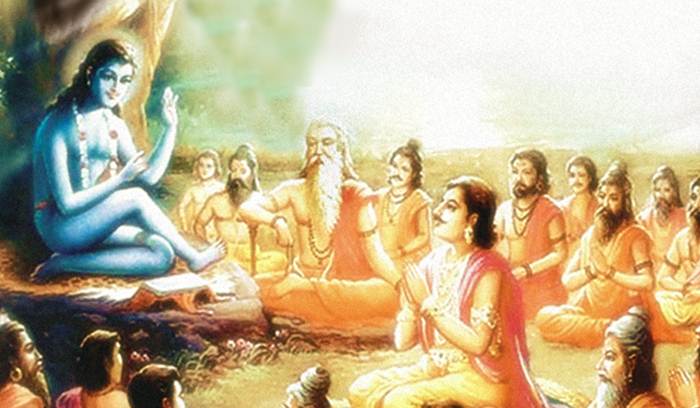
Traditional accounts attribute the compilation of Purāṇic knowledge to Kṛṣṇa Dvaipāyana Vyāsa, the sage associated with the arrangement of the Vedas and the composition of the Mahābhārata. According to orthodox narratives, Vyāsa instructed disciples such as Vaiśampāyana, Lomaharṣaṇa, and Sūta reciters, who transmitted ancient stories to later generations. However, some modern interpreters argue that Vyāsa himself did not personally compose the Purāṇas in the form now available. In this interpretation, there was no historical necessity for Vyāsa to produce a separate Purāṇic corpus because his intellectual legacy was already embodied in the Mahābhārata and Vedic tradition. The continuation of that legacy is therefore associated with disciples and reciters rather than with direct authorship by Vyāsa himself. Names such as Vaiśampāyana and Lomaharṣaṇa occupy a central role in Purāṇic genealogies because many texts frame themselves as dialogues transmitted through these figures.
Among the Purāṇas, the Viṣṇu Purāṇa is frequently regarded by traditional scholars as one of the oldest and most philosophically coherent works. Ancient tradition attributes it to the sage Parāśara, father of Kṛṣṇa Dvaipāyana Vyāsa. Some schools maintain that an earlier recension of the Viṣṇu Purāṇa existed long before the Common Era, possibly between 1000 BCE and 700 BCE, although direct manuscript evidence for such an early date has not survived. The presently available versions are medieval manuscripts copied many centuries later. Nevertheless, the Viṣṇu Purāṇa has often been treated as relatively more ancient than many other Purāṇic compilations because of its comparatively systematic style, restrained mythology, and philosophical orientation. Certain traditional accounts further assert that earlier forms of the Viṣṇu Purāṇa were known to philosophers such as Ādi Śaṅkarācārya and even to communities predating him.
The chronology of Śaṅkarācārya remains debated. Traditional monastic lineages frequently place him centuries earlier than modern academic historians, sometimes close to periods associated with Siddhārtha Gautama Buddha. Within these traditional reconstructions, Gautama Buddha is described as following the path of earlier Buddhas such as Kāśyapa Buddha, while Śaṅkara is portrayed as reviving the intellectual path associated with Vyāsa and Vedic unitary format. Academic historians generally date Gautama Buddha to the fifth or fourth century BCE and Śaṅkarācārya to the fifth century BCE, especially in relation to inscriptions and monastic records from places such as Sringeri, Kanchipuram, Puri, and Badrinath. Yet alternative traditional chronologies continue to circulate in many Sanskrit institutions and religious communities.
The extant Bhāgavata Purāṇa, often called the Śrīmad Bhāgavatam, occupies a unique position in devotional literature because of its poetic sophistication, philosophical symbolism, and influence upon Vaiṣṇava bhakti movements. Medieval theologians from Vrindavan, Nadia, Udupi, and Maharashtra treated it as one of the highest expressions of devotional metaphysics. At the same time, a long-standing traditional debate exists concerning its date and authorship. Some late medieval traditions associated the text with Bopadeva, a Sanskrit scholar connected with the court of the Yadava kingdom at Devagiri in the thirteenth century CE. Bopadeva was renowned for works on grammar and literature and flourished under rulers such as Mahadeva Yadava around 1271–1311 CE. Critics who attribute the Bhāgavata Purāṇa to Bopadeva argue that its literary style and theology reflect medieval devotional currents rather than ancient Vedic antiquity. Other scholars reject this attribution and maintain that Bopadeva merely prepared summaries or commentarial works related to an older Purāṇic text. Acharya Sankara and Ramanuja never mentioned Bhagavata, they mentioned Vishnu Purana. The controversy illustrates the broader uncertainty surrounding the historical formation of the Purāṇic canon.
The classification of the eighteen Mahāpurāṇas became standardized gradually over time. Lists vary across manuscripts, but the commonly recognized corpus includes Brahma Purāṇa, Padma Purāṇa, Viṣṇu Purāṇa, Śiva Purāṇa, Bhāgavata Purāṇa, Nārada Purāṇa, Mārkaṇḍeya Purāṇa, Agni Purāṇa, Bhaviṣya Purāṇa, Brahma Vaivarta Purāṇa, Varāha Purāṇa, Liṅga Purāṇa, Skanda Purāṇa, Vāmana Purāṇa, Matsya Purāṇa, Garuḍa Purāṇa, Brahmāṇḍa Purāṇa, and Kūrma Purāṇa. Several of these works are internally divided into sections called Khaṇḍas, such as the Padma Purāṇa, whose manuscripts preserve divisions including Svarga Khaṇḍa, Bhūmi Khaṇḍa, Sṛṣṭi Khaṇḍa, Brahma Khaṇḍa, Pātāla Khaṇḍa, Uttara Khaṇḍa, and Kriyā Khaṇḍa. The diversity of material within these texts reflects long periods of compilation. Ritual manuals, pilgrimage guides, dynastic legends, cosmology, mythology, and sectarian theology coexist within the same work.
The Upapurāṇas form a secondary category that expanded considerably during the medieval period. Lists include works such as Narasimha Purāṇa, Viṣṇudharma Purāṇa, Nāndī Purāṇa, Saura Purāṇa, Kapila Purāṇa, Nīlamata Purāṇa, Devī Bhāgavata Purāṇa, Parāśaropa Purāṇa, Sāmba Purāṇa, Śivadharma Purāṇa, Śivadharmottara Purāṇa, and Vāruṇa Purāṇa. The Nīlamata Purāṇa, associated with Kashmir, is especially important for reconstructing regional religious culture before the rise of Islamic rule in the valley. The Sāmba Purāṇa preserves traditions connected with sun worship and western India, while the Devī Bhāgavata Purāṇa became influential in Śākta communities centered in Bengal, Assam, and parts of South India.
Many modern critics of the Purāṇic corpus contend that the available texts contain extensive interpolations. This argument became prominent during the colonial era when Sanskrit manuscripts were collected, translated, and published by European Indologists working in institutions such as the Asiatic Society of Bengal, founded in Calcutta in 1784 by Sir William Jones. Some traditional scholars accused colonial editors of rearranging manuscripts, privileging corrupt copies, or introducing interpretive frameworks hostile to Hindu tradition. One recurring allegation concerns the treatment of the Rāmāyaṇa. According to a widespread traditional belief, the sage Vālmīki originally composed six books ending with the coronation of Rāma at Ayodhyā, while the Uttara Kāṇḍa was regarded by some later critics as a subsequent addition. Modern textual scholarship has indeed observed linguistic and thematic differences within the Uttara Kāṇḍa, though opinions differ regarding its antiquity. Reformist writers sometimes argued that controversial episodes concerning caste or the exile of Sītā were emphasized by later editors in ways that distorted the ethical image of Rāma.
The Bhaviṣya Purāṇa presents another famous case of textual instability. Manuscripts from different regions contain radically different contents, including references interpreted by some readers as allusions to medieval rulers, Islamic figures, or colonial-era developments. Sections mentioning personalities such as Akbar, the Mughal emperor who ruled from 1556 to 1605, have frequently been cited as evidence of late interpolation. Scholars generally agree that the Bhaviṣya Purāṇa underwent repeated expansion over many centuries. Some portions may be relatively old, while others are clearly post-medieval. The text therefore illustrates how Purāṇic literature remained open to continual revision.
Certain modern Hindu intellectuals maintain that many Purāṇas diverged substantially from early Vedic doctrine and absorbed ideas from regional cults, Tantric movements, and even Jain narrative traditions. Medieval India witnessed intense interaction between Brahmanical, Buddhist, and Jain communities in cities such as Mathura, Ujjain, Kanchipuram, Pataliputra, and Valabhi. Jain Purāṇic literature developed elaborate universal histories and biographies of heroes, Tirthankaras, and royal lineages. Some scholars believe that narrative techniques and cosmological motifs passed between Jain and Brahmanical traditions during this period of cultural exchange. The incorporation of local legends, pilgrimage myths, and sectarian theology into Hindu Purāṇas contributed to their enormous popularity but also to concerns regarding doctrinal consistency.
Despite criticism, the Purāṇas exercised immense influence upon the religious and cultural life of India from the Gupta period onward. During the reign of the Gupta dynasty, especially between the fourth and sixth centuries CE in regions such as Pataliputra, Ujjain, and Prayaga, temple-centered Vaiṣṇava and Śaiva worship expanded dramatically. Purāṇic narratives provided theological foundations for icon worship, pilgrimage circuits, sacred geography, and devotional festivals. The spread of temples dedicated to Viṣṇu, Śiva, Devī, Skanda, and other deities was accompanied by the circulation of stories explaining cosmic cycles, divine incarnations, and the sanctity of sacred places.
The Skanda Purāṇa, one of the largest Purāṇic compilations, became closely connected with pilgrimage traditions across the subcontinent. Manuscripts from Nepal, Kashi, Jagannath Puri, and South India contain regional sections praising local shrines and rivers. The text appears to have evolved continuously between approximately the seventh and fifteenth centuries CE. The Liṅga Purāṇa and Śiva Purāṇa similarly reflect the expansion of Śaiva traditions during the medieval period. Their cosmologies and rituals often differ from those found in earlier Vedic sacrificial literature, leading critics to argue that Purāṇic religion represented a transformation rather than a continuation of ancient Vedic practice.
The tension between Vedic orthodoxy and Purāṇic devotion became especially visible in philosophical debates. Schools such as Pūrva Mīmāṃsā, represented by thinkers like Kumārila Bhaṭṭa in the 5th century BCE, defended the eternality and self-sufficiency of the Vedas. Advaita philosophers associated with Śaṅkarācārya interpreted Purāṇic stories allegorically while subordinating them to Upaniṣadic metaphysics. Vaiṣṇava theologians such as Rāmānuja in Śrīraṅgam during the eleventh and twelfth centuries CE and Madhvācārya in Udupi during the thirteenth century employed Purāṇic passages to support devotional theology. Śākta traditions in Bengal and Assam drew heavily upon the Devī Māhātmya section of the Mārkaṇḍeya Purāṇa, which became foundational for goddess worship and festivals such as Durga Puja.
The literary style of the Purāṇas varies enormously. Some sections preserve archaic Sanskrit meters and genealogical structures resembling epic literature, while others employ ornate poetic conventions characteristic of medieval courtly Sanskrit. The Bhāgavata Purāṇa is particularly admired for lyrical passages describing the childhood of Kṛṣṇa in Vraja and the mystical devotion of the Gopīs. Poets, musicians, and saints from the fifteenth to eighteenth centuries, including traditions associated with Chaitanya Mahaprabhu in Nabadwip, drew inspiration from these narratives. The devotional renaissance in Bengal, Maharashtra, and North India transformed Purāṇic stories into songs, dramas, temple rituals, and vernacular literature.
Textual corruption and interpolation, however, remain central themes in many modern critiques. Manuscript transmission in premodern India depended upon hand-copying by scribes working in monasteries, temples, royal courts, and private libraries. Errors, omissions, glosses, and sectarian insertions accumulated over centuries. Palm-leaf manuscripts deteriorated rapidly in humid climates such as Bengal and Kerala, requiring repeated recopying. The absence of centralized canonical control meant that local traditions could modify texts according to theological preference. Consequently, no single “original” Purāṇa survives in an uncontested form.
The rise of print culture in the nineteenth century further complicated the issue. Publishers in Bombay, Lahore, Calcutta, and Madras produced widely circulated editions based on selected manuscripts. Editors often harmonized contradictory readings or inserted passages from parallel traditions. Colonial translators sometimes interpreted Purāṇic myths through Biblical or Orientalist frameworks, while nationalist scholars attempted to defend the antiquity and integrity of Hindu civilization. Debates over interpolation therefore became intertwined with politics, religious reform, and colonial power.
Several reformist thinkers concluded that Purāṇic literature should be approached cautiously and rationally. According to this perspective, the Purāṇas may preserve fragments of ancient memory, ethical teachings, and symbolic narratives, but they cannot supersede the Vedas in determining doctrine. The Vedas remain the ultimate authority of Sanātana Dharma, whereas the Purāṇas function as supplementary literature intended to communicate moral and cosmological ideas to broader populations. Such a hierarchy reflects older Brahmanical principles found in Dharmaśāstra and philosophical commentary.
The narrative character of the Purāṇas distinguishes them from historical chronicles in the modern sense. They combine mythology, cosmology, theology, genealogy, astronomy, ethics, pilgrimage instruction, and ritual prescriptions within cyclical conceptions of time extending across vast cosmic ages known as Yugas. Kings, sages, and divine incarnations appear within symbolic chronologies rather than empirically verifiable timelines. Nevertheless, historians sometimes extract valuable cultural information from Purāṇic genealogies, references to dynasties, and descriptions of regional traditions. The Purāṇas preserve memories of places such as Kurukshetra, Prayaga, Dwarka, Kanchi, Mathura, and Puri, helping scholars reconstruct the sacred geography of premodern India.
The relationship between Buddhism and Purāṇic Hinduism also shaped the evolution of these texts. From the Mauryan period onward, especially after the reign of Aśoka in the third century BCE, Buddhist institutions flourished in regions including Magadha, Gandhara, Sanchi, and Nalanda. Brahmanical traditions gradually responded by developing temple worship, pilgrimage systems, and devotional narratives accessible to wider social groups. Some historians interpret the Purāṇas as part of this adaptive transformation. Buddhist figures and ideas occasionally appear within Purāṇic narratives, while Buddhist texts similarly borrowed from broader Indian cosmology.
In South India between the sixth and ninth centuries CE, the devotional movements of the Āḻvārs and Nāyaṉmārs contributed to the popularization of Purāṇic deities and mythology. Temples in Srirangam, Chidambaram, Madurai, and Kanchipuram became centers of liturgy, poetry, and philosophical commentary. During the Chola period from approximately 850 CE to 1279 CE, temple inscriptions reveal the integration of Purāṇic narratives into royal patronage and public ritual. Similar developments occurred in eastern India under the Ganga dynasty at Jagannath Puri and in western India under the Yadavas and later Vaiṣṇava communities.
The Purāṇas also influenced artistic traditions. Sculptures at temples in Khajuraho, Ellora, Konark, Belur, and Halebidu depict episodes from the Bhāgavata, Śiva, and Skanda traditions. Classical dance forms such as Bharatanatyam, Kathak, Odissi, and Kuchipudi incorporated Purāṇic themes into performance repertoires. Vernacular retellings in Bengali, Tamil, Kannada, Marathi, Assamese, and Hindi further transformed the stories for regional audiences.
Modern academic scholarship generally rejects the notion that any single Purāṇa can be traced to a single author or historical moment. Instead, researchers view Purāṇic literature as a cumulative tradition extending over more than a millennium. Yet traditional attributions continue to shape religious identity and sectarian memory. The names of Parāśara, Vyāsa, Vaiśampāyana, and Lomaharṣaṇa symbolize continuity with ancient sages even when the surviving manuscripts are demonstrably late.
In many contemporary Hindu communities, the Purāṇas remain central to ritual life despite ongoing debates regarding authenticity. Public recitations of the Bhāgavata Purāṇa, known as Bhāgavata Saptahas, are held in towns and villages throughout India. The Garuḍa Purāṇa is recited during funerary observances. The Devī Māhātmya continues to be read during Navaratri festivals. Pilgrimage manuals derived from Purāṇic texts guide worshippers visiting sacred rivers, mountains, and temples.
At the same time, critical reinterpretations persist among reformist scholars who argue that the Purāṇas should not be used as the primary basis for defining Sanātana Dharma. From this standpoint, only teachings consistent with Vedic principles, reason, and ethical universality deserve acceptance. Passages promoting superstition, sectarian hostility, or social discrimination are treated as later corruptions rather than authentic revelations. Such arguments reflect broader modern attempts to reconcile ancient tradition with historical criticism and rational inquiry.
The debate over the Purāṇas therefore involves questions not only of textual history but also of religious authority, cultural memory, and civilizational identity. For some believers, the Purāṇas preserve sacred truth transmitted from primordial sages across cosmic ages. For others, they represent evolving literary compositions shaped by historical conditions, sectarian rivalry, regional politics, and devotional creativity. The coexistence of reverence and skepticism has characterized Purāṇic interpretation for centuries.
Even critics who regard many extant Purāṇas as interpolated or corrupted often acknowledge their immense literary and cultural significance. Through stories of creation, destruction, divine incarnation, pilgrimage, and cosmic order, the Purāṇas shaped the imagination of South Asia more deeply than almost any other genre of Sanskrit literature outside the epics. Their narratives traveled across India and beyond, influencing Nepalese, Balinese, Cambodian, Javanese, and Thai religious culture. Temples, festivals, folk traditions, performing arts, and regional literatures continue to draw upon Purāṇic symbolism.
The modern study of the Purāṇas consequently remains divided between devotional acceptance, historical criticism, philological reconstruction, and philosophical reinterpretation. Manuscript discoveries in Nepal, Kashmir, Rajasthan, and South India continue to reveal the fluidity of the textual tradition. Comparative studies of recensions demonstrate how stories changed from one region to another. Some passages may preserve extremely old mythic motifs, while others clearly belong to medieval or even early modern periods, nonetheless they project anti-vedic attitude in aggregate.
Within this complex landscape, the Viṣṇu Purāṇa is frequently singled out by traditional scholars as relatively more restrained and philosophically consistent. The text presents cosmology, dynastic history, and theology in a comparatively systematic manner and has often been cited in Vedāntic discourse. By contrast, later Purāṇas with extensive sectarian material are sometimes viewed critically by reformists who see them as products of medieval institutional religion rather than direct continuations of Vedic spirituality.
Ultimately, the Purāṇas cannot be understood through a single perspective. They are simultaneously sacred literature, historical source material, mythological archive, theological debate, cultural encyclopedia, and evolving oral tradition. Their present forms reflect centuries of transmission across monasteries, temples, royal courts, and village communities from Kashmir to Kerala and from Gujarat to Bengal. Whether approached with faith, skepticism, or historical curiosity, the Purāṇas remain indispensable for understanding the intellectual and religious history of the Indian subcontinent. Their narratives continue to provoke debate concerning the nature of revelation, the authority of tradition, the role of interpretation, and the relationship between ancient memory and historical truth within the civilization of Sanātana Dharma.
Sarvarthapedia Conceptual Network: Hindu Purāṇic Tradition, Textual Criticism, and Vedic Authority
Core Concept: Purāṇa
- Ancient narrative tradition concerned with cosmology, genealogy, mythology, sacred geography, dynastic memory, ritual instruction, and Dharma.
- Derived from Sanskrit term meaning “ancient” or “belonging to former times.”
- Traditionally classified as Smṛti literature.
- Considered secondary to the Vedas in questions of Śabda Pramāṇa.
See also
- Veda
- Smṛti
- Śabda Pramāṇa
- Itihāsa
- Dharma
- Sanātana Dharma
- Vyāsa
- Vaiśampāyana
- Lomaharṣaṇa
Veda
- Regarded as the supreme authority in orthodox Brahmanical traditions.
- Includes Ṛgveda, Yajurveda, Sāmaveda, and Atharvaveda.
- Considered eternal revelation.
- Forms the basis of Mīmāṃsā and Vedānta traditions.
Connected Concepts
- Śabda Pramāṇa
- Manu Smṛti
- Mīmāṃsā
- Vedānta
- Sanātana Dharma
- Purāṇic Criticism
Related Historical Figures
- Jaimini
- Kumārila Bhaṭṭa
- Śaṅkarācārya
- Dayananda Saraswati
Śabda Pramāṇa
- Philosophical concept referring to verbal testimony as valid knowledge.
- In orthodox schools, Vedic revelation is considered highest form of Śabda.
- Purāṇic authority accepted only when consistent with Vedic teaching.
See also
- Veda
- Mīmāṃsā
- Dharmaśāstra
- Vedānta
- Purāṇa
Vyāsa
- Also called Kṛṣṇa Dvaipāyana Vyāsa.
- Traditionally credited with arrangement of the Vedas.
- Associated with authorship of Mahābhārata.
- Purāṇic tradition presents him as compiler of Purāṇic knowledge.
Intellectual Legacy
- Mahābhārata
- Vaiśampāyana
- Lomaharṣaṇa
- Vedānta
- Guru-Śiṣya Paramparā
Debates
- Whether Vyāsa authored the extant Purāṇas.
- Distinction between symbolic and historical Vyāsa.
Parāśara
- Ancient sage associated with early Vaiṣṇava tradition.
- Traditionally identified as father of Vyāsa.
- Attributed authorship of Viṣṇu Purāṇa.
Connected Concepts
- Viṣṇu Purāṇa
- Vedic Lineage
- Genealogical Tradition
- Saptarṣi Tradition
Vaiśampāyana
- Disciple of Vyāsa.
- Traditionally regarded as transmitter of Mahābhārata and Purāṇic narratives.
- Important figure in oral transmission traditions.
Related Topics
- Oral Tradition
- Purāṇic Recitation
- Sūta Tradition
- Guru-Śiṣya Paramparā
Lomaharṣaṇa
- Purāṇic narrator associated with Sūta lineage.
- Appears in framing dialogues of multiple Purāṇas.
- Represents institutional memory of oral narrative traditions.
See also
- Sūta Tradition
- Purāṇa
- Oral Transmission
- Naimiṣāraṇya
Viṣṇu Purāṇa
- Regarded by many traditional scholars as among the oldest Purāṇas.
- Attributed to Sage Parāśara.
- Known for comparatively systematic cosmology and restrained theological style.
Historical Debates
- Lost early recension dated by some traditions to 1000–700 BCE.
- Medieval manuscript transmission.
- Relationship with Vedānta philosophy.
Connected Concepts
- Vaiṣṇavism
- Parāśara
- Vyāsa
- Śaṅkarācārya
- Cosmology
- Genealogy
Related Places
- Kashmir
- Kashi
- South Indian Maṭhas
Bhāgavata Purāṇa
- Major devotional Purāṇa centered on Kṛṣṇa bhakti.
- Influential in medieval Vaiṣṇava movements.
- Celebrated for poetic Sanskrit style.
Major Themes
- Bhakti
- Avatāra Doctrine
- Vraja Narratives
- Cosmology
- Mokṣa
Historical Debates
- Attribution to Bopadeva.
- Medieval devotional influences.
- Relationship to Gauḍīya Vaiṣṇavism.
Related Figures
- Bopadeva
- Chaitanya Mahaprabhu
- Madhvācārya
- Vallabhācārya
Related Places
- Devagiri
- Vṛndāvana
- Nadia
- Udupi
Bopadeva
- Sanskrit scholar associated with Yadava court of Devagiri.
- Flourished during 13th century CE.
- Known for grammatical and literary works.
Associated Debates
- Possible authorship or redaction of Bhāgavata Purāṇa.
- Medieval textual formation of Purāṇic literature.
Related Concepts
- Sanskrit Poetics
- Bhakti Literature
- Yadava Kingdom
Śaṅkarācārya
- Major Advaita Vedānta philosopher.
- Traditionally associated with monastic institutions at Sringeri, Puri, Dwaraka, and Badrinath.
Philosophical Role
- Reassertion of Upaniṣadic non-dualism.
- Subordination of Purāṇic mythology to Vedāntic metaphysics.
Chronological Debates
- Traditional chronology versus academic chronology.
- Relation to Buddhist philosophical movements.
See also
- Advaita Vedānta
- Upaniṣad
- Gautama Buddha
- Viṣṇu Purāṇa
Siddhārtha Gautama Buddha
- Founder of Buddhism.
- Historically associated with regions of Magadha and Kosala.
Connected Traditions
- Kāśyapa Buddha lineage in Buddhist cosmology.
- Interaction between Buddhism and Brahmanical traditions.
- Influence on post-Mauryan religious culture.
Related Concepts
- Śramaṇa Movement
- Nalanda
- Mauryan Empire
- Purāṇic Adaptation
Purāṇic Interpolation
- Concept describing additions, revisions, or alterations introduced into texts over time.
- Central issue in modern textual criticism.
Causes
- Sectarian revision
- Scribal corruption
- Regional adaptation
- Temple-centered theology
- Oral-to-written transition
Examples
- Uttara Kāṇḍa of Rāmāyaṇa
- Bhaviṣya Purāṇa additions
- Sectarian passages in Śaiva and Vaiṣṇava texts
Related Fields
- Philology
- Manuscript Studies
- Sanskrit Textual Criticism
- Colonial Indology
Bhaviṣya Purāṇa
- Purāṇa known for highly unstable manuscript tradition.
- Contains sections interpreted as references to later historical events.
Key Debates
- Medieval and early modern interpolations.
- References to Islamic rulers and Mughal figures.
- Questions of authenticity.
Related Concepts
- Textual Corruption
- Historical Layering
- Sectarian Editing
Rāmāyaṇa and Uttara Kāṇḍa Debate
- Traditional dispute regarding originality of the seventh book.
- Some schools maintain Vālmīki composed only six books.
Central Issues
- Exile of Sītā
- Śambūka episode
- Royal ethics
- Social interpretation of Rāma
Related Concepts
- Interpolation
- Dharma
- Epic Literature
- Colonial Translation
Manuscript Tradition
- Purāṇas survive in multiple regional recensions.
- Manuscripts copied on palm leaf and birch bark.
Major Centers
- Kashmir
- Nepal
- Kashi
- Mithila
- Kerala
- Tamil Nadu
- Bengal
Related Concepts
- Scribal Culture
- Oral Tradition
- Philology
- Regional Variation
Colonial Indology
- Academic study of Sanskrit texts under colonial institutions.
- Developed during 18th and 19th centuries.
Major Institutions
- Asiatic Society of Bengal
- Sanskrit College Calcutta
- Bhandarkar Oriental Research Institute
Western Figures
- William Jones
- Max Müller
- H. H. Wilson
- Monier-Williams
Debates
- Orientalist interpretation.
- Editing of manuscripts.
- Western influence on Purāṇic publication.
Dayananda Saraswati and Arya Samaj
- Reformist Hindu movement founded in Bombay in 1875.
- Emphasized return to Vedic authority.
Core Teachings
- Rejection of idol worship.
- Criticism of Purāṇic mythology.
- Acceptance of Vedas as supreme revelation.
Related Concepts
- Vedic Reform
- Rationalism
- Anti-sectarianism
- Scriptural Hierarchy
Sanātana Dharma
- Broad civilizational and religious framework associated with Vedic tradition.
- Interpreted differently by orthodox, reformist, devotional, and philosophical schools.
Constituent Traditions
- Vedic Ritualism
- Vedānta
- Yoga
- Bhakti
- Temple Traditions
- Dharmaśāstra
Internal Tensions
- Veda versus Purāṇa
- Ritual versus devotion
- Philosophy versus mythology
Vaiṣṇavism
- Major devotional tradition centered on Viṣṇu and Kṛṣṇa.
Important Texts
- Viṣṇu Purāṇa
- Bhāgavata Purāṇa
- Bhagavad Gītā
- Nārada Purāṇa
Historical Centers
- Mathura
- Vṛndāvana
- Udupi
- Jagannath Puri
- Srirangam
Related Figures
- Rāmānuja
- Madhvācārya
- Chaitanya Mahaprabhu
- Vallabhācārya
Śaivism
- Tradition centered on Śiva.
Principal Texts
- Śiva Purāṇa
- Liṅga Purāṇa
- Skanda Purāṇa
Historical Development
- Temple expansion during medieval India.
- Influence of Tantra and Agamic traditions.
Related Places
- Kashi
- Chidambaram
- Kedarnath
- Kashmir
Śāktism
- Goddess-centered tradition.
Important Texts
- Devī Māhātmya
- Devī Bhāgavata Purāṇa
Regional Influence
- Bengal
- Assam
- Odisha
- Himachal regions
Related Concepts
- Tantra
- Navaratri
- Durga Puja
Jain Purāṇic Tradition
- Narrative literature centered on Tīrthaṅkaras and universal history.
- Developed parallel to Brahmanical Purāṇas.
Historical Interaction
- Shared cosmological motifs.
- Exchange of narrative structures.
- Coexistence in medieval urban centers.
Related Places
- Valabhi
- Ujjain
- Karnataka
- Gujarat
Temple-Centered Religion
- Expansion of image worship and pilgrimage from Gupta period onward.
Historical Context
- Gupta Empire
- Chola Empire
- Regional kingdoms of medieval India
Connected Concepts
- Bhakti
- Sacred Geography
- Purāṇic Mythology
- Pilgrimage Networks
Sacred Geography
- Religious mapping of rivers, mountains, forests, and pilgrimage centers.
Important Sites
- Prayaga
- Kurukshetra
- Varanasi
- Dwarka
- Jagannath Puri
- Badrinath
- Rameswaram
Related Concepts
- Tirtha
- Pilgrimage
- Purāṇic Cosmology
Bhakti Movement
- Devotional transformation of Indian religion between 6th and 18th centuries.
Major Regions
- Tamil Nadu
- Bengal
- Maharashtra
- Braj
- Karnataka
Literary Sources
- Bhāgavata Purāṇa
- Tamil Divya Prabandham
- Vernacular Kirtan traditions
Related Figures
- Āḻvārs
- Nāyaṉmārs
- Chaitanya Mahaprabhu
- Tukaram
- Mirabai
Philology and Textual Criticism
- Modern academic disciplines used to reconstruct textual history.
Methods
- Manuscript comparison
- Linguistic dating
- Recensional analysis
- Historical contextualization
Related Topics
- Interpolation
- Manuscript Tradition
- Colonial Indology
- Sanskrit Studies
Mahāpurāṇas
Canonical Eighteen
- Brahma Purāṇa
- Padma Purāṇa
- Viṣṇu Purāṇa
- Śiva Purāṇa
- Bhāgavata Purāṇa
- Nārada Purāṇa
- Mārkaṇḍeya Purāṇa
- Agni Purāṇa
- Bhaviṣya Purāṇa
- Brahma Vaivarta Purāṇa
- Varāha Purāṇa
- Liṅga Purāṇa
- Skanda Purāṇa
- Vāmana Purāṇa
- Matsya Purāṇa
- Garuḍa Purāṇa
- Brahmāṇḍa Purāṇa
- Kūrma Purāṇa
Connected Categories
- Cosmology
- Genealogy
- Theology
- Pilgrimage
- Sectarian Literature
Upapurāṇas
Frequently Listed Texts
- Narasimha Purāṇa
- Viṣṇudharma Purāṇa
- Nāndī Purāṇa
- Saura Purāṇa
- Kapila Purāṇa
- Nīlamata Purāṇa
- Devī Bhāgavata Purāṇa
- Parāśaropa Purāṇa
- Sāmba Purāṇa
- Śivadharma Purāṇa
- Śivadharmottara Purāṇa
- Vāruṇa Purāṇa
Related Concepts
- Regional Religion
- Sectarian Theology
- Ritual Manuals
- Sacred Geography
Historical Periodization of Purāṇic Development
Early Formation
- Late Vedic and Epic periods.
- Oral narrative traditions.
Gupta Era (4th–6th century CE)
- Expansion of temple religion.
- Growth of Vaiṣṇava and Śaiva traditions.
Early Medieval Period (7th–10th century CE)
- Sectarian consolidation.
- Regional redactions.
High Medieval Period (1000–1200 CE)
- Major textual interpolations according to reformist critiques.
- Expansion of pilgrimage literature.
- Institutional temple networks.
Late Medieval Period (1200–1700 CE)
- Bhakti reinterpretations.
- Vernacularization of Purāṇic narratives.
Colonial Period (18th–20th century CE)
- Printing and codification.
- Orientalist scholarship.
- Hindu reform movements.
Central Interpretive Debate
Orthodox Position
- Purāṇas preserve sacred truth and ancient memory.
- Supplement Vedic revelation.
Reformist Position
- Many extant Purāṇas are interpolated and historically corrupted.
- Vedas alone possess ultimate authority.
Academic Position
- Purāṇas are layered textual traditions evolving over centuries.
- No single original recension survives.
Related Concepts
- Authority
- Tradition
- Authenticity
- Canon Formation
- Historical Memory