Statement of Objects and Reasons
Jaina Succession Act, 1928 (Tamil Nadu Act III of 1929).
The Jains in South Kanara district are about 9,000 in number and are rich landowners. In matters of faith and religious practices they conform to the Jains in other parts of India. They belong to the Digambara Sect. Their shrines situated in Karkal, Venur, Mudabidri and other places are worshipped by all classes of Jains in India and are visited by pilgrims in large numbers annually. In matters of social usages, they conform to those prevailing among the higher classes of Hindus governed by the Mitakshara Law of Inheritance. The thread investment ceremony, the pouring of water at the time of the ‘Dhara’ or marriage ceremony by the parents, the rules of pollution on the occasion of birth and death are observed as in Makkalasanthana system. The Jain temples are officiated by Jain priests called “Indars” and they preside at the marriage and other ceremonies. They inter-marry with Jains in other parts of India.
Yet, by a strange irony of fate, while they have everything in common with the Jains in other parts of India who are governed by the rules of Hindu Law and who observe the Makkalasanthana system of inheritance to their property, the Jains in South Kanara are governed by the Aliyasanthana system of inheritance by which the line of decent to property is traced to females and whereby the property devolves on sisters and nephews rather than on sons and daughters, as found among Bunts, Billawars and other communities. Even here the practice is not uniform. The “Indars” or the priestly class are followers of the Makkalasanthana Law and some of the chief families as “Ajlar” and the Dharmastal Heggade also follow it. It is futile to ascertain how these incongruities arose and no sufficient materials are available to make researches into it. But the disabilities arising from the application of the Aliyasanthana system of inheritance to Jains who have very little in common with the other classes governed by the Aliyasanthana Law are keenly felt, the more so when marriage among them is a recognised institution but is not recognised by law as conferring the right of inheritance from father to son. The Malabar Marriage Act, 1896, though it included all Hindus governed by Aliyasanthana Law, has failed to give any relief to the Jains, since the registration of marriages which is made compulsory under the Act before the marriage is legally recognised, is strongly resented by the Jains and is opposed to the social custom which recognizes it and governs all their relations. Even among Mhrumakkattayam and other followers the Malabar Marriage Act, the Act is more or less a dead letter as very few marriages have been registered though the Act was passed more than several decades ago. The present measure, therefore, takes for granted the institution of marriage as it exists and accepts it as being sufficient to confer rights of inheritance. The attempt is to bring it into line with the right of inheritance enjoyed by Jains in other parts of India who follow the Mitakshara Law of Inheritance under the Hindu Law. It is not attempted to revolutionize the whole system of Aliyasanthana inheritance and the tarwad or family rights are not in anyway touched upon and are kept intact, since it will affect the vested rights. The Bill affects only the self-acquired or the tarwad properties of the last surviving owner who could effectively dispose of it by will or testament.
It may be relevant to point out that the Legislature has interfered to give redress in similar instances. In the case of Mappillas of South Kanara who have a recognized system of marriage under Mahomadan Law but among whom the Marumakkattayam or Aliyasanthana system of marriage prevailed, the Legislature by Act 1 of 1918 gave the necessary relief by confining its operation to self-acquired properties and made the properties descendable to children instead of tarwad members, i.e., to sisters and sisters’ children. The present bill attempts no more than what has been done under Act 1 of 1918 and is practically framed on the same lines by giving legal sanction to the marriages prevalent and recognizing the issue of such marriage entitlings them to inherit the property.
The matter was brought to the notice of Government by a memorial, dated 29th May, 1918, through the Collector of the district and the Government, after obtaining the opinions of the High Court Judges, the Advocate-General and the District Judges of South Kanara who all favourably viewed it gave permission by G. O. No. 944 (Home-Judicial), dated 29th April, 1919, to introduce a Bill in the Local Legislative Council by a non-official member. Leave to introduce was given to this very Bill by the last Council to Mr. Dharmastal Heggade, a Jain himself but for lack of time it lapsed. There are only five sections; sections 1 and 4 require no comment and section 5 has been sufficiently dealt with.
Published in Part IV, page 87 of the Fort St. George Gazette, dated the 20th September 1927.
Adopted by – Tamil Nadu Adaptation of Laws Order 1970
Jaina Succession Act, 1928
(Tamil Nadu Act 3 of 1929)
Received the assent of the Governor on the 14th January 1969 and that of the
Governor-General on the 14th February 1969 and first published in the Fort St. George Gazette, dated the 5th March 1929.
An Act to amend and define the law of intestate succession among Jainas governed by the Aliyasantana Law of Inheritance.
Preamble. – Whereas it is expedient to amend and define the law relating to intestate succession among Jainas governed by the Aliyasantana Law of Inheritance and whereas the previous sanction of the Governor-General has been obtained under section 80-A of the Government of India Act; It is enacted as follows:-
1- Short title and extent. – This Act may be called the Jaina Succession Act, 1928.
Notes. – This Act was extended to the merged State of Pudukkottai.
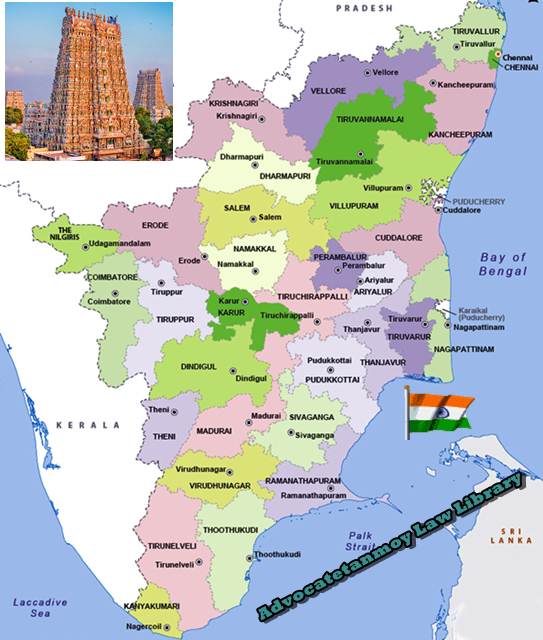
2. Local extent. – It extends to the whole of the [State of Tamil Nadu].
3. Jainas to whom the Act is applicable. – It applies to Jainas domiciled in the State of Tamil Nadu who are governed by the Aliyasanthana Law of Inheritance and also in respect of immovable property situated within the [State of Tamil Nadu] to Jainas domiciled outside the said State who are so governed.
4. Definition of intestate property. – A person is deemed to die intestate in respect of all property, of which he has not made a testamentary disposition which is capable of taking effect.
Explanation. – Property in this section does not include tarwad (kutumba) property, unless the person dying intestate was exclusively entitled to it.
5. Application of Mitakshara Law of Inheritance of Jainas. – Such property shall, notwithstanding any law or custom to the contrary, devolve upon his heirs in the order and according to the rules of the Mitakshara Law of Inheritance, under Hindu Law as administered in the [State of Tamil Nadu]. Such property, on devolution, shall be subject to all the incidents of the Mitakshara Law of Inheritance as administered in the [State of Tamil Nadu].
6. [Omitted.]