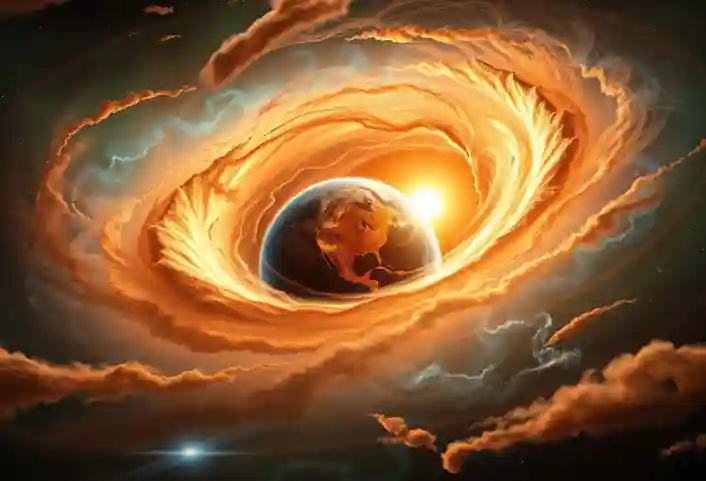
Exploring Earth’s Birth: The Role of the Solar Nebula
The formation of the Earth is a critical chapter in planetary science, which we claim, still, we do not know certainly about the formation of the Earth apart from presenting hypothesis. We run our knowledge system on the hypothesis. Earth’s formation is thought to have occurred approximately 4.6 billion years ago, hypothetically through a series of complex astrophysical and geochemical processes, without having any better details to describe here. To fully comprehend the Earth formation hypothesis, it is vital to compare it with the formation of other planets (one thing to remember is that we have no better information about the formation of other planes like Earth), both terrestrial and gas giants, within the solar system. This comparative analysis elucidates the interplay of mass, composition, distance from the Sun (Age of the sun is 4.6 billion years), and the influence of the early solar system.
When the solar system settled into its current layout about 4.5 billion years ago, Earth formed when gravity pulled swirling gas and dust in to become the third planet from the Sun. Like its fellow terrestrial planets, Earth has a central core, a rocky mantle, and a solid crust. (NASA)
Formation of Earth
1. Accretion Process
Earth formed through the process of accretion within the solar nebula—a rotating disk of gas and dust left over from the Sun’s formation. Dust grains in the nebula coalesced due to electrostatic forces, forming planetesimals (small rocky or icy bodies). Through collisions and gravitational attraction, planetesimals are combined into protoplanets. Earth’s formation was dominated by silicate materials and metal, reflecting its proximity to the Sun where high temperatures allowed for the condensation of these refractory materials.
2. Differentiation
As Earth grew, the heat generated from accretion, radioactive decay, and core formation caused partial melting. Differentiation segregated Earth’s interior into the iron-nickel core, silicate mantle, and crust. This process established the planet’s geochemical and geophysical structure, with the dense materials sinking to the center and lighter silicates forming the crust.
3. Late Heavy Bombardment and the Moon
Earth’s development was influenced by the Late Heavy Bombardment (LHB) period, during which frequent impacts modified its surface and possibly delivered water and organic compounds. The Moon’s formation, attributed to a giant impact with a Mars-sized body (Theia), profoundly affected Earth’s rotation, axial tilt, and possibly its magnetic field.
4. Atmospheric and Hydrospheric Development
Earth’s initial atmosphere, composed primarily of hydrogen and helium, was stripped away by solar winds. Volcanic outgassing and impact delivery of volatiles created a secondary atmosphere rich in water vapor, carbon dioxide, and nitrogen. Over time, the condensation of water vapor formed oceans, creating the hydrosphere and enabling the conditions for life.
Comparative Analysis with Other Planets
1. Terrestrial Planets: Mercury, Venus, and Mars
- Mercury shares a similar accretion process with Earth but is significantly smaller, resulting in a relatively weaker gravity and loss of much of its volatile materials. Mercury’s high density suggests a large metallic core, potentially due to impact stripping of its silicate mantle during early formation.
- Venus is often referred to as Earth’s twin in terms of size and composition. However, the lack of plate tectonics and its extreme greenhouse atmosphere mark a divergent evolutionary path, possibly due to the absence of significant water content and a robust magnetic field.
- Mars exhibits evidence of water in its past, suggesting that it may have followed an Earth-like trajectory initially. However, its smaller size and weaker gravity failed to sustain a thick atmosphere or significant tectonic activity, leading to its current cold and arid state.
2. Gas Giants: Jupiter and Saturn
- Jupiter’s Formation dominated the early solar system dynamics due to its massive size. Its rapid accretion of gas prevented the formation of terrestrial planets in its vicinity, influencing the distribution of materials in the inner solar system. Unlike Earth, Jupiter retained hydrogen and helium, which dominate its atmosphere and prevent geological differentiation similar to terrestrial planets.
- Saturn follows a similar formation model to Jupiter but is less massive and exhibits unique features like its ring system. Both gas giants formed rapidly from the solar nebula before the dissipation of gas, unlike Earth, which accreted over a longer period.
3. Ice Giants: Uranus and Neptune
- Uranus and Neptune, while composed predominantly of ice (water, ammonia, methane), show a stark contrast to Earth in their formation. Their larger distances from the Sun allowed them to accrete icy materials unavailable to terrestrial planets. They also have significant gaseous envelopes, unlike Earth.
4. Exoplanetary Comparisons
Beyond the solar system, super-Earths and rocky exoplanets provide insights into alternative planetary formation scenarios. Many super-Earths exhibit significant atmospheric retention due to their higher mass, whereas Earth’s moderate mass allowed for the development of a life-supporting atmosphere.
Critical Reflection on Earth’s Uniqueness
Earth’s formation is distinguished by its optimal size, distance from the Sun, and the presence of water, which collectively created conditions for life. The dynamic interactions between its lithosphere, hydrosphere, and atmosphere have sustained this habitability. In contrast, the diverse outcomes observed in other planets highlight the sensitive dependency of planetary evolution on initial conditions and external influences. For instance, the lack of a large satellite like the Moon in Venus’ history or the early cessation of tectonic activity on Mars demonstrates how critical events and properties shape planetary destinies.
Moreover, Earth’s magnetic field, generated by its molten metallic core, plays a vital role in shielding the atmosphere from solar wind, a feature absent or diminished in other terrestrial planets. This protective barrier may have been pivotal in retaining water and organic compounds, further enabling life’s evolution.
Recapture
The formation of Earth reflects a probable balance of stochastic and deterministic processes, each fine-tuned by the conditions of the early solar system(theoretically there should not be any early solar system or any system at all). Comparisons with other planets within and beyond the solar system reveal Earth’s unique trajectory in planetary evolution. This comparative framework emphasizes the interplay of mass, composition, and environmental factors in shaping a planet’s potential for habitability.
Solar Nebula
Earth emerged from the primordial solar nebula as per the present standard of information—a vast, rotating disk of gas and dust surrounding the young Sun! Understanding the conditions and mechanisms during Earth’s earliest stages may provide insight into its relationship with the Sun, the driving force behind the solar system’s formation and evolution. The age of the Sun and the Earth is the same!
1. The Solar Nebula and Earth’s Birth
The Sun’s formation, initiated by the gravitational collapse of a molecular cloud, set the stage for the emergence of the solar system. The energy released during the Sun’s formation generated intense solar winds, which swept lighter gases like hydrogen and helium toward the outer regions of the nebula. This redistribution of materials resulted in a gradient in temperature and composition across the disk.
- Inner Solar System Dynamics: Near the Sun, high temperatures prevented the condensation of volatile materials like water and methane. Instead, refractory elements such as iron, nickel, and silicates condensed, forming the building blocks of terrestrial planets, including Earth. Earth’s proximity to the Sun ensured that its composition was dominated by these denser, heat-resistant materials.
- Planetesimal Formation: Small particles of dust and ice in the nebula began to collide and stick together due to electrostatic forces, forming aggregates known as planetesimals. These grew through continued collisions and accretion, eventually forming protoplanets. Earth’s early growth was a chaotic process marked by frequent impacts, including those with other protoplanets.
2. The Role of Solar Energy in Earth’s Early Evolution
The Sun’s energy profoundly influenced Earth’s early environment:
- Volatile Stripping: Intense solar radiation and winds stripped away Earth’s initial hydrogen-helium atmosphere, a process more pronounced in the inner solar system. This left Earth with a secondary atmosphere, formed later through volcanic outgassing and the delivery of volatiles by comets and asteroids.
- Thermal Effects: The Sun’s radiation kept the inner solar system hot during Earth’s formation, contributing to the differentiation of materials within the growing Earth. Only metals and silicates remained stable at these high temperatures, while lighter, more volatile elements were driven outward.
- Stellar Influence on Rotation and Orbit: The gravitational interactions between Earth, the Sun, and other nearby protoplanets influenced Earth’s rotational dynamics and orbital properties. The current near-circular orbit ensures a relatively stable climate, which has been crucial for the development and sustainability of life.
3. The Hadean Era: Earth’s Fiery Beginning
The Hadean eon, spanning the first 500 million years of Earth’s history, was a period of intense heat and activity:
- Formation of the Proto-Earth: Early Earth was a molten body due to the heat generated by accretion, radioactive decay, and the decay of short-lived isotopes like aluminum-26. This molten state allowed differentiation, where denser materials like iron and nickel sank to form the core, while lighter silicates rose to form the mantle and crust.
- The Giant Impact Hypothesis: A significant event during the Hadean was the hypothesized collision between Earth and a Mars-sized protoplanet, Theia. This impact not only contributed additional heat but also ejected material that coalesced to form the Moon. The Moon’s formation stabilized Earth’s axial tilt, influencing climatic patterns and the development of tides.
- Atmospheric Evolution: Outgassing from Earth’s molten interior released volatiles, forming a thick atmosphere composed primarily of water vapor, carbon dioxide, methane, and nitrogen. This primordial atmosphere differed starkly from today’s, lacking oxygen and resembling those of Venus and Mars.
4. Relationship with the Sun and the Evolution of Earth’s Surface
The Sun’s role in Earth’s surface evolution has been multifaceted:
- Solar Luminosity: During its early stages, the Sun was about 70% as luminous as it is today, a phenomenon known as the “faint young Sun paradox.” Despite this reduced output, Earth’s surface maintained liquid water, likely due to a greenhouse atmosphere trapping heat. This balance contrasts with Venus and Mars, which experienced runaway greenhouse effects or atmospheric loss, respectively.
- Solar Wind and Magnetic Field: The young Sun emitted powerful solar winds, which interacted with Earth’s magnetosphere. Earth’s molten core generated a magnetic field that protected its atmosphere from erosion by these winds. This protection was essential for retaining water and other volatiles, unlike Mars, which lost its magnetic field early and consequently much of its atmosphere.
- Photosynthetically Active Radiation: The Sun’s radiation drove early photochemical reactions in Earth’s atmosphere and surface. These processes eventually played a role in the emergence of life, as photosynthetic organisms harnessed sunlight to produce energy, transforming Earth’s atmosphere with the release of oxygen.
5. Comparative Solar Influence on Earth and Other Planets
Earth’s relationship with the Sun is distinct among the terrestrial planets due to its unique size, composition, and distance:
- Venus: Closer proximity to the Sun exposed Venus to greater solar radiation, leading to the loss of water and the development of a thick, carbon dioxide-rich atmosphere. Without plate tectonics or a magnetic field, Venus lacks mechanisms to moderate its runaway greenhouse effect.
- Mars: Farther from the Sun, Mars received less energy, contributing to its colder climate. Its smaller size and weaker gravity made it incapable of retaining a thick atmosphere, exacerbated by the loss of its magnetic field.
Earth’s intermediate position within the “habitable zone” allowed for liquid water, stable temperatures, and an atmosphere conducive to life—a delicate interplay with solar energy and planetary properties.
Bibliography
The Sun’s influence on Earth’s formation and early evolution was pivotal, shaping its physical structure, atmospheric composition, and surface conditions. The delicate balance of factors such as Earth’s distance from the Sun, its magnetic field, and its ability to retain water established it as a unique oasis for life. (Read our Sanskrit article where we questioned the existence of Earth before the Sun)
1. Chambers, J. E. (2004).
“Planetary Accretion in the Inner Solar System”
Annual Review of Earth and Planetary Sciences, Vol. 32, pp. 539–570.
- Publication Date: 2004
- Why to Read: This seminal review provides an in-depth analysis of the processes of planetary accretion, including the formation of Earth and other terrestrial planets. It explores the physics of collisional growth, the role of protoplanetary dynamics, and the unique events shaping Earth’s composition. A foundational text for understanding how Earth’s formation fits into the broader narrative of planetary science.
2. Hartmann, W. K. (2005).
“Moons and Planets” (5th Edition)
Belmont, CA: Brooks/Cole.
- Publication Date: 2005
- Why to Read: This textbook comprehensively overviews solar system formation, planetary differentiation, and comparative planetology. It addresses the formation of Earth’s Moon and its implications for Earth’s evolution. Hartmann’s accessible writing makes this a cornerstone resource for graduate and doctoral studies in planetary science.
3. Canup, R. M., & Righter, K. (Eds.) (2000).
“Origin of the Earth and Moon”
University of Arizona Press.
- Publication Date: 2000
- Why to Read: This compilation of essays by leading scientists explores hypotheses on Earth’s origin, the Moon-forming impact, and early differentiation. It critically examines evidence from geochemistry, orbital dynamics, and computer simulations, making it a critical resource for understanding Earth’s formative events and their implications for the inner solar system.
4. Lammer, H., et al. (2009).
“Origin and Evolution of Planetary Atmospheres: Implications for Habitability”
Space Science Reviews, Vol. 139, pp. 399–436.
- Publication Date: 2009
- Why to Read: This paper bridges planetary formation and atmospheric evolution, providing insights into how Earth’s atmosphere developed under the influence of solar radiation and outgassing. It is particularly relevant for understanding the faint young Sun paradox and Earth’s capacity to support life.
5. Taylor, S. R. (1998).
“Destiny or Chance: Our Solar System and Its Place in the Cosmos”
Cambridge University Press.
- Publication Date: 1998
- Why to Read: Taylor’s book critically evaluates the uniqueness of Earth’s formation and its implications for life. By comparing Earth with other solar system planets and extrasolar systems, it offers a philosophical and scientific perspective on planetary development and habitability.
6. Morbidelli, A., et al. (2012).
“Building Terrestrial Planets”
Annual Review of Earth and Planetary Sciences, Vol. 40, pp. 251–275.
- Publication Date: 2012
- Why to Read: This article provides a detailed overview of terrestrial planet formation through simulations of the solar nebula. It delves into the role of giant planets in shaping the early inner solar system and offers critical comparisons with exoplanetary systems.
7. Kasting, J. F. (2010).
“How to Find a Habitable Planet”
Princeton University Press.
- Publication Date: 2010
- Why to Read: Kasting’s work explains the concept of the habitable zone and Earth’s unique positioning within it. The book combines planetary science and astrobiology, offering insights into Earth’s relationship with the Sun and the factors enabling life.
8. Allegre, C. J., et al. (1995).
“The Chemical Composition of the Earth”
Earth and Planetary Science Letters, Vol. 134, pp. 515–526.
- Publication Date: 1995
- Why to Read: This paper examines Earth’s composition in detail, with a focus on its differentiation and early geochemical evolution. It provides essential data and models for understanding Earth’s internal structure and its formation processes.
9. Ward, P. D., & Brownlee, D. (2000).
“Rare Earth: Why Complex Life is Uncommon in the Universe”
Springer-Verlag.
- Publication Date: 2000
- Why to Read: This influential book discusses Earth’s formation and early evolution in the context of planetary habitability. It argues for the rarity of conditions conducive to complex life, offering a thought-provoking perspective for planetary scientists and astrobiologists.
10. Zahnle, K., et al. (2007).
“Emergence of a Habitable Planet”
Space Science Reviews, Vol. 129, pp. 35–78.
- Publication Date: 2007
- Why to Read: This comprehensive review traces Earth’s journey from its formation to the development of a habitable environment. It focuses on the interplay between geological, atmospheric, and solar influences, making it an indispensable resource for understanding Earth’s early evolution.
11. Solar System Exploration: NASA Science
Website Resource:
https://solarsystem.nasa.gov
- Why to Read: This resource offers up-to-date information on planetary science, missions, and data. It includes models of Earth’s formation, comparisons with other planets, and educational materials suitable for advanced research.
Date: 10/12/2024
- Top 10 Ways to Spend Your Last Day on Earth
- Astronomers discovered a new active galaxy 31 billion light-years away from Earth