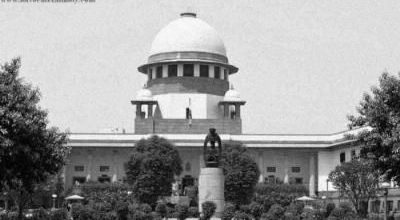
08 July 2024: The Supreme Court of India dismissed the appeal by the State of West Bengal against the High Court’s decision to dismiss their petition challenging an arbitration award. The dispute arose from a bridge construction contract, with the arbitration award in favor of the respondent. The appellant’s petition was dismissed by the High Court due to being time-barred, as it was filed after the expiry of the limitation period. The Supreme Court upheld the High Court’s decision, stating that the petition was indeed filed after the specified period, and therefore, the appeal was dismissed.
Supreme Court of India
The State of West Bengal represented through the Secretary & Ors. vs Rajpath Contractors and Engineers Ltd.
(Civil Appeal No. 7426 of 2023)
08 July 2024
[2024] 7 S.C.R. 1
2024 INSC 477
Acts: Arbitration and Conciliation Act, 1996; Limitation Act of 1963
[Abhay S. Oka and Pankaj Mithal, JJ.]
Judgment
Abhay S. Oka, J.
FACTUAL ASPECTS
1- The first appellant – the State of West Bengal appointed the respondent as a contractor for the construction of a bridge. As there was a dispute between the parties, the respondent invoked the arbitration clause in the contract, and a sole arbitrator was appointed. On 30th June 2022, the Arbitral Tribunal passed an award directing the appellants to pay a sum of Rs.2,11,67,054.00 (Two Crores Eleven Lakhs Sixty-Seven Thousand Fifty-Four Rupees Only) to the respondent with interest thereon, as directed. The counter-claim made by the appellants was dismissed. The appellants received a copy of the award on the same day. The High Court of Judicature at Calcutta was closed for pooja vacation from 1st October 2022 to 30th October 2022 (both days inclusive). On 31st October 2022, the appellants filed a petition under Section 34 of the Arbitration and Conciliation Act, 1996 (for short, ‘the Arbitration Act’) to challenge the award. By the impugned order dated 4th May 2023, the High Court dismissed the petition under Section 34 of the Arbitration Act filed by the appellants on the ground of bar of limitation. The High Court held that the period of limitation for filing a petition under Section 34 expired on 30th September 2022. Therefore, the appellants are not entitled to the benefit of Section 4 of the Limitation Act of 1963 (for short, ‘the Limitation Act’).
2.Being aggrieved by the view taken by the High Court, the appellants are in this appeal. We may note here that under the impugned judgment, the High Court granted a certificate to prefer an appeal before this Court by exercising powers under Article 133 (1) and Article 134(A)(a) of the Constitution of India.
SUBMISSIONS
3.The learned counsel appearing for the appellants submitted that as the period of limitation for filing a petition under Section 34 of the Arbitration Act ought to have been calculated from 1st July 2022, the prescribed period of limitation ended on 1st October 2022, which was the first day of pooja vacation. Therefore, the petition under Section 34 of the Arbitration Act filed immediately after the re-opening of the Court on 31st October 2022 must be held to be within limitation. The learned counsel relied upon Section 9 of the General Clauses Act, 1897 (for short, ‘the General Clauses Act’). The learned counsel also submitted that the petition could not be e-filed in pooja vacation as the relevant e-filing notification provided for e-filing of only urgent matters during the vacations. The learned counsel relied upon a decision of this Court in the case of State of Himachal Pradesh and Another v. Himachal Techno Engineers and Another1.
4.The learned counsel appearing for the respondent supported the findings recorded by the High Court. He submitted that in any event, the benefit of Section 4 of the Limitation Act is available only if the proceedings are filed within the prescribed period of limitation, which will be three months in this case in terms of Section 34(3) of the Arbitration Act. The learned counsel relied upon a decision made by this court in the case of Assam Urban Water Supply & Sewerage Board v Subash Projects & Mktg. Ltd.2. He also invited our attention to a decision of this Court in the case of Union of India v. Popular Construction Company 3. He submitted that, as held by this Court in the said decision, the applicability of Section 5 of the Limitation Act is excluded in view of the language used in the proviso to sub-section (3) of Section 34.
OUR VIEW
5.The facts are undisputed. The award made by the Arbitral Tribunal on 30th June 2022 was served upon the appellant on the same day. Between 1st October 2022 and 30th October 2022 (both days inclusive), the High Court was closed for pooja vacation. The petition under Section 34 of the Arbitration Act was filed on 31st October 2022.
6.The period of limitation for filing a petition under Section 34 of the Arbitration Act is governed by sub-section (3) of Section 34. Sub-section (3) of Section 34 reads thus:
“(3) An application for setting aside may not be made after three months have elapsed from the date on which the party making that application had received the arbitral award or, if a request had been made under section 33, from the date on which that request had been disposed of by the arbitral tribunal:
Provided that if the Court is satisfied that the applicant was prevented by sufficient cause from making the application within the said period of three months it may entertain the application within a further period of thirty days, but not thereafter.”
7.As per Section 12(1) of the Limitation Act, the day from which the limitation period is to be reckoned must be excluded. In this case, the period of limitation for filing a petition under Section 34 will have to be reckoned from 30th June 2022, when the appellants received the award. In view of Section 12(1) of the Limitation Act, 30th June 2022 will have to be excluded while computing the limitation period. Thus, in effect, the period of limitation, in the facts of the case, started running on 1st July 2022. The period of limitation is of three months and not ninety days. Therefore, from the starting point of 1st July 2022, the last day of the period of three months would be 30th September 2022. As noted earlier, the pooja vacation started on 1st October 2022.
8.We may note here that Section 43 of the Arbitration Act provides that the Limitation Act shall apply to the arbitrations as it applies to proceedings in the Court. We may note here that the consistent view taken by this Court right from the decision in the case of Union of India v. Popular Construction Co.(3) is that given the language used in proviso to sub-section (3) of Section 34 of the Arbitration Act, the applicability of Section 5 of the Limitation Act to the petition under Section 34 of the Arbitration Act has been excluded.
9.Now, we proceed to consider whether the appellant will be entitled to the benefit of Section 4 of the Limitation Act. Section 4 of the Limitation Act reads thus:
“4. Expiry of prescribed period when court is closed.—Where the prescribed period for any suit, appeal or application expires on a day when the court is closed, the suit, appeal or application may be instituted, preferred or made on the day when the court re-opens.
Explanation.—A court shall be deemed to be closed on any day within the meaning of this section if during any part of its normal working hours it remains closed on that day.”
(underline supplied)
The meaning of “the prescribed period” is no longer res integra. In the case of Assam Urban Water Supply & Sewerage Board v. Subash Projects & Mktg. Ltd.2, in paragraphs nos. 13 and 14, the law has been laid down on the subject. The said paragraphs read thus:
“13. The crucial words in Section 4 of the 1963 Act are “prescribed period”. What is the meaning of these words?
- Section 2(j) of the 1963 Act defines:
“2. (j) ‘period of limitation’ [which] means the period of limitation prescribed for any suit, appeal or application by the Schedule, and ‘prescribed period’ means the period of limitation computed in accordance with the provisions of this Act;
Section 2(j) of the 1963 Act when read in the context of Section 34(3) of the 1996 Act, it becomes amply clear that the prescribed period for making an application for setting aside an arbitral award is three months. The period of 30 days mentioned in the proviso that follows sub-section (3) of Section 34 of the 1996 Act is not the “period of limitation” and, therefore, not the “prescribed period” for the purposes of making the application for setting aside the arbitral award. The period of 30 days beyond three months which the court may extend on sufficient cause being shown under the proviso appended to sub-section (3) of Section 34 of the 1996 Act being not the “period of limitation” or, in other words, the “prescribed period”, in our opinion, Section 4 of the 1963 Act is not, at all, attracted to the facts of the present case.”
(underline supplied)
Even in this case, this Court was dealing with the period of limitation for preferring a petition under Section 34 of the Arbitration Act. We may note that the decision in the case of State of Himachal Pradesh and Another v. Himachal Techno Engineers and Another 1 which is relied upon by the appellant, follows the aforesaid decision.
10.In the facts of the case in hand, the three months provided by way of limitation expired a day before the commencement of the pooja vacation, which commenced on 1st October 2022. Thus, the prescribed period within the meaning of Section 4 of the Limitation Act ended on 30th September 2022. Therefore, the appellants were not entitled to take benefit of Section 4 of the Limitation Act. As per the proviso to sub-section (3) of Section 34, the period of limitation could have been extended by a maximum period of 30 days. The maximum period of 30 days expired on 30th October 2022. As noted earlier, the petition was filed on 31st October 2022.
11.Thus, looking from the angle, the High Court was right in holding that the petition filed by the appellants under Section 34 of the Arbitration Act was not filed within the period specified under sub-section (3) of Section 34. Hence, we find no merit in the appeal, and it is, accordingly, dismissed.
Appeal Dismissed.
___________
1 [2010] 8 SCR 1025 : (2010) 12 SCC 210
2 [2012] 1 SCR 403 : (2012) 2 SCC 624
3 [2001] Supp. 3 SCR 619 : (2001) 8 SCC 470