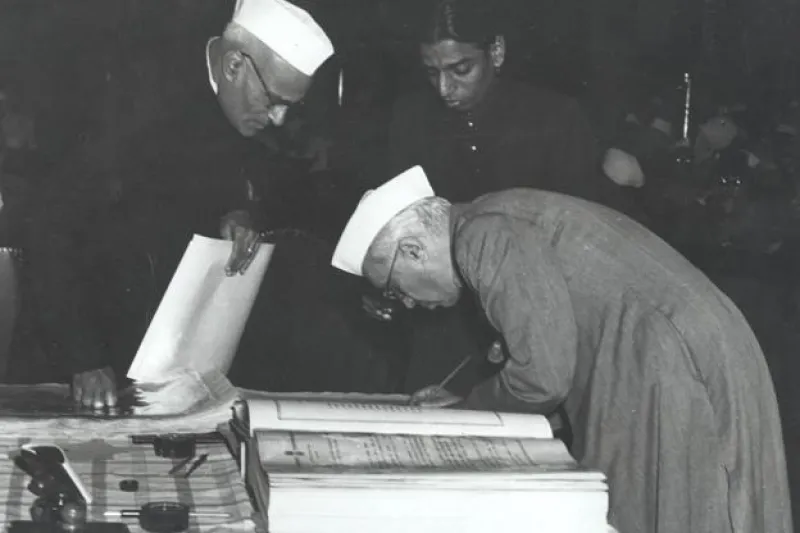
Jawaharlal Nehru signing the Indian Constitution, 1950
ARTHUR BERRIEDALE KEITH
D.C.L., D.LITT., F.B.A.
OF THE) INNER TEMPLE, BABB.ISTBB.-AT-LAW, AND ADVOCATE OF THE SCOTTISH BAR; REGIUS PROFESSOR OF SANSKRIT AND COMPARATIVE PHILOLOGY AND LECTURER ON THE CONSTITUTION OF THE BRITISH EMPIRE AT THE UNIVERSITY OF EDINBURGH
METHUEN & CO. LTD. LONDON
36 Essex Street W.C.
First published in 1936
PREFACE
IT was the aim of the greatest among the early British administrators in India to train the peoples of India to govern and protect themselves, as Sir Thomas Munro wrote in 1824, rather than to establish the rule of a British bureaucracy. The method which they contemplated was doubtless that carried out with the most conspicuous success in Mysore, which, thanks in the main to the efforts of Sir Mark Cubbon as resident, was handed back to Indian rule in 1881 with the assurance that a tradition of sound government had been created which could be operated without detailed British supervision. Elsewhere this ideal proved impossible of accomplishnment; the necessity of securing justice and order led to the progressive extension of direct British sovereignty and the evolution of that splendid instrument of government, the Indian Civil Service. That service, however, brought with it British political ideas and made English the official language of the higher functions of government. The result was inevitable; with steadily increasing strength the Indian intelligentsia demanded the fulfillment of self-government, not in the form contemplated by Munro and his contemporaries, but in that of British Parliamentary institutions to men deply imbued with the fundamental principles of democracy, such as Lord Morley of Blackburn, these demands seemed inconsistent with the structure of Indian society, which is founded based on social inequality and racial and religious diversity. But the services of India in the war elicited a formal declaration on August 20th, 1917 of the policy of the British Government as involving steps to the gradual realization of responsible government in India as an integral part of the British Empire.
It is possible to condemn the declaration as an ill-considered piece of war propaganda; it seems clear at least that Lord Curzon did not realize that the pledge involved a parliamentary government of the British type.
But, whether the adoption of the policy was wise or not, it is clear that it had to be honored, and the constitution of 1919 was the method suggested by Mr. Montagu and Lord Chelmsford to inaugurate the process of change. Whether the system of dyarchy on which it was based was workable may be doubted; the insight into it which I derived from membership of Lord Crewe’s Committee on the
Home Administration of India satisfied me that, for the reasons pointed out in my report (Cmd. 207)
as a member, radical’ alterations in the principle of control would be essential, if the principle of responsibility was to be tested. Naturally enough, considerations of caution prevailed, and the constitution as enacted and as operated effectively negatived ay real test of the capacity of Indian ministers to work in responsible government. It is the essential merit of the Act of 1935 that it recognizes the failure of the Act of 1919 and presents, so far as Indian social conditions permit, the possibility in the provinces of true responsible government. It would, of course, be absurd to ignore the difficulties of operating the system under Indian conditions, which necessitate reserving large powers of intervention to the governors, but the task is at least not impossible as it was under the Act of 1919.
In the federal government also the semblance of responsible government is presented. But the reality
is lacking, for the powers in defense and external affairs necessarily, as matters stand, given to the governor-general limit vitally the scope of ministerial activity, and the measure of representation given
to the rulers of the Indian States negatives any possibility of even the beginnings of democratic control. It will be a matter of the utmost interest to watch the development of a form of government so unique; certainly, if it operates successfully, the highest credit will be due to the political capacity of Indian
leaders, who have more serious difficulties to face than had the colonial statesmen who evolved the system of self-government which has now culminated in Dominion status.
Since this book was written, the British Government has taken the necessary decisions regarding
the separation of Sind and Orissa from their present union with Bombay and Bihar.
The new provinces during the period of transition will have a distinctive form of government. Each will be governed by a governor without either an executive or a legislative council and without any form of dyarchy. A measure of aid will be afforded by advisory councils of not more than twenty-five and twenty members respectively, nominated by the governor, of whom not more than three will be officials. The governor may choose one or more of the council to assist him in such manner as he thinks fit. Legislation
rests with the governor-general in council under the procedure provided in the Government of India Act (s. 71) for special areas; finance with the governor, who, however, is required to submit his statement of
revenue and expenditure and proposals for appropriation to his council, but only for general discussion. Revenue Commissioners are provided for the two provinces, and arrangements are made for the allocation of officers, and apportionment of property, assets and liabilities between the provinces; in
the case of Orissa, the matter is complicated by the fact that certain areas are transferred from Madras and the Central Provinces to constitute with the Orissa Division of Bihar and Orissa the new province.
Reductions are necessarily made in the size of the Legislative Councils of the diminished provinces; that of Bombay is reduced to ninety-five members (sixty-seven elected): that of Bihar loses ten elected and two nominated official members, that of Madras two elected members. The High Court at
Patna becomes the High Court for the whole of the newly-constituted Orissa.
The new arrangements are obviously suited only for a brief transitional period; it is hoped that the necessary delimitation of constituencies under the Act of 1935 and the investigations of financial conditions will be carried out in time to permit of provincial autonomy by bringing Part III of the Act into operation in 1937; federation will be necessarily slower in reaching fruition. The selection of Commander A. D.Cochrane, M.P., as the governor of Burma marks the preparation for the inauguration
there of the new regime; the precedent indicates that under the changed conditions the chance of
members of the Indian Civil Service attaining governorships is greatly reduced, necessarily involving a further decline in the attractiveness of a service that has conferred great benefits on India, but what inevitably must lose authority under the new regime.
For purposes of convenience the original Government of India Act, 1935 (25 & 26 Geo. V, c. 42) has been reprinted as the Government of India Act, 1935 (26 Geo. V, c. 2) and the Government of Burma Act, 1935 (26 Geo. V, c. 3), and the section references in this book refer to these Acts accordingly.
The Government of India Act, without date, to which reference is occasionally made, is the Act of 1915 consolidating earlier legislation, as reprinted by direction of Parliament with alterations under amending legislation passed before the Act of 1935. When the latter Act takes full effect, the earlier legislation
will pass away, together with the historic system that it represents. The vital change between the Act of 1935 and 1919 is thus formally attested; if it was possible to fit the changes then made as amendments into the substance of the old system that was out of the question with the Act of 1935.
In this sketch of constitutional history, I have necessarily concentrated attention on those matters which appeared to be of special significance as bearing on the evolution of self-government. After the earlier periods, administrative and judicial details have, therefore, been passed over. Brevity also has dictated curtailment of discussion; otherwise, I should have desired to deal fully with the views of the apologists for the action of Warren Hastings, and the defenders of the remarkable and in my opinion quite untenable claims put forward by the rulers of the Indian States.
A. BERRIEDALE KEITHTHE UNIVERSITY OF EDINBURGH
February 12th 1936
I. THE COMPANY BEFORE PLASSEY; ITS CONSTITUTION, RELATION TO THE INDIAN STATES, AND THE ADMINISTRATION OF ITS SETTLEMENTS AND TERRITORIES
- THE CONSTITUTION OF THE COMPANY
- THE COMPANY AND THE NATIVE PRINCES
- THE GOVERNMENT OF THE COMPANY’S SETTLEMENTS AND TERRITORIES
(a) THE EXECUTIVE GOVERNMENT
(b) JURISDICTION AND LEGISLATION IN BOMBAY
(c) JURISDICTION AND LEGISLATION IN MADRAS
(d) JURISDICTION AND LEGISLATION IN BENGAL
II. THE DIWANI, THE EXPLOITATION OF BENGAL, DYARCHY, AND ANARCHY
- THE GRANT OF THE DIWANI
- THE WORKING OF DYARCHY
III. THE INTERVENTION OF PARLIAMENT, NORTH’S REGULATING ACT, AND WARREN HASTINGS
- WARREN HASTINGS IN BENGAL
- THE INTERVENTION OF PARLIAMENT AND THE REGULATING ACT
- WARREN HASTINGS AS GOVERNOR-GENERAL EXTERNAL AFFAIRS
- WARREN HASTINGS AS GOVERNOR-GENERAL INTERNAL AFFAIRS
IV. THE ESTABLISHMENT OF ORGANIZED ADMINISTRATION: PITT’S ACT AND CORNWALLIS
- THE ESTABLISHMENT OF PARLIAMENTARY CONTROL
- CORNWALLIS AND EXTERNAL RELATIONS
- THE REFORMS OF CORNWALLIS