Sarvarthapedia (Twelve Core Areas)
Indira Gandhi’s 1978 Interview: Emergency, Shah Commission, and Indian Politics
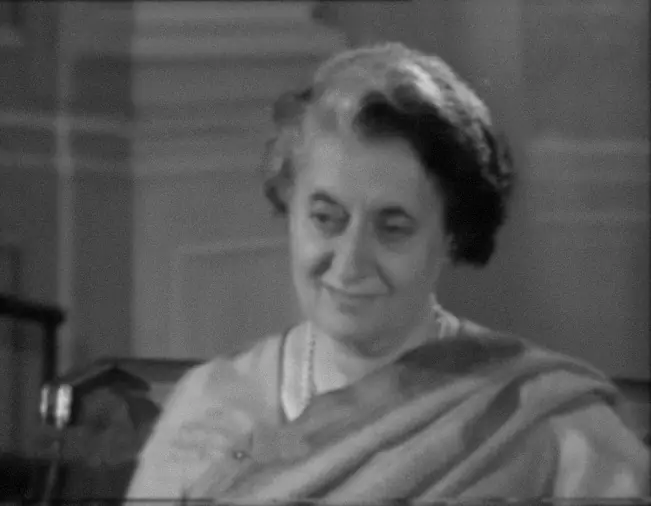
The televised encounter of 16 November 1978 between Indira Gandhi and Jonathan Dimbleby, produced by Thames Television, belongs to a turbulent interlude in Indian political history when the meaning of the Indian Emergency was still unsettled, contested, and intensely personal. By that date, Gandhi had already fallen from power, been subjected to public inquiry, and yet had begun—quietly but unmistakably—her political return. The interview, stripped of its conversational surface, reveals a layered political argument shaped by defeat, resilience, and a determination to reclaim narrative authority.
In 1978, India stood in a rare phase of post-Congress governance, under the Janata coalition led by Morarji Desai. This government emerged from the general elections of March 1977, which followed the lifting of the Emergency in January that year. For the first time since 1947, the Congress Party had been decisively removed from power at the Union level. The electoral outcome itself became a central reference point in Gandhi’s retrospective reasoning: she framed the defeat not as a moral repudiation but as the result of “sustained propaganda”, implying that public opinion had been temporarily distorted rather than fundamentally transformed.
The deeper context of the interview lies in the chain of events beginning on 12 June 1975, when the Allahabad High Court delivered its judgment invalidating Gandhi’s 1971 election on charges of electoral malpractice. This judicial decision created a constitutional crisis. Within thirteen days, on 25 June 1975, the Emergency was proclaimed under Article 352, citing threats to national security. In the 1978 reflections, Gandhi’s central justification rested on the notion of “imminent danger”—a phrase that remained deliberately imprecise. She consistently described the threat as both internal unrest and externally supported destabilization, invoking a geopolitical logic typical of Cold War-era leaderships in postcolonial states.
Her argument, when reorganized analytically, rests on three pillars: national survival, institutional sanction, and political necessity. First, she characterized the pre-Emergency climate as one of escalating disorder, influenced by movements led by figures such as Jayaprakash Narayan, who had mobilized mass protests against the government. Gandhi’s retrospective framing cast these movements not merely as dissent but as precursors to “anarchy”—a breakdown of governance that required decisive intervention. Second, she emphasized that the Emergency was formally approved by the Cabinet and ratified by Parliament, thereby asserting a form of constitutional legitimacy. Third, she suggested that conventional legal instruments were inadequate for a country of India’s scale and complexity, reinforcing the idea that extraordinary conditions required extraordinary measures.
Yet by 1978, this justification was under systematic challenge, particularly through the work of the Shah Commission. Established in May 1977, the Commission investigated allegations of abuse of power, including mass detentions, censorship, and administrative excesses. Its findings undermined the claim that the Emergency had been based on credible intelligence. Gandhi’s response, visible in her broader public statements of the time, was to delegitimize the inquiry itself—portraying it as “one-sided”, politically motivated, and inattentive to the pressures facing the state in 1975. This rejection illustrates a broader political strategy: rather than conceding factual errors, she contested the authority of the investigative framework.
One of the most contentious aspects of the Emergency—preventive detention—was similarly reframed. Tens of thousands of individuals, including opposition leaders, activists, and journalists, had been imprisoned under laws such as the Maintenance of Internal Security Act (MISA). Gandhi’s defense recast these detentions as necessary actions against forces that threatened democratic order. Figures like Morarji Desai, who would later become Prime Minister, were described not as political prisoners but as actors contributing to instability. This inversion—portraying opposition as anti-democratic—formed a key element of her narrative.
Equally significant is the question of civil liberties, particularly the suspension of the right to judicial remedy. During the Emergency, constitutional rights under Articles 14, 21, and 22 were effectively curtailed, and the judiciary itself became constrained, as seen in the controversial ADM Jabalpur case (1976). In her retrospective stance, Gandhi compared these measures to wartime restrictions, suggesting that they were temporary and proportionate to the perceived threat. This analogy to war is revealing: it places the Emergency within a framework of exceptional sovereignty, where the state assumes expanded powers to ensure survival.
The issue of press censorship offers another window into the political logic of the period. Beginning in June 1975, newspapers were subject to pre-publication censorship, and dissenting voices were suppressed. By 1978, Gandhi acknowledged administrative shortcomings in how censorship was implemented but did not fundamentally question its necessity. Instead, she reframed the press as part of a broader “obstructive force”, resistant to social and economic reforms. This interpretation aligns with her long-standing critique of elite institutions, which she often depicted as barriers to redistributive policies.
Among the most controversial policies associated with the Emergency was the family planning drive, particularly the mass sterilization campaigns of 1976–77. These campaigns, often linked to Sanjay Gandhi, led to millions of procedures, with numerous reports of coercion, intimidation, and administrative pressure. Gandhi’s later position was marked by partial acknowledgment—accepting that “mistakes” may have occurred—while rejecting the idea of systematic coercion. This careful calibration allowed her to accept formal responsibility as head of government without conceding moral culpability.
By November 1978, Gandhi’s political situation was paradoxical. She was both marginalized and resurgent. Having been arrested briefly in October 1977 and subjected to intense criticism, she nevertheless regained a parliamentary seat in November 1978 through a by-election in Chikmagalur. This victory signaled a shift in public sentiment and demonstrated that the memory of the Emergency was not uniformly decisive. Her rhetoric during this period reflects a transition from defensive justification to counter-accusation, particularly against the Janata government, which she portrayed as ineffective and itself prone to excesses.
The interview context also reveals a broader ideological tension between liberal democratic norms and postcolonial statecraft. Dimbleby’s line of questioning emphasized individual rights, judicial oversight, and press freedom—principles associated with Western democratic traditions. Gandhi’s responses, in contrast, emphasized collective stability, developmental urgency, and the challenges of governing a vast and diverse nation. This divergence is not merely rhetorical; it reflects differing assumptions about the relationship between state authority and democratic practice.
The significance of the 1978 moment becomes clearer when viewed in retrospect. Within two years, in January 1980, Gandhi would return to power after a decisive electoral victory, marking the collapse of the Janata experiment. The arguments she articulated in 1978—about instability, governance, and national coherence—would reappear, albeit in modified form, during her subsequent tenure. The Emergency itself, however, remained a defining and controversial chapter, shaping both her legacy and the evolution of Indian democracy.
In historical perspective, the 16 November 1978 encounter can be read as part of a broader process of narrative reconstruction. Gandhi was not merely answering questions; she was actively reinterpreting a contested past, seeking to reposition herself within the political imagination of India. The emphasis on “necessity”, the rejection of external judgment, and the insistence on national self-determination all point to a leader engaged in redefining legitimacy after a period of profound crisis.
The episode thus illustrates how political memory is constructed and contested in real time. The Emergency, far from being a closed chapter in 1978, remained an open question—its meaning shaped by competing accounts, institutional inquiries, and public debate. Gandhi’s intervention in this process, as captured in the interview, reveals both the durability of her political instincts and the complexity of India’s democratic trajectory in the late twentieth century.
Here’s a clean, corrected transcript of the interview segment you provided, with grammar, punctuation, and readability improved while keeping the meaning intact:
Interview with Mrs. Gandhi (Extract) Dated 16th November 1978
Interviewer: Mrs. Gandhi, can you imagine any circumstances in which you might once again become Prime Minister of India?
Indira Gandhi: I can certainly imagine the circumstances. But the question is whether I want to be, or whether I would agree to be.
Interviewer: Under what terms would you agree?
Indira Gandhi: It’s not about terms. I don’t want to be categorical. You’re not in politics—you can’t give very definite answers. I didn’t want to be in Parliament, and I told everybody I wouldn’t stand. But here I am.
Interviewer: What do you think the Indian people saw in you? What made you the figure you are in their eyes?
Indira Gandhi: What I’ve done for them—it’s what they’ve seen that I’ve done.
Interviewer: Yet they voted you out in 1977.
Indira Gandhi: “Booted” is a strong word. We were defeated. But within less than a month, people were coming back to me because there had been sustained, malicious propaganda that people were taken in by.
Interviewer: When your own parliamentary spokesman described you as “the woman to whom the gods have entrusted the destiny of India,” what was your reaction?
Indira Gandhi: I haven’t even heard that phrase. I don’t know how it was used. Such expressions are meaningless extravagance. In India, speeches are often full of such phrases.
Interviewer: Do you feel you ever abused the trust the Indian people placed in you?
Indira Gandhi: Certainly not.
Interviewer: That question relates to the Emergency you declared in 1975, when you assumed very great powers. You wrote to the President that there was “an imminent danger to the security of India.” What was the precise nature of that danger?
Indira Gandhi: You can’t define it with great precision. There was a deep and widespread conspiracy. It’s obvious now—the whole subcontinent has been destabilized. It was both internal and supported from outside.
Interviewer: But you invoked special powers based on internal upheaval.
Indira Gandhi: Had it been only internal, it could have been handled more easily. But there was foreign interference as well.
Interviewer: The Shah Commission reported that there was no evidence—no police or intelligence reports—to justify the Emergency.
Indira Gandhi: That’s not true at all. As Prime Minister, I had access to information from many sources—not just police reports, but other governments and agencies. The report is prejudiced and one-sided.
Interviewer: Justice Shah was a former Chief Justice. Do you question his judgment?
Indira Gandhi: He had expressed strong views against me and my policies even before his appointment. That raises questions about impartiality.
Interviewer: At the same time, the Allahabad High Court found you guilty of electoral malpractice. Was it a coincidence that the Emergency followed?
Indira Gandhi: It was not a coincidence. But if I had wanted to remain Prime Minister at all costs, I could have done so. The party would have supported me indefinitely.
Interviewer: Did you not exaggerate the threat to justify staying in power?
Indira Gandhi: That is a very rude and baseless question.
Interviewer: The Shah Commission says thousands were detained and many illegal actions followed.
Indira Gandhi: In a parliamentary democracy, is a judge competent to override Parliament? The Emergency was ratified by the Cabinet and Parliament, and initially supported by the nation.
Interviewer: Why was it necessary to imprison opposition leaders like Morarji Desai?
Indira Gandhi: They were undermining democracy. Some even advocated surrounding Parliament and preventing its functioning. There were calls to win “by the bullet” if not by the ballot.
Interviewer: Why not use existing laws instead of Emergency powers?
Indira Gandhi: India is a vast and complex country. There was widespread indiscipline—anarchy was developing. Without action, India might not have survived.
Interviewer: Why remove citizens’ right to go to court?
Indira Gandhi: It was temporary, like wartime measures. India faced a threat comparable to war.
Interviewer: Why censor the press and even restrict reporting of parliamentary speeches?
Indira Gandhi: Censorship may not have been properly managed. It was intended as a short-term measure to prevent chaos.
Interviewer: The Shah Commission says censorship was used to suppress dissent and control information.
Indira Gandhi: We do not accept that report. It is irrelevant to the actual situation.
Interviewer: During those 20 months, millions were sterilized. There are claims of coercion.
Indira Gandhi: I have always opposed compulsion. Mistakes may have occurred in such a large program, but many allegations are exaggerated.
Interviewer: Do you accept responsibility?
Indira Gandhi: As head of government, yes. But one cannot be categorical—mistakes happen in any large effort.
Interviewer: Would you impose another Emergency if faced with similar conditions?
Indira Gandhi: No. Today’s situation is different. In fact, I believe there is now an undeclared emergency without constitutional sanction.
Interviewer: What do you expect for India’s future?
Indira Gandhi: India’s future is for us to decide. We will determine it ourselves.
Interviewer: If you face charges based on the Shah Commission, why not accept a trial?
Indira Gandhi: Because I am not guilty.
Sarvarthapedia Conceptual Node: Indira Gandhi (1978 Interview Context)
The 1978 televised exchange operates as a central interpretive node linking state authority, democratic crisis, and post-Emergency political reconstruction. It reflects a transitional phase in which leadership narratives, institutional legitimacy, and public memory intersect.
See also
- Indian Emergency
- Shah Commission
- Morarji Desai
- Allahabad High Court
- Jayaprakash Narayan
- Contemporary Indian Politics
Cluster: Emergency and Constitutional Crisis (1975–1977)
The proclamation of Emergency on 25 June 1975 represents a convergence of judicial conflict, political unrest, and executive consolidation of power. It serves as the foundational event shaping the 1978 discourse.
Linked Concepts
- Article 352 (Indian Constitution) – Legal mechanism enabling Emergency rule
- Preventive Detention – Expansion of executive control over civil liberties
- Suspension of Fundamental Rights – Curtailment of judicial remedies
- ADM Jabalpur Case (1976) – Judicial validation of state authority during crisis
Cross-links
- Connects to Judicial Authority vs Executive Power (Allahabad High Court ruling)
- Connects to State vs Dissent (Jayaprakash Narayan movement)
- Connects to Media Control and Censorship
Cluster: Judicial Authority and Political Legitimacy
The June 1975 judgment of the Allahabad High Court invalidating Gandhi’s election triggered a constitutional confrontation between judiciary and executive authority.
Linked Concepts
- Electoral Malpractice (1971 Election Case)
- Judicial Review in Indian Democracy
- Parliamentary Supremacy vs Judicial Oversight
Cross-links
- Leads to Emergency Proclamation (1975)
- Intersects with Shah Commission Findings (1977–78)
- Influences Post-Emergency Legal Accountability
Cluster: Shah Commission and Accountability (1977–1978)
The Shah Commission represents institutional attempts to reconstruct the Emergency through investigation, testimony, and state accountability.
Linked Concepts
- Abuse of Power Allegations
- Mass Detentions and Civil Liberties Violations
- Administrative Excesses
Cross-links
- Opposed by Indira Gandhi’s Narrative of Necessity
- Connected to Janata Government Legitimacy
- Feeds into Historical Memory of the Emergency
Cluster: Opposition Movements and Political Mobilization
Mass protests led by Jayaprakash Narayan formed the backbone of pre-Emergency unrest, representing grassroots resistance to centralized authority.
Linked Concepts
- Total Revolution Movement
- Civil Disobedience and Mass Protest
- Coalition Politics (Janata Formation)
Cross-links
- Precipitates Emergency Declaration (1975)
- Transforms into Janata Party Government (1977)
- Reframed as “Anarchy” in Gandhi’s Defense
Cluster: Janata Government and Post-Emergency Politics
The rise of Morarji Desai symbolizes the first non-Congress central government, marking a shift in Indian political structure.
Linked Concepts
- Coalition Governance Challenges
- Anti-Emergency Political Mandate
- Internal Fragmentation of Janata Party
Cross-links
- Initiates Shah Commission Inquiry
- Creates conditions for Indira Gandhi’s Political Comeback (1978–1980)
- Highlights Limits of Anti-Congress Unity
Cluster: Media Control and Censorship
During the Emergency, the press became a critical site of state regulation and information control, reflecting tensions between freedom of expression and state security.
Linked Concepts
- Pre-publication Censorship
- Suppression of Opposition Voices
- State Broadcasting Dominance
Cross-links
- Linked to Emergency Governance Mechanisms
- Critiqued in Shah Commission Findings
- Reinterpreted as Administrative Necessity in 1978 Narrative
Cluster: Population Policy and Sterilization Campaigns
The family planning drive (1976–77), often associated with Sanjay Gandhi, represents one of the most controversial socio-political programs of the Emergency.
Linked Concepts
- Mass Sterilization Campaigns
- Coercion vs Development Policy
- Administrative Target Systems
Cross-links
- Criticized in Shah Commission Reports
- Defended as Developmental Necessity
- Contributes to Public Backlash in 1977 Elections
Cluster: State vs Democracy Debate
The interview crystallizes a broader theoretical tension between authoritarian centralization and democratic pluralism.
Linked Concepts
- National Security vs Civil Liberties
- Developmental State Theory
- Postcolonial Governance Challenges
Cross-links
- Anchored in Emergency Justification Narrative
- Opposed by Liberal Democratic Critiques (Western Media)
- Shapes Historiography of Indian Democracy
Cluster: Political Comeback and Historical Memory (1978–1980)
By late 1978, Indira Gandhi’s political revival was underway, demonstrating the fluidity of public memory and electoral legitimacy.
Linked Concepts
- Chikmagalur By-election (1978)
- Reconstruction of Political Image
- Electoral Return (1980)
Cross-links
- Builds on Critique of Janata Government
- Reframes Emergency as Necessary Action
- Influences Long-term Congress Strategy
Network Summary
This conceptual network situates the 1978 interview within overlapping domains of:
- Crisis Governance (Emergency)
- Institutional Conflict (Judiciary vs Executive)
- Accountability Mechanisms (Shah Commission)
- Political Transition (Janata Government)
- Narrative Reconstruction (Indira Gandhi’s Defense)
- Contemporary World History
Each cluster is interdependent, forming a dense web where historical events, political actors, and institutional processes continuously reshape one another.
