Global Crude Oil Market Report May 2026: Prices, Reserves and Economic Risks
In May 2026, the global oil market entered one of the most unstable and historically consequential periods since the oil shocks of the 1973 Arab–Israeli War and the 1979 Iranian Revolution. The crisis developed around the Strait of Hormuz, the narrow maritime corridor between Iran and Oman through which nearly one quarter of the world’s seaborne oil trade normally passes. The International Energy Agency warned during April and May 2026 that the disruption around Hormuz represented the largest interruption to global oil flows in modern energy history. The closure and militarisation of the strait transformed oil from a commodity driven mainly by economics into a geopolitical instrument shaped by naval deployments, sanctions, missile attacks, tanker insurance costs, export restrictions and emergency strategic reserves.
The roots of the crisis stretched back several decades. Since the late twentieth century, the Persian Gulf had remained the central artery of world petroleum supply. After the discovery of giant oil fields in Saudi Arabia during the 1930s, followed by large discoveries in Kuwait, Iraq, Iran, Abu Dhabi, and Qatar, the Gulf emerged as the most important hydrocarbon region on earth. By the early twenty-first century, countries bordering the Persian Gulf controlled more than half of the world’s proven conventional crude oil reserves. The Strait of Hormuz therefore became a strategic bottleneck comparable to the Suez Canal or the Bosporus, but far more significant to industrial civilisation because of the world’s dependence on oil for transportation, chemicals, aviation, military operations and electricity generation.
The vulnerability of the strait had been recognised since the Iran–Iraq War of 1980–1988, particularly during the so‑called “Tanker War” phase between 1984 and 1987, when oil tankers moving through the Gulf were repeatedly attacked. The United States Navy launched Operation Earnest Will in 1987 to escort Kuwaiti tankers after Iranian mines damaged several vessels. Since then, every major geopolitical confrontation involving Iran carried the possibility of disruptions at Hormuz. However, until 2026, even severe confrontations never resulted in a prolonged paralysis of the route.
The crisis escalated dramatically after renewed confrontation between the United States, Israel and Iran during late February 2026. Iranian naval deployments, drone attacks and anti‑shipping operations led to widespread commercial withdrawal from Gulf shipping lanes. The United States responded by attempting to restrict Iranian tanker movements through naval enforcement operations, while commercial insurers sharply increased war‑risk premiums. The practical result was a semi‑closure of the Strait of Hormuz, even before any formal blockade existed. Tanker traffic collapsed, freight rates surged and refiners in Asia struggled to secure replacement crude.
By April 2026, the International Energy Agency stated that global oil supply had suffered the largest disruption in recorded history. The agency estimated that world oil supply losses exceeded ten million barrels per day during the worst weeks of the crisis. Oil demand simultaneously weakened because soaring prices reduced consumption, manufacturing activity and transport demand. The unusual combination of shrinking supply and slowing demand reflected not a healthy market rebalancing but an increasingly fragile world economy.
The IEA warned that both supply growth and demand growth in 2026 would remain weaker than the previous year. Such assessments indicated that the crisis was no longer a short‑term shipping disruption but part of a broader economic slowdown affecting industrial production, freight movement and household consumption. Analysts increasingly described the situation as “demand destruction,” a term widely used during earlier energy crises when high prices suppress economic activity. Demand destruction historically appeared during the oil shocks of the 1970s, during the Asian Financial Crisis of 1997–1998, and again during the COVID‑19 pandemic of 2020. In 2026, however, the phenomenon emerged under uniquely geopolitical circumstances.
Oil prices reacted violently. Brent crude, the international benchmark, climbed above 114 dollars per barrel in early May 2026, while West Texas Intermediate in the United States traded above 106 dollars per barrel. Some cargoes destined for Asian buyers traded at substantially higher spot premiums because of shipping scarcity and insurance costs. Analysts from investment banks in London, New York and Singapore warned that prices could exceed 150 dollars per barrel if the strait remained inaccessible through the northern summer.
The oil market’s instability was magnified by hoarding behaviour. Governments and corporations began stockpiling petroleum products, diesel, aviation fuel and liquefied natural gas. Export restrictions appeared across multiple producing nations. Some countries prioritised domestic energy security over international contractual commitments, undermining confidence in long‑standing trade arrangements. Strategic petroleum reserves accumulated after the 1973 oil crisis were partially released, but these emergency stocks could only soften the immediate shock rather than resolve the structural disruption.
The consequences spread unevenly across regions. Asia suffered most because approximately eighty percent of Gulf crude exports normally moved toward Asian markets. China, India, Japan, South Korea, Pakistan, Bangladesh and several Southeast Asian states depended heavily on Gulf energy imports. European countries faced elevated prices and inflationary pressures, while the United States, although less exposed due to domestic shale production, still experienced gasoline price increases and transportation cost inflation.
Among the most vulnerable states was Pakistan, whose energy structure depended heavily on imported petroleum and liquefied natural gas. Prime Minister Shehbaz Sharif publicly stated during spring 2026 that Pakistan’s monthly oil import bill had increased from approximately 300 million dollars to nearly 800 million dollars. This increase represented a severe shock for a country already struggling with inflation, debt servicing, currency weakness and balance‑of‑payments pressures.
The effects within Pakistan spread rapidly through transport, agriculture and food supply chains. Diesel prices affected trucking costs, fertiliser production and irrigation systems, while higher fuel costs increased urban transportation expenses. Food inflation accelerated because Pakistan’s agricultural distribution networks relied heavily on petroleum‑based logistics. Households already burdened by weak real incomes reduced consumption of non‑essential goods, and economists warned that rising energy prices could push millions more people below the poverty line.
The Pakistani government faced an acute policy dilemma. Passing the entire burden of international oil prices onto consumers risked public protests and further inflation. Attempting to shield consumers through subsidies, however, threatened to widen fiscal deficits and weaken negotiations with international lenders such as the International Monetary Fund. The State Bank of Pakistan raised its policy interest rate to 11.5 percent in an effort to contain inflationary expectations, but tighter monetary policy simultaneously risked slowing investment, reducing industrial output and weakening economic growth.
The broader global economy displayed similar tensions. Higher freight rates disrupted international trade routes. Insurance costs for ships entering Gulf waters rose sharply after missile and drone attacks near Fujairah, Muscat and other regional maritime corridors. Airlines reduced routes because of jet fuel costs and airspace security concerns. Petrochemical industries in Asia and Europe faced shortages of feedstock, while manufacturing sectors dependent on plastics and industrial chemicals experienced rising input costs.
Historically, oil crises often reshaped political alliances and economic structures. The 1973 embargo accelerated energy conservation policies in Europe and North America. The 1979 Iranian Revolution contributed to stagflation and recession across industrial economies. The Gulf War of 1990–1991 highlighted the strategic importance of Gulf security for Western powers. The 2026 Hormuz crisis similarly appeared capable of redefining global energy security doctrines for decades.
The role of OPEC, the Organization of the Petroleum Exporting Countries founded in Baghdad in September 1960, became increasingly controversial during the crisis. OPEC historically coordinated production quotas among major exporters in order to influence global oil prices. Its founding members included Iran, Iraq, Kuwait, Saudi Arabia and Venezuela. Over time the organisation expanded to include additional producers across the Middle East, Africa and Latin America.
By the early 2020s, OPEC operated together with Russia and several non‑OPEC states under the broader framework known as OPEC+. This arrangement emerged after the 2014 oil price collapse and sought to stabilise markets through coordinated production cuts. However, tensions within the group intensified as members pursued competing economic and geopolitical interests.
One of the most significant developments of 2026 was the decision of the United Arab Emirates to leave OPEC and OPEC+. The UAE formally announced its withdrawal effective 1 May 2026. The move reflected years of disagreement over production quotas and investment strategy. Abu Dhabi had invested billions of dollars through ADNOC to expand production capacity toward five million barrels per day, but OPEC restrictions limited the extent to which these investments could translate into exports.
The UAE’s exit also carried geopolitical symbolism. Emirati officials argued that the Strait of Hormuz should not become an instrument of political coercion. The UAE increasingly sought an independent energy policy capable of balancing relations with Western powers, Asian importers and regional rivals. Analysts interpreted the withdrawal as evidence of fragmentation within the traditional oil cartel system.
Despite the UAE’s exit, the immediate market impact remained constrained because Hormuz disruptions limited export capacity for nearly all Gulf producers. Nevertheless, traders understood that once shipping routes reopened, the UAE might substantially increase output outside OPEC quota systems. This prospect introduced additional uncertainty into long‑term market expectations.
The historical significance of the UAE’s departure resembled earlier moments of tension within producer alliances. During the 1980s, disagreements over quotas repeatedly undermined OPEC discipline. Saudi Arabia sometimes reduced production dramatically to support prices, only to lose market share to other producers. The 2026 split revived fears that coordinated supply management might weaken permanently.
The United States occupied a complex position in the crisis. Since the shale revolution beginning around 2008, America had transformed from the world’s largest oil importer into one of the largest producers. Major shale basins in Texas, North Dakota and New Mexico dramatically increased domestic production. By the mid‑2020s, U.S. crude output frequently exceeded thirteen million barrels per day.
American oil reserves remained strategically significant. The Strategic Petroleum Reserve, created after the 1973 oil embargo, continued to function as an emergency buffer stored in underground salt caverns along the Gulf Coast. The United States also possessed enormous unconventional shale reserves, particularly in the Permian Basin, the Bakken Formation and the Eagle Ford Shale.
However, the American market was not insulated from global price shocks. Oil remained a globally traded commodity priced through international benchmarks. Even though domestic production reduced import dependence, American consumers still experienced rising gasoline and diesel prices when international crude prices surged. Political pressure therefore intensified on Washington to stabilise global shipping routes.
American energy companies benefited unevenly from the crisis. Major integrated firms such as ExxonMobil, Chevron and ConocoPhillips saw elevated revenues because of higher crude prices, yet refining margins became volatile and transportation costs increased. Airlines, logistics firms and agricultural producers suffered from expensive fuel. The broader American economy faced renewed inflationary pressure at a time when central banks were already concerned about post‑pandemic debt burdens and weak industrial productivity.
Russia remained one of the world’s most influential oil exporters throughout the crisis. Since the Soviet era, Russian oil production centred on Siberian fields such as Samotlor, along with later Arctic and Far Eastern developments. Russia’s energy partnership with China deepened after Western sanctions imposed during the Ukraine conflict of the 2020s.
Russian crude exports increasingly moved eastward through pipelines such as the Eastern Siberia–Pacific Ocean pipeline and through maritime routes to China and India. During the 2026 crisis, Russian oil acquired additional strategic value because buyers sought alternatives to disrupted Gulf supplies. India and China significantly increased purchases of discounted Russian crude.
Yet Russia also faced challenges. Infrastructure limitations, sanctions technology restrictions and declining investment complicated long‑term production growth. Some mature Siberian fields experienced natural decline rates, requiring costly enhanced recovery techniques. Nevertheless, Moscow used the crisis to strengthen geopolitical leverage, presenting itself as a relatively stable supplier outside the Gulf conflict zone.
China, the world’s largest crude importer, confronted major energy security concerns during the Hormuz crisis. Chinese industrialisation since the 1990s had generated enormous demand for imported hydrocarbons. By the 2020s, China relied heavily on Middle Eastern oil, especially from Saudi Arabia, Iraq, Iran and the UAE.
Chinese strategic policy therefore emphasised diversification. Beijing invested in pipelines from Russia and Central Asia, expanded strategic petroleum reserves and financed overseas oil infrastructure through the Belt and Road Initiative. Chinese companies acquired stakes in African, Latin American and Middle Eastern oil fields in order to secure long‑term supply.
Despite these efforts, the Hormuz disruption exposed the vulnerability of maritime supply chains. Chinese refiners experienced logistical delays, while manufacturing exporters faced higher transport costs. The Chinese government responded by releasing strategic reserves, increasing Russian imports and accelerating renewable energy investment.
Historically, China’s response resembled Japan’s strategy after the 1973 oil shock, when Tokyo diversified suppliers and improved energy efficiency. In China’s case, however, the scale was far larger because of the country’s massive industrial economy and population.
India experienced similar pressures. India’s economic expansion since the liberalisation reforms of 1991 increased dependence on imported crude. By 2026, India imported more than eighty percent of its oil requirements. Major suppliers included Iraq, Saudi Arabia, Russia and the UAE.
Indian policymakers feared that prolonged high oil prices would worsen inflation, weaken the rupee and increase subsidy burdens. Transport fuel costs affected everything from railway freight to fertiliser prices. The Reserve Bank of India monitored inflationary spillovers closely, while New Delhi accelerated negotiations for discounted long‑term supply agreements.
India also expanded investment in strategic petroleum reserves at locations such as Visakhapatnam, Mangalore and Padur. Renewable energy initiatives, especially solar expansion in Rajasthan and Gujarat, gained additional urgency as policymakers recognised the geopolitical vulnerability associated with imported hydrocarbons.
The Middle East itself remained both the centre of global oil wealth and the epicentre of instability. Saudi Arabia, possessing the world’s largest spare production capacity, attempted to reassure markets through promises of additional output. Yet even Saudi exports depended heavily on Gulf infrastructure and shipping lanes.
Saudi Arabia historically developed alternative export routes to reduce Hormuz dependence. The East‑West Pipeline connecting the Gulf to the Red Sea port of Yanbu became critically important during the crisis. Nevertheless, the pipeline could not fully replace normal Gulf shipping volumes.
Iran, despite sanctions, remained a pivotal energy actor. Iranian reserves ranked among the largest globally, with major fields located in Khuzestan and offshore Gulf areas. Since the 1979 revolution, Iran’s oil sector had repeatedly experienced sanctions, war damage and underinvestment. Yet Tehran retained significant influence because of geography. Control over the northern side of Hormuz gave Iran asymmetric leverage disproportionate to its export capacity.
Iranian strategy historically relied on demonstrating that if Iranian exports were blocked, regional stability itself could become impossible. This doctrine shaped Iranian naval development, including fast attack craft, anti‑ship missiles and drone capabilities designed specifically for Gulf disruption scenarios.
Iraq, another major producer, struggled with its own infrastructural and political challenges. Since the 2003 Iraq War, the country’s oil industry experienced cycles of reconstruction, corruption, insurgency and foreign investment. Southern export terminals near Basra remained exposed to Gulf instability, while northern routes through Turkey faced separate geopolitical risks.
Kuwait and Qatar also depended heavily on uninterrupted maritime access. Qatar in particular played a crucial role in liquefied natural gas exports. Any interruption at Hormuz therefore affected not only oil markets but also global LNG supplies, especially for South Asia and Europe.
The role of Venezuela represented another historically important dimension. Venezuela possessed some of the world’s largest proven oil reserves, particularly within the Orinoco Belt. During the twentieth century, Venezuela was among the wealthiest Latin American countries because of petroleum exports. However, political instability, sanctions, underinvestment and economic collapse during the 2010s devastated production capacity.
By 2026, Venezuela attempted gradual recovery through selective foreign partnerships and partial sanctions relief. Its heavy crude remained difficult and expensive to refine, but global shortages increased interest in Venezuelan exports. American and Asian refiners reconsidered Venezuelan supply opportunities despite political complications.
Historically, Venezuela had been a founding member of OPEC and an early advocate for producer coordination. The contrast between Venezuela’s immense geological wealth and its prolonged economic crisis became one of the defining paradoxes of modern petroleum history.
The global oil market of May 2026 therefore reflected multiple overlapping transitions. One transition involved geopolitics, with Hormuz disruptions reshaping strategic calculations. Another involved economics, as high prices weakened consumption and threatened recession. A third involved structural transformation, because governments accelerated investment in renewable energy, electric vehicles and alternative supply chains.
Energy historians frequently compared the 2026 crisis with earlier turning points. The 1859 drilling of the Drake Well in Pennsylvania initiated the modern petroleum age. The rise of Standard Oil under John D. Rockefeller transformed oil into a global industrial commodity. The discovery of Middle Eastern super‑giant fields after the First World War shifted the centre of gravity toward the Gulf. The 1973 embargo demonstrated the political power of oil exporters. The shale revolution of the twenty‑first century altered American energy dependence.
The 2026 Hormuz crisis potentially represented another such turning point because it revealed the limits of globalisation under conditions of geopolitical fragmentation. Oil markets had long assumed that maritime trade routes would remain fundamentally open even during regional conflicts. The events of 2026 challenged that assumption.
Financial markets responded with extraordinary volatility. Commodity traders in London, New York, Dubai and Singapore reacted instantly to every military announcement, tanker incident or diplomatic statement. Hedge funds increased speculative positions, while airlines and industrial firms expanded hedging operations to protect against further price surges.
Insurance companies played a surprisingly influential role. War‑risk premiums for tankers entering Gulf waters reached levels unseen since the Iran–Iraq Tanker War. Some shipping firms refused Gulf routes entirely. Others demanded government guarantees or naval escorts. The practical cost of transporting oil therefore rose far beyond the nominal crude price itself.
The environmental dimension also entered policy discussions. Critics argued that repeated oil crises demonstrated the unsustainability of dependence on fossil fuels concentrated in geopolitically unstable regions. Governments in Europe accelerated renewable targets, while China, India and the United States expanded battery manufacturing and electric vehicle infrastructure.
Yet the crisis simultaneously revealed the enduring centrality of oil. Aviation, heavy industry, petrochemicals, shipping and military logistics remained overwhelmingly dependent on hydrocarbons. Even countries aggressively pursuing decarbonisation discovered that alternatives could not replace petroleum quickly enough to avoid economic pain during major supply disruptions.
The relationship between oil and inflation became another defining issue. Central banks across the world confronted difficult choices reminiscent of the stagflation era of the late 1970s. Raising interest rates could slow inflation expectations but risk recession. Maintaining loose monetary policy could support growth but allow energy inflation to spread into wages and consumer prices.
Developing countries faced particularly severe consequences. Nations with weak currencies experienced imported inflation as both oil prices and the dollar strengthened simultaneously. Debt‑servicing costs increased. Governments dependent on fuel subsidies encountered widening fiscal deficits. Political unrest became more likely in states where transportation and food costs represented large shares of household spending.
In Africa, several oil‑importing economies struggled with fuel shortages and electricity instability. In Latin America, transportation strikes emerged in response to rising diesel costs. Southeast Asian governments expanded emergency subsidy programmes despite already strained public finances.
The crisis also reshaped diplomatic alignments. Asian importers sought deeper energy partnerships with Russia, Central Asia and Africa. European governments revisited strategic reserve policies. Gulf monarchies increased security cooperation with Western naval forces while simultaneously maintaining cautious relations with China, their largest long‑term customer.
The future trajectory of the market remained uncertain in May 2026. Some analysts believed diplomatic negotiations might gradually reopen Hormuz and restore partial normality. Others warned that even if the immediate conflict de‑escalated, the psychological and financial damage to shipping confidence would persist for years.
Longer‑term scenarios depended on infrastructure adaptation. Expanded pipeline networks bypassing Hormuz, larger strategic reserves, diversified suppliers and accelerated renewable investment could reduce vulnerability. However, such transformations required years of capital expenditure and political coordination.
Without credible strategies to reduce dependence on imported energy and strengthen resilience against external shocks, countries like Pakistan faced repeated cycles of instability whenever global oil markets experienced geopolitical disruption. The 2026 crisis therefore became not merely an energy story but a broader warning about economic fragility in an interconnected world.
The historical lesson of petroleum markets had always been that oil crises rarely remained confined to energy sectors alone. They influenced wars, revolutions, inflation, elections, industrial policy, transportation systems and international alliances. In May 2026, with the Strait of Hormuz trapped in dangerous limbo, the world once again confronted the reality that modern civilisation still depended heavily on a narrow maritime corridor vulnerable to geopolitics, military escalation and economic panic. The global oil market, built over more than a century of industrial expansion and international trade, entered an era defined less by abundance and efficiency than by insecurity, fragmentation and strategic competition.
Sarvarthapedia Conceptual Network: Global Oil Market Crisis (May 2026)
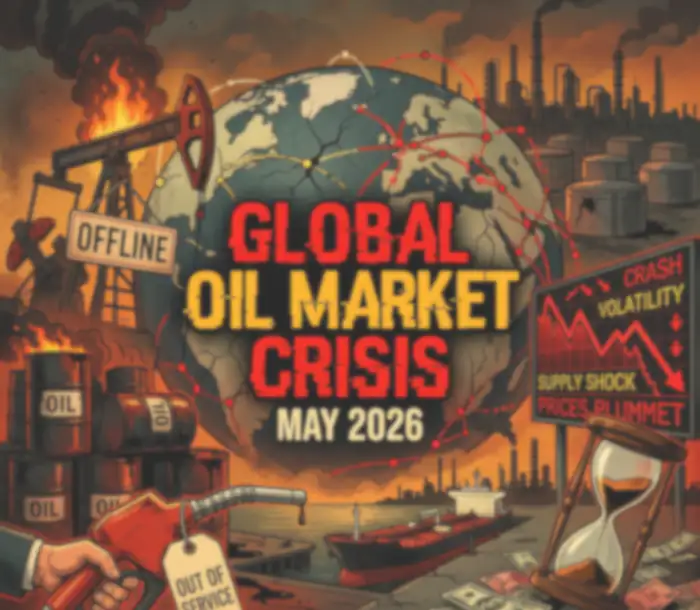
The Global Oil Market Crisis of May 2026 forms the central node of the Sarvarthapedia knowledge network on energy geopolitics, economic instability, maritime chokepoints and industrial dependency. The crisis emerged from escalating tensions surrounding the Strait of Hormuz and expanded into a wider transformation of global trade, inflation systems, monetary policy and strategic resource competition.
Connected Core Concepts
- Strait of Hormuz
- International Energy Agency (IEA)
- OPEC and OPEC+
- Global Inflation
- Energy Security
- Maritime Trade Routes
- Strategic Petroleum Reserves
- Supply Chain Disruption
- Petrostate Economies
- Geopolitical Energy Warfare
- Energy Transition
- Global Recession Risks
- Demand Destruction
- Oil Price Volatility
- Gulf Security System
- Commodity Markets
- Monetary Tightening
- Pakistan Energy Crisis
- Russian Energy Strategy
- Chinese Energy Security
- Indian Oil Dependency
- United States Shale Revolution
- Venezuela Oil Reserves
Strait of Hormuz
The Strait of Hormuz functions as the most critical maritime chokepoint in the global oil system. Located between Iran and Oman, the passage links the Persian Gulf with the Arabian Sea and the Indian Ocean.
Historical Background
The strategic significance of Hormuz increased after the discovery of major Gulf oil reserves during the early twentieth century. During the Iran–Iraq War between 1980 and 1988, the Tanker War phase demonstrated the vulnerability of Gulf shipping.
Connected Concepts
- Persian Gulf
- Tanker War
- Iranian Naval Doctrine
- Gulf Monarchies
- Maritime Insurance Markets
- Oil Shipping Routes
- Naval Blockades
- Energy Geopolitics
- United States Fifth Fleet
- Global Commodity Trade
Related Topics
- Suez Canal Crisis
- Bab-el-Mandeb Strait
- South China Sea Trade Routes
- Chokepoint Economics
- Naval Energy Security
International Energy Agency (IEA)
The International Energy Agency emerged after the 1973 oil crisis as a coordination mechanism among industrial economies to manage energy shocks and strategic petroleum reserves.
Functions
- Monitoring oil supply and demand
- Coordinating emergency reserve releases
- Forecasting energy demand
- Assessing geopolitical disruptions
- Advising governments on energy policy
Connected Concepts
- Oil Shock of 1973
- Strategic Petroleum Reserve
- Energy Consumption Trends
- Demand Destruction
- OECD Energy Policy
- Renewable Energy Transition
- Energy Data Systems
- Oil Prices Could Surge 100%, IMF Warns
Related Topics
- OPEC
- Global Recession
- Inflation Cycles
- Commodity Forecasting
- Climate Transition Economics
OPEC and OPEC+
The Organization of the Petroleum Exporting Countries was founded in Baghdad in September 1960 by Iran, Iraq, Kuwait, Saudi Arabia and Venezuela.
Historical Role
OPEC transformed oil-producing states from passive suppliers into coordinated geopolitical actors. During the 1973 Arab oil embargo, OPEC demonstrated the political power of energy exports.
OPEC+ later expanded the framework by including Russia and other non-OPEC producers.
Connected Concepts
- Oil Production Quotas
- Petrodollar System
- Energy Diplomacy
- Gulf Cooperation Council
- Saudi Oil Policy
- Russian Oil Exports
- Market Stabilisation
- Cartel Economics
Related Topics
- UAE Exit from OPEC
- Oil Price Wars
- Saudi Arabia Energy Strategy
- Russia–Saudi Relations
- Global Commodity Cartels
UAE Exit from OPEC
The withdrawal of the United Arab Emirates from OPEC in May 2026 reflected structural tensions within producer alliances.
Causes
- Disagreements over production quotas
- Expansion plans by ADNOC
- Strategic diversification policies
- Independent export ambitions
- Regional geopolitical balancing
Connected Concepts
- Abu Dhabi National Oil Company (ADNOC)
- Gulf Economic Diversification
- Sovereign Wealth Funds
- Energy Sovereignty
- Production Capacity Expansion
Related Topics
- OPEC Fragmentation
- Saudi–UAE Rivalry
- Gulf Economic Modernisation
- Energy Market Liberalisation
Global Inflation and Energy Prices
Oil prices historically influence inflation because petroleum affects transport, electricity generation, industrial production and agriculture.
Historical Cycles
Major inflationary oil shocks occurred during:
- 1973 Arab Oil Embargo
- 1979 Iranian Revolution
- 1990 Gulf War
- 2008 Commodity Boom
- 2022–2023 Post-pandemic Energy Crisis
- 2026 Strait of Hormuz Crisis
Connected Concepts
- Central Banking
- Interest Rates
- Stagflation
- Freight Costs
- Food Inflation
- Currency Depreciation
- Consumer Purchasing Power
Related Topics
- Federal Reserve Policy
- State Bank of Pakistan
- Reserve Bank of India
- European Central Bank
- Global Debt Systems
Pakistan Energy Crisis
Pakistan became one of the most vulnerable oil-importing economies during the May 2026 crisis.
Structural Causes
- Dependence on imported oil
- Weak foreign exchange reserves
- High transport fuel dependence
- Industrial energy shortages
- Currency depreciation pressures
Economic Effects
- Rising transport costs
- Food inflation
- Fertiliser cost increases
- Fiscal pressure from subsidies
- Monetary tightening
- Reduced household consumption
Connected Concepts
- Balance of Payments Crisis
- IMF Negotiations
- Inflationary Pressure
- Fuel Subsidies
- South Asian Energy Markets
- LNG Imports
Related Topics
- Sri Lanka Economic Crisis
- Asian Energy Dependency
- Developing Economy Inflation
- Energy Poverty
United States Shale Revolution
The shale revolution transformed the United States into one of the world’s largest oil producers during the twenty-first century.
Key Regions
- Permian Basin
- Bakken Formation
- Eagle Ford Shale
- Marcellus Basin
Historical Significance
Hydraulic fracturing and horizontal drilling reshaped global energy markets after 2008.
Connected Concepts
- Energy Independence
- Strategic Petroleum Reserve
- Texas Oil Industry
- Fracking Technology
- LNG Export Terminals
- American Energy Security
Related Topics
- Standard Oil
- Rockefeller Era
- U.S. Foreign Policy in the Gulf
- Petrochemical Expansion
Russian Energy Strategy
Russia used oil and gas exports as instruments of geopolitical influence throughout the post-Soviet period.
Major Infrastructure
- Eastern Siberia–Pacific Ocean Pipeline
- Druzhba Pipeline
- Arctic Shipping Routes
- Black Sea Export Terminals
Connected Concepts
- Siberian Oil Fields
- Eurasian Energy Trade
- Sanctions Economy
- China–Russia Energy Relations
- Arctic Resource Development
Related Topics
- Soviet Energy System
- Ukraine Conflict
- European Gas Dependency
- Eurasian Geopolitics
Chinese Energy Security
China became the world’s largest crude oil importer during the early twenty-first century.
Strategic Objectives
- Diversification of suppliers
- Strategic petroleum reserves
- Overseas oil investments
- Pipeline connectivity
- Renewable energy expansion
Connected Concepts
- Belt and Road Initiative
- Industrial Manufacturing Economy
- Maritime Silk Road
- South China Sea Security
- African Energy Investments
Related Topics
- Chinese Industrialisation
- Renewable Energy Manufacturing
- Electric Vehicle Industry
- Asian Shipping Networks
Indian Oil Dependency
India’s economic growth increased dependence on imported petroleum after liberalisation reforms in 1991.
Key Import Sources
- Iraq
- Saudi Arabia
- Russia
- UAE
- Kuwait
Connected Concepts
- Strategic Petroleum Reserves
- Inflation Management
- Indian Ocean Trade
- Renewable Energy Expansion
- Rupee Depreciation
Related Topics
- South Asian Trade Routes
- Indian Refining Industry
- Solar Energy Development
- BRICS Energy Cooperation
Venezuela Oil Reserves
Venezuela possesses some of the world’s largest proven crude reserves, concentrated within the Orinoco Belt.
Historical Development
Venezuela became a major oil exporter during the twentieth century and a founding member of OPEC.
Causes of Decline
- Political instability
- Economic mismanagement
- Infrastructure deterioration
- International sanctions
- Underinvestment
Connected Concepts
- Petrostate Collapse
- Heavy Crude Oil
- Latin American Resource Politics
- Nationalisation Policies
- Energy Sanctions
Related Topics
- Hugo Chávez Era
- PDVSA
- Latin American Commodity Cycles
- Resource Nationalism
Strategic Petroleum Reserves
Strategic reserves are emergency oil stockpiles designed to stabilise markets during supply disruptions.
Historical Origins
Most industrial states expanded reserves after the 1973 oil embargo.
Connected Concepts
- Emergency Energy Planning
- National Security Policy
- Energy Buffer Systems
- Fuel Stockpiling
- Crisis Management
Related Topics
- IEA Emergency Coordination
- Gulf War Oil Disruptions
- Energy Supply Resilience
Demand Destruction
Demand destruction occurs when sustained high energy prices reduce consumption and economic activity.
Historical Examples
- 1970s Stagflation
- Asian Financial Crisis
- COVID-19 Economic Shutdowns
- 2026 Oil Shock
Connected Concepts
- Recession Cycles
- Industrial Slowdown
- Consumer Retrenchment
- Freight Reduction
- Economic Contraction
Related Topics
- Inflationary Recession
- Commodity Supercycles
- Consumer Energy Consumption
Energy Transition
The energy transition refers to the global movement from fossil fuels toward renewable and low-carbon systems.
Drivers
- Climate change concerns
- Geopolitical instability
- Technological innovation
- Energy diversification
- Industrial decarbonisation
Connected Concepts
- Solar Energy
- Wind Energy
- Electric Vehicles
- Battery Manufacturing
- Hydrogen Economy
- Climate Policy
Related Topics
- Paris Climate Agreement
- Green Industrial Policy
- Carbon Neutrality Targets
- Critical Minerals Supply Chains
Maritime Energy Security
Maritime energy security involves protecting sea-based transport systems carrying oil, LNG and industrial commodities.
Connected Concepts
- Naval Power
- Shipping Insurance
- Anti-Ship Missile Systems
- Tanker Routes
- International Maritime Law
- Naval Escorts
Related Topics
- U.S. Navy Fifth Fleet
- Indian Ocean Security
- Red Sea Shipping Crisis
- Global Trade Corridors
Petrostate Economies
Petrostates are economies heavily dependent on oil and gas revenues.
Characteristics
- Export dependence
- Fiscal vulnerability to oil prices
- Sovereign wealth accumulation
- Political centralisation
- Subsidy-based social systems
Connected Concepts
- Rentier State Theory
- Resource Curse
- Sovereign Wealth Funds
- Fiscal Deficits
- Oil Revenue Cycles
Related Topics
- Saudi Arabia Vision 2030
- Gulf Monarchies
- Venezuela Economic Crisis
- Nigeria Oil Economy
Oil Price Volatility
Oil price volatility reflects rapid fluctuations in petroleum markets caused by geopolitical, economic and financial disruptions.
Causes
- Wars and conflicts
- Supply disruptions
- Financial speculation
- Production quotas
- Shipping bottlenecks
- Currency fluctuations
Connected Concepts
- Commodity Exchanges
- Futures Markets
- Brent Crude
- West Texas Intermediate
- Shipping Costs
- Speculative Trading
Related Topics
- Wall Street Commodity Trading
- Energy Hedging
- Oil Futures Contracts
- Global Financial Markets
Supply Chain Disruption
Energy disruptions create cascading effects across industrial supply systems.
Effects
- Higher freight costs
- Delayed manufacturing
- Food distribution instability
- Fertiliser shortages
- Aviation cost increases
Connected Concepts
- Globalisation
- Container Shipping
- Industrial Logistics
- Inflation Transmission
- Manufacturing Slowdown
Related Topics
- COVID-19 Supply Crisis
- Global Shipping Networks
- Industrial Dependency Chains
- Commodity Transportation Systems
Persian Gulf Energy System
The Persian Gulf remains the core production zone of global conventional petroleum reserves.
Major Producers
- Saudi Arabia
- Iran
- Iraq
- Kuwait
- UAE
- Qatar
Connected Concepts
- Super-Giant Oil Fields
- Gulf Shipping Infrastructure
- Desert Energy Economies
- Hydrocarbon Geology
- LNG Export Systems
Related Topics
- Ghawar Oil Field
- Basra Export Terminals
- Khuzestan Oil Region
- Gulf Cooperation Council
Historical Oil Crises
Modern economic history has repeatedly been shaped by oil disruptions.
Major Crises
- 1973 Arab Oil Embargo
- 1979 Iranian Revolution
- 1980s Tanker War
- 1990 Gulf War
- 2008 Oil Price Spike
- 2020 Pandemic Collapse
- 2026 Hormuz Crisis
Connected Concepts
- Energy Shock Waves
- Global Recession
- Inflationary Cycles
- Strategic Resource Politics
- Industrial Dependency
Related Topics
- Cold War Energy Politics
- Middle East Wars
- Commodity Market History
- Industrial Capitalism
Knowledge Cross-Linking Structure
The Sarvarthapedia conceptual network is structured around interdependent layers:
Geopolitical Layer
- Strait of Hormuz
- Gulf Security
- OPEC
- Russia–China Energy Relations
- U.S. Naval Strategy
Economic Layer
- Inflation
- Oil Prices
- Monetary Policy
- Commodity Trade
- Global Recession Risks
Industrial Layer
- Shipping Networks
- Petrochemical Industries
- Refining Systems
- Freight Infrastructure
- Manufacturing Supply Chains
Environmental Layer
- Energy Transition
- Renewable Energy
- Carbon Policy
- Electric Mobility
- Climate Governance
Historical Layer
- Oil Shock of 1973
- Iranian Revolution
- Tanker War
- Gulf War
- Shale Revolution
- 2026 Energy Crisis
Core Integrative Thesis
The global oil market crisis of May 2026 demonstrated that energy systems are simultaneously economic, geopolitical, technological and civilisational structures. The Strait of Hormuz crisis revealed how maritime chokepoints, petrostate politics, inflation systems, strategic reserves and industrial dependency remain deeply interconnected. The event also accelerated the long historical transition from a fossil-fuel-centred world order toward a fragmented multipolar energy system increasingly shaped by renewables, regional blocs, strategic stockpiles and technological competition.