History of the British Parliament: A 100-Volume Encyclopedia of British Politics, Monarchy, Empire, and Democratic Evolution
The Origin and Development of Parliament in England and the World
The institution known as Parliament emerged gradually from the political customs and administrative practices of medieval Europe, particularly in England, where the term itself first entered official and political language during the thirteenth century. The word ‘parliament’ derived from the Old French parlement, meaning discussion or speaking, and was initially used to describe an enlarged meeting of the King’s council attended by barons, bishops, judges, and prominent royal servants. These assemblies were summoned by the monarch to advise on matters of governance, assist in judicial business, and deliberate on law-making and taxation. Although such gatherings had earlier precedents in the Anglo-Saxon Witan and Norman royal councils, the thirteenth century witnessed the transformation of these councils into a more structured representative institution that would eventually become the model for parliamentary systems throughout the world.
The development of Parliament in England cannot be understood without reference to the constitutional conflicts of the medieval monarchy. During the reign of King John between 1199 and 1216, disputes with the nobility over taxation, military failures, and arbitrary rule culminated in the sealing of the Magna Carta at Runnymede near Windsor on 15 June 1215. Although Magna Carta did not establish Parliament in the modern sense, it affirmed the principle that the King was bound by law and could not levy certain taxes without “common counsel.” This principle laid the constitutional foundation upon which later parliamentary authority was constructed. During the minority of Henry III, who reigned from 1216 to 1272, councils of nobles and churchmen became more frequent, especially as royal finances weakened and demands for broader consultation increased.
The decisive stage in parliamentary evolution occurred during the political crisis led by Simon de Montfort, Earl of Leicester. In 1265, after defeating Henry III at the Battle of Lewes in Sussex, Montfort summoned an assembly that included not only nobles and bishops but also representatives from counties and boroughs. Knights from shires and burgesses from towns were invited to attend, establishing a precedent for broader representation. Although Montfort’s political experiment collapsed after his death at the Battle of Evesham in Worcestershire later that same year, his assembly became a significant milestone in parliamentary history because it introduced the principle that local communities might send representatives to national councils.
The reign of Edward I from 1272 to 1307 gave lasting institutional form to Parliament. Edward’s assembly of 1295, later called the Model Parliament, brought together bishops, abbots, earls, barons, two knights from each county, and two burgesses from selected boroughs. The King’s purpose was primarily fiscal, for wars in Wales, Scotland, and France required unprecedented taxation. The principle that “what touches all should be approved by all” became central to royal government. Although knights and burgesses were not invariably summoned to the earliest English Parliaments, by the middle of the fourteenth century they attended regularly, and the Commons, as they were collectively known, came to claim that their assent was a necessary prerequisite for royal taxation.
By approximately the same period, the Lords and Commons began to deliberate separately. Initially, the King, Lords, and Commons assembled together in ceremonial fashion. Afterwards, the Lords and Commons withdrew into separate chambers to debate independently, and finally the Commons or their spokesmen rejoined the King and the Lords to present petitions, grievances, and taxation grants. This separation eventually produced the bicameral structure that became characteristic of the English Parliament and later of many parliamentary systems across the world. The House of Lords consisted principally of hereditary nobles and senior clergy, while the House of Commons represented counties and boroughs.
By the thirteenth century Westminster in London had become the centre of English royal government, and the Palace of Westminster became the habitual meeting place of Parliament. From at least the mid-fourteenth century onward, the Lords and Commons usually met for the opening of Parliament in the Painted Chamber, an elaborately decorated hall within the old palace. After hearing the royal cause of summons, they were ordered to meet separately for deliberation. The Lords withdrew to the White Chamber at the south-east corner of the palace, where they continued to meet until the early nineteenth century. The Commons, by contrast, met in different locations including the Painted Chamber itself and the Chapter House of Westminster Abbey. After 1394 they frequently used the Abbey’s refectory. The Commons did not acquire a permanent meeting place until after 1547, when they were granted the use of St Stephen’s Chapel within the Palace of Westminster.
Parliamentary offices also evolved during this period. There were spokesmen for the Commons from the mid-thirteenth century, although it is uncertain whether they formally presided over meetings. Tradition long regarded Sir Peter de la Mare, elected during the Good Parliament of 1376, as the first Speaker of the House of Commons. However, the first Speaker specifically recorded on the Parliament Rolls was his successor, Sir Thomas Hungerford, who served in 1377. The Speaker gradually became the recognised intermediary between Crown and Commons, responsible for communicating parliamentary petitions and protecting the privileges of the House. The first recorded reference to a parliamentary Clerk is to Robert de Melton in 1363, demonstrating the increasing bureaucratic sophistication of Parliament.
The term “Member of Parliament” originally referred to members of either House. Since the Restoration of 1660, however, the phrase has generally referred to members of the House of Commons. In earlier centuries, members carried distinctive titles according to the constituencies they represented. County representatives were known as knights of the shire; representatives from cities were termed citizens; representatives from boroughs were known as burgesses; the representatives of the Cinque Ports were called barons; and members returned by the Universities of Oxford and Cambridge were described as burgesses of the universities. These ancient distinctions survived in official election returns until the Parliamentary and Municipal Elections Act of 1872, which standardised terminology and contributed to the modern conception of a Member of Parliament as a single representative category.
The growth of Parliament during the late medieval period was closely linked with taxation and war. During the reign of Edward III between 1327 and 1377, England’s involvement in the Hundred Years’ War against France created enormous financial demands. Parliament increasingly used its power of taxation to secure concessions from the Crown. The Commons began presenting petitions concerning grievances before approving subsidies. By the late fourteenth century, the impeachment of royal ministers and criticism of corruption became regular parliamentary practices. The Good Parliament of 1376 attacked royal favourites associated with the ageing Edward III and established important precedents for parliamentary oversight.
Under the Lancastrian dynasty, beginning with Henry IV in 1399, parliamentary authority strengthened further because the new monarchy depended heavily upon political legitimacy. During the fifteenth century, however, the instability of the Wars of the Roses between the Houses of Lancaster and York weakened Parliament’s independence. Kings increasingly used parliamentary statutes to confirm dynastic claims and confiscate the property of enemies through acts of attainder. Nevertheless, Parliament remained indispensable because legislation and taxation required parliamentary consent.
The accession of the Tudor dynasty after the Battle of Bosworth in 1485 introduced a period of stronger monarchy under Henry VII and Henry VIII. Yet the Tudor period paradoxically enhanced Parliament’s legal importance. Henry VIII’s break with the Roman Catholic Church during the 1530s was accomplished through a series of parliamentary statutes collectively known as the Reformation Parliament, which sat from 1529 to 1536. Acts such as the Act of Supremacy of 1534 declared the King Supreme Head of the Church of England. Parliament thereby became the instrument through which revolutionary constitutional and religious changes were enacted.
The union between Crown and Parliament became increasingly unstable during the seventeenth century. Under the Stuart monarchs, disputes concerning taxation, religion, and royal prerogative intensified. James I, who ruled from 1603 to 1625, defended the doctrine of divine right monarchy, while Parliament increasingly asserted ancient liberties. His son Charles I intensified conflict by imposing taxes without parliamentary consent and attempting to govern without Parliament between 1629 and 1640 in a period known as the Personal Rule. Financial necessity eventually forced Charles to summon the Long Parliament in 1640.
Tensions escalated into the English Civil War between Parliamentarians and Royalists from 1642 to 1651. Battles occurred across England, including at Edgehill, Marston Moor, and Naseby. Parliamentary forces led by Oliver Cromwell eventually triumphed, and Charles I was tried and executed in London on 30 January 1649. England briefly became a republic known as the Commonwealth. During this revolutionary era, Parliament claimed sovereignty, although military power often overshadowed constitutional principles. Cromwell later dissolved the Rump Parliament in 1653 and governed as Lord Protector.
The monarchy was restored in 1660 under Charles II, but the relationship between Crown and Parliament had changed permanently. The Restoration settlement recognised Parliament as an essential partner in government. During the reign of James II, fears of Catholic absolutism led to the Glorious Revolution of 1688, when William of Orange invaded England and James fled to France. Parliament declared that James had abdicated and offered the Crown jointly to William III and Mary II. The Bill of Rights of 1689 established critical constitutional principles: the monarch could not suspend laws without parliamentary consent, taxation required parliamentary approval, and regular Parliaments were necessary.
The late seventeenth and early eighteenth centuries witnessed the emergence of parliamentary government in a more recognisably modern form. The Act of Settlement of 1701 secured Protestant succession, while the Acts of Union of 1707 united the Parliaments of England and Scotland into the Parliament of Great Britain, located at Westminster. Scottish peers and commoners entered the new British Parliament, although Scotland retained separate legal and educational systems. The development of cabinet government accelerated during the reigns of the early Hanoverian monarchs, particularly George I and George II, who relied heavily upon ministers commanding parliamentary support.
The office of Prime Minister emerged gradually during the eighteenth century, especially under Sir Robert Walpole, who served between 1721 and 1742. Although not officially recognised at first, the Prime Minister became the leading minister responsible for managing parliamentary majorities in the Commons. Political parties such as the Whigs and Tories developed more organised parliamentary identities, and parliamentary debate increasingly shaped national policy.
Despite these developments, eighteenth-century Parliament remained unrepresentative by modern standards. Voting rights were restricted by property qualifications, and many constituencies known as rotten boroughs had tiny electorates yet returned members to Parliament. Industrial cities such as Manchester, Birmingham, and Leeds lacked direct representation, while depopulated boroughs retained disproportionate influence. Corruption, patronage, and aristocratic control were widespread.
Pressure for reform intensified during the late eighteenth and early nineteenth centuries, influenced by the American Revolution of 1776 and the French Revolution of 1789. Economic transformation brought by the Industrial Revolution created new urban populations demanding representation. After prolonged agitation, the Reform Act of 1832 redistributed seats, abolished many rotten boroughs, and extended the franchise to sections of the middle class. Although limited, the Act marked a major constitutional turning point by acknowledging the principle of representative reform.
Further reforms followed. The Second Reform Act of 1867 expanded voting rights for urban working men, while the Third Reform Act of 1884 extended similar rights to rural voters. The Ballot Act of 1872 introduced secret voting, reducing bribery and intimidation. During the nineteenth century the House of Commons became increasingly dominant, while the House of Lords gradually lost political supremacy.
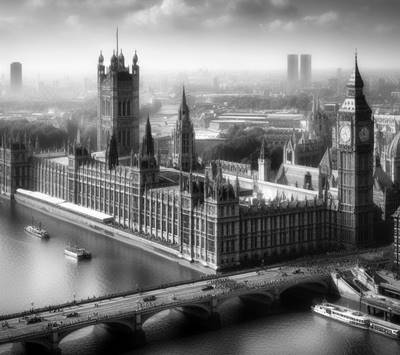
The physical setting of Parliament also changed dramatically during this period. On 16 October 1834, a catastrophic fire destroyed much of the medieval Palace of Westminster in London. The new Houses of Parliament were designed principally by architect Charles Barry with Gothic detailing by Augustus Welby Pugin. Construction began in 1840, producing one of the most recognisable parliamentary buildings in the world. The clock tower later renamed the Elizabeth Tower, often popularly associated with the bell Big Ben, became an enduring symbol of British parliamentary democracy.
During the nineteenth century the British parliamentary model influenced constitutional development across the expanding British Empire. Representative assemblies emerged in colonies such as Canada, Australia, New Zealand, and parts of India. Many colonial legislatures adopted bicameral structures resembling Westminster. The principle of responsible government, under which executive ministers required the confidence of elected assemblies, spread throughout the empire.
In India, parliamentary traditions developed under British colonial administration before independence. The Indian Councils Act of 1861 introduced limited legislative councils. The Government of India Act of 1919 expanded Indian participation, while the Government of India Act of 1935 created provincial legislatures and a federal framework. Following independence on 15 August 1947, the Parliament of India was established under the Constitution that came into effect on 26 January 1950. India adopted a bicameral Parliament consisting of the Lok Sabha and Rajya Sabha, influenced strongly by Westminster traditions but adapted to Indian federalism and democratic universal suffrage.
Elsewhere, parliamentary institutions evolved according to local traditions. In France, the revolutionary assemblies of the late eighteenth century eventually produced republican legislatures. The National Assembly became central to French political life. In Germany, the Reichstag of the German Empire, founded in 1871, represented another model of parliamentary development. The United States Congress, created under the Constitution of 1787, differed from Westminster because it operated within a presidential system rather than a parliamentary executive structure. Nevertheless, bicameralism and legislative deliberation reflected shared historical roots.
The twentieth century transformed Parliament through democratic expansion. In Britain, the Parliament Act of 1911 curtailed the veto powers of the House of Lords after conflict with the Liberal government over taxation. The Lords retained only delaying powers regarding most legislation. A further Parliament Act of 1949 reduced this delaying period even more. Universal adult suffrage emerged gradually through the Representation of the People Acts. Women over thirty obtained voting rights in 1918, and equal voting rights with men were granted in 1928.
Parliament also played decisive roles during global crises. During the First World War from 1914 to 1918, Parliament authorised wartime legislation, military expenditure, and emergency powers. During the Second World War between 1939 and 1945, Parliament continued sitting despite bombing raids on London. On 10 May 1941, the House of Commons chamber was destroyed by German bombing during the Blitz. Debates temporarily moved to the House of Lords chamber until a reconstructed Commons chamber reopened in 1950.
The post-war period witnessed further constitutional adaptation. Decolonisation after 1945 produced numerous independent states adopting parliamentary systems, including India, Pakistan, Sri Lanka, Malaysia, and many African and Caribbean nations. Some retained constitutional monarchies under the Commonwealth, while others became republics with parliamentary executives.
Parliamentary terminology also evolved across jurisdictions. In Britain, members are called Members of Parliament or MPs. In India, members of the lower house are Members of Parliament in the Lok Sabha, while members of state legislatures are known as MLAs or Members of Legislative Assembly. In Canada, federal representatives are MPs, whereas provincial legislators may be termed Members of Provincial Parliament in Ontario or Members of the National Assembly in Quebec. In Australia, federal legislators are MPs or Senators depending on the chamber. In Ireland, members of the lower house are called Teachtaí Dála. In Germany, members of the Bundestag are often termed deputies, while in France members of the National Assembly are known as deputies or députés.
The number of members in the English and later British House of Commons changed repeatedly across centuries. Medieval Parliaments varied considerably in size because attendance depended upon royal summons. By the sixteenth century the Commons contained approximately 300 members. After the union with Scotland in 1707, the Parliament of Great Britain contained 558 members, including representatives from Scotland. The Act of Union with Ireland in 1801 increased membership to 658. Nineteenth-century reforms periodically redistributed seats while maintaining fluctuating totals. In the modern United Kingdom, the House of Commons consists of 650 members, each elected from a parliamentary constituency.
Parliamentary procedure became increasingly formalised over centuries. Ceremonial traditions such as the State Opening of Parliament, the Speech from the Throne, and the symbolic slamming of the Commons door against the monarch’s representative reflect historical struggles over parliamentary independence. The office of the Speaker developed into one of strict political neutrality. Parliamentary privilege protected freedom of speech within debates, allowing members to discuss matters without fear of legal prosecution.
Modern parliamentary systems generally operate according to several fundamental principles: representation, deliberation, accountability, and legislation. Parliament authorises taxation and expenditure, scrutinises the executive, debates national policy, and enacts laws. In parliamentary democracies the executive government depends upon maintaining the confidence of the elected chamber. A government defeated on major financial or confidence matters may resign or seek dissolution for a general election.
Different countries have adapted parliamentary institutions according to distinct constitutional traditions. Some possess bicameral legislatures with upper and lower houses, while others maintain unicameral systems. In federal states such as India, Australia, and Canada, upper houses often represent regional interests. In constitutional monarchies the sovereign remains a ceremonial component of Parliament, whereas republics generally vest formal legislative authority in elected assemblies and presidents.
The rise of political parties fundamentally reshaped parliamentary life. During the nineteenth and twentieth centuries disciplined party organisations came to dominate elections and legislative voting. Debates increasingly reflected ideological competition between conservatives, liberals, socialists, nationalists, and other political movements. Party whips ensured voting discipline, while parliamentary committees investigated legislation and public administration in greater detail.
Technological and social changes also altered parliamentary culture. Printed records such as Hansard, first systematically published during the nineteenth century, allowed public access to debates. Radio broadcasts began in the twentieth century, followed by television coverage. Digital technology in the twenty-first century introduced online streaming, electronic petitions, and rapid public scrutiny through social media.
Despite criticism concerning partisanship, bureaucracy, and executive dominance, Parliament remains one of the central institutions of constitutional government. Its historical significance lies not only in law-making but also in the gradual limitation of arbitrary power. From medieval councils advising kings at Westminster to modern democratic legislatures representing millions of citizens, Parliament embodies the long historical development of representative governance.
The historical journey of Parliament demonstrates the transformation of political authority across more than seven centuries. What began in thirteenth-century England as enlarged meetings of the King’s council evolved through conflict, reform, revolution, and constitutional adaptation into a global political model. The summons of knights and burgesses, the separation of Lords and Commons, the emergence of Speakers and Clerks, the battles over taxation and royal authority, and the expansion of electoral rights collectively shaped modern parliamentary democracy. Institutions in London, Delhi, Ottawa, Canberra, Dublin, and countless other capitals continue to reflect this inheritance. Parliament therefore represents not merely a building or assembly, but a historical process through which consultation gradually replaced arbitrary rule, and representation became a defining principle of modern political civilisation.
Sarvarthapedia Conceptual Nod Parliament
Parliament developed from medieval royal advisory councils into a representative legislative institution responsible for law-making, taxation, governance oversight, and constitutional accountability.
Primary Historical Clusters
- Medieval Monarchy
- Constitutional Development
- Representative Government
- Bicameral Legislature
- Parliamentary Sovereignty
- Democratic Reform
- Imperial and Global Expansion
- Modern Parliamentary Democracy
Medieval Origins of Parliament
Related Core Concepts
- King’s Council
- Feudal Monarchy
- Royal Administration
- Medieval Governance
- Anglo-Saxon Witan
- Norman Royal Council
Connected Historical Figures
- King John
- Henry III
- Edward I
- Simon de Montfort
Connected Institutions
- Palace of Westminster
- Westminster Abbey
- Painted Chamber
- White Chamber
- St Stephen’s Chapel
Key Historical Links
- Magna Carta (1215)
- Model Parliament (1295)
- Battle of Lewes (1264)
- Battle of Evesham (1265)
Associated Political Ideas
- Common Counsel
- Royal Taxation
- Feudal Obligation
- Representative Consultation
Magna Carta and Constitutional Foundations
Central Themes
- Rule of Law
- Limitation of Monarchical Power
- Consent to Taxation
- Constitutionalism
Historical Connections
- Runnymede
- King John
- English Barons
- Medieval Legal Traditions
Later Institutional Influence
- Parliamentary Sovereignty
- Bill of Rights (1689)
- Constitutional Monarchy
- Due Process
Related Concepts
- Civil Liberties
- Legal Restraint on Government
- Consent of the Governed
Simon de Montfort and Early Representation
Historical Significance
- Inclusion of Knights and Burgesses
- Expansion of Political Participation
- Precedent for Commons Representation
Related Topics
- County Representation
- Borough Representation
- Medieval Electoral Practices
- Representative Assemblies
Linked Events
- Battle of Lewes
- Battle of Evesham
Connected Institutions
- House of Commons
- Parliamentary Representation
Model Parliament of 1295
Structural Importance
- Clergy Representation
- Noble Representation
- County Delegates
- Borough Delegates
Linked Principles
- “What touches all should be approved by all”
- Taxation by Consent
- National Representation
Related Developments
- Commons Taxation Rights
- Parliamentary Petitioning
- Medieval Fiscal Government
Emergence of the House of Lords and House of Commons
Bicameral Development
- Separation of Deliberation
- Upper Chamber
- Lower Chamber
House of Lords Connections
- Hereditary Peerage
- Bishops and Clergy
- Aristocratic Authority
House of Commons Connections
- Knights of the Shire
- Burgesses
- County Constituencies
- Borough Constituencies
Related Constitutional Concepts
- Bicameralism
- Legislative Procedure
- Parliamentary Debate
Westminster as the Parliamentary Centre
Geographic Connections
- Westminster
- London
- Westminster Abbey
Institutional Structures
- Palace of Westminster
- Painted Chamber
- White Chamber
- Chapter House
- St Stephen’s Chapel
Architectural and Political Links
- Medieval Royal Government
- Ceremonial Parliament
- Gothic Revival Architecture
- Charles Barry
- Augustus Welby Pugin
Connected Modern Symbols
- Elizabeth Tower
- Big Ben
- Houses of Parliament
Parliamentary Offices and Procedure
Important Offices
- Speaker of the House
- Parliamentary Clerk
Key Individuals
- Sir Peter de la Mare
- Sir Thomas Hungerford
- Robert de Melton
Related Administrative Concepts
- Parliamentary Rolls
- Legislative Records
- Parliamentary Privilege
- Neutral Speakership
Procedural Traditions
- State Opening of Parliament
- Royal Summons
- Parliamentary Petitioning
Taxation, War, and Parliamentary Power
Historical Drivers
- Hundred Years’ War
- Royal Military Campaigns
- Fiscal Crisis
Linked Monarchs
- Edward III
- Henry IV
Related Parliamentary Practices
- Subsidy Grants
- Impeachment
- Ministerial Accountability
- Petition of Grievances
Connected Constitutional Ideas
- Financial Oversight
- Executive Accountability
- Legislative Consent
Tudor Parliament and Religious Transformation
Key Monarchs
- Henry VII
- Henry VIII
Related Events
- Battle of Bosworth (1485)
- English Reformation
- Reformation Parliament (1529–1536)
Major Legislative Acts
- Act of Supremacy (1534)
Connected Religious Concepts
- Church of England
- Royal Supremacy
- Anti-Papal Legislation
Broader Themes
- Statutory Authority
- Parliamentary Legislation
- Religious Governance
Stuart Conflict and Constitutional Crisis
Central Monarchs
- James I
- Charles I
Core Political Disputes
- Divine Right of Kings
- Royal Prerogative
- Taxation Without Consent
Linked Events
- Personal Rule (1629–1640)
- Long Parliament (1640)
- English Civil War
Connected Political Groups
- Parliamentarians
- Royalists
Related Battles
- Edgehill
- Marston Moor
- Naseby
English Civil War and Commonwealth
Key Figures
- Oliver Cromwell
- Charles I
Connected Events
- Execution of Charles I (1649)
- Commonwealth of England
- Rump Parliament
- Protectorate
Related Constitutional Ideas
- Parliamentary Sovereignty
- Republican Government
- Military Rule
Broader Historical Themes
- Revolution
- Anti-Monarchical Politics
- Constitutional Experimentation
Restoration and Glorious Revolution
Key Monarchs
- Charles II
- James II
- William III
- Mary II
Foundational Documents
- Bill of Rights (1689)
- Act of Settlement (1701)
Connected Constitutional Concepts
- Constitutional Monarchy
- Parliamentary Supremacy
- Protestant Succession
Related Events
- Glorious Revolution (1688)
- Restoration (1660)
Union and the Parliament of Great Britain
Key Legislation
- Acts of Union (1707)
- Act of Union (1801)
Geographic Connections
- England
- Scotland
- Ireland
Institutional Outcomes
- Parliament of Great Britain
- United Kingdom Parliament
Related Themes
- Political Union
- Imperial Governance
- British State Formation
Rise of Cabinet Government and Prime Ministership
Key Figures
- Sir Robert Walpole
- George I
- George II
Related Political Concepts
- Cabinet Government
- Collective Responsibility
- Parliamentary Majority
Connected Institutions
- Prime Minister
- Political Parties
- House of Commons Leadership
Related Parties
- Whigs
- Tories
Electoral Reform and Democratisation
Key Legislation
- Reform Act (1832)
- Second Reform Act (1867)
- Third Reform Act (1884)
- Ballot Act (1872)
Connected Social Forces
- Industrial Revolution
- Urbanisation
- Middle-Class Politics
- Working-Class Suffrage
Related Electoral Problems
- Rotten Boroughs
- Patronage
- Electoral Corruption
Linked Democratic Ideas
- Representative Reform
- Secret Ballot
- Electoral Equality
Parliament and Empire
Geographic Expansion
- Canada
- Australia
- New Zealand
- India
Related Constitutional Concepts
- Responsible Government
- Colonial Legislature
- Westminster System
Linked Institutions
- Dominion Parliament
- Colonial Assembly
Broader Themes
- Imperial Administration
- Constitutional Export
- Commonwealth Traditions
Parliament in India
Key Constitutional Developments
- Indian Councils Act (1861)
- Government of India Act (1919)
- Government of India Act (1935)
- Constitution of India (1950)
Connected Institutions
- Parliament of India
- Lok Sabha
- Rajya Sabha
Related Constitutional Concepts
- Federalism
- Universal Adult Suffrage
- Bicameral Legislature
Geographic and Historical Links
- British India
- New Delhi
- Independence of India (1947)
Comparative Parliamentary Systems
United Kingdom
- Westminster Parliament
- Constitutional Monarchy
India
- Parliamentary Federal Republic
- Lok Sabha and Rajya Sabha
Canada
- House of Commons
- Senate of Canada
Australia
- Federal Parliament
- Senate
France
- National Assembly
- Republican Legislature
Germany
- Reichstag
- Bundestag
United States
- Congress
- Presidential System
Parliament Acts and Twentieth-Century Reform
Major Legislation
- Parliament Act (1911)
- Parliament Act (1949)
- Representation of the People Acts
Related Democratic Expansions
- Women’s Suffrage
- Universal Franchise
- Electoral Modernisation
Institutional Changes
- Decline of House of Lords Power
- Commons Supremacy
Parliament During World Wars
First World War
- Emergency Powers
- Wartime Legislation
- Military Finance
Second World War
- Blitz
- Destruction of Commons Chamber
- Wartime Coalition Government
Related Themes
- National Emergency Governance
- Democratic Continuity During War
Modern Parliamentary Procedure
Core Concepts
- Legislative Debate
- Confidence Motions
- Cabinet Accountability
- Parliamentary Committees
Ceremonial Traditions
- State Opening of Parliament
- Speech from the Throne
- Black Rod Ceremony
Legal Principles
- Parliamentary Privilege
- Freedom of Speech in Debate
Parliamentary Terminology Across Jurisdictions
United Kingdom
- Member of Parliament (MP)
India
- MP
- MLA
Canada
- MP
- Member of Provincial Parliament
Ireland
- Teachtaí Dála
France
- Député
Germany
- Bundestag Deputy
Political Parties and Parliamentary Culture
Major Historical Parties
- Whigs
- Tories
- Liberals
- Conservatives
- Labour Party
Related Concepts
- Party Discipline
- Whips
- Coalition Government
- Opposition Politics
Modern Developments
- Mass Democracy
- Media Politics
- Parliamentary Broadcasting
Parliament and Constitutional Theory
Foundational Ideas
- Sovereignty
- Representation
- Accountability
- Rule of Law
Related Political Philosophies
- Liberal Constitutionalism
- Democratic Governance
- Responsible Government
Connected Institutional Principles
- Separation of Powers
- Checks and Balances
- Legislative Supremacy
See Also
Medieval England
- Feudalism
- Norman Conquest
- Angevin Empire
Constitutional Documents
- Magna Carta
- Bill of Rights
- Act of Settlement
Political Revolutions
- English Civil War
- Glorious Revolution
- French Revolution
- American Revolution
Democratic Institutions
- Legislature
- Constitutional Monarchy
- Republic
- Federalism
Parliamentary Architecture
- Palace of Westminster
- Westminster Abbey
- Gothic Revival Architecture
Electoral Systems
- First-Past-the-Post
- Proportional Representation
- Universal Suffrage
Comparative Governance
- Presidential System
- Parliamentary System
- Semi-Presidential System