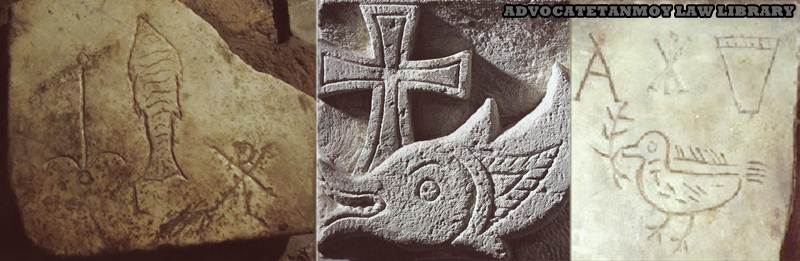
Who is Jesus is the great question till could be asked and may not be settled in near future, having said so we have several ways to know Jesus. When I am saying so, I am not at all interested in what Jesus told to his disciples or the birthday of Jesus, rather the very person of Jesus as apprehended by early Christian Comunity or Authority. I do accept the maxim that what master says – the slaves follow. Therefor for my inquiry, I have to inquire about the following premises without assuming anything about what I have heard (I hate hearsay evidence) from the local Bishops or Evangelist. Again I shall examine the captioned image produced by the early church. While saying so I am not going to subscribe that Jesus inaugurated his first discourse in a fishermen community or some Jodic sign turned into “Jesus Concept’. I shall consider that yesterday Pope Francis ordered to shutdown Vatican for visitors out of coronavirus fear.
So my first discovery is – Earthly fear exists and Christian leaders have no faith in Jesus. This fear was there in Judea, Roam, and Alexandria around 40-50 CE. Now people accepted a ‘closed’ door circumstance, then also people accepted an ‘underground’ circumstances and a new phenomenon which took the shape of Jesus – we shall inquire about the nature of ‘fear’ faced by the early Jesus community. Then we shall inquire when and how Jesus phenomenon took the incorporeal body as the son of Mary. The journey of Jesus as a son of Mary and his elevated position of crucified criest would be interesting to inquire, and last we shall inquire how Jesus Christ became the highest tradable item in so-called big Trading Corporations under leaders, which faithful called as ‘Ecclesia.’
Synopsis
Syrian Orthodox (Jacobites)– there was one kyana (ܟܝܢܐ nature) and one qnoma (ܩܢܘܡܐ -self/hypostasis) in the incarnate Christ.
Chalcedonians (Melkites) – there were two kyane(ϕύσιϚ) and one qnoma;
Church of the East (Nestorians)- there were two kyane and two qnome
Eutyches- Christ was consubstantial only with the Father
John 1:14-The Word became flesh
Synod of 605 AD-the divinity and humanity are united in a true union of the one person (πρὀσωπου) of the Son.
Western synods were political maneuvering and were called to bring multiple Jesus communities under the Roman Control and producing some official record for reference.
Synoptic Gospel shall be used for understanding conflicting Text materials. at the same time, we also use Syriac Evangelion Damhalte for our discussion.
List of the Eastern Synod :
THE SYNOD OF MAR ISAAC (410 CE)
THE SYNOD OF MAR YAHBALLAHA I (420 CE)
THE SYNOD OF DADISHO’ (424 CE)
THE SYNOD OF BARSAUMA (484 CE)
THE SYNOD OF MAR ACACIUS (486 CE)
THE SYNOD OF CATHOLICOS BABI (497 CE)
THE SYNOD OF CATHOLICOS MAR ABA I (544 CE)
THE SYNOD OF CATHOLICOS MAR JOSEPH (554 CE)
[THE SYNOD OF MAR EZEKIEL (576 CE)]
THE SYNOD OF MAR ISHO’YAHB I (585 CE)
THE SYNOD OF CATHOLICOS SABARISHO’ I (596 CE)
THE SYNOD OF PATRIARCH GREGORY I (605 CE)
THE SYNOD OF 612 AFTER THE DEATH OF PATRIARCH GREGORY I
THE SYNOD OF CATHOLICOS PATRIARCH GEORGE I (676 CE)
THE SYNOD OF MAR HANANISHO’ II (775 CE)
THE SYNOD OF MAR TIMOTHY I (790 CE)
We come to know about the New Testament from Eusebius from his Vita Constantini (Life of Constantine).
Bible Manuscript had been collected by British Library, the Leipzig University Library, the National Library of Russia in Saint Petersburg, and the Saint Catherine’s Monastery in Egypt.
Bible Manuscripts
- Codex Sinaiticus (Complete New Testament in Greek) with 24000 corrections, discovered by Constantin von Tischendorf -400CE
- Codex Vaticanus (Complete New Testament in Greek)[Book of 1 and 2 Timothy, Titus, Philemon, and Revelation were never in the codex]. 400CE
- The earliest fragment of the Gospel of Mark(Geek papyrus), dating it from between A.D. 150–250, published by the Egypt Exploration Society.
- Codex Ambrosianus(Aramaic Peshitta Old Testament)-1006/1007 CE
- Codex Leningradensis (Complete edition of the Hebrew Bible)1008 CE
- Greek New Testament of Dutch philologist Desiderius Erasmus of Rotterdam 1516[ Complete New testament books]
English Bible Translations
- John Wycliffe’s Bible 1382 CE
- William Tyndale’s New Testament of 1526
- Complutensian Polyglot Bible 1520
- Rabbinic Bible (Mikraot Gedolot) 1524
- Coverdale Bible 1535
- King James Version of 1611
- English Revised Version of 1885
- American Standard Version of 1901
- Revised Standard Version of 1952 and 1971
- The Koren Tanakh (Hebrew Bible) published from Israel in 1962.