Skip to content

ADVOCATETANMOY LAW LIBRARY

Research & Library Database

Primary Menu
  • News
  • Opinion
  • Countries198
    • National Constitutions: History, Purpose, and Key Aspects
  • Judgment
  • Book
  • Legal Brief
    • Legal Eagal
  • LearnToday
  • HLJ
    • Supreme Court Case Notes
    • Daily Digest
  • Sarvarthapedia
    • Sarvarthapedia (Core Areas)
    • Systemic-and-systematic
    • Volume One
02/04/2026
  • Sanatan Dharma

Mandukya Upanisad: Om, Self, Brahman and Consciousness

Māṇḍūkya Upaniṣad’s teachings on Om, the Self, and the four states of consciousness—waking, dreaming, deep sleep, and Turiya—for spiritual insight and inner realization.
advtanmoy 18/10/2025 2 minutes read

© Advocatetanmoy Law Library

  • Share on WhatsApp (Opens in new window) WhatsApp
  • Share on X (Opens in new window) X
  • Share on Facebook (Opens in new window) Facebook
  • Share on Telegram (Opens in new window) Telegram
Mandukya Upanisad: Om, Self, Brahman and Consciousness

Home » Law Library Updates » Sarvarthapedia » Sanatan Dharma » Mandukya Upanisad: Om, Self, Brahman and Consciousness

The essence of Om and the fourfold nature of the Self

Om—this sacred syllable is the breath of all that was, is, and shall be; the horizon of past, present, and future melts into its eternal resonance, and even what lies beyond the threefold passage of time reverberates as Om. All that exists is Brahman; the Self, our innermost essence, is none other than this Brahman, enfolded in four luminous quarters in Human.

The first quarter awakens as Vaiśvānara, the sovereign of the waking world, outwardly luminous, seven-limbed, nineteen-mouthed, tasting the tangibility of the gross, the palpable forms of being. The second, Taijasa, dreams upon the subtle stage, inwardly aware, mirroring seven limbs and nineteen mouths, savoring the delicate whispers of imagined worlds.

Read Next

  • The Hidden History of ISKCON Sannyasa: How a Radical Departure Became Law
  • Bahman and Brahman, and Moral Consciousness in Zoroastrian & Vedic Philosophy
  • “Hare Krishna” Is Not a Vedic Mantra: A Critical Study of Its Evolution

Beyond dreaming and waking lies the sanctuary of deep slumber, Suṣupta, where no desire stirs, no dream dances; here consciousness condenses into unity, a radiant mass of bliss, a doorway through which pure experience flows, the realm of Prajña, the third quarter, tranquil and resplendent.

He, the eternal Ishwar (mentioned in Isha Upanishad), the Knower of all, the hidden sovereign within, the origin of all that rises and dissolves—this Brahman (mentioned in Keno Upanishad) flows through every being, the invisible architect of genesis and dissolution alike. Yet He transcends cognition: neither inwardly conscious, nor outwardly, nor both; neither a mass of thought, nor awareness, nor its absence; unseen, intangible, incomprehensible, ungraspable, unmanifest, unthinkable. Essence itself is the Self alone, serene in cessation, radiant in bliss, non-dual and auspicious. This is the Fourth, the Turiya, where the Self is to be realized.

Om, the syllable, is this Self. Its tones—A, U, M—echo the quarters: A, the waking Vaiśvānara, first in presence, pervading, the gateway to desire and fulfillment; U, the dreaming Taijasa, rising in subtlety, the harmonizer of knowledge, the balancer of flow, ensuring none ignorant of Brahman arises; M, the deep-sleep Prajña, the measure and absorption, the total embrace of all into unity.

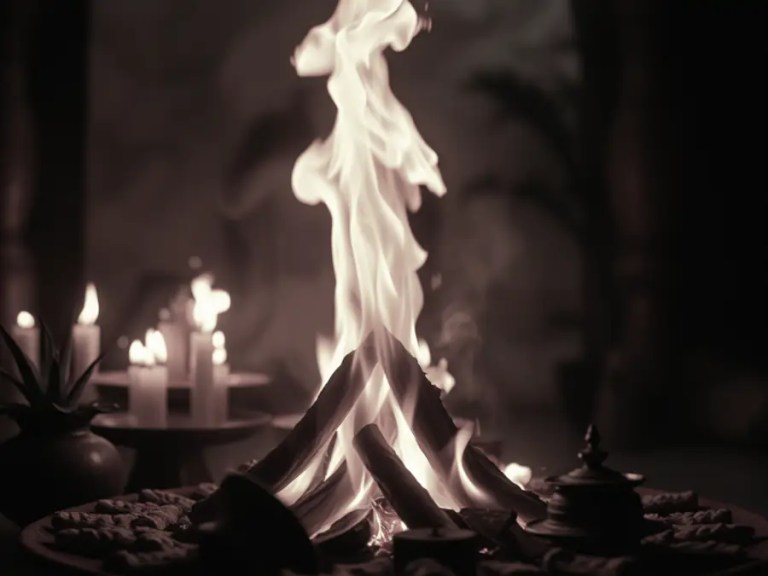
The Fourth, beyond sound and form, beyond action and phenomenon, is tranquil, auspicious, non-dual—pure cessation, the dissolution of multiplicity. Om, radiant, indivisible, is the Self itself; he who knows thus merges, as flame to flame, the Self within the Self, and rests in unbroken, eternal harmony.

Read Next

  • The Hidden History of ISKCON Sannyasa: How a Radical Departure Became Law
  • Bahman and Brahman, and Moral Consciousness in Zoroastrian & Vedic Philosophy
  • “Hare Krishna” Is Not a Vedic Mantra: A Critical Study of Its Evolution

Tanmoy Bhattacharyya

18th October 2025


माण्डूक्योपनिषत्

ओमित्येतदक्षरमिदं सर्वं तस्योपव्याख्यानं भूतं भवद्भविष्यदिति सर्वमोङ्कार एव । यच्चान्यत्त्रिकालातीतं तदप्योङ्कार एव ॥ १ ॥
सर्वं ह्येतद्ब्रह्मायमात्मा ब्रह्म सोऽयमात्मा चतुष्पात् ॥ २ ॥
जागरितस्थानो बहिःप्रज्ञः सप्ताङ्ग एकोनविंशतिमुखः स्थूलभुग्वैश्वानरः प्रथमः पादः ॥ ३ ॥
स्वप्नस्थानोऽन्तःप्रज्ञः सप्ताङ्ग एकोनविंशतिमुखः प्रविविक्तभुक्तैजसो द्वितीयः पादः ॥ ४ ॥
यत्र सुप्तो न कञ्चन कामं कामयते न कञ्चन स्वप्नं पश्यति तत्सुषुप्तम् । सुषुप्तस्थान एकीभूतः प्रज्ञानघन एवानन्दमयो ह्यानन्दभुक्चेतोमुखः प्राज्ञस्तृतीयः पादः ॥ ५ ॥
एष सर्वेश्वर एष सर्वज्ञ एषोऽन्तर्याम्येष योनिः सर्वस्य प्रभवाप्ययौ हि भूतानाम् ॥ ६ ॥
नान्तःप्रज्ञं नबहिःप्रज्ञं नोभयतःप्रज्ञं नप्रज्ञानघनं नप्रज्ञं नाप्रज्ञम् । अदृश्यमव्यवहार्यमग्राह्यमलक्षणमचिन्त्यमव्यपदेश्यमेकात्मप्रत्ययसारं प्रपञ्चोपशमं शान्तं शिवमद्वैतं चतुर्थं मन्यन्ते स आत्मा स विज्ञेयः ॥ ७ ॥
सोऽयमात्माध्यक्षरमोङ्कारोऽधिमात्रं पादा मात्रा मात्राश्च पादा अकार उकारो मकार इति ॥ ८ ॥
जागरितस्थानो वैश्वानरोऽकारः प्रथमा मात्राप्तेरादिमत्त्वाद्वाप्नोति ह वै सर्वान्कामानादिश्च भवति य एवं वेद ॥ ९ ॥
स्वप्नस्थानस्तैजस उकारो द्वितीया मात्रोत्कर्षादुभयत्वाद्वोत्कर्षति ह वै ज्ञानसन्ततिं समानश्च भवति नास्याब्रह्मवित्कुले भवति य एवं वेद ॥ १० ॥
सुषुप्तस्थानः प्राज्ञो मकारस्तृतीया मात्रा मितेरपीतेर्वा मिनोति ह वा इदं सर्वमपीतिश्च भवति य एवं वेद ॥ ११ ॥
अमात्रश्चतुर्थोऽव्यवहार्यः प्रपञ्चोपशमः शिवोऽद्वैत एवमोङ्कार आत्मैव संविशत्यात्मनात्मानं य एवं वेद ॥ १२ ॥

Read Next

  • The Hidden History of ISKCON Sannyasa: How a Radical Departure Became Law
  • Bahman and Brahman, and Moral Consciousness in Zoroastrian & Vedic Philosophy
  • “Hare Krishna” Is Not a Vedic Mantra: A Critical Study of Its Evolution

Tanmoy Bhattacharyya on Consciousness: Biology, Psychology & Philosophy
10 Upanishads: Isa Keo Katho Pras Munda Mandu Taite Aite Chando Brihad

Tags: Consciousness Tanmoy Bhattacharyya UpanishadEnglishTranslation

Post navigation

Previous: Kena Upanishad: The truth as taught by Adorable Huma
Next: Pak Army Chief Warns India: No Space for War in Nuclear Zone
Sarvarthapedia
Sarvarthapedia

Research Methodology and Investigation: Concepts, Frameworks, and Emerging Trends

Surupa Guha Murder Case
Sarvarthapedia

Surupa Guha Murder Case 1976 : w/o Indranath Guha (ex-Principal of South Point School & Friend of Aparna Sen)

Uric Acid: From 18th Century Discovery to Modern Medical Science

Christian Approaches to Interfaith Dialogue: Orthodox, Catholic, Protestant, and Pentecostal Views

Origin of Central Banking in India: From Hastings to RBI and the History of Preparatory Years (1773–1934)

Howrah District Environment Plan: Waste Management, Water Quality & Wetland Conservation

Bharatiya Nyaya Sanhita 2023: Sections (1-358), Punishments, and Legal Framework

Bengali Food Culture: History, Traditions, and Class Influences

West Bengal Court-Fees Act, 1970: Fees, Schedules, and Procedures

WB Land Reforms Tribunal Act 1997: History, Features, Provisions, Structure, Powers and Functions

Civil Procedure Law of the Democratic People’s Republic of Korea (1976)

Knowledge Management in the Modern Era: From History to Digital Transformation

Vedic Interpretation Methodical Style: History, Principles, and Evolution  From Yaska to Aurobindo

Research on English Law: Courts, Legislation, and Case Reporting System

  • Sarvarthapedia

  • Delhi Law Digest

  • Howrah Law Journal

  • Amit Arya vs Kamlesh Kumari: Doctrine of merger20/12/2025
  • David Vs. Kuruppampady: SLP against rejecting review by HC (2020)28/10/2025
  • Nazim & Ors. v. State of Uttarakhand (2025 INSC 1184)06/10/2025
  • Geeta v. Ajay: Expense for daughter`s marriage allowed in favour of the wife05/10/2025
  • Bharatiya Nagarik Suraksha Sanhita 2023 (BNSS)
  • Bharatiya Sakshya Adhiniyam 2023 (BSA): Indian Rules for Evidence
  • Bharatiya Nyaya Sanhita (BNS) 2023
  • The Code of Civil Procedure (CPC)
  • Supreme Court Daily Digest
  • U.S. Supreme Court Orders
  • U.k. Supreme Court Orders
  • Uric Acid: From 18th Century Discovery to Modern Medical Science
  • Christian Approaches to Interfaith Dialogue: Orthodox, Catholic, Protestant, and Pentecostal Views
  • Origin of Central Banking in India: From Hastings to RBI and the History of Preparatory Years (1773–1934)
  • Howrah District Environment Plan: Waste Management, Water Quality & Wetland Conservation

2026 © Advocatetanmoy Law Library

  • About
  • Global Index
  • Judicial Examinations
  • Indian Statutes
  • Glossary
  • Legal Eagle
  • Subject Guide
  • Journal
  • SCCN
  • Constitutions
  • Legal Brief (SC)
  • MCQs (Indian Laws)
  • Sarvarthapedia (Articles)
  • Contact Us
  • Privacy Policy
  • FAQs
  • Library Updates