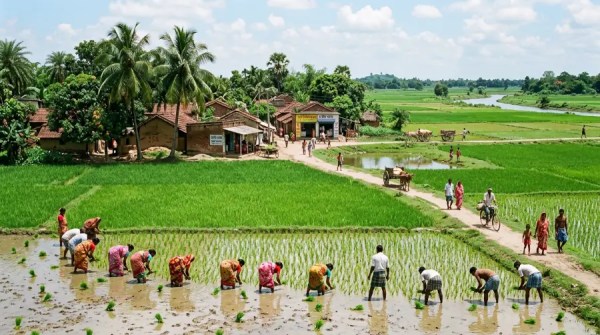
The face of Truth lies hidden behind a golden vessel, as taught by the Isha Upanishad
English Translation
All this—whatever moves upon the living world—is pervaded by the Lord, the Eternal Īshwar (Yaksha of Kena Upanishad). By renouncing, enjoy; desire not, for whose indeed is wealth? Performing righteous deeds alone in this life, one should wish to live a hundred years, for thus it is ordained—no other way exists—and such action binds not the man who walks in truth. Those realms devoid of light, wrapped in blind darkness, are entered after death by those who slay the self. Unmoving, yet swifter than the mind, the divine powers cannot overtake It, for It forever goes before; standing still, It outstrips all that runs, and within It the cosmic breath upholds the flowing waters. It (Brahman of Mandukya Upanisad) moves, and It moves not; It is far, yet It is near; It dwells within all, and yet abides beyond all. He (the disciple) who beholds every being within his own Self, and his own Self in all beings—such a one never turns away in scorn or sorrow.
When to the knower all beings have become his very Self, what delusion, what grief can exist for him who perceives the One in all? He, the radiant, all-pervading Ishwar—bodiless, woundless, sinewless, pure, untouched by evil—the Seer, the Thinker, the All-encompassing, Self-born—He hath ordained all things rightly from everlasting ages (As mentioned in The Aitareya Upanishad). Into blind darkness enter those who follow ignorance; yet into deeper darkness still go those who are enamoured of mere knowledge, the knowledge of forms and fragments.
For different indeed, they say, is the fruit of knowledge, and different indeed the fruit of ignorance—thus have we heard from the wise (Rishis) who taught the truth. He who knows both knowledge and ignorance together—by ignorance crosses beyond death, and by knowledge attains immortality. Into blind darkness enter those who worship the Unmanifested; into greater darkness, as it were, go those who delight in the Manifested. For different indeed, they say, is the fruit of the Manifested, and different indeed is the fruit of the Unmanifested—thus have we heard from the sages who discerned Reality. He who knows both birth and dissolution together—by dissolution crosses death, and by birth attains immortality.
The face of Truth lies hidden behind a golden vessel; O Pūṣan, O radiant power of the Ishwar, unveil it for me, the lover of Truth, that I may behold the Reality. O Pūṣan, O solitary Seer, O Sun, offspring of the Eternal Creator! Gather back thy rays, withdraw thy dazzling light, that most gracious form of thine I behold—that Supreme Person who abides there yonder—He Indeed Am I. Let this body be reduced to ashes, and let the life-breath merge into the immortal Air.
O Mind, remember thy deeds; remember, O Mind, remember! O holy Fire, lead us by the auspicious path unto prosperity, O Divine One who knowest all our ways; remove from us the crooked sin, and to thee we offer our deepest reverence and praise.
ईशावास्योपनिषत् – मन्त्राः
Original Text
- ईशा वास्यमिदं सर्वं यत्किं च जगत्यां जगत् । तेन त्यक्तेन भुञ्जीथा मा गृधः कस्य स्विद्धनम् ॥ १ ॥
- कुर्वन्नेवेह कर्माणि जिजीविषेच्छतं समाः । एवं त्वयि नान्यथेतोऽस्ति न कर्म लिप्यते नरे ॥ २ ॥
- असुर्या नाम ते लोका अन्धेन तमसा वृताः । तांस्ते प्रेत्याभिगच्छन्ति ये के चात्महनो जनाः ॥ ३ ॥
- अनेजदेकं मनसो जवीयो नैनद्देवा आप्नुवन्पूर्वमर्षत् । तद्धावतोऽन्यानत्येति तिष्ठ—त्तस्मिन्नपो मातरिश्वा दधाति ॥ ४ ॥
- तदेजति तन्नैजति तद्दूरे तद्वन्तिके । तदन्तरस्य सर्वस्य तदु सर्वस्यास्य बाह्यतः ॥ ५ ॥
- यस्तु सर्वाणि भूतानि आत्मन्येवानुपश्यति । सर्वभूतेषु चात्मानं ततो न विजुगुप्सते ॥ ६ ॥
- यस्मिन्सर्वाणि भूतानि आत्मैवाभूद्विजानतः । तत्र को मोहः कः शोक एकत्वमनुपश्यतः ॥ ७ ॥
- स पर्यगाच्छुक्रमकायमव्रण—मस्नाविरं शुद्धमपापविद्धम् । कविर्मनीषी परिभूः स्वयम्भूर्याथातथ्यतो—ऽर्थान्व्यदधाच्छाश्वतीभ्यः समाभ्यः ॥ ८ ॥
- अन्धं तमः प्रविशन्ति ये अविद्यामुपासते । ततो भूय इव ते तमो य उ विद्यायां रताः ॥ ९ ॥
- अन्यदेवाहुर्विद्यया अन्यदाहुरविद्यया । इति शुश्रुम धीराणां ये नस्तद्विचचक्षिरे ॥ १० ॥
- विद्यां चाविद्यां च यस्तद्वेदोभयं सह । अविद्यया मृत्युं तीर्त्वा विद्ययामृतमश्नुते ॥ ११ ॥
- अन्धं तमः प्रविशन्ति येऽसम्भूतिमुपासते । ततो भूय इव ते तमो य उ सम्भूत्यां रताः ॥ १२ ॥
- अन्यदेवाहुः सम्भवादन्यदाहुरसम्भवात् । इति शुश्रुम धीराणां ये नस्तद्विचचक्षिरे ॥ १३ ॥
- सम्भूतिं च विनाशं च यस्तद्वेदोभयं सह । विनाशेन मृत्युं तीर्त्वा सम्भूत्यामृतमश्नुते ॥ १४ ॥
- हिरण्मयेन पात्रेण सत्यस्यापिहितं मुखम् । तत्त्वं पूषन्नपावृणु सत्यधर्माय दृष्टये ॥ १५ ॥
- पूषन्नेकर्षे यम सूर्य प्राजापत्य व्यूह रश्मीन्समूह तेजो यत्ते रूपं कल्याणतमं तत्ते पश्यामि योऽसावसौ पुरुषः सोऽहमस्मि ॥ १६ ॥
- वायुरनिलममृतमथेदं भस्मान्तं शरीरम् । ओं क्रतो स्मर कृतं स्मर क्रतो स्मर कृतं स्मर ॥ १७ ॥
- अग्ने नय सुपथा राये अस्मान्विश्वानि देव वयुनानि विद्वान् । युयोध्यस्मज्जुहुराणमेनो भूयिष्ठां ते नमउक्तिं विधेम ॥ १८ ॥
Vedic Vocabulary
ईशा (Lord, supreme ruler), वास्यम् (to be inhabited, pervaded), इदम् (this), सर्वम् (all), यत्किञ्च (whatever), जगत्याम् (in the world), जगत् (moving universe), तेन (by that), त्यक्तेन (by renunciation), भुञ्जीथाः (enjoy, partake), मा (do not), गृधः (covet), कस्यस्वित् (of anyone), धनम् (wealth), कुर्वन् (doing), एव (indeed), इह (here), कर्माणि (actions), जिजीविषेत् (should wish to live), शतम् (hundred), समाः (years), एवं (thus), त्वयि (for you), न (not), अन्यथा (otherwise), इतः (than this), अस्ति (is), कर्म (action), लिप्यते (is tainted), नरे (in man), असुर्याः (demonic), नाम (named), ते (those), लोकाः (worlds), अन्धेन (by blindness), तमसा (darkness), वृताः (covered), तान् (those), ते (they), प्रेत्य (after death), अभिगच्छन्ति (go towards), ये (who), के च (and whoever), आत्महनः (Self-Sabotage/r), जनाः (people), अनेजत् (unmoving), एकम् (one), मनसः (than mind), जवीयः (faster), न (not), एनत् (this), देवाः (gods), आप्नुवन् (attain), पूर्वम् (before), अर्षत् (went), तत् (that), धावतः (running), अन्यान् (others), अत्येति (surpasses), तिष्ठत् (standing), तस्मिन् (in that), अपः (waters), मातरिश्वा (cosmic air), दधाति (places), तत् (that), एजति (moves), तत् (that), न एजति (does not move), तत् (that), दूरे (far), तत् (that), अन्तिके (near), तत् (that), अन्तरस्य (within), सर्वस्य (of all), तत् (that), उ (indeed), सर्वस्य (of all), अस्य (this), बाह्यतः (outside), यः (who), तु (indeed), सर्वाणि (all), भूतानि (beings), आत्मनि (in the self), एव (alone), अनुपश्यति (sees), सर्वभूतेषु (in all beings), च (and), आत्मानम् (self), ततः (then), न (not), विजुगुप्सते (hates), यस्मिन् (in which), सर्वाणि (all), भूतानि (beings), आत्मा (self), एव (alone), अभूत् (became), विजानतः (of the knower), तत्र (there), कः (what), मोहः (delusion), कः (what), शोकः (sorrow), एकत्वम् (oneness), अनुपश्यतः (seeing), सः (he), पर्यगात् (pervaded), शुक्रम् (pure), अकायम् (bodiless), अव्रणम् (woundless), अस्नाविरम् (without sinews), शुद्धम् (pure), अपापविद्धम् (untainted by sin), कविः (seer), मनीषी (thinker), परिभूः (all-pervading), स्वयम्भूः (self-existent), याथातथ्यतः (as it is), अर्थान् (objects), व्यदधात् (ordained), शाश्वतीभ्यः (eternal), समाभ्यः (years), अन्धम् (blind), तमः (darkness), प्रविशन्ति (enter), ये (who), अविद्याम् (ignorance), उपासते (worship), ततः (than that), भूयः (greater), इव (indeed), ते (they), तमः (darkness), ये (who), उ (indeed), विद्यायाम् (knowledge), रताः (delight), अन्यत् (different), एव (indeed), आहुः (they say), विद्यया (by knowledge), अन्यत् (different), आहुः (they say), अविद्यया (by ignorance), इति (thus), शुश्रुम (we have heard), धीराणाम् (of the wise), ये (who), नः (to us), तत् (that), विचचक्षिरे (explained), विद्याम् (knowledge), च (and), अविद्याम् (ignorance), च (and), यः (who), तत् (that), वेद (knows), उभयम् (both), सह (together), अविद्यया (through ignorance), मृत्युम् (death), तीर्त्वा (crossing), विद्यया (through knowledge), अमृतम् (immortality), अश्नुते (attains), अन्धम् (blind), तमः (darkness), प्रविशन्ति (enter), ये (who), असम्भूतिम् (unmanifest), उपासते (worship), ततः (than that), भूयः (greater), इव (indeed), ते (they), तमः (darkness), ये (who), उ (indeed), सम्भूत्याम् (in manifest), रताः (engaged), अन्यत् (different), एव (indeed), आहुः (they say), सम्भवात् (from creation), अन्यत् (different), आहुः (they say), असम्भवात् (from non-creation), इति (thus), शुश्रुम (we have heard), धीराणाम् (of the wise), ये (who), नः (to us), तत् (that), विचचक्षिरे (explained), सम्भूतिम् (creation), च (and), विनाशम् (destruction), च (and), यः (who), तत् (that), वेद (knows), उभयम् (both), सह (together), विनाशेन (through destruction), मृत्युम् (death), तीर्त्वा (crossing), सम्भूत्या (through creation), अमृतम् (immortality), अश्नुते (attains), हिरण्मयेन (golden), पात्रेण (vessel), सत्यस्य (of truth), अपिहितम् (covered), मुखम् (face), तत् (that), त्वम् (you), पूषन् (sun nourisher), अपावृणु (uncover), सत्यधर्माय (for truth-seeker), दृष्टये (for vision), पूषन् (solar power), एकर्षे (sole seer), यम (controller), सूर्य (sun), प्राजापत्य (offspring of Prajapati), व्यूह (withdraw), रश्मीन् (rays), समूह (gather), तेजः (light), यत् (which), ते (your), रूपम् (form), कल्याणतमम् (most auspicious), तत् (that), ते (your), पश्यामि (I see), यः (who), असौ (that), पुरुषः (person), सः (he), अहम् (I), अस्मि (am), वायुः (air), अनिलम् (immortal air), अमृतम् (immortal), अथ (then), इदम् (this), भस्मान्तम् (to ashes), शरीरम् (body), ओम् (sacred syllable), क्रतो (will), स्मर (remember), कृतम् (done), स्मर (remember), अग्ने (O fire), नय (lead), सुपथा (good path), राये (to wealth), अस्मान् (us), विश्वानि (all), देव (O god), वयुनानि (ways), विद्वान् (knower), युयोधि (remove), अस्मत् (from us), जुहुराणम् (sinful), एनः (sin), भूयिष्ठाम् (abundant), ते (to you), नमउक्तिम् (salutation), विधेम (we offer).
Bhāsvatī Tantra Bhashyam
The Ishavasya Upanishad, revered as one of the most profound philosophical compositions within the Vedic corpus, occupies a unique and exalted position as the 40th chapter of the Shukla Yajur Veda (Madhyandina recension). Within the tradition of interpretative literature, the Bhāsvatī Tantra Bhashyam (Vajrajalatantra) of Ishavasya Upanishad emerges as a distinctive and integrative commentary, synthesizing Vedic ritualism, tantric metaphysics, and non-dual philosophical inquiry. The declaration “भस्वतीतन्त्रम् आरभ्यते” signals the commencement of a contemplative framework in which the Bhāsvatī Tantra unfolds as both a ritualistic and metaphysical exposition, rooted in the Yajurvedic tradition and culminating in the highest realization of Brahman.
The Bhāsvatī Tantra, described as holding a central place in the Yajur Veda, begins with foundational mantras such as “इषे त्वा ऊर्जे त्वा”, emphasizing the primacy of yajña (sacrificial action) as a means of sustaining cosmic order and human welfare. This framework situates the ritual act not merely as an external performance but as a symbolic enactment of cosmic harmony (ṛta). In the Darśa-Pūrṇamāsa iṣṭi section, the procedures of homa (fire offerings) are elaborated with precision, demonstrating the intricate relationship between human intention, ritual correctness, and cosmic reciprocity. The term “इष्टि”, meaning sacrifice or offering, especially in the form of Agnihoma, signifies the transformative process through which material offerings are transmuted into spiritual merit and knowledge.
Across the 39 chapters of the Yajur Veda, the gradual progression from ritual action (karma) to knowledge (jñāna) is meticulously mapped. The culmination occurs in the Ishavasya Upanishad, where the declarative insight “ईशावास्यमिदं सर्वम्” elevates the discourse from external ritualism to inner realization. Thus, the Bhāsvatī Tantra serves as a bridge, beginning with ritual engagement and culminating in self-realization (ātma-sākṣātkāra). This progression illustrates a profound philosophical synthesis in which karma and jñāna are not oppositional but complementary, guiding the individual toward spiritual ascent.
The Ishavasya Upanishad itself explores the nature of existence, emphasizing the unity of all life and the pervasive presence of the divine essence. It articulates a worldview in which individual consciousness (jīvātman) and universal consciousness (paramātman) are fundamentally interconnected. This realization is not abstract but experiential, attainable through mindful action, ethical living, and deep introspection. The Upanishad advocates a life of balance, where renunciation (tyāga) and enjoyment (bhoga) coexist, creating a harmonious approach to existence.
The hermeneutical richness of the text lies in its layered meanings. The word “Upanishad”, derived from upa-ni-ṣad, implies sitting near the teacher, but more profoundly signifies the dissolution of ignorance through proximity to truth. This dissolution leads to the cessation of suffering (वेदना अन्त) and the attainment of moksha, liberation from the cycle of birth and death. The commentary tradition, particularly in the Vajrajalatantre Bhāsvatītantra Bhāṣyam, expands this understanding by integrating tantric symbolism, wherein the external ritual becomes an internalized spiritual process.
The interpretation of “ईशा” in the phrase “ईशावास्यमिदं सर्वम्” becomes central to philosophical inquiry. The term “वास्य” denotes pervasion, covering, or enveloping, suggesting that the entire universe is imbued with divine presence. Yet, the commentary raises critical questions: What is this “Isha”? Who governs whom? If reality is singular, what does it envelop? This dialectical exploration acknowledges the human tendency toward multiplicity, proposing that understanding plurality becomes a necessary stage in grasping ultimate unity.
The grammatical analysis deepens this insight: “ईश” derives from a root meaning sovereignty or lordship, “वस” implies covering or inhabiting, and “गृधु” signifies desire or greed. Together, they articulate an ethical vision in which the world, being pervaded by the divine, cannot be possessed or exploited. The injunction “मा गृधः कस्यस्विद्धनम्” explicitly discourages covetousness, advocating instead a life of contentment and stewardship. This principle forms what is described as the First Vedic Constitution, emphasizing that all resources belong to the divine and must be used responsibly.
The metaphorical illustrations reinforce this ethic: birds consume fruits without destroying trees, fish inhabit water without polluting it, and bees gather nectar without harming flowers. These examples establish a model of sustainable coexistence, aligning human behavior with natural harmony. The Upanishadic vision thus anticipates contemporary concerns about environmental ethics and collective responsibility, presenting a timeless framework for equitable resource distribution.
The Second Vedic Constitution, articulated through the mantra “कुर्वन्नेवेह कर्माणि जिजीविषेच्छतं समाः”, underscores the importance of active engagement in life through righteous action. It rejects passive renunciation and instead promotes dynamic participation in societal duties, provided such actions are performed without attachment. This doctrine reflects the principle of karma-yoga, where action becomes a means of liberation rather than bondage.
A significant dimension of this teaching is the emphasis on food production and communal responsibility. The text highlights that participation in sustenance activities is essential for both material survival and spiritual growth. Dependency without contribution is equated with ignorance and darkness, as expressed in the Third Vedic Constitution: “असुर्या नाम ते लोकाः अन्धेन तमसावृताः”. Here, the absence of self-reliance and awareness leads to a state of spiritual obscurity, not necessarily in terms of rebirth but as a condition of consciousness.
The Upanishad then advances toward deeper metaphysical insights. The paradoxical descriptions—“तदेजति तन्नैजति” (It moves, it moves not), “तद्दूरे तद्वन्तिके” (It is far, it is near)—reveal the transcendent nature of Brahman, which defies conventional categories of space and motion. This culminates in the realization articulated in the Fourth Vedic Constitution: seeing the Self in all beings and all beings in the Self eliminates doubt, sorrow, and delusion.
The discourse on OM (ॐ) provides a symbolic encapsulation of this philosophy. As a पूर्णशब्द (complete sound), OM represents the totality of existence, self-contained and self-sufficient. The addition of “खं”, symbolizing space or expansion, indicates the manifestation of Brahman in the cosmos. Thus, “ओ३म् खं ब्रह्म” expresses the unity of transcendence and immanence, where the unmanifest absolute becomes the manifest universe.
Further elaboration connects Brahman with Shiva, as expressed in “अन्तरिक्षं शिवं (यजुर्वेदः 35.9)”, where space itself becomes a symbol of pure consciousness—limitless, formless, and auspicious. This interpretation aligns with tantric metaphysics, where the void (ākāśa) is not emptiness but potentiality, the ground of all existence.
The latter mantras of the Upanishad address the integration of knowledge (vidyā) and ignorance (avidyā), asserting that both must be understood together. Avidyā, associated with ritual and empirical knowledge, enables one to overcome mortality, while vidyā, representing spiritual insight, leads to immortality. This dual approach reinforces the central thesis of the Bhāsvatītantra Bhāṣyam: that ritual and knowledge are sequential stages in a unified path.
The contemplation of the body’s impermanence, expressed in “भस्मान्तं शरीरम्”, serves as a reminder of the urgency of spiritual practice. The invocation to Agni—“अग्ने नय सुपथा”—symbolizes the guiding force that leads the seeker from ignorance to illumination. Similarly, the identification with the solar being—“योऽसावादित्ये पुरुषः सोऽसावहम्”—articulates the realization of identity between the individual and the cosmic self.
The tantric interpretation of “पुरुषः” further deepens this understanding. The Purusha is both the bound individual and the liberated consciousness, obscured by māyā yet inherently divine. The recognition that “अहम्” encompasses the entire spectrum of existence reflects the non-dual insight that self and cosmos are one.
The concluding vision of the text affirms that the integration of ज्ञान (knowledge), भक्ति (devotion), and योग (discipline) constitutes the highest path of life. The commentary emphasizes that the realization of “ईशावास्यमिदं सर्वम्” is not merely intellectual but experiential—a state in which one perceives the divine in all existence.
Thus, the Bhāsvatītantra Bhāṣyam (Vajrajalatantra) on the Ishavasya Upanishad presents a comprehensive spiritual system. Beginning with ritual action, progressing through ethical discipline, and culminating in non-dual realization, it offers a holistic path to liberation. It integrates Vedic orthodoxy with tantric innovation, demonstrating that spiritual truth transcends doctrinal boundaries.
The text concludes with a universal benediction: “द्यौः शान्तिः… सर्वं शान्तिः”, affirming that the ultimate goal of all knowledge and practice is peace—not merely the absence of conflict, but the harmonious alignment of the individual with the cosmos. In this vision, self-realization becomes synonymous with universal well-being, and the seeker, having traversed the path from karma to jñāna, attains the state of पूर्णता (wholeness).
Core Knowledge Web: Ishavasya Upanishad and Bhāsvatītantra Bhāṣyam (Vajrajalatantra)
This conceptual network organizes the philosophical, ritualistic, and metaphysical ideas of the Ishavasya Upanishad and its exposition in the Vajrajalatantre Bhāsvatītantra Bhāṣyam into interconnected clusters. Each concept is cross-referenced to related ideas, forming a “See also” style knowledge web for Sarvarthapedia.
Cluster 1: Foundational Textual Framework
Ishavasya Upanishad
- See also: Yajur Veda, Vedanta, Moksha, Brahman, Atman, Scriptures and Interpretation
- Core idea: Unity of existence and divine pervasion (ईशावास्यमिदं सर्वम्)
- Linked to: Renunciation and Enjoyment, Self-Realization, Cosmic Order
Vajrajalatantre Bhāsvatītantra Bhāṣyam
- See also: Tantra, Ritualism, Non-dualism, Commentary Tradition
- Core idea: Integration of karma (ritual) and jñāna (knowledge)
- Linked to: Homa, Yajña, OM, Brahman
Bhāsvatī Tantra
- See also: Yajurvedic Ritualism, Darśa-Pūrṇamāsa Iṣṭi, Agnihoma
- Core idea: Ritual foundation leading to metaphysical realization
- Linked to: First Vedic Constitution, Second Vedic Constitution
Cluster 2: Vedic Structure and Progression
Yajur Veda (39 Chapters + 40th Chapter)
- See also: Karma Kanda, Jñāna Kanda, Upanishads
- Core idea: Transition from ritual action to spiritual knowledge
- Linked to: Bhāsvatī Tantra, Ishavasya Upanishad
Yajña (Sacrifice)
- See also: Homa, Iṣṭi, Ṛta, Dharma
- Core idea: Cosmic exchange and sustenance
- Linked to: Food Production, Social Responsibility
Homa (Fire Ritual)
- See also: Agni, Transformation, Offering
- Core idea: Symbolic transformation of material into spiritual
- Linked to: Inner Sacrifice, Self-Purification
Cluster 3: Metaphysical Core Concepts
Brahman
- See also: OM, Akasha (खं), Shiva, Absolute Reality
- Core idea: Infinite, formless, all-pervasive reality
- Linked to: Atman, Non-dualism, Cosmic Expansion
Atman (Self)
- See also: Jivatman, Paramatman, Self-Realization
- Core idea: Inner consciousness is identical with Brahman
- Linked to: Moksha, Unity of Existence
OM (ॐ)
- See also: Brahman, Cosmic Sound, Creation
- Core idea: Totality and completeness
- Linked to: Kh (Space), Expansion, Silence
Kh (Space / Expansion)
- See also: Akasha, Shiva, Infinity
- Core idea: Symbol of unbounded existence
- Linked to: Brahman, OM
Cluster 4: Philosophical Doctrines
Non-dualism (Advaita)
- See also: Unity of Existence, Brahman-Atman Identity
- Core idea: No separation between self and universe
- Linked to: Moksha, Knowledge (Vidyā)
Unity of Existence
- See also: ईशावास्यमिदं सर्वम्, Interconnectedness
- Core idea: All beings are expressions of the divine
- Linked to: Ethical Living, Compassion
Vidyā and Avidyā
- See also: Knowledge, Ignorance, Dual Approach
- Core idea: Both are necessary for complete realization
- Linked to: Mortality, Immortality
Cluster 5: Ethical and Social Philosophy
First Vedic Constitution (Ownership and Consumption)
- See also: Non-possession, Stewardship, Sustainability
- Core idea: All resources belong to the divine
- Linked to: Renunciation, Social Harmony
Second Vedic Constitution (Karma and Duty)
- See also: Karma Yoga, Non-attachment, Action
- Core idea: Perform duties without attachment
- Linked to: Moksha, Social Responsibility
Third Vedic Constitution (Ignorance and Dependency)
- See also: Darkness (Tamas), Self-Reliance
- Core idea: Dependency leads to spiritual ignorance
- Linked to: Food Production, Responsibility
Fourth Vedic Constitution (Unity of Self)
- See also: Ego and Non-Ego, Self-Realization
- Core idea: Seeing self in all beings
- Linked to: Freedom from sorrow, Enlightenment
Cluster 6: Human Life and Practice
Karma (Action)
- See also: Dharma, Duty, Non-attachment
- Core idea: Action as a path to liberation
- Linked to: Yajña, Social Contribution
Moksha (Liberation)
- See also: Self-Realization, Freedom, Enlightenment
- Core idea: Liberation from cycle of birth and death
- Linked to: Knowledge, Non-dualism
Renunciation (Tyāga)
- See also: Detachment, Simplicity
- Core idea: Letting go of possessiveness
- Linked to: Enjoyment (Bhoga), Balance
Enjoyment (Bhoga)
- See also: Consumption, Moderation
- Core idea: Ethical enjoyment without attachment
- Linked to: Tyāga
Cluster 7: Cosmology and Symbolism
Agni (Fire)
- See also: Homa, Transformation, Divine Guide
- Core idea: Mediator between human and divine
- Linked to: Prayer, Enlightenment
Aditya (Sun)
- See also: Purusha, Light, Consciousness
- Core idea: Source of illumination and life
- Linked to: Inner Self, Vision
Purusha
- See also: Biology, Cosmology, Consciousness, Shiva, Atman
- Core idea: Cosmic being and individual self
- Linked to: Identity (Aham), Brahman
Aham (I)
- See also: Identity, Self-awareness
- Core idea: Microcosmic reflection of macrocosm
- Linked to: Advaita, Self-Realization
Cluster 8: Knowledge and Interpretation
Hermeneutics (Interpretation)
- See also: Symbolism, Metaphor, Commentary
- Core idea: Multi-layered meaning of texts
- Linked to: Tantra, Vedanta
Commentary Tradition
- See also: Bhāṣya, Philosophical Analysis
- Core idea: Expansion of scriptural meaning
- Linked to: Vajrajalatantre Bhāṣyam
Tantra
- See also: Energy, Symbolism, Practice
- Core idea: Internalization of ritual and knowledge
- Linked to: Bhāsvatī Tantra, Yoga
Cluster 9: Ecology and Sustainability
Food Production
- See also: Yajña, Community, Responsibility
- Core idea: Essential duty of all beings
- Linked to: Self-reliance, Social Ethics
Sustainability
- See also: Non-possession, Ecology
- Core idea: Balanced use of resources
- Linked to: First Vedic Constitution
Coexistence
- See also: Harmony, Interdependence
- Core idea: Living without exploitation
- Linked to: Unity of Existence
Cluster 10: Ultimate Synthesis
Integration of Karma and Jñāna
- See also: Ritual and Knowledge, Path to Moksha
- Core idea: Sequential and unified spiritual path
- Linked to: Bhāsvatī Tantra, Ishavasya Upanishad
Self-Realization (Ātma-Sākṣātkāra)
- See also: Enlightenment, Unity
- Core idea: Direct experience of truth
- Linked to: Brahman, Moksha
Universal Peace (Śānti)
- See also: Physics, Harmony, Cosmic Balance
- Core idea: Final state of realization
- Linked to: “द्यौः शान्तिः… सर्वं शान्तिः”
Cross-Link Summary (See Also Network)
Ishavasya Upanishad
- See also: Brahman, Atman, Moksha, Yajur Veda, Non-dualism
Vajrajalatantre Bhāṣyam
- See also: Tantra, Karma-Jñāna Integration, OM, Bhāsvatī Tantra
Bhāsvatī Tantra
- See also: Yajña, Homa, Ritualism, Self-Realization
Brahman
- See also: OM, Kh, Shiva, Atman
Karma
- See also: Dharma, Yajña, Moksha
Moksha
- See also: Self-Realization, Non-dualism, Liberation
This Sarvarthapedia conceptual network reveals a deeply interconnected system where ritual, philosophy, ethics, and metaphysics converge, demonstrating that the teachings of the Ishavasya Upanishad and the Bhāsvatītantra Bhāṣyam (Vajrajalatantra) form not isolated doctrines but an integrated knowledge web of existence, action, and realization.
Read More
- Kena Upanishad: The truth as taught by Adorable Huma
- Mandukya Upanisad: Om, Self, Brahman, and Consciousness
- Aitareya Upanishad: Indirectness of Creation and Consciousness
- The Enlightened Scilence: Upanishad Of Anandakirtan
- Aswamedha Upanishad (अश्वमेध उपनिषद्)
- Vajrajalatantre Ishavasya Upanishad: Bhaswatitantra Bhashyam