The saga of silence and darkness
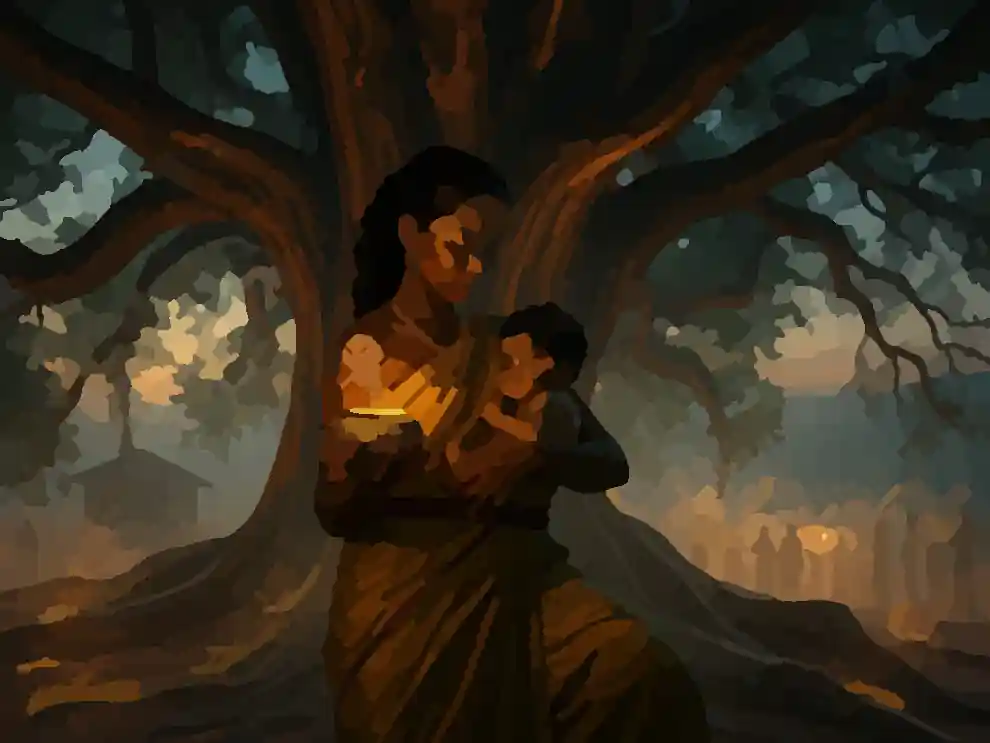
After the evening had long surrendered to stillness, a dark-skinned woman appeared beneath the ancient banyan tree, her young child sleeping gently across her lap. In her hand, she carried an earthen lamp, its trembling flame casting golden circles upon the ground. She placed it beside Anandakirtan and said softly, “Father, take this food. I have cooked for you.”
From the hush of his trance, where his mind wandered along the farthest shores of the universe, Anandakirtan murmured, “Blessed Krishna, may I call you so? This is the third time you have visited me. Today you bring light and nourishment—tending to me as though I were your own son.”
She smiled faintly and urged, “Father, take the food. The villagers are coming behind me; they wish to hear you speak.”
“Let them come,” Anandakirtan replied, his voice floating through the fog like the hum of an unseen bell. “I shall share this food with them.” His words rippled outward, merging with the mist that veiled the horizon.
Soon, the multitude arrived, carrying burning torches that painted wavering shadows upon the banyan roots. They offered fruits at Anandakirtan’s feet and settled around him, wrapped in reverent silence. An old man, his hands joined in prayer, spoke with a trembling tone: “Sir, tell us about silence. The whole day we have worked in the stone-crushing factory; our heads still echo with its noise.”
Anandakirtan urged for the fruits to be gathered together. “Keep them all in one place,” he said gently, “and share among yourselves.”
They obeyed, and as they did, they saw how his eyes gleamed like constellations scattered upon a moonless sky. Then spoke Anandakirtan, his words flowing with the rhythm of wind upon still water:
“Today, you came with light and food; you have dispelled the darkness of Amavashya. You are the children of nature’s boundless grace, the true fruit of creation, apostles of light and goodwill. Look up—see how the stars watch you in their infinite quiet. Observe the trees; their silence roars louder than thunder. Touch the earth beneath you, and feel how it hums with tranquil life.
“It is from silence and blissful darkness that all things arise. Every color, every sound, every movement is born of that womb. Silence is the mother of music; darkness is the cradle of light. The Rishis sought this silence, the countless Buddhas meditated upon it, and the Tirthankars found their liberation within it.
“Buddhas after Buddhas have spoken of darkness as the ultimate serenity. Look at these lamps—they sway like serpents with a thousand whispering tongues. Light itself has a sound, and sound bears within it a hidden light. This silence you ask about is not the absence of speech; it is the watching of words before they are born, the listening to the wind as it passes through the flute, playing its eternal game of hide and seek.
“When the Abadhuts reached the threshold of Nirvana, they entered the Great Silence. They washed their minds in the still waters of that silence and veiled their conscience with the blessed darkness, where all distinctions dissolve, and only being remains”.
“Krishna brought me food today, and I told her I would share it with you. Take a morsel from this plate. It is not the measure that satisfies hunger, but the peace that fills the soul. When you share your food, you share your silence. Only silence is whole; only silence interprets the darkness.
“Do not fear them—silence and darkness. They seem frightening when one lives isolated, but when you share your excess through compassion, they become the song of peace.
The mind, born of light, moves restlessly—it flickers, it sounds, it never settles. Some try to silence it by force; others drown it in intoxication. But you, the humble people of this village, need not struggle so. Share what you have in excess. Smile upon one another. Offer kindness instead of words. This alone will calm your mind, and in that calm, the blissful darkness will bloom within you”.
“The Buddhas cherished this darkness so deeply that they named it Nirvana itself.”
He then looked at the old man with serene compassion, his eyes a quiet blessing, and slowly drew in a deep breath. His final gesture—simple, reassuring—seemed to dissolve the weariness that hung over the gathering.
By now, the torches had burned themselves into silence. Only the small earthen lamp remained, casting a dim yet steadfast glow. Anandakirtan gazed upon it, as though seeing within its fragile light the reflection of his own inner flame. The pale shimmer quivered once, twice—and then he fell into wordless contemplation.
The night deepened, and the silence that followed was not emptiness, but presence—the living breath of the universe itself.
Sarvarthapedia Conceptual Network: Upanishad Of Anandakirtan
Systemic and Systematic Cross-Referencing Framework
Core Narrative Node
The Saga of Silence and Darkness
This narrative functions as a primary experiential node, from which multiple conceptual strands emerge. It is not merely a story, but a living model of metaphysical, ethical, and phenomenological principles.
Cluster I: Foundational Ontology
Silence (Primary Substrate)
- Defined as pre-manifest awareness
- Not absence, but potentiality before expression
- Cross-links:
- Blissful Darkness
- Nirvana
- Consciousness
- Compassion (as silent expression)
Blissful Darkness (Generative Void)
- The womb of creation
- Source of light, sound, and differentiation
- Cross-links:
- Silence
- Creation
- Non-duality
- Liberation
Being (Pure Existence)
- State where distinctions dissolve
- Experienced in deep silence
- Cross-links:
- Nirvana
- Abadhut State
- Inner Stillness
Cluster II: Cosmogenesis and Emergence
Light (Manifest Expression)
- Emerges from darkness
- Represents activity, mind, perception
- Cross-links:
- Sound
- Mind
- Restlessness
Sound (Vibrational Reality)
- Born from silence
- Carries hidden light
- Cross-links:
- Language
- Thought
- Creation
Creation (Dynamic Emergence)
- Interplay of silence and expression
- Cross-links:
- Nature
- Human Life
- Sharing
Cluster III: Human Consciousness and Mind
Mind (Restless Construct)
- Born of light and movement
- Characterized by fluctuation
- Cross-links:
- Noise
- Desire
- Suffering
Inner Observation (Witnessing)
- Watching thoughts before birth
- Entry point into silence
- Cross-links:
- Meditation
- Awareness
- Liberation
Tranquility (Stabilized Mind)
- Emerges through non-forceful means
- Cross-links:
- Sharing
- Compassion
- Silence
Cluster IV: Ethical-Relational Field
Sharing (Transformative Action)
- Converts excess into harmony
- A practical path to silence
- Cross-links:
- Compassion
- Community
- Inner Peace
Compassion (Silent Communication)
- Expression beyond words
- Bridges individuals into unity
- Cross-links:
- Sharing
- Non-duality
- Social Harmony
Community (Collective Consciousness)
- Collective participation in silence
- Cross-links:
- Ritual
- Listening
- Unity
Cluster V: Spiritual Traditions and Archetypes
Rishis (Seekers of Silence)
- Pursued primordial stillness
- Cross-links:
- Meditation
- Knowledge
- Cosmic Awareness
Buddhas (Realizers of Darkness)
- Identified darkness as Nirvana
- Cross-links:
- Liberation
- Emptiness
- Enlightenment
Tirthankars (Liberated Beings)
- Achieved freedom through inner stillness
- Cross-links:
- Detachment
- Silence
- Self-realization
Abadhuts (Transcendent Ascetics)
- Entered Great Silence beyond identity
- Cross-links:
- Non-duality
- Nirvana
- Dissolution of Ego
Cluster VI: Symbolic Elements in Narrative
Earthen Lamp (Localized Consciousness)
- Fragile yet persistent awareness
- Cross-links:
- Inner Flame
- Light within Darkness
- Individual Soul
Banyan Tree (Cosmic Shelter)
- Symbol of continuity and rootedness
- Cross-links:
- Nature
- Wisdom
- Timelessness
Food (Shared Existence)
- Material becomes spiritual through sharing
- Cross-links:
- Compassion
- Community
- Balance
Night (Field of Realization)
- Enables perception of silence and depth
- Cross-links:
- Darkness
- Stillness
- Contemplation
Cluster VII: Experiential Pathways
Path of Non-Force
- Silence arises naturally, not through suppression
- Cross-links:
- Acceptance
- Observation
- Ease
Path of Simplicity
- Everyday acts (sharing, kindness) lead to transcendence
- Cross-links:
- Village Life
- Humility
- Harmony
Path of Dissolution
- Letting go of distinctions and identity
- Cross-links:
- Nirvana
- Darkness
- Being
Cluster VIII: Integrated Systemic Flow
From Darkness to Light
Blissful Darkness → Silence → Sound → Light → Mind → Restlessness
From Restlessness to Liberation
Restlessness → Sharing → Compassion → Tranquility → Silence → Nirvana
From Individual to Universal
Individual Awareness → Community Sharing → Collective Silence → Universal Being
Meta-Structure
Systemic Nature
- Each concept is interdependent, not isolated
- Circular causality: Silence creates expression, expression returns to silence
Systematic Nature
- Organized progression:
- Ontology → Cosmology → Psychology → Ethics → Spirituality → Practice
- Knowledge Graph
Central Integrative Insight
Silence and darkness are not endpoints but origins and destinations simultaneously.
All phenomena arise from them, and all resolution returns to them.
The narrative demonstrates that the highest metaphysical truths are accessible through the simplest human acts.
Note: In a tranquil evening, a dark-skinned woman offers food to Anandakirtan, a revered figure entranced in meditation. As villagers gather, he emphasizes the importance of silence and darkness, likening them to the womb of creation. He elaborates on how true serenity arises from shared experiences and compassion, suggesting that silence is not merely the absence of words but a profound understanding that fosters connection and peace. As he speaks of the wisdom of the Buddhas and the essence of Nirvana, the gathering is enveloped in a deep, contemplative silence, affirming the significance of shared kindness and the inner light that each person carries within.


