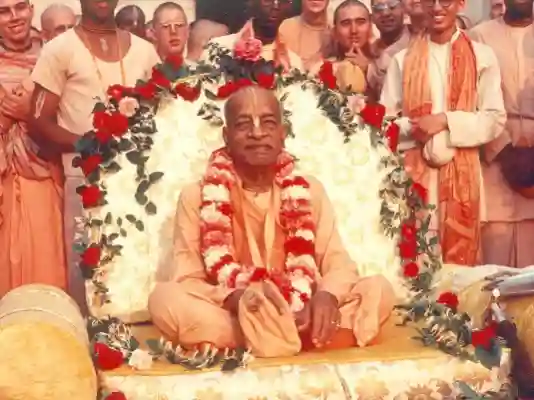
Sanatan Dharma vs Krishna Consciousness of Abhay Charan Bhaktivedanta
The origin and antiquity of the Vedic civilisation remain shrouded in mystery; it may be five thousand or even ten thousand years old—there is no definite way to measure it. With the departure of Lord Krishna from the mortal world, the Kali Yuga calendar began, marking a new epoch in human consciousness. The discovery of the Sindhu–Saraswati civilisation does not shorten the life span of the Vedic civilisation, nor does it contradict its antiquity. Similarly, the cave paintings of Bhimbetka in Madhya Pradesh, dated to around 10,000 BCE, do not preclude the possible existence of a higher civilisation, such as the Vedic one in ancient Bharatvarsha. Our modern debates in classrooms or colleges cannot claim to represent the truth of such an immense and complex civilisation.
At its core, the Vedic civilisation was sustained by Sanatan Dharma, a socio-legal and spiritual framework that defined an orderly society. Whether or not this order was perfect is beyond the present discussion; what matters is that the Vedic people were fully aware of their social, linguistic, and literary evolution. Their consciousness had crystallised into linguistic potency of the highest order—so refined that they called their language Brahma, identifying it with divine creative power. Those who absorbed and mastered this sacred language, or Bhasha, were known as Brahmanas, the custodians of sacred knowledge. The idea of the Vedic civilisation was vast—it encompassed all aspects of life: civil and military affairs, agriculture, rural and urban life, the sky, the earth, the waters, fire, and the divine realm. Nothing escaped their perception or intellectual reach. The Vedic people were deeply self-aware—of their past, their limitations, their moral and spiritual responsibilities, and their destiny toward restoration and balance.
Their extensive literature—the Samhitas, Brahmanas, and Aranyakas—served as both spiritual and cultural compasses. The Vedangas functioned as interpretative tools to understand these sacred texts, forming the foundation for law, ethics, and governance. The Vedic concept of Dharma was consciously defined and applied in administration and jurisprudence. Judges and lawmakers understood human frailty and recognised the need for education and training to overcome it. Their judicial philosophy aimed not at retribution but at harmonisation—seeking to align human conduct with the eternal cosmic order (Rita). Vedic legislation was not arbitrary or circumstantial; each law was required to conform to Dharma and to be consistent with the moral and behavioural standards inherited from antiquity. Kings and administrators acknowledged the universality of Dharma, knowing that all beings—humans, animals, and vegetation—formed part of one manifestation of creation. Any act of injustice or Adharma was believed to disturb the balance of the world. This awareness defined the essence of Vedic consciousness.
The Vedic people did not seek a personal God in the Abrahamic sense, for such a concept was foreign to them. The Isa or Ishwara of the Yajur Veda (40th Chapter) cannot be interpreted in monotheistic terms. Rather, they perceived Dvaivattam—divinity present in all existence—and strove consciously to become divine themselves. The Savitri hymn of the Vedas stands as evidence of this disciplined spiritual pursuit. They did not isolate one idea from another, nor did they engage in comparison or competition; instead, they sought Bhuma, the totality of all existence, where nothing was left out.
In contrast, the movement known as Krishna Consciousness arose in the 1960s through Abhay Charan Bhaktivedanta, a disciple of Vimala Charan Siddhanti Saraswati, a respected Tridandi Swami of the Gaudiya Sampradaya. Drawing inspiration from Swami Krishna Chaitanya of Bengal, Bhaktivedanta established the International Society for Krishna Consciousness (ISKCON) as a non-profit organisation in San Francisco, USA. He coined the term “Krishna Consciousness” to represent the devotional movement rooted in Chaitanya Charitamrita, which served as its guiding manual. The movement centred on joyous Kirtan, congregational singing, and the global establishment of Radha-Krishna temples. Devotees venerate Swami Krishna Chaitanya (Gouranga Mahaprabhu) as the combined incarnation of Lord Krishna and the Hladini Shakti—the personified energy of Lord Krishna. Through his English commentaries on the Bhagavad Gita and the Bhagavata Purana, Abhay Charan introduced Krishna’s teachings and pastimes to a worldwide audience, often emphasising Krishna’s supremacy and viewing all other Vedic deities as manifestations or aspects of Krishna himself.
The Krishna Consciousness movement, however, represents a Neo-Hindu devotional revival rather than a continuation of the Vedic worldview. Its essence lies in faith, emotion, and communal worship rather than the philosophical and universal depth of Sanatan Dharma. Some of its members have even attempted to disassociate the movement from Hinduism to appeal to a global audience. Yet, its scriptural and cultural roots are undeniably Hindu and derive from the same Vedic tradition.
By contrast, Sanatan Dharma transcends all individuals, sects, and regions. It is not dependent on any single person, prophet, or place. Lord Rama, Lord Krishna, and countless other divine beings and heroes emerged in different ages to interpret, defend, and uphold Sanatan Dharma in their unique ways. Yet, even they were subject to it, for Sanatan Dharma is eternal, sovereign, and self-existent. Those who follow it recognise themselves as the sons and daughters of the immortal, united in consciousness with the totality of being. For them, consciousness is not the cause of liberation; rather, liberation is the natural harmony of one’s individual existence with the whole of creation—a timeless symphony of spirit and order that endures beyond the ages.
Tanmoy Bhattacharyya
13th October 2025
Read More
- Last Will of A.C. Bhaktivedanta Swami Prabhupada, founder-acharya of ISKCON (04/06/1977)
- A.C. Bhaktivedanta’s Direction for ISKCON Management (Property, Society and Bhakti-28/07/1970)
- ISKCON Mayapur- Vrindaban Trust Fund Agreement by AC Bhaktivedanta (1971)
- Bhaktivedanta Book Trust Agreement (ISKCON-29/05/1972)
- Kirtan Standards Paper, Kirtan Standards Committee by ISKCON GBC (The Church of Krishna Chaitanya)