

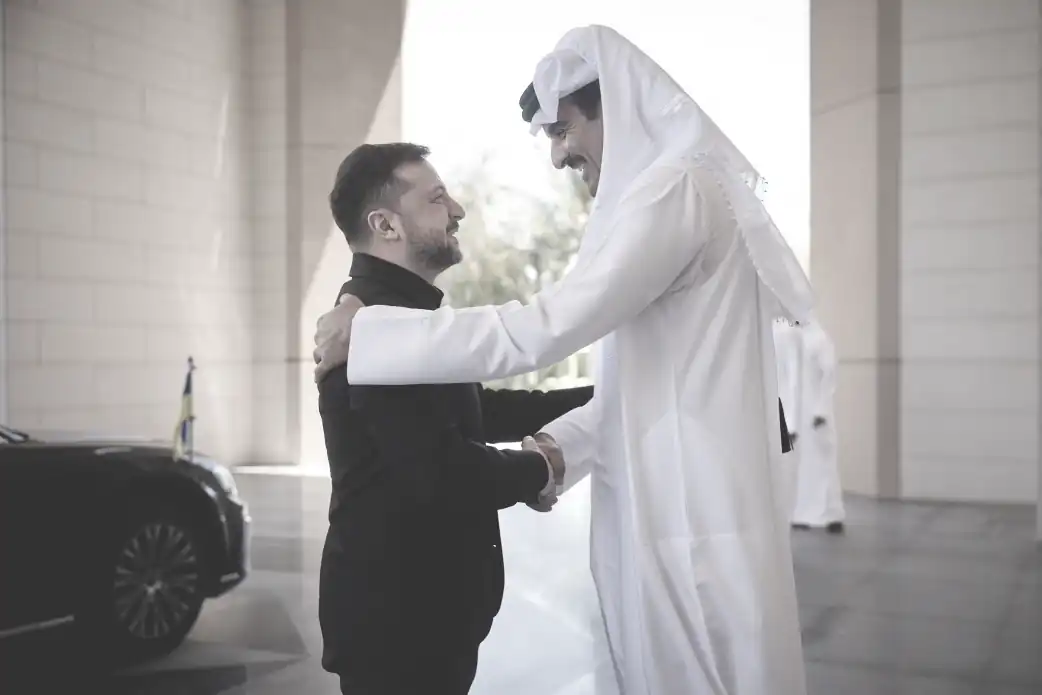
Volodymyr Zelenskyy and Sheikh Tamim bin Hamad Al Thani Agree on 10-Year Defense Partnership
On 28 March 2026 in Doha, Volodymyr Zelenskyy held talks with Sheikh Tamim bin Hamad Al Thani, in the presence of Sheikh Mohammed bin Abdulrahman Al Thani, focusing on expanding bilateral engagement with a strong emphasis on long-term defense cooperation.
The meeting included a review of the Ukrainian team’s activities in Qatar and the initial outcomes of its work. The Amir conveyed appreciation for Ukraine’s support and underscored the high caliber of Ukrainian expertise. Both leaders examined avenues to enhance life protection measures in their countries and reached an understanding to establish a mutually advantageous defense partnership set to span at least a decade.
Significant attention was devoted to the evolving security dynamics across the Middle East and the Gulf region. The discussions addressed the creation of an integrated framework capable of safeguarding civilian lives and mitigating the risk of further escalation of ongoing conflicts.
President Zelenskyy briefed the Qatari leadership on the current situation in Ukraine, outlining how the population continues to endure amid sustained Russian assaults. He highlighted the critical importance of strengthening Ukraine’s air defense systems and reiterated the country’s reliance on continued assistance from international partners.
For his part, the Amir expressed hope that global circumstances would improve by the time of their next meeting, emphasizing a shared aspiration for the swift conclusion of both Russia’s war against Ukraine and conflicts affecting the Middle East and Gulf region.
At the conclusion of the visit, the Chiefs of the General Staff of Ukraine and Qatar formalized a 10-year intergovernmental agreement on defense collaboration. The accord encompasses key domains such as defense industry advancement, technological innovation, air defense, counter-drone operations, military education and training, exchange of expertise, cybersecurity, artificial intelligence, and command-and-control systems.
The agreement further provides for joint defense manufacturing initiatives, the development of co-production facilities, and deeper technological cooperation between companies. It is expected to reinforce Ukraine’s strategic footprint in the Middle East, significantly broaden bilateral ties, and create a platform for substantial investment flows and enduring contractual partnerships.
Core Node: Ukraine–Qatar 10-Year Defense Partnership (2026)
Linked Concept: Bilateral Defense Agreements
This concept refers to formalized long-term military cooperation between two sovereign states. The Ukraine–Qatar agreement exemplifies a modern bilateral defense pact that extends beyond traditional arms deals into joint production, training, and technological collaboration.
See also: Strategic Alliances, Military Diplomacy, Security Cooperation Frameworks
Linked Concept: Military Diplomacy
Military diplomacy involves the use of defense-related cooperation to build trust, influence, and strategic partnerships. The Doha meeting highlights how defense agreements can serve as instruments of diplomatic engagement between Europe and the Gulf.
See also: Soft Power, Defense Attachés, International Security Dialogues
Linked Concept: Defense Industry Collaboration
A core pillar of the agreement is joint development in defense manufacturing, including co-production facilities and technological partnerships. This reflects a shift toward shared industrial ecosystems rather than unilateral procurement.
See also: Military-Industrial Complex, Technology Transfer, Co-Production Models
Linked Concept: Air Defense Systems
The emphasis on strengthening Ukraine’s air defense reflects ongoing security pressures. Air defense is a critical component of modern warfare, involving missile interception, radar systems, and integrated command structures.
See also: Missile Defense, Integrated Defense Systems, Aerial Warfare
Linked Concept: Counter-Drone Capabilities
The agreement prioritizes counter-drone technologies, addressing the increasing use of unmanned aerial systems in contemporary conflicts. This includes detection, interception, and electronic warfare measures.
See also: Drone Warfare, Electronic Countermeasures, Autonomous Weapons Systems
Linked Concept: Cybersecurity and Artificial Intelligence in Defense
Cybersecurity and AI integration represent advanced domains of cooperation. These technologies enhance intelligence analysis, threat detection, and command efficiency in modern military operations.
See also: Cyber Warfare, AI in Military Strategy, Digital Defense Infrastructure
Linked Concept: Command and Control Systems
Command and control systems enable coordinated military operations through communication networks and decision-making frameworks. Their inclusion signals a focus on operational interoperability.
See also: Network-Centric Warfare, Military Communications, Operational Strategy
Linked Concept: Middle East and Gulf Security Dynamics
The discussions addressed broader regional instability, situating the agreement within the security architecture of the Gulf and Middle East. Qatar’s role as a regional actor intersects with Ukraine’s strategic outreach.
See also: Gulf Cooperation Council, Regional Conflicts, Energy Security Geopolitics
Linked Concept: Russia–Ukraine War Context
The partnership is shaped by the ongoing war involving Ukraine and Russia. Volodymyr Zelenskyy emphasized resilience and the need for sustained international support.
See also: European Security Crisis, NATO Relations, Military Aid Networks
Linked Concept: Strategic Presence in the Middle East
The agreement enhances Ukraine’s geopolitical footprint in the Middle East, marking a diversification of alliances beyond its traditional Western partners.
See also: Foreign Policy Expansion, Strategic Regions, Diplomatic Outreach
Investment and Long-Term Contracts
The framework includes provisions for large-scale investments and extended contractual cooperation, linking defense collaboration with economic engagement.
See also: Defense Economics, International Investment Agreements, Industrial Partnerships
Linked Concept: Integrated Security Systems
Both leaders discussed building systems capable of preventing conflict escalation and protecting civilian populations, reflecting a holistic approach to security.
See also: Human Security, Crisis Prevention Mechanisms, Multilateral Security Systems
Linked Concept: Leadership and High-Level Diplomacy
The presence of Sheikh Mohammed bin Abdulrahman Al Thani underscores the role of top-level political leadership in shaping defense and security policy.
See also: Executive Diplomacy, State Visits, International Negotiations
More Stories
Professional Indemnity Insurance UK: Legal Requirements, Costs and Cover
Encyclopedia of Constitution and Constitutional Law of the United Kingdom (10-Volume): History and Development
UK Biobank Data: From 2003 Foundation to Modern Data Infrastructure