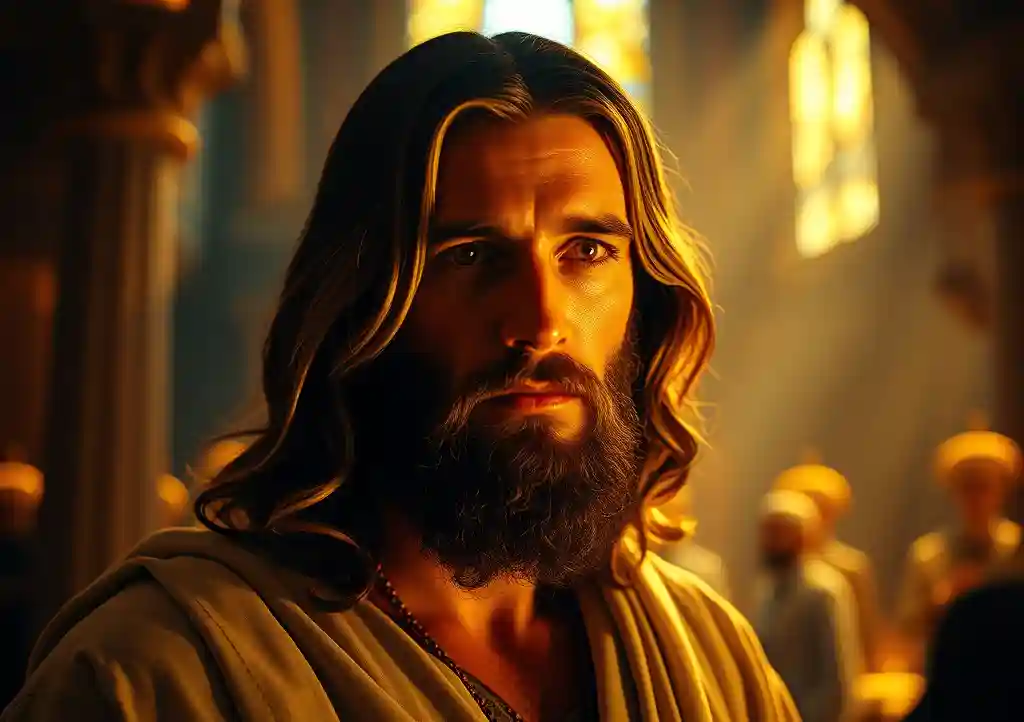
Paul had no knowledge of the Sermon on the Mount
The assertion that Paul lacked knowledge of the Sermon on the Mount remains a persistent fault line in New Testament studies. The Sermon, preserved in Matthew 5–7 and commonly dated to Jesus’ Galilean ministry around 28–30 CE, represents the most sustained ethical discourse attributed to Jesus. It demands inward righteousness, enemy-love, nonretaliation, mercy, humility, and fidelity to the law fulfilled rather than revoked (Matt 5:17–48). Paul’s letters, by contrast—generally dated between c. 50 and 60 CE—display little interest in Jesus’ remembered words or settings. His theology is centered not on Jesus the Palestinian teacher but on Christ as a divine–cosmic agent revealed through death and resurrection.
Paul never quotes the Sermon on the Mount. There is no reference to the Beatitudes (Matt 5:3–12), the Lord’s Prayer (Matt 6:9–13), or injunctions such as turning the other cheek or loving enemies as formulated by Jesus. This silence is notable because Paul’s epistles predate the written Gospels and constitute the earliest Christian texts we possess. When Paul addresses ethics, he does so without grounding his exhortations in Jesus’ sayings. Moral life flows instead from faith (Rom 3:28), grace (Rom 5:1–2), and the indwelling Spirit (Gal 5:16–25).
The divergence becomes sharper in Paul’s treatment of the law. Jesus, in the Sermon, intensifies Torah by relocating it within intention and desire, insisting that righteousness must exceed that of the scribes and Pharisees (Matt 5:20). Paul repeatedly frames the Mosaic law as something from which believers are liberated (Gal 3:23–25; Rom 7:4–6). While Jesus speaks of fulfillment, Paul emphasizes supersession. This contrast has led many scholars to question whether Paul knew Jesus’ teaching on the law or whether he reinterpreted it through a radically different theological lens.
Paul’s own account of authority reinforces the impression of independence. He insists that his gospel was received “through a revelation of Jesus Christ” and “not from any human source” (Gal 1:11–12). His proclamation is explicitly reduced to “Christ crucified” (1 Cor 2:2) and summarized as Christ’s death, burial, and resurrection “according to the Scriptures” (1 Cor 15:3–4). Jesus’ parables, miracles, ethical discourses, and geographical movements are absent. The historical ministry yields to the kerygma of the risen Lord.
Yet Paul is not entirely disconnected from Jesus’ ethical vision. Certain exhortations echo Jesus’ teaching without citation. “Bless those who persecute you” (Rom 12:14) recalls Matt 5:44. Paul’s claim that love fulfills the law (Rom 13:8–10) resonates with Jesus’ summary of the commandments. The fruit of the Spirit—love, joy, peace, patience, gentleness, self-control (Gal 5:22–23)—parallels virtues commended in the Beatitudes. These convergences suggest indirect familiarity, likely mediated through oral tradition circulating in early communities before the composition of the Gospels.
Paul’s limited engagement with Jesus’ earthly life extends beyond teaching to place and person. Neither his letters nor Acts record a visit to Galilee, the mount of the Sermon, the tomb, or even extended reflection on Jerusalem as sacred memory. Paul’s encounter with Jesus occurs years after the crucifixion—commonly dated to c. 33 CE—on the road to Damascus (Acts 9:1–9). His Christ is encountered in revelation, not in remembered geography.
This same logic explains Paul’s indifference to Mary. She is never named. Jesus’ birth is reduced to a formula: “born of a woman, born under the law” (Gal 4:4). Paul’s Christology is vertical rather than familial. Christ preexists “in the form of God” (Phil 2:6), empties himself (Phil 2:7), obeys unto death on a cross (Phil 2:8), is raised (1 Cor 15:4), exalted (Phil 2:9–11), enthroned at God’s right hand (Rom 8:34), and will return (1 Thess 1:10). Christ appears after the resurrection to Cephas, the Twelve, more than five hundred believers, James, all the apostles, and finally Paul himself—but never to his mother (1 Cor 15:5–8). The maternal relationship is theologically irrelevant because Paul proclaims Christ, not Jesus the son of Mary.
Paul’s focus is consistently cosmic and soteriological. Christ dies for sins (Rom 3:25), reconciles humanity to God (Rom 5:10), redeems from the curse of the law (Gal 3:13), inaugurates new creation (2 Cor 5:17), and will abolish death itself (1 Cor 15:26). Ethics emerge from participation in this Christ, not from imitation of Jesus’ remembered conduct. Hence Paul’s exhortation: “Be imitators of me, as I am of Christ” (1 Cor 11:1).
Whether this represents faithful development or theological displacement remains contested. If Paul’s letters truly belong to the 50s CE, then Christianity took decisive shape before the Gospels were written, privileging Christ over Jesus, revelation over memory, and grace over the Sermon’s moral rigor. If, hypothetically, the Pauline corpus were dated centuries later, the coherence would be easier to explain—but such dating creates more problems than it solves. What is certain is that early Christian thought emerged from unresolved tension: between Jesus the teacher of the Sermon on the Mount and Christ the crucified and risen Lord. Paul stands firmly on the latter side, and his silence continues to provoke doubt about not only what he knew, but which Jesus ultimately prevailed.
It is difficult to decide whether Jesus or Paul is the decisive figure, because through Paul’s thirteen letters we do not truly know Jesus—or even Christ—unless we first accept Paul himself. Paul encounters Christ only five to seven years after the crucifixion, yet he shows no sustained interest in the concrete questions that would normally follow: why Christ died, how he died, who was responsible, and where the more than five hundred witnesses supposedly were (1 Cor 15:5–8). Those witnesses are listed, but none speaks, none teaches, and none leaves an independent theological trace. Knowledge of Christ, in practice, passes exclusively through Paul.
Paul consistently asserts the superiority of his gospel, insisting that it came by direct revelation from Christ-God and not from human tradition (Gal 1:11–12). This claim places Paul in a role structurally similar to Muhammad’s in Islam. Just as Allah is inaccessible without Muhammad, Christ is inaccessible without Paul. No figure named in 1 Corinthians 15—Cephas, the Twelve, James, or the five hundred—functions as a theological authority comparable to Paul. The church that emerges is therefore not the church of Peter or James, but the church of Paul, just as the umma is the community formed around Muhammad. In this sense, Muhammad may be seen as a reader of Paul who grasped Paul’s logic more consistently than later Christians.
This leads to a deeper question: is Jesus primary, or is Christ primary? Reading Paul alone, logic suggests that Christ comes first and Jesus follows. Christ preexists in divine form (Phil 2:6), empties himself, and only then appears in human likeness (Phil 2:7). Jesus of Nazareth (A Palestinian Jew) is a secondary manifestation of a prior, cosmic Christ. This may explain why the earliest community called itself “Christian,” a Greek term with no Aramaic equivalent. The name does not arise from Jesus’ teaching in Galilee but from belief in Christ as a divine figure interpreted through Hellenistic categories.
Only later, as belief in Christ spread and humanity was said to emerge “in Christ,” did attention turn toward Mary as Mother, and centuries later the community attempted to fix dates for Jesus’ birth—first January 6, then December 25. These developments suggest a gradual historical anchoring of a figure who, in Paul’s letters, remains largely unmoored from biography. Paul preached Christ; later generations increasingly supplied Jesus.
One could frame it this way: the persecuted tent-maker Paul, who was described as an agent of repression, undergoes a psychological and theological rupture that he later narrates as revelation. In Damascus, Christ is not merely encountered but internalized—merged with Paul’s own consciousness, history, and bodily existence. What Paul calls death and resurrection becomes a bio-cosmic event enacted within himself, a collapse of self followed by reconstruction. The old Paul dies; a new Paul rises, now speaking as the bearer of Christ.
Read through this lens, the resurrection appearances listed in 1 Corinthians 15 culminate not accidentally but necessarily in Paul himself. Christ appears last “as to one untimely born” (1 Cor 15:8), yet this final appearance is decisive, because thereafter Christ speaks only through Paul. The witnesses named before him remain silent; Paul alone theologizes, commands, organizes, and defines belief. Christ appears to Paul, and Paul becomes the locus in which Christ dwells (“it is no longer I who live, but Christ who lives in me,” Gal 2:20). The line between revealer and revealed blurs.
Thus Christ is not simply worshipped by Paul; Christ is constituted in Paul. Paul venerates Christ, yet Christ’s voice, authority, and identity are inseparable from Paul’s own person. The resurrected Christ functions as Paul’s legitimating principle, while Paul functions as Christ’s sole interpreter.
Christ is not discovered by Paul but projected by him as the agent who will hand a renewed cosmos back to God for eternal sovereignty. The abolition of death, the defeat of decay, and the final reign of God are not achievable by the historical Jesus, nor even by Paul as a man, but only by a higher, transhuman power—a cosmic mutation shaped by Greek metaphysics and apocalyptic expectation. Christ, in Paul’s thought, is less a remembered person than an ontological force, the instrument through which history is transformed into eternity.
Paul thinks the present through the grammar of the future. He does not bring the future into the present, as Jesus does in the Sermon on the Mount, but projects the present forward into an imminent cosmic resolution. Resurrection, new creation, and the kingdom are anticipated realities, already real in faith but not yet visible in history. That is why Paul can speak of believers as already raised (Rom 6:4–5; Col 3:1) while death still reigns empirically. The logic is not ethical immediacy but eschatological certainty.
Within this framework, faith in Paul becomes more decisive than faith in Jesus. Jesus functions largely as a narrative gateway—a necessary but dispensable entry point—while Paul’s Christ carries the full theological weight of salvation. Jesus teaches, suffers, and dies; Christ redeems, transforms, and rules. The kingdom of God is not built by imitation of Jesus’ life but secured by participation in Christ’s death and resurrection as articulated by Paul. Thus Jesus becomes an addendum to a system whose true center is Pauline Christology.
This, then, is the core of the core of the gospel as Paul presents it: not the ethical program of Jesus, not the memory of Galilee, and not the immediacy of the Sermon on the Mount, but faith in a cosmic Christ who will abolish death, and return creation to God. The gospel is not about how to live now, but about what will finally be made absolute. In that sense, Christianity emerges not from Jesus’ proclamation of the kingdom, but from Paul’s projection of a future in which Christ alone makes God “all in all” (1 Cor 15:28).
Tanmoy Bhattacharyya
13/11/2024
Bibliography
Adeney, The Christian Conception of God, New York.
Baillie, Our Knowledge of God, New York, 1939.
Bartlett, The Triune God, New York, 1937.
Boettner, The Reformed Doctrine of Predestination, Grand Rapids, 1932.
Brightman, The Problem of God, New York, 1930.
Candlish, The Fatherhood of God, Edinburgh, 1866.
Clarke, The Christian Doctrine of God, New York, 1923.
Crawford, The Fatherhood of God. Edinburgh, 1866.
Farmer, Experience of God, New York, 1929.
Fleming, Evolution or Creation. London.
Harris, God the Creator and Lord of All, New York, 1896.
Heim, God Transcendent, New York, 1936.
Hendry, God the Creator, Nashville, 1938.
Kerr, A God-Centered Faith, New York, 1935.
Mathews, The Growth of the Idea of God, New York, 1931.
More, The Dogma of Evolution, Princeton, 1925.
Newton, My Idea of God (A Symposium), Boston, 1927.
Otto, The Idea of the Holy, London, 1928.
Pink, The Sovereignty of God, Swengel, Pa., 1918.
Pringl-Pattison, The Idea of God, London, 1917.
Rimmer, The Theory of Evolution and the Facts of Science, Grand Rapids, 1935.
Robinson, The God of the Liberal Christian, New York, 1926.
Shute, The Fatherhood of God, Cincinnati, 1904.
Snowden, The Personality of God, New York, 1920; id., The Discovery of God, New York, 1932.
Steenstra, The Being of God as Unity and Trinity, New York, 1891.
Thomas, The Biblical Idea of God, New York, 1924.
Thomson, W. R., The Christian Idea of God, London.
Youtz, The Enlarging Conception of God, New York. 1924.
Read more
- Consciousness under general anesthesia: Lecture by Tanmoy Bhattacharyya
- Consciousness in near-death experiences: Tanmoy Bhattacharyya
- Tanmoy Bhattacharyya on Consciousness: Biology, Psychology & Philosophy
- Western Philosophy for Indian Students: Ten Lectures by Tanmoy Bhattacharyya