
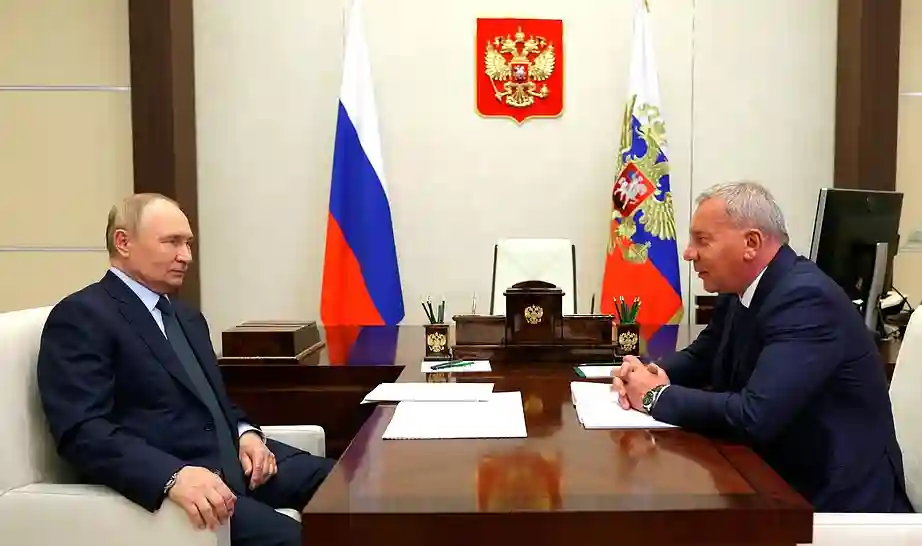
Meeting with Head of Roscosmos Yury Borisov
Vladimir Putin had a working meeting with the Director General of the Roscosmos State Corporation for Space Activities Yury Borisov.
November 15, 2024
President of Russia Vladimir Putin: Mr Borisov, we had a meeting in late 2023, followed by an instruction to draft a project for developing the space industry.
Head of Roscosmos Yury Borisov: In fact, I came here to report on this national project, its main goals, objectives, and the expected deliverables.
This is a major challenge for us. I think that the effort to carry out this national project will define the way Russia’s space industry develops in the near future, at least until 2030, and probably until 2036.
Today, the space industry plays a major role in both the global and national economies. It is instrumental in terms of defence capabilities and the development of all manufacturing sectors. The global space industry is growing much faster than global GDP, and investment has reached immense proportions. Regarding this momentum and our projections, let me tell you that by 2030, we expect the global satellite constellation to be in the range of 60,000 to 100,000 satellites of various types and designations.
Therefore, if I may, I would like to report to you about our plans, share the challenges we face, so that we can think of ways to overcome them.
Vladimir Putin: Ok.
Mr Borisov, you have visited Artek, haven’t you?
Yury Borisov: Yes, Mr President. I met with young people, and we had a very interesting conversation. I talked about the history of world cosmonautics and the role the Soviet Union and Russia played in it. Space has always held a special place in the hearts of all Russians. This is our national pride. This made my visit to Artek very interesting.
Roscosmos is Artek’s partner. We attach great importance to educating young people. This year, four hero-cosmonauts visited the camp and met with its students.
Overall, I was amazed by the scale of the upgrades and all the construction at this recreation centre. It is probably the world’s best institution of its kind. There are young people from 80 countries there, all bright-eyed – it is a pleasure just to look at them.
Artek’s centenary is around the corner. Overall, this was a great trip. The camp’s museum is so big, and very good too – with all these exhibits on Yury Gagarin. He visited Artek quite often. In fact, he travelled there seven times after his spaceflight. We have agreed that Roscosmos will help with new exhibits. I have already transferred Yury Gagarin’s personal file to the museum. We have declassified this document. This matters a great deal to the museum, since they treasure every artefact they have there.
Vladimir Putin: Excellent.
Note: The Federal Space Agency (Roscosmos) is an authorised federal executive body responsible for implementing government policy and legal regulation, providing government services and managing state property in the field of space exploration, international space cooperation and joint projects and programmes in space, space research, missile and space technology for military purposes, strategic missile systems, coordination of the maintenance, further development and use of the Global Navigation Satellite System (GLONASS) in the interests of civilian consumers, including commercial consumers, and international cooperation in this sphere, as well as the general coordination and management of the activities being carried out at the Baikonur space centre.
Read more:
- Putin met with PM Modi | Kazan BRICS Summit 2024
- BRICS security officials meet | Putin tagged Russia, India & China
- 120th anniversary of TASS | Address of Vladimir Putin
- Russia-Hungary Bilateral Cooperation: Press Statements by Putin-Orban
- Putin addressed the 27th Petersburg International Economic Forum
More Stories
Income Tax Bar Association Ahmedabad (Office-Bearers) 2026-27
DLSA Howrah Panel Advocate Enrollment 2026 (Group-B)
DLSA West Bengal Contact List – All 22 District Legal Services Authorities