Skip to content

ADVOCATETANMOY LAW LIBRARY

Research & Library Database

Primary Menu
  • News
  • Opinion
  • Countries198
    • National Constitutions: History, Purpose, and Key Aspects
  • Judgment
  • Book
  • Legal Brief
    • Legal Eagal
  • LearnToday
  • HLJ
    • Supreme Court Case Notes
    • Daily Digest
  • Sarvarthapedia
    • Sarvarthapedia (Core Areas)
    • Systemic-and-systematic
    • Volume One
09/04/2026
  • North America

National Security Memorandum on AI: Remarks by Lael Brainard

National Security Memorandum: On October 24, 2024, National Economic Advisor Lael Brainard announced the first National Security Memorandum (NSM) on Artificial Intelligence (AI), highlighting its crucial impact on national security. The NSM aims to strengthen the US’s leadership in advanced AI technologies, emphasizing the importance of domestic semiconductor production and infrastructure. It addresses the need for an innovative workforce, underlining both economic and environmental goals for sustainable AI datacenters powered by clean energy. The NSM is part of a broader strategy, including existing laws and initiatives, to enhance US competitiveness in AI while managing associated risks effectively.
advtanmoy 25/10/2024 4 minutes read

© Advocatetanmoy Law Library

  • Share on WhatsApp (Opens in new window) WhatsApp
  • Share on X (Opens in new window) X
  • Share on Facebook (Opens in new window) Facebook
  • Share on Telegram (Opens in new window) Telegram
USA, United States of America

Home » Law Library Updates » Sarvarthapedia » National » North America » National Security Memorandum on AI: Remarks by Lael Brainard

Statement from National Economic Advisor Lael Brainard on National Security Memorandum (NSM) on Artificial Intelligence (AI)

October 24, 2024

National Security Memorandum on Artificial Intelligence

National Security Memorandum: Today, the President is issuing the first-ever National Security Memorandum (NSM) on Artificial Intelligence (AI). The fundamental premise is that AI will have significant implications for national security. The AI NSM sets out goals to enable the US Government to harness cutting-edge AI technologies, and to advance international consensus and governance around AI.

In addition, there are implications for economic policy. The AI National Security Memorandum establishes that retaining US leadership in the most advanced AI models will be vital for our national security in coming years. The US lead today on the most advanced AI models reflects several important US economic strengths: our innovative private sector, the ability to develop and source world class talent, strengths in advanced semiconductor design, dynamic capital allocation, and abundant compute power.

Read Next

  • U.S. Under Secretary of War Meets Jaishankar and Misri, Deliverd Speech
  • Cybercrime, Fraud, and Predatory Schemes Against US Citizens (EO – 6 Mar 2026)
  • Trump’s 2026 Executive Order on Citizenship Verification and Federal Election Integrity

We should not take those strengths for granted in the future. Indeed, we are all familiar with past instances when we saw critical technologies and supply chains that were developed and commercialized here in the US migrate offshore for lack of critical public sector support. That is why we are laser-focused on maintaining the strongest AI ecosystem in the world here in the United States. The NSM directs the National Economic Council to coordinate an economic assessment of the relative competitive advantage of the US private sector AI ecosystem.

Sustaining US preeminence in frontier AI into the future will require strong domestic foundations in semiconductors, infrastructure, and clean energy—including the large datacenters that provide computing resources. The private sector is already making significant investments in AI innovation, and now we’re making sure the government is moving quickly on policy changes and the support necessary to enable rapid AI infrastructure growth over the next several years. The historic Biden-Harris investment laws will be critical enablers.

Developing AI systems will require a large volume of the most advanced semiconductors. The CHIPS and Science Act is enabling major investments here in the US for the fabrication of the leading-edge semiconductors that are critical to AI frontier models, in close proximity to world-class chips designers and downstream customers.

One of the most pressing needs is the rapid growth in computational power for the training and operation of frontier AI models. AI datacenters will need to run on clean energy and in order to meet their needs we will need to accelerate the deployment of transmission and clean energy projects. We will meet these needs while keeping residential electricity costs low and meeting our climate goals. Fortunately, the Bipartisan Infrastructure Law and the clean energy provisions of the Inflation Reduction Act have given us a good foundation to build on. We are committed to helping navigate permitting processes across the federal government, and working with states and localities. We took a step towards supporting these goals with the Task Force on AI Datacenter Infrastructure that we launched last month. And we have seen a number of recent announcements of companies investing in projects that will bring new clean energy online to power AI data centers.

Read Next

  • U.S. Under Secretary of War Meets Jaishankar and Misri, Deliverd Speech
  • Cybercrime, Fraud, and Predatory Schemes Against US Citizens (EO – 6 Mar 2026)
  • Trump’s 2026 Executive Order on Citizenship Verification and Federal Election Integrity

Having the right workforce and talent will also play a key role in developing large-scale AI datacenters. This will range from AI experts to pipefitters and electrical workers. We are taking action to ensure AI infrastructure creates good jobs, while investing in our workforce to enable American workers to drive innovation.

Of course, all of these efforts must be governed by the critical guardrails established last year by the Executive Order on Safe, Secure, and Trustworthy Artificial Intelligence and commitments we secured last year from leading AI companies to manage the risks posed by AI. Today’s NSM is just the latest step in a series of actions thanks to the leadership and diplomatic engagement of the President and Vice President, and there will be additional steps taken in the coming months to further support US leadership in AI.
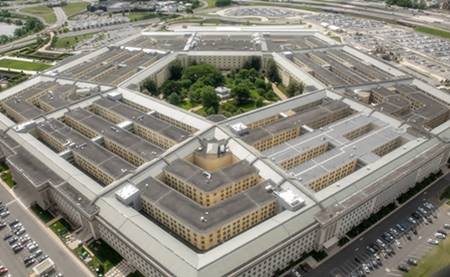
Pentagon
  • Promoting the Use of Trustworthy Artificial Intelligence in the Federal Government-US Executive Order-03/12/2020
  • Regulating Military Applications of Artificial Intelligence- Position paper of China (2021)
  • Remarks of President Putin in international conference on artificial intelligence and data analysis, Moscow-2021
  • China`s Stand on Ethical Governance of Artificial Intelligence (2022)
  • Artificial Intelligence and Human Dignity: Pope Francis Speech at G7 Summit
  • Artificial Intelligence: Biden’s Executive Order (30/10/2023)
  • Rick Brigs NASA Ames Research Center: Knowledge Representation in Sanskrit and Artificial Intelligence

Read Next

  • U.S. Under Secretary of War Meets Jaishankar and Misri, Deliverd Speech
  • Cybercrime, Fraud, and Predatory Schemes Against US Citizens (EO – 6 Mar 2026)
  • Trump’s 2026 Executive Order on Citizenship Verification and Federal Election Integrity
Tags: 2024 CE 24th October AI Ecosystem AI infrastructure Artificial intelligence USA

Post navigation

Previous: Ukraine & Middle East War | Macron, Scholz, Starmer & Biden Meeting
Next: High-value Asset | A Police officer needs permission before buying
Communism
Sarvarthapedia

Manifesto of the Communist Party 1848: History, Context, and Core Concepts

Arrest
Sarvarthapedia

Latin Maxims in Criminal Law: Meaning, Usage, and Courtroom Application

Abolition of Slave Trade Act 1807: Facts, Enforcement, and Historical Context

British Slavery and the Church of England: History, Theology, and the Codrington Estates

United States of America: History, Government, Economy, and Global Power

Biblical Basis for Slavery: Old and New Testament Laws, Narratives, and Interpretations

Rule of Law vs Rule by Law and Rule for Law: History, Meaning, and Global Evolution

IPS Cadre Strength 2025: State-wise Authorised Strength

Uric Acid: From 18th Century Discovery to Modern Medical Science

Christian Approaches to Interfaith Dialogue: Orthodox, Catholic, Protestant, and Pentecostal Views

Origin of Central Banking in India: From Hastings to RBI and the History of Preparatory Years (1773–1934)

Howrah District Environment Plan: Waste Management, Water Quality & Wetland Conservation

Bharatiya Nyaya Sanhita 2023: Sections (1-358), Punishments, and Legal Framework

Bengali Food Culture: History, Traditions, and Class Influences

  • Sarvarthapedia

  • Delhi Law Digest

  • Howrah Law Journal

  • Amit Arya vs Kamlesh Kumari: Doctrine of merger
  • David Vs. Kuruppampady: SLP against rejecting review by HC (2020)
  • Nazim & Ors. v. State of Uttarakhand (2025 INSC 1184)
  • Geeta v. Ajay: Expense for daughter`s marriage allowed in favour of the wife
  • Ram v. Sukhram: Tribal women’s right in ancestral property [2025] 8 SCR 272
  • Naresh vs Aarti: Cheque Bouncing Complaint Filed by POA (02/01/2025)
  • Bharatiya Nagarik Suraksha Sanhita 2023 (BNSS)
  • Bharatiya Sakshya Adhiniyam 2023 (BSA): Indian Rules for Evidence
  • Bharatiya Nyaya Sanhita (BNS) 2023
  • The Code of Civil Procedure (CPC)
  • Supreme Court Daily Digest
  • U.S. Supreme Court Orders
  • U.k. Supreme Court Orders
United Kingdom, UK

Abolition of Slave Trade Act 1807: Facts, Enforcement, and Historical Context

British Slavery and the Church of England: History, Theology, and the Codrington Estates

British Slavery and the Church of England: History, Theology, and the Codrington Estates

USA, America

United States of America: History, Government, Economy, and Global Power

Biblical Basis for Slavery, english slave trade

Biblical Basis for Slavery: Old and New Testament Laws, Narratives, and Interpretations

2026 © Advocatetanmoy Law Library

  • About
  • Global Index
  • Judicial Examinations
  • Indian Statutes
  • Glossary
  • Legal Eagle
  • Subject Guide
  • Journal
  • SCCN
  • Constitutions
  • Legal Brief (SC)
  • MCQs (Indian Laws)
  • Sarvarthapedia (Articles)
  • Contact Us
  • Privacy Policy
  • FAQs
  • Library Updates