
The 2050 Epistemic Collapse Hypothesis posits that humanity may face an intellectual stagnation due to reliance on...
Artificial intelligence
Artificial intelligence’s quest began in the 1950s, with Alan Turing’s pioneering work and John McCarthy (America) coining the term in 1956 . Early decades saw the creation of logic programs and expert systems, followed by an “AI winter” of reduced funding in the mid-1970s and again in the late 1980s after an initial boom . A resurgence came with statistical methods like Support Vector Machines in the 1990s. This era also saw IBM’s Deep Blue defeating a chess champion in 1997. The modern deep learning revolution began in the 2010s, fueled by big data and powerful GPUs. Key milestones include the 2016 victory of Google DeepMind’s AlphaGo, which mastered the complex game of Go . The current trend is dominated by generative AI, sparked by the 2017 transformer architecture. OpenAI’s release of GPT-3 in 2020 and ChatGPT in 2022 brought large language models to the public, demonstrating unprecedented text generation . Contemporary trends for 2025 focus on several frontiers. Multimodal AI integrates text, image, and video seamlessly, as seen in models like GPT-4o . Agentic AI refers to systems that can autonomously plan and execute complex tasks . AI is also moving into the physical world through embodied intelligence in advanced robots, while Edge AI runs models locally on devices for privacy and speed . Finally, Explainable AI (XAI) is critical for ensuring trust and safety as these systems become more powerful.

Become AI expert without a degree ! This guide outlines how to become an AI expert without...

The theology of the Roman Catholic Church emphasizes the importance of faith as a response to God's...

National Security Memorandum: On October 24, 2024, National Economic Advisor Lael Brainard announced the first National Security...

Italy,14 June 2024: Pope Francis emphasized the importance of human control over AI decisions, the need for...
Artificial Intelligence: a machine-based system that can, for a given set of human-defined objectives, make predictions, recommendations,...

Artificial Intelligence Regulation: Jerusalem 17th December 2023 – Israel has unveiled its first-ever comprehensive policy on Artificial...

Building upon this backgrounds and the outcomes of past G7 Digital and Tech Ministers' meetings, we discussed...

The Hiroshima AI Process, including the G7 Digital & Tech Ministers’ Statement issued on September 7, 2023,...

The Israeli military employs 'The Gospel AI System' to select terror targets in Gaza, which speeds up...

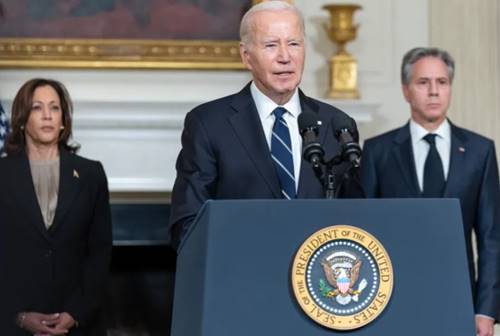
Vice President Harris and senior Administration officials will meet today with CEOs of four American companies at...

AI-related security governance is a common challenge for mankind. With wide applications of AI in various fields,...

We are launching advanced technology academic programmes in our universities and creating artificial intelligence competence centres at...

Software-based artificial neural networks (ANN) can be seen defeating humans in games (AlphaGo and AlphaZero) or helping...