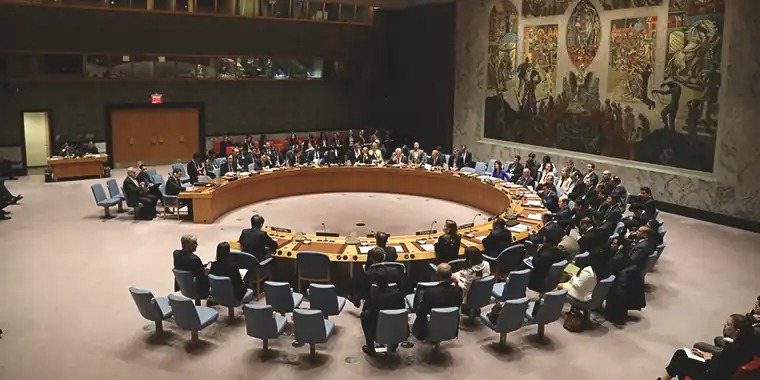
United Nations Security Council
Security Council Condemns Iran’s Regional Attacks as Middle East Violence Intensifies
Security Council Approves Resolution 2817 as War Between Iran, Israel and US Escalates
The United Nations Security Council convened for its 10,119th meeting on the evening of 11 March 2026 and adopted a new resolution addressing the rapidly intensifying violence across the Middle East. During the session, the Council approved Resolution 2817 (2026), which strongly condemns Iran for what members described as severe and unacceptable attacks against several neighboring states. At the same meeting, however, a separate draft resolution introduced by the Russian Federation was rejected after failing to secure sufficient support among Council members.
The fifteen-member Council adopted Resolution 2817 with thirteen votes in favor, none against, and two abstentions cast by China and the Russian Federation. The decision came amid a regional crisis that has escalated dramatically since 28 February, when Israel and the United States launched airstrikes against Iran. Nearly two weeks after those initial attacks, the conflict has spread beyond the original battleground and now affects close to a dozen countries across an already fragile Middle Eastern landscape.
Through the adopted text, the Security Council expressed its condemnation in the strongest possible terms regarding Iran’s military actions against several Gulf and regional states. The resolution specifically denounces attacks targeting Bahrain, Kuwait, Oman, Qatar, Saudi Arabia, the United Arab Emirates, and Jordan. Council members reaffirmed their unwavering support for the sovereignty, territorial integrity, and political independence of those nations.
Particular concern was raised over strikes directed at residential zones and civilian infrastructure. The resolution condemns such actions and demands that Iran immediately halt attacks on non-military targets. It further calls on Tehran to stop issuing threats and provocations in the region and to refrain from activities that disrupt maritime trade routes. Additionally, the Council urged Iran to cease providing assistance to proxy armed groups operating throughout the Middle East.
The representative of Bahrain welcomed the Council’s decision and highlighted the extensive global backing for the measure. According to him, the outcome sends a powerful message demonstrating that the international community firmly rejects hostile actions directed at sovereign states. He emphasized that these attacks not only threaten individual countries but also undermine regional stability and the well-being of millions of people. He also pointed out that nearly 140 United Nations Member States co-sponsored the resolution, describing that level of support as a reflection of the international community’s collective moral stance. The Gulf region, he added, represents a vital hub for global trade, security, and economic stability, meaning that safeguarding it serves the interests of the entire world.
Denmark’s delegate likewise stressed the importance of listening to regional voices during such a critical moment. She condemned Iran’s attacks and urged their immediate cessation. Highlighting the large number of Council members and broader UN delegations that supported the text, she warned that each passing day brings further instability to a region already marked by tension and volatility. She called for maximum restraint from all parties involved and insisted that the protection of civilians and strict adherence to international law must remain central priorities.
France’s representative emphasized that the conflict poses serious risks to regional security and insisted that the fighting must end without delay. He argued that sustainable peace and stability can only be achieved through diplomacy and respect for international legal norms. According to him, Iran’s recent actions have significantly broadened the scope of the conflict, placing substantial responsibility for the escalation on Tehran. He also reiterated longstanding French concerns regarding Iran’s nuclear ambitions and its support for armed proxy groups operating in different parts of the region.
Speaking in his national capacity, the representative of the United States, which held the rotating presidency of the Council for March, stated that Iran has launched attacks in multiple directions across the region. He noted that countries which previously disagreed on many issues have united in response to these developments. He praised Bahrain for taking the lead in drafting the resolution and guiding negotiations, highlighting that the initiative ultimately attracted an unprecedented number of co-sponsors.
The representative of Liberia spoke on behalf of his own country as well as the Democratic Republic of the Congo and Somalia. He explained that their support for the resolution reflected a principled commitment to diplomacy, dialogue, and de-escalation as the only viable path toward lasting peace in the Middle East. At the same time, he cautioned that the Security Council should not adopt interpretations of Article 51 of the United Nations Charter that stretch beyond its core principles or weaken the established limitations on the use of force.
Delegates from the United Kingdom, Greece, Panama, Latvia, and Colombia also confirmed their support for the resolution, emphasizing the need for accountability and the preservation of regional stability.
China’s representative, while abstaining from the vote, expressed concern that the current crisis began when the United States and Israel carried out military strikes without authorization from the Security Council. He urged those countries to immediately cease their actions. Although he affirmed the importance of respecting the sovereignty and security of Gulf Arab states, he argued that the adopted resolution did not sufficiently address the deeper causes of the conflict or present a balanced overview of the situation.
Pakistan’s delegate voted in favor of the resolution but indicated that his country would also support a second draft resolution introduced by the Russian Federation.
Before presenting that alternative proposal, Russia’s representative criticized the text that had just been adopted, describing it as biased and one-sided. He argued that someone reading the resolution without context might conclude that Iran had launched attacks across the region without provocation. According to him, the resolution portrays the protection of civilians in a selective manner, ignoring the casualties inflicted in Iran by Israeli and United States strikes, including the killing of the country’s supreme leader. He warned that adopting such a document could embolden those responsible for initiating the war to continue military operations against Iran.
Russia then introduced its own draft resolution, which its representative described as an impartial document intended to urgently reduce tensions. He explained that the proposed text was deliberately concise and refrained from naming any particular parties involved in the conflict.
When the Council voted on the Russian proposal, it failed to pass. The draft received four votes in favor from China, Pakistan, the Russian Federation, and Somalia. Two members, Latvia and the United States, voted against it, while nine countries abstained: Bahrain, Colombia, the Democratic Republic of the Congo, Denmark, France, Greece, Liberia, Panama, and the United Kingdom.
Following the vote, the Russian delegate expressed disappointment, arguing that many Council members allowed short-term political calculations, alliance pressures, and concerns about maintaining favor with powerful partners to determine their positions.
China’s representative also regretted that the proposal was not adopted, stating that the war should never have begun and benefits no party involved.
Bahrain’s representative explained that his country abstained because the Russian draft used broad language that did not adequately address the seriousness of the current escalation. According to him, the proposal failed to acknowledge Iran’s significant responsibility for launching indiscriminate attacks against neighboring states that posed no threat.
France’s delegate, who also abstained, noted that although the Russian Federation’s intention to contribute to addressing the crisis was appreciated, the text did not provide a practical basis for unity within the Council or for an effective response to the unfolding situation.
The representative of the United States stated that Russia was aware beforehand that it lacked the votes needed for adoption but nevertheless chose to proceed with the vote.
Latvia’s delegate voted against the proposal and criticized it sharply, pointing out that it had been introduced by a permanent member of the Council that has itself used force for years against civilian populations and infrastructure in another sovereign country. She argued that Iran is now employing similar weapons against its neighbors and described the Russian text as deeply cynical.
The United Kingdom’s representative echoed that sentiment, stating that it was difficult to overlook what he described as the contradiction of Russia portraying itself as a defender of international peace and security.
Representatives of Israel and Iran also addressed the Council during the meeting. Israel’s delegate welcomed the initiative by Gulf states to condemn Iran’s actions and stated that the message delivered by the Council was unmistakable. According to him, targeting civilians and urban areas is unacceptable and must stop. He further argued that Iran had used diplomatic engagement as a cover while strengthening its nuclear program, rejecting Tehran’s claims that the program is solely peaceful.
Iran’s representative strongly criticized the adopted resolution, calling it a serious blow to the credibility of the Security Council. He argued that the United States, which he described as responsible for launching a brutal war against his country, was presiding over the Council while simultaneously obstructing attempts to end the conflict. He insisted that the resolution represented a clear injustice against Iran, which he characterized as the primary victim of aggression. He also accused the Council of failing to condemn attacks carried out by the United States and Israel against Iran, including incidents in which schoolgirls were reportedly killed.
Date: 11 March 2026
Read More
- Iran Rules Out Talks With US After Deadly Strikes, Foreign Minister Says
- The legality of defensive action by UK Govt in respect of Iranian regional attacks