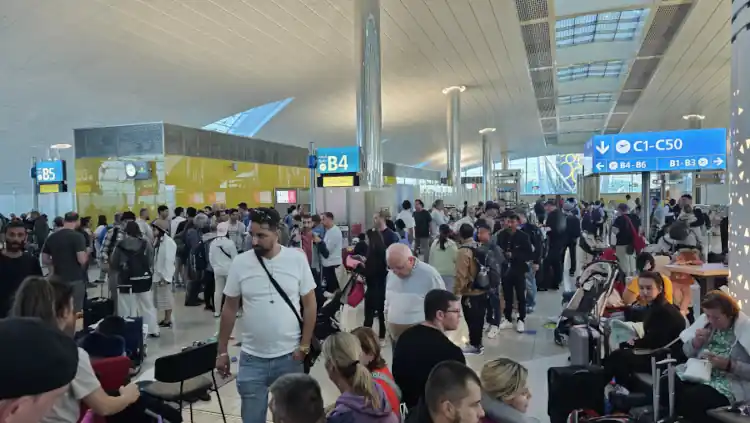
Dubai airport struck by Iranian missile on 1st March 2026
Gulf States Under Fire: Iranian Attacks Widen, and Abu Dhabi Airport Confirms Death, Injuries
Date: 2nd March 2026
Retaliatory strikes launched by Iran have now affected ten countries across the Middle East, dramatically widening the regional fallout from the joint operation carried out on February 28 by the United States and Israel against the Islamic Republic. Missiles and drones were detected over Bahrain, Jordan, Iraq, Qatar, Kuwait, Oman, Saudi Arabia and the United Arab Emirates, where US military sites are based. Iranian authorities insisted the strikes were aimed solely at Israeli territory and US military infrastructure, not at neighboring states, though regional air-defense systems across several capitals were activated. Israel remained the primary focus of Iranian fire, while air defenses in Syria engaged incoming projectiles, with explosions reported in Damascus by residents.
The escalation followed large-scale attacks that struck major Iranian cities, including Tehran, killing Supreme Leader Ali Khamenei and several senior officials. The elite Islamic Revolutionary Guard Corps (IRGC) declared an extensive retaliatory campaign, while Iran entered a 40-day national mourning period. In a televised address, President Masoud Pezeshkian confirmed that a temporary governing council had begun operating to oversee state affairs until a successor to Khamenei is chosen. According to Security Council Secretary Ali Larijani, the council will exercise the responsibilities of the supreme leader during this transition.
Iran launched further missile and drone attacks on March 2, striking locations in Bahrain and Kuwait as well as Abu Dhabi and Dubai in the UAE, and Doha in Qatar. These followed an earlier wave that had broadly expanded the conflict zone. Local governments have offered only limited details on the extent of damage, though disruptions to civilian aviation and military movements were reported in several states.
In the midst of these attacks, a deadly incident occurred at the Zayed International Airport in Abu Dhabi. The operator, Abu Dhabi Airports, confirmed that at least one person died and seven others were injured. The company stated that the incident took place at Zayed International Airport and pledged to release further information after completing its assessment. No details have yet been provided on whether the casualties were linked to regional military tensions or to airport-specific circumstances.
Elsewhere, the conflict spilled into the Eastern Mediterranean. A drone struck the Akrotiri Air Base in Cyprus, causing what local authorities described as “minor damage.” Media reports indicated that a small drone impacted the airfield, after which base personnel were instructed to remain in sheltered positions amid warnings of potential additional strikes. The explosion was reportedly heard in Limassol. Although unconfirmed reports pointed to a Shahed-136-type drone, no government formally attributed responsibility for the attack.
Inside Iraq, the pro-Iranian faction Saraya Awliya al-Dam claimed responsibility for a drone and missile strike on the airport in Erbil, the capital of the Kurdistan Region. The group said the attack was part of a large-scale campaign targeting US military facilities in retaliation for the killing of Khamenei. Local reports indicated that most drones were intercepted by air-defense systems near the airport. Additional information emerged suggesting that German military facilities in both Jordan and Iraq were also targeted by Iranian missiles and drones, though all were reportedly intercepted; one US soldier was said to have been injured by falling debris.
As the geopolitical crisis intensified, economic concerns grew sharply. Analysts warned that the conflict could cause the most significant disruption to global gas markets since 2022. Approximately 20% of the world’s LNG shipments pass through the Strait of Hormuz, and its temporary closure after the attack on Iran halted much of this traffic. Asian buyers, who receive about a quarter of their LNG from Qatar, immediately began seeking alternate delivery routes. Experts cautioned that if instability continues, gas-market conditions may mirror the upheaval witnessed after the outbreak of the conflict in Ukraine. Some analysts projected that Brent crude oil prices traded in London could rise by nearly one-third, potentially surpassing $90 per barrel, if shipping in the area remains at risk. Earlier warnings from IRGC commanders suggested the strait could remain closed, though former commander Mohsen Rezaei later stated that the passage remains open to oil tankers.
In Washington, officials reacted cautiously to the evolving situation and the uncertain political landscape emerging in Iran after the death of Khamenei. US President Donald Trump indicated he would consider lifting sanctions if Iran’s future leadership demonstrates pragmatism, though he refrained from addressing whether the US would support efforts to challenge existing authorities. He described the current phase of US policy as “ahead of schedule,” signaling that Washington will continue to shape events with flexibility as the crisis unfolds.
With simultaneous incidents in the Gulf, the Levant, Iraq, and Cyprus—and with aviation casualties now reported in Abu Dhabi—the regional situation remains highly volatile. Governments across the Middle East are assessing the scale of Iranian retaliation, the durability of air-defense capabilities, and the broader implications for political stability and global energy markets as the confrontation continues to expand.
Read More
- The Rise and Death of the Islamic Revolution in Iran: Redefined Middle East Power Dynamics
- Benjamin Netanyahu Declares Joint Israel–US Strike on the Ayatollah Regime
- Pakistan PM Postpones Russia Visit as Regional Turmoil Intensifies