Lack of Results Raises Questions Over Gaza Peace Framework
Gaza Board of Peace Fails to Deliver Tangible Outcomes
The US-sponsored Gaza Board of Peace emerged in the turbulent aftermath of the Israel–Gaza War, a conflict that reshaped diplomatic alignments and revived debates around international intervention, post-war governance, and the long-standing question of Palestinian statehood. The initiative, formally codified on January 22, 2026, when 19 countries signed its founding charter, was presented by United States as a pragmatic mechanism to stabilize the Gaza Strip while creating a framework for reconstruction and political transition. The signing took place under multilateral auspices, with diplomatic coordination involving the United Nations, although the structure itself remained heavily influenced by Washington’s strategic vision.
The origins of the Board can be traced to the escalation that began on October 7, 2023, when Hamas launched attacks into southern Israel, triggering a massive military response from Israel. By mid-2024, the conflict had devastated large parts of Gaza, displacing millions and creating one of the most severe humanitarian crises in recent history. Diplomatic efforts led by the United States intensified through 2025, culminating in a ceasefire agreement on October 10, 2025, which laid the groundwork for transitional governance arrangements. It was within this fragile pause that the idea of a Board of Peace gained traction.
The Board was envisioned as a hybrid body combining elements of international administration, economic development authority, and security coordination mechanism. According to initial drafts circulated in late 2025, it would oversee infrastructure rebuilding, distribution of humanitarian aid, and the establishment of a civil governance framework to replace the wartime vacuum. The initiative drew comparisons to earlier international interventions, such as the Coalition Provisional Authority in Iraq (2003) and the UN Transitional Administration in East Timor (1999), though American officials insisted the Gaza model would be more collaborative and regionally anchored.
Key figures involved in shaping the Board included U.S. Secretary of State officials, Israeli security planners, and intermediaries linked to Hamas through indirect negotiations facilitated by Qatar and Egypt. While Hamas did not formally endorse the Board in public statements, it reportedly agreed to its formation as part of a broader arrangement allowing limited administrative continuity in Gaza. This ambiguity became one of the defining tensions within the initiative: whether the Board represented a genuine step toward self-governance or merely an externally imposed structure.
The legal basis for the Board was linked to UN Security Council Resolution 2803, adopted in late 2025 on Washington’s initiative. The resolution called for a ceasefire implementation mechanism, deployment of an International Stabilization Force, and creation of a National Enclave Management Committee. However, by April 2026, implementation lagged significantly, prompting criticism from several member states, most notably Russia.
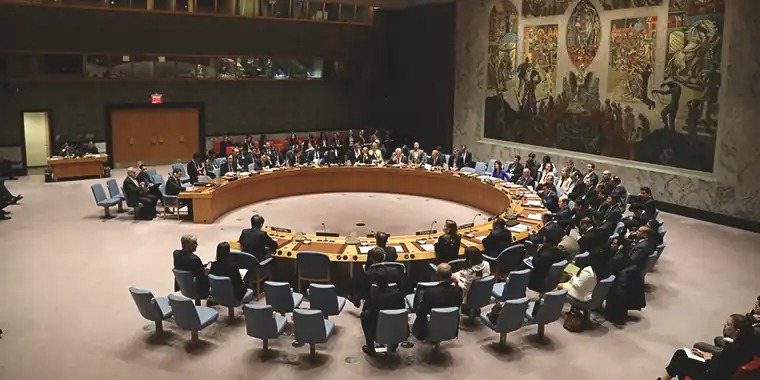
On April 28, 2026, during a Security Council session in New York, Vasily Nebenzya, Russia’s Permanent Representative to the UN, delivered a sharply critical assessment. He stated that Moscow saw “no tangible results” from the Board’s activities, arguing that the initiative had failed to address core political realities. Nebenzya emphasized that “attempts are being made to literally buy off the Palestinians with business projects rather than solve the political problem”, highlighting what Russia viewed as a fundamental flaw in the approach: prioritizing economic incentives over sovereign statehood.
Nebenzya’s remarks underscored several concrete shortcomings. The International Stabilization Force, intended to provide security and prevent renewed hostilities, had not been deployed. The National Enclave Management Committee remained outside Gaza, unable to establish authority on the ground. Meanwhile, more than half of the Gaza Strip was still under Israeli military control, and humanitarian access continued to face severe restrictions. He further noted that since the October 10 ceasefire, approximately 800 Palestinians had been killed, raising questions about the durability of the truce.
The Russian critique also invoked the broader framework of the two-state solution, referencing the long-standing international consensus around establishing an independent Palestinian state within the 1967 borders, with East Jerusalem as its capital. According to Nebenzya, the Board’s focus on projects branded as “New Gaza” risked sidelining these political imperatives in favor of technocratic governance and investment-driven reconstruction.
Supporters of the Board, particularly within the United States and allied countries, countered that the initiative represented a realistic pathway given the constraints on the ground. American officials argued that immediate progress toward full statehood was unlikely amid ongoing security concerns, and that stabilizing Gaza through economic revitalization and institutional rebuilding was a necessary first step. They pointed to planned investments in energy infrastructure, port facilities, and housing reconstruction as evidence of tangible progress, even if political outcomes remained uncertain.
The composition of the 19 signatory countries reflected a blend of Western allies and regional actors. Alongside the United States, participants reportedly included members of the European Union, as well as Middle Eastern states seeking to play a role in post-war stabilization. The inclusion of Arab states was particularly significant, as it lent a degree of regional legitimacy to an initiative otherwise perceived by critics as heavily American-driven.
Historically, international governance mechanisms in conflict zones have often faced similar dilemmas. The balance between external oversight and local autonomy, the sequencing of security versus political reform, and the role of economic development in conflict resolution are recurring themes. In Gaza, these tensions were amplified by the territory’s unique status: a densely populated enclave with contested sovereignty, limited resources, and deep political divisions.
The Board’s mandate also extended beyond Gaza in theory, with provisions suggesting it could serve as a model for conflict prevention and resolution in other regions. This ambition reflected a broader U.S. strategy of creating flexible, coalition-based governance tools adaptable to different crises. However, skeptics questioned whether a model struggling to gain traction in Gaza could be effectively exported elsewhere.
Another dimension of the debate centered on Israeli policy objectives. For Israel, the Board offered a mechanism to offload administrative responsibilities in Gaza while maintaining security control. Critics argued that this arrangement risked entrenching a form of indirect occupation, while supporters viewed it as a pragmatic compromise that reduced the burden on Israeli forces and allowed for international involvement.
Within Palestinian society, reactions to the Board were mixed. Some saw potential benefits in the influx of international aid and the possibility of improved living conditions. Others feared that the initiative would institutionalize a fragmented political landscape, delaying or undermining the quest for national self-determination. The absence of unified Palestinian representation in the Board’s leadership structures further complicated its legitimacy.
The humanitarian situation remained a central concern throughout early 2026. Despite the ceasefire, access to food, water, and medical supplies was inconsistent, and reconstruction efforts faced logistical and political obstacles. International organizations, including agencies within the United Nations system, continued to operate under challenging conditions, often coordinating with the Board while maintaining a degree of independence.
By April 2026, the Board of Peace stood at a crossroads. Its establishment marked a significant diplomatic milestone, yet its effectiveness was widely debated. The gap between ambitious objectives and limited implementation became increasingly apparent, as highlighted by Russia’s critique and echoed by other observers. Whether the initiative would evolve into a meaningful instrument of stability or remain a largely symbolic framework depended on several factors: the willingness of key actors to compromise, the availability of resources, and the broader trajectory of the Israeli-Palestinian conflict.
In historical perspective, the Board of Peace can be seen as part of a long continuum of attempts to manage and resolve the Gaza question through international intervention. From the Oslo Accords of the 1990s to various ceasefire arrangements and reconstruction plans, each effort has grappled with the interplay of local agency and external influence. The Board represents the latest iteration of this pattern, shaped by the specific conditions of the post-2023 war environment.
Ultimately, the debate surrounding the US-sponsored Gaza Board of Peace reflects deeper questions about the nature of peacebuilding in protracted conflicts. Is it possible to achieve lasting stability through incremental, economically driven approaches, or must political solutions addressing core grievances take precedence? The answer remains uncertain, as the situation in Gaza continues to evolve under the watchful eyes of the international community.
29th April 2026
Sarvarthapedia Core Node: US-Sponsored Gaza Board of Peace
Central Concept: A hybrid post-conflict governance mechanism linking security stabilization, economic reconstruction, and transitional administration in the Gaza Strip after the Israel–Gaza War.
See also:
- Trump’s Gaza Development Plan
- Transitional Governance
- International Intervention
- Post-War Reconstruction
- Ceasefire Mechanisms
- Two-State Solution
- American Law
- Jewish History
Cluster 1: Conflict Origins and War Dynamics
Israel–Gaza War (2023– )
A large-scale armed conflict triggered on October 7, 2023, reshaping regional geopolitics.
See also: Asymmetric Warfare; Urban Conflict; Humanitarian Crisis; Security Dilemma
Hamas–Israel Escalation
Cycle of attack and retaliation involving Hamas and Israel.
See also: Non-State Actors; Counterinsurgency; Deterrence Failure
Ceasefire of October 10, 2025
Temporary halt in hostilities enabling diplomatic experimentation.
See also: Armistice Politics; Conflict De-escalation; Monitoring Regimes
Humanitarian Catastrophe
Mass displacement and infrastructure collapse in Gaza.
See also: Emergency Relief Systems; War-Induced Famine; Civilian Protection Norms
Cluster 2: Institutional Architecture
Board of Peace Charter (January 22, 2026)
Foundational document signed by 19 countries establishing governance principles.
See also: Multilateral Treaties; Charter-Based Governance; Legal Mandates
Hybrid Governance Model
Combination of civil administration, economic authority, and security oversight.
See also: Technocratic Governance; Transitional Authority; Administrative Sovereignty
National Enclave Management Committee
Proposed local administrative body operating under international oversight.
See also: Proxy Governance; Local Autonomy; Institutional Legitimacy
International Stabilization Force
Planned multinational force for maintaining order and preventing relapse into conflict.
See also: Peacekeeping Operations; Security Sector Reform; Military Neutrality
Cluster 3: International Actors and Diplomacy
United States Strategic Role
Primary architect promoting stability through structured intervention.
See also: Hegemonic Mediation; Strategic Stabilization; Liberal Internationalism
United Nations Framework
Provides legitimacy through resolutions and diplomatic coordination.
See also: Security Council Authority; Peacebuilding Mandates; International Law
Russia Critique
Opposes economic-first approach, emphasizing political sovereignty.
See also: Multipolar Diplomacy; Great Power Rivalry; Normative Contestation
Mediation by Qatar and Egypt
Facilitators of indirect negotiations between adversaries.
See also: Backchannel Diplomacy; Regional Mediation; Conflict Brokerage
Cluster 4: Legal and Normative Frameworks
UN Security Council Resolution 2803
Legal basis for ceasefire implementation and governance transition.
See also: Binding Resolutions; International Enforcement; Legal Compliance
Two-State Solution Paradigm
Longstanding framework advocating Palestinian statehood alongside Israel.
See also: 1967 Borders Doctrine; East Jerusalem Status; Self-Determination
Sovereignty vs External Control
Tension between local independence and international oversight.
See also: Neo-Trusteeship; Conditional Sovereignty; Political Legitimacy
Cluster 5: Economic Reconstruction and Development
“New Gaza” Development Vision
Economic revitalization strategy centered on infrastructure and investment.
See also: Post-Conflict Economies; Developmental Peace Theory; Reconstruction Capital
Infrastructure Rehabilitation
Rebuilding energy, housing, and transport systems.
See also: Urban Recovery; Critical Infrastructure Security; Aid Logistics
Aid Distribution Mechanisms
Channels for humanitarian and development assistance.
See also: Donor Coordination; Aid Conditionality; Relief Governance
Economic Incentivization Strategy
Use of business projects to stabilize political environments.
See also: Peace Through Prosperity; Economic Statecraft; Development Diplomacy
Cluster 6: Criticism and Contested Narratives
“No Tangible Results” Thesis
Critique articulated by Vasily Nebenzya at the UN on April 28, 2026.
See also: Policy Failure Analysis; Implementation Gap; Diplomatic Criticism
Technocratic vs Political Solution Debate
Conflict between governance-by-projects and sovereignty-based resolution.
See also: Depoliticization Critique; Structural Conflict Theory; Political Settlement
Indirect Occupation Argument
Concern that governance mechanisms mask continued control by Israel.
See also: Occupation Law; Proxy Authority; Territorial Control
Legitimacy Deficit
Absence of unified Palestinian representation in governance structures.
See also: Representation Crisis; Political Fragmentation; Consent of Governed
Cluster 7: Comparative Historical Models
Coalition Provisional Authority (Iraq, 2003)
US-led transitional authority following regime change.
See also: Occupation Governance; Nation-Building; Institutional Imposition
UN Transitional Administration in East Timor (1999)
UN-led model for full administrative control during transition.
See also: International Trusteeship; Post-Colonial Transition; State Formation
Oslo Accords Legacy
Earlier framework attempting negotiated peace between Israelis and Palestinians.
See also: Incremental Peace Process; Bilateral Negotiations; Interim Governance
Cluster 8: Social and Local Dynamics
Palestinian Public Response
Mixed reactions ranging from cautious optimism to skepticism.
See also: Grassroots Legitimacy; Civil Society Role; Public Perception
Fragmented Political Landscape
Division between governing factions and absence of unified authority.
See also: Factionalism; Political Dualism; Governance Vacuum
Humanitarian Access Constraints
Ongoing barriers to aid delivery despite ceasefire.
See also: Blockade Politics; Relief Corridors; Humanitarian Law
Cluster 9: Strategic and Global Implications
Model for Future Conflict Zones
Proposal to replicate the Board framework elsewhere.
See also: Policy Transfer; Governance Templates; Crisis Management Models
Great Power Competition
Diverging visions between US-led initiatives and rival powers.
See also: Geopolitical Rivalry; Strategic Influence; Global Governance
Stability vs Justice Dilemma
Balancing immediate order with long-term political rights.
See also: Peace vs Justice Debate; Transitional Justice; Conflict Resolution Ethics
Integrative Links
Governance Nexus
Links Hybrid Governance Model ↔ Sovereignty vs External Control ↔ Legitimacy Deficit
Security Nexus
Links International Stabilization Force ↔ Ceasefire Mechanisms ↔ Security Sector Reform
Economic Nexus
Links “New Gaza” Vision ↔ Economic Incentivization ↔ Post-Conflict Economies
Political Resolution Nexus
Links Two-State Solution ↔ Oslo Accords Legacy ↔ Political Settlement
Meta-Concept: Peacebuilding in Protracted Conflict
The Board of Peace functions as a case study in modern peacebuilding, where incremental economic stabilization, external governance frameworks, and unresolved sovereignty claims intersect.
See also:
- Conflict Transformation
- State-Building Theory
- International Peace Architecture
- Post-War Political Order
- US-Iran war ↔ Iran Rules Out Talks With US
See also:
- Pope Leo XIV Invokes Just War Doctrine to Oppose Iran Conflict
- Trump Peace Declaration on Gaza (2025): Israel is not a signatory
- Gaza Ceasefire Falters as Hamas, Israel Defy Fragile Truce
- Ceasefire Ends Gaza War: María Machado Wins 2025 Nobel Prize
- Modern history of Palestine and Zionism since 1516