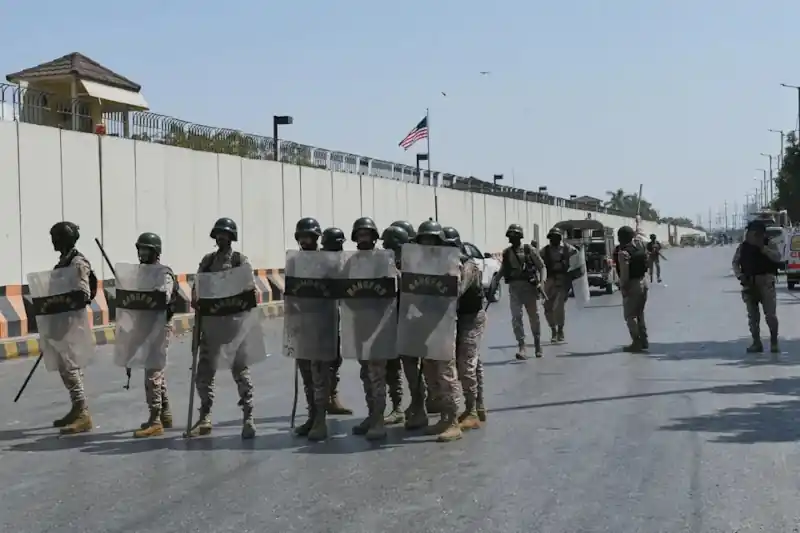
At least 22 killed and more than 120 wounded in Pakistan as protesters try to storm US Consulate.
Diplomatic Uncertainty in Islamabad: Pakistan Juggles Iran Solidarity and US-Aligned Gulf Commitments
Date: 2nd March 2026
Pakistan’s current response to fast-moving Middle East tensions shows a confused diplomatic posture and an inability to clearly assess its long-standing, complicated relationship with the United States. After the assassination of Iran’s supreme leader, Ayatollah Ali Khamenei, Prime Minister Shehbaz Sharif publicly condemned the violation of international norms, stressing that targeting heads of state goes against established global conventions. He extended deep condolences on behalf of the government and people of Pakistan, calling the killing an irreparable loss and urging respect for international law. President Asif Ali Zardari also voiced profound sorrow, saying the loss of such high-ranking Iranian leadership would impact the entire Muslim world and reaffirmed Pakistan’s solidarity with Iran.
Yet Pakistan’s messaging becomes contradictory as the prime minister simultaneously strengthens outreach to US-aligned Gulf monarchies. In separate calls, he discussed the escalating regional crisis with Jordan’s King Abdullah II ibn Al Hussein and Bahrain’s King Hamad bin Isa Al Khalifa. He condemned Iranian strikes on Gulf countries following US-Israeli attacks and reaffirmed Pakistan’s support for “brotherly nations” such as Jordan and Bahrain. He urged restraint, dialogue, and de-escalation while pledging Pakistan’s readiness to back regional peace initiatives. These parallel expressions of sympathy toward Iran and alignment with US partners highlight Islamabad’s difficulty defining its strategic direction, creating diplomatic ambiguity that affects its regional standing and its ability to manage ties with Washington.
Inside Pakistan, tensions escalated sharply. In Karachi, large crowds clashed with security forces near the US Consulate Karachi on Mai Kolachi Road. Police used teargas and baton-charge to disperse protesters. Section 144 was extended across Sindh, banning rallies, demonstrations, wall chalking, and the display of weapons for one month. Licensed private security guards were allowed to carry arms only at workplaces and were banned from displaying them during transit.
Hospitals across Karachi reported a rising casualty count. Civil Hospital received eight bodies, with two more victims dying of injuries, raising the death toll to 10. A total of 73 people were injured across SMBB Trauma Centre, JPMC, AKUH, and Fatimiyah Hospital, with 14 remaining admitted and six in critical condition. Additional injuries were reported from protests at Native Jetty, Numaish Chowrangi, and Paposh Nagar. The US Embassy Islamabad issued a security alert advising American citizens to avoid large crowds, monitor local news, and update their STEP registration.
The Sindh government expressed deep regret over the loss of life, stating that protesters breached the US Consulate security cordon and committed vandalism. A high-level joint investigation team was formed to review the causes, circumstances, and responsibility for the incident. The government restated that peaceful protest is a constitutional right but emphasised that violence, vandalism, and taking the law into one’s own hands would not be tolerated.
This combination of diplomatic contradictions, public unrest, rising anti-US sentiment, and pressure from both Iran and Gulf allies shows Pakistan struggling to craft a coherent foreign policy. The country appears unable to clearly assess or articulate its relationship with the United States, leaving Islamabad caught between geopolitical alliances, domestic reactions, and regional instability.
Read more
Pakistan PM Postpones Russia Visit as Regional Turmoil Intensifies
Pakistan Launches Operation Ghazab lil-Haq Against Afghan Taliban