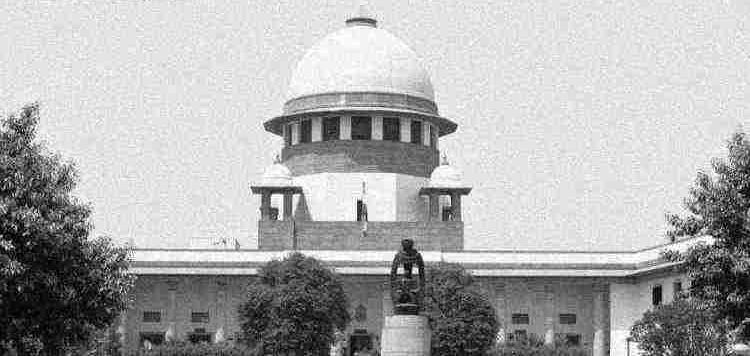
SUPREME COURT OF INDIAArticle 124 of the Constitution of India Constitution of India > 124. Supreme Court (1) There shall be a Supreme Court of India consisting of a Chief Justice of India and, until Parliament by law prescribes a larger number, of not more than seven other Judges. (2) Every Judge of the Supreme Court shall be appointed by the President by warrant under his hand and seal and shall hold office until he attains the age of sixty-five years: Provided that-- (a) a Judge may, by writing under his hand addressed to the President, resign his office (b) a Judge may be removed from his office in the manner provided in clause (4). (2A) The age of a Judge of the Supreme Court shall be determined by such authority and in such manner as Parliament may by law provide. (3) A person shall not be qualified for appointment as a Judge of the Supreme Court unless he is a citizen of India and-- (a) has been for at least five years a Judge of a High Court or of two or more such Courts in succession; or (b) has been for at least ten years an advocate of a High Court or of two or more such courts in succession; or (c) is, in the opinion of the President, a distinguished jurist. (4) A Judge of the Supreme Court shall not be removed from his office except by an order of the President passed after an address by each House of Parliament supported by a majority of the total membership of that House and by a majority of not less than two-third of the members of the House present and voting has been presented to the President in the same session for such removal on the ground of proved misbehavior or incapacity. (5) Parliament may by law regulate the procedure for the presentation of an address and for the investigation and proof of the misbehavior or incapacity of a Judge under clause (4): (6) Every person appointed to be a Judge of the Supreme Court shall, before he enters upon his office, make and subscribe before the President, or some person appointed in that behalf by him, an oath or affirmation according to the form set out for the purpose in the Third Schedule. (7) No person who has held office as a Judge of the Supreme Court shall plead or act in any court or before any authority within the territory of India.
DIVISION BENCH
( Before : Jagdish Singh Khehar, CJI. and Kurian Joseph, J. )
NIDHI KAIM — Appellant
Vs.
STATE OF MADHYA PRADESH — Respondent
Civil AppealCivil Appeal Vasant Ganesh Damle vs. Shrikant Trimbak Datar (AIR 2002 SC 1237) in the following words: "The appeal is considered to be an extension of the suit because U/S. 107 of the Code of Civil Procedure, the appellate Court has the same powers as are conferred by the Code on Courts of original jurisdiction in respect of suits instituted therein. Such a power can be exercised by the appellate Court "as nearly as may be" exercised by the trial Court under the Code. If the powers conferred upon the trial Court are under a specified statute and not under the Code, it has to be ascertained as to whether such a power was intended to be exercised by the appellate Court as well. Such a position can be ascertained by having a reference to the specified law by keeping in mind the legislative intention of conferment of power on the appellate Court either expressly or by necessary implication." No. 1727 of 2016
Decided on : 13-02-2017
Constitution of IndiaConstitution of India भारतस्य संविधानम्: 1950 ∫ वयं भारतस्य जनाः (3) मौलिक अधिकार: (Fundamental Rights) > (4) राजनैतिकनीतेः निर्देशात्मकसिद्धान्ताः (Directive principles)> (5) The Union > (6) The States> (11) संघस्य च सम्बन्धाः राज्यम् (Union-State Relation)> (15) निर्वाचनम् (Elections)> (17) राजभाषा (Official Language) (18) आपत्कालीन प्रावधानम् (Emergency provisions) (20) संविधानसंशोधनम् (Amendment of Constitution). सप्तमी अनुसूची: (Seventh Schedule). Parliament, Supreme Court, President of India, Prime Minister of India. ∑ (Govt of India Act 1935, Manu Samhita 5000, BCE Rigveda 7000 BCE), 1950 – Article 142Article 142 Constitution of India > The Supreme Court in the exercise of its jurisdiction may pass such decree or make such order as is necessary for doing complete justice in any cause or matter pending before it, and any decree so passed or order so made shall be enforceable throughout the territory of India in such manner as may be prescribed by or under any law made by Parliament and, until provision in that behalf is so made, in such manner as the President may by order prescribe., Article 145(5)
(2017) AIRAIR All India Reporter(SCW) 986 : (2017) AIR(SC) 986 : (2017) 2 AllWC 1554 : (2017) 1 HLT 161 : (2017) 2 JT 337 : (2017) 2 MLJ 412 : (2017) 2 Scale 626 : (2017) 4 SCCSCC Supreme Court Cases 1 : (2017) 2 SCT 150
JUDGMENTJudgment The statement given by the Judge on the grounds of a decree or order - CPC 2(9). It contains a concise statement of the case, points for determination, the decision thereon, and the reasons for such decision - Order 20 Rule 4(2). Section 354 of CrPC requires that every judgment shall contain points for determination, the decision thereon and the reasons for the decision. Indian Supreme Court Decisions > Law declared by Supreme Court to be binding on all courts (Art 141 Indian Constitution) Civil and judicial authorities to act in aid of the Supreme Court (Art 144) Supreme Court Network On Judiciary – Portal > Denning: “Judges do not speak, as do actors, to please. They do not speak, as do advocates, to persuade. They do not speak, as do historians, to recount the past. They speak to give Judgment. And in their judgments, you will find passages, which are worthy to rank with the greatest literature….” Law Points on Judgment Writing > The judge must write to provide an easy-to-understand analysis of the issues of law and fact which arise for decision. Judgments are primarily meant for those whose cases are decided by judges (State Bank of India and Another Vs Ajay Kumar Sood SC 2022)
Jagdish Singh Khehar, CJI. – Leave granted in the special leave petitions.
2. Orders were passed by the Madhya Pradesh Professional Examination Board (hereinafter referred to as, `Vyapam’), cancelling the results of the appellants, of their professional MBBS course, on the ground that the appellants had gained admission to the course, by resorting to unfair means, during the Pre-Medical Test. These orders were passed, with reference to candidates, who had been admitted to the above course, during the years 2008 to 2012. A challenge to the orders of cancellation, was raised by the appellants, by invoking the jurisdictionJurisdiction Authority by which courts receive and decide cases. Limited Jurisdiction: the authority over only particular types of cases, or cases under a prescribed amount in controversy, or seeking only certain types of relief, the District Court is a court of limited jurisdiction. Original Jurisdiction: Jurisdiction of the first court to hear a case. of the High CourtHigh Court High Court Judges in England and Wales handle complex and tough cases, sitting in London and traveling to court centers around the country. They preside over serious criminal and important civil cases, and support the Lord and Lady Justices in hearing appeals. High Court Judges are commonly referred to as ‘Mr/Mrs/Ms Justice surname’ and are given the prefix ‘The Honourable’. They are assigned to the King’s Bench Division, the Family Division, or the Chancery Division. The King’s Bench Division focuses on civil wrongs and judicial review, the Family Division deals with family law, and the Chancery Division handles various cases including company law and probate. Judges are appointed through a rigorous process overseen by the Judicial Appointments Commission. of Madhya Pradesh (hereinafter referred to as, `the High Court’) under Article 226 of the ConstitutionConstitution The Constitution encompasses the global system of rules governing constitutional authority. Simply reading selected provisions of the written text may be misleading. Understanding the underlying principles, such as federalism, democracy, constitutionalism, the rule of law, and respect for minorities, is crucial. Democratic institutions must allow for ongoing discussion and evolution, reflected in the right of participants to initiate constitutional change. This right entails a reciprocal duty to engage in discussions. Democracy involves more than majority rule, existing within the context of other constitutional values. Therefore, a profound understanding of these principles informs our appreciation of constitutional rights and obligations. Read more. All writ petitions raising the above challenge were dismissed. Resultantly, the appellants approached this Court. The orders of the High Court were affirmed by a Division Bench (hereinafter referred to as, the `former Division Bench’), on 12.05.2016. However, in exercise of jurisdiction vested in this Court, under Article 142 of the Constitution, J. Chelameswar, J. (the Hon’ble Presiding Judge, of the `former Division Bench’) expressed the view, that complete justiceJustice δικαιοσύνη > judicature ( δικαιοσύνη) > judge (δικαστής / κριτής). The whole purpose of Plato`s Republic is to search for Justice. The purpose of Justice is to establish a perfect State. The State of happiness (ευτυχία) in the matterMatter Normal matter is made of molecules, which are themselves made of atoms. Inside the atoms, electrons are spinning around the nucleus. The nucleus is made of protons and neutrons. Inside the protons and neutrons, exist indivisible quarks, like the electrons. All matter around us is made of elementary particles. ( building blocks of matter > quarks and leptons). All stable matter in the universe is made from particles that belong to the first-generation. Fundamental forces result from the exchange of force-carrier particles, which belong to a broader group called “bosons”. The strong force is carried by the “gluon”, electromagnetic force is carried by the “photon.” would be rendered, if the qualifications successfully acquired by the appellants were not annulled, and the knowledge gained by them, was not wasted. This, for the simple reason, that knowledge could not be transferred to those, who had been wrongfully deprived of admission, and cancellation of the results of the appellants, would not serve any purpose. Abhay Manohar Sapre, J. (the Hon’ble Companion Judge – in the `former Division Bench’) expressed his disinclination for invoking jurisdiction under Article 142, to sustain the benefit of education acquired by the appellants, through a separate order of the same date – 12.5.2016. This, for the simple reason, that those who had adopted unfair means, could not be extended any indulgence.
3. On account of the divergence of opinionOpinion A judge's written explanation of a decision of the court. In an appeal, multiple opinions may be written. The court’s ruling comes from a majority of judges and forms the majority opinion. A dissenting opinion disagrees with the majority because of the reasoning and/or the principles of law on which the decision is based. A concurring opinion agrees with the end result of the court but offers further comment possibly because they disagree with how the court reached its conclusion. expressed by the `former Division Bench’, through their separate orders (dated 12.5.2016) referred to above, Hon’ble the Chief Justice of IndiaIndia Hind/ hend >hindia. Bharat Varsha (Jambudvipa used in Mahavamsha) is the name of this land mass. The people of this land are Sanatan Dharmin and they always defeated invaders. Indra (10000 yrs) was the oldest deified King of this land. Manu's jurisprudence enlitened this land. Vedas have been the civilizational literature of this land. Guiding principles of this land are : सत्यं वद । धर्मं चर । स्वाध्यायान्मा प्रमदः । The place also been called Hindusthan in Pesia. The word Hendu is mentioned in Avesta. Read more, constituted this larger Division Bench, to deal with the matter. During the course of hearing, Mr. Shyam Divan, learned senior counsel submitted, that this Court had granted leave, in the petitionPetition αναφορά > παρακαλώ (Prayer) filed by his client (and many others, similarly situated) on 24.2.2016. It was pointed out, that all these appeals had remained pending before this Court, wherein the correctness of the impugned judgment(s) rendered by the High Court, was under consideration. It was submitted, that leave having been granted, the principle underlying the doctrine of merger would entail, that the judgments rendered by the High Court would eventually merge in the final or operative determination of this Court. It was also pointed out, that in terms of Article 145(5) of the Constitution, no judgment could be delivered by this Court, save with the concurrence of majority of Judges, present and hearing the case. It was submitted, that there was no majority judgment on 12.5.2016, when the two Hon’ble Judges constituting the `former Division Bench’, passed separate orders. According to learned counsel, in the absence of merger, all the civil appeals in hand, must be deemed to have remained on the docket of this Court, awaiting decision by an appropriate bench. It was contended, that the correct course to be followed, where there is a divergence of opinion between the two Hon’ble Judges was, a rehearing of the entire matter by a larger Bench. The above determination, according to learned counsel, emerges from the legal position expressed by this Court in Gaurav Jain v. Union of India, (1998) 4 SCC 270. It was submitted, that in the absence of a majority judgment, in terms of Article 145(5), and consequently in the absence of an effective judgment of this Court (despite the two separate orders passed by the `former Division Bench’ on 12.05.2016), there existed no judgment in the eyes of lawLaw νόμος: Positive command of sovereign or divine. One can be ruled either by a Statute, a Statue, or a Statement. Legislation is the rule-making process by a political or religious organisation. Physics governs natural law. Logical thinking is a sign of a healthy brain function. Dharma is eternal for Sanatanis. Judiciary > Show me the face, and I will show you the law. Some people know how to bend the law rather than break it. Law Practice. Read a scholarly article. It was accordingly submitted, that the present Division Bench (of three-Judges) by a mandate of law, was required to adjudicate upon the civil appeals fully, on all issues. It is therefore, that this Bench passed the following order on 28.7.2016:
“After hearing had gone on for sometime, wherein the limited issue canvassed was, whether this Court was justified in exercising jurisdiction under Article 142 of the Constitution of IndiaArticle 142 of the Constitution of India Indian Bank v. ABS Marine Products Pvt. Ltd.( AIR 2006 SC 1899) while distinguishing a precedent from mere directions: "Many a time, after declaring the law, this Court in the operative part of the judgment, gives some directions which may either relax the application of law or exempt the case on hand from the rigour of the law in view of the peculiar facts or in view of the uncertainty of law till then, to do complete justice. While doing so, normally it is not stated that such direction/order is in exercise of power under Article 142..... When the High Courts repeatedly follow a direction issued under Article 142, by treating it as the law declared by this Court, incongruously the exemption/relaxation granted under Article 142 becomes the law, though at variance with the law declared by this Court. The courts should, therefore, be careful to ascertain and follow the ratio decidendi, and not the relief given on the special facts, exercising power under Art.", our attention was invited to the mandate contained in Article 145(5) of the Constitution, so as to suggest, that the entire controversy needed to be heard afresh, in view of the following order passed by the Bench on 12th May, 2016:
“In view of the divergence of opinion in terms of separate judgments pronounced by us in these appeals today, the Registry is directed to place the papers before Hon’ble the Chief Justice of India for appropriate further orders.”
We are of the view that the instant issue can be resolved by referring the matter back to the Bench, for a clarification, of the order dated 12th May, 2016, whether the reference required re-hearing of the entire matter, and if not, the limited issue referred for consideration.
We have chosen to adopt the above course, so as to save precious timeTime χρόνος. Judicial: Where any expression of it occurs in any Rules, or any judgment, order or direction, and whenever the doing or not doing of anything at a certain time of the day or night or during a certain part of the day or night has an effect in law, that time is, unless it is otherwise specifically stated, held to be standard time as used in a particular country or state. (In Physics, time and Space never exist actually-“quantum entanglement”) यमः , पुं, (यमयति नियमयति जीवानां फलाफलमिति । यम् + अच् । विश्वे च कलयत्येव यः सर्व्वायुश्च सन्ततम् । अतीव दुर्निवार्य्यञ्च तं कालं प्रणमाम्यहम् ॥यमैश्च नियमैश्चैव यः करोत्यात्मसंयमम् । स चादृष्ट्वा तु मां याति परं ब्रह्म सनातनम् ॥ of the Court. In the above view of the matter, the Registry is directed to place the files of this case, before Hon’ble the Chief Justice of India, for seeking clarification of the Division Bench which passed the order dated 12th May, 2016.
Post the matters for hearing, after clarification.”
4. On 30.8.2016, the `former Division Bench’ passed another order, in furtherance of the order extracted above. Relevant extract of the same is reproduced below:
“Pursuant to the Order dated 28th July, 2016 of the larger Bench, the matter was placed before this Bench.
Heard the learned counsel.
It appears from the above-mentioned order that, it was argued before the larger Bench that by the Order of this Bench dated 12th May, 2016, a Reference was made to a larger Bench. The submission is factually incorrect. It is clear from the Order dated 12th May, 2016 that there was a disagreement between both of us regarding the final order to be passed in the appeals before us. Both of us recorded a concurrent opinion that the examination process in issue in these appeals, conducted by Vyapam for the years 2008 to 2012 was vitiated with reference to the appellants before this Court and few others. We also agreed upon the conclusion that the appellants herein are the beneficiaries of such vitiated process.
The only point of divergence between both of us is that whether the appellants should be dis entitled to retain the benefits of the training in medical course which they secured by virtueVirtue Aristotelian model: Excess Mean Deficiency >Irascibility Gentleness Spiritlessness >Rashness Courage Cowardice>Shamelessness Modesty Diffidence>Profligacy Temperance Insensitiveness>Envy Righteous Indignation Malice>Greed Justice Loss>Prodigality Liberality Meanness>Boastfulness Honesty Self-deprecation>Flattery Friendliness Surliness>Subservience Dignity Stubborness>Luxuriousness Hardness Endurance>Vanity Greatness of Spirit Smallness of Spirit>Extravagance Magnificence Shabbiness> Rascality Prudence Simpleness. of their being beneficiaries of a tainted examination process conducted for the purpose of admitting them for training in medical colleges.
While one of us (Justice Abhay Manohar Sapre) is clearly of the opinion that the case of the appellants deserves no further consideration, the moment we concluded that they are the beneficiaries of such tainted examination process, the other (Justice J. Chelameswar) opined for the reasons recorded that their cases deserve some consideration and also opined that the appellants should be permitted to pursue their medical course and complete the same subject to certain conditions indicated in the order.
We completely fail to understand the reference made to Article 145(5) of the Constitution in the Order dated 28th July, 2016. We are of the opinion that neither the Constitution of India nor any other law of this country provides an intra-court appeal insofar as the Supreme Court is concerned. A re-hearing of the entire matter as apparently suggested to the larger Bench, in our opinion, would amount to an intra-court appeal. If the larger Bench of this Court wishes to create such an intra-court appeal, we obviously are powerless to stop it. We can only record our understanding of the law on the question and it is as recorded above.
Ordered accordingly.”
In view of the order extracted above, it is apparent that, we are only dealing with the issue, whether the jurisdiction vested in this Court under Article 142 of the Constitution, should be invoked in favour of the appellants, in order to render complete justice in the matter.
5. According to Mr. R. Venkataramani, learned senior counsel appearing for the appellants in Civil Appeal Nos. 1727, 1720-1724, 1726, 1728, 1776-1787 and 1846 of 2016, the invocation of Article 142 in favour of the appellants was a just and rightful determination, inasmuch as, complete justice was sought to be rendered without adversely affecting or impinging upon the rights of any other party. It was submitted, that there is a distinction between “inherent jurisdiction” and “inherent powerPower The amount of energy transferred or converted per unit of time. In the International System of Units, the unit of it is the watt, equal to one joule per second. The capacity of energy infrastructure is rated using watts, which indicate its potential to supply or consume energy in a given period of time. A Power-plant rated at 100 MW has the potential to produce 100 MWh if it operates for one hour.”. Likewise, there is a distinction between ensuring, that the ends of justice are met – as against, rendering of complete justice. It was pointed out, that Section 151 of the Code of Civil ProcedureCode of Civil Procedure Main Sections: Filing, Summons, Trial, Judgment, Execution, Appeal, Interim Applications, Interim Injunction, Cost, Notice Rules: Order VII. Statutory Drafting and Forms: General Pleding, 1908 (hereinafter referred to as, `the CPCCode of Civil Procedure Main Sections: Filing, Summons, Trial, Judgment, Execution, Appeal, Interim Applications, Interim Injunction, Cost, Notice Rules: Order VII. Statutory Drafting and Forms: General Pleding’) and Section 482 of the Code of Criminal Procedure, 1973 (hereinafter referred to as, `the CrPC’) provide for situations, wherein a Court can exercise inherent powers. It was submitted, that inherent powers as contemplated under Section 151 of the CPC, and Section 482 of the CrPC, are controlled, and had limitations. It was asserted, that the power conferred on the Supreme Court under Article 142 of the Constitution, was aimed at allowing this Court to do complete justice, in any cause or matter. The instant power vested in this Court, it was submitted, is unlimited. It was pointed out, that the expanse of Article 142, was clearly distinct from the inherent power contemplated under the two procedural enactments, referred to above. In order to substantiate his contention, learned counsel placed reliance on a treatise by Roscoe Pound – An Introduction to the PhilosophyPhilosophy Metaphysics (Matter), Epistemology (knowledge of knowledge), Ethics (Sense of Good or Bad), Logic ( structure of reasoning) > Philosophers: Plato Aristotle Aquinas Locke Marx Hume Mill Kant Wittgenstein Descartes Nietzsche Sartre. Disciplines: Philosophy of Law. Philosophy of Feminism. Philosophy of Religion. Philosophy of Science. Philosophy of Mind. Philosophy of Literature. Political Philosophy. Philosophy of the Arts. Philosophy of History. Philosophy of Language. Theology Vs Philosophy of Law, (Sixth IndianIndia Hind/ hend >hindia. Bharat Varsha (Jambudvipa used in Mahavamsha) is the name of this land mass. The people of this land are Sanatan Dharmin and they always defeated invaders. Indra (10000 yrs) was the oldest deified King of this land. Manu's jurisprudence enlitened this land. Vedas have been the civilizational literature of this land. Guiding principles of this land are : सत्यं वद । धर्मं चर । स्वाध्यायान्मा प्रमदः । The place also been called Hindusthan in Pesia. The word Hendu is mentioned in Avesta. Read more Reprint – 2012, published by the Universal Law Publishing Co. Pvt. Ltd.). Learned counsel invited the Court’s attention to the following opinion expressed by the author:
“If we look back at the means of individualizing the application of law which have developed in our legal system, it will be seen that almost without exception they have to do with cases involving the moralMorality Mental frame. It can be high morality or low morality, savage morality or civilised morality or Christian morality, or Nazi morality. Decent Behaviour is acceptable norms of the nations. Christian morality starts with the belief that all men are sinners and that repentance is the cause of divine mercy. Putting Crucified Christ in between is the destruction of Christian morality and logic. Now morality shifted to the personal choice of Jesus. What Jesus did is 'good'. The same would be the case of Ram, Krishna, Muhammad, Buddha, Lenin, etc. Pure Human Consciousness degraded to pure followership. There exists no proof the animals are devoid of morality. quality of individual conduct or of the conduct of enterprises, as distinguished from matters of property and of commercialCommercial Profit-making economic activities, such as the production, consumption, exchange, and distribution of goods and services, are primarily undertaken to earn money or a livelihood. Key Features > (1) Involve sale and exchange of goods and services for consideration (money or value), (2) Aim to earn profit and ensure business growth, (3) Include risk-bearing and creation of utility, (4) Economic in nature and satisfy customer needs. Commercial Activities > Earning profit, Business growth, Serving society, Achieving market leadership. law. Equity uses its powers of individualizing to the best advantage in connection with the conduct of those in whom trustTrust It originated and was reduced to practice under the jurisdiction of courts by the civil law, was expanded and developed in the courts of chancery, and has been employed in nearly every field of human activity. The fundamental nature of a trust is the division of title, with the trustee being the holder of legal title and the beneficiary that of equitable title. By definition, the creation of a trust must involve a conveyance of property. > Trust Deed ∫ Having trust/faith/confidence in something and confidence has been reposed. Jury lawlessness is an agency of justice chiefly in connection with the moral quality of conduct where the special circumstances exclude that “intelligence without passion” which, according to Aristotle, characterizes the law. It is significant that in EnglandEngland 47 boroughs, 36 counties, 29 London boroughs, 12 cities and boroughs, 10 districts, 12 cities, 3 royal boroughs boroughs: Barnsley, Blackburn with Darwen, Blackpool, Bolton, Bournemouth, Bracknell Forest, Brighton and Hove, Bury, Calderdale, Darlington, Doncaster, Dudley, Gateshead, Halton, Hartlepool, Kirklees, Knowsley, Luton, Medway, Middlesbrough, Milton Keynes, North Tyneside, Oldham, Poole, Reading, Redcar and Cleveland, Rochdale, Rotherham, Sandwell, Sefton, Slough, Solihull, Southend-on-Sea, South Tyneside, St. Helens, Stockport, Stockton-on-Tees, Swindon, Tameside, Thurrock, Torbay, Trafford, Walsall, Warrington, Wigan, Wirral, Wolverhampton counties (or unitary authorities): Bedfordshire, Buckinghamshire, Cambridgeshire, Cheshire, Cornwall, Cumbria, Derbyshire, Devon, Dorset, Durham, East Sussex, Essex, Gloucestershire, Hampshire, Herefordshire, Hertfordshire, Isle of Wight, Kent, Lancashire, Leicestershire, Lincolnshire, Norfolk, North Yorkshire, Northamptonshire, Northumberland, Nottinghamshire, Oxfordshire, Shropshire, Somerset, Staffordshire, Suffolk, Surrey, Warwickshire, West Sussex, Wiltshire, Worcestershire today the civil jury is substantially confined to cases of fraud, defamation, malicious prosecution, assault and battery, and breach of promise of marriage. Judicial individualization through choice of a rule is most noticeable in the law of torts, in the law of domestic relations, and in passing upon the conduct of enterprises.
The Application of Law
The elaborate system of individualization in criminal procedure has to do wholly with individual humanHuman Ο άνθρωπος (Humanum> Homo sapiens) मानव:. We have failed to consider the minimum need to be a 'human'. For Christians, human beings are sinful creatures, who need some saviour. For Evolution biology a man is still evolving, for what, we don´t know. For Buddhist Nagarjuna, the realisation of having a human body is a mere mental illusion. We are not ready to accept that a human is a computer made of meat. For a slave master, a human person is another animal, his sons and daughters are his personal property. conduct. The informal methods of petty courts are meant for tribunals which pass upon conduct in the crowd and hurry of our large cities. The administrative tribunals, which are setting up on every hand, are most called for and prove most effective as means of regulating the conduct of enterprises.
A like conclusion is suggested when we look into the related controversy as to the respective provinces of common lawCommon law The legal system that originated in England and is now in use in the United States. It is based on court decisions rather than statutes passed by the legislature. and of legislation. Inheritance and succession, definition of interests in property and the conveyance thereof, matters of commercial law and the creation, incidents, and transfer of obligations have provedProved A fact is said to be proved when, after considering the matters before it, the Court either believes it to exist, or considers its existence so probable that a prudent man ought, under the circumstances of the particular case, to act upon the supposition that it exists; a fruitful field for legislation. In these cases the social interest in the general security is the controlling element. But where the questions are not of interests of substance but of the weighing of human conduct and passing upon its moral aspects, legislation has accomplished little. No codification of the law of torts has done more than provide a few significantly broad generalizations. On the other hand, succession to property is everywhere a matter of stature law, and commercial law is codified or codifying throughout the worldWorld Κόσμος . Moreover the common law insists upon its doctrine of stare decisis chiefly in the two cases of property and commercial law. Where legislation is effective, there also mechanical application is effective and desirable. Where legislation is ineffective, the same difficulties that prevent its satisfactory operation require us to leave a wide margin of discretion in application, as in the standard of the reasonable man in our law of negligence and the standard of the upright and diligent head of a family applied by the Roman law, and especially by the modern Roman law, to so many questions of fault, where the question is really one of good faithFaith πίστει.. All attempts to cut down this margin have proved futile. May we not conclude that in the part of the law which has to do immediatelyForthwith In Rao Mahmood Ahmad Khan v. Ranbir Singh , has held that the word ‘forthwith’ is synonymous with the word immediately, which means with all reasonable quickness. When a statute requires something to be done ‘forthwith’ or ‘immediately’ or even ‘instantly’, it should probably be understood as allowing a reasonable time for doing it. The interpretation of the word ‘forthwith’ would depend upon the terrain in which it travels and would take its colour depending upon the prevailing circumstances which can be variable. (Shento Varghese v. Julfikar Husen & Ors [2024] 6 S.C.R. 409). Anwar Ahmad v. State of UP [1976] 1 SCR 779 : AIR (1976) SC 680; Nevada Properties (P) Ltd. v. State of Maharashtra & Anr. [2019] 15 SCR 223 : (2019) 20 SCC 119; State of Maharashtra v. Tapas D. Neogy [1999] Supp. 2 SCR 609 : 1999 INSC 417; Ravinder Kumar & Anr. v. State of Punjab [2001] Supp. 2 SCR 463 : (2001) 7 SCC 690; Bhajan Singh and Ors. v. State of Haryana [2011] 7 SCR 1 : 2011 INSC 422; HN Rishbud v. State of Delhi [1955] 1 SCR 1150 : (1954) 2 SCC 934; Sk. Salim v. State of West Bengal [1975] 3 SCR 394 : (1975) 1 SCC 653; China Apparao and Others v. State of Andhra Pradesh [2002] Supp. 3 SCR 175 : (2002) 8 SCC 440; Navalshankar Ishwarlal Dave v. State of Gujarat [1993] 3 SCR 676 : 1993 Supp. 3 SCC 754; Rao Mahmood Ahmad Khan v. Ranbir Singh [1995] 2 SCR 230 : (1995) Supp. 4 SCC 275; Bidya Deb Barma v. District Magistrate [1969] 1 SCR 562 : (1968) SCC OnLine SC 82. with conduct complete justice is not to be attained by the mechanical application of fixed rules? Is it not clear that in this part of the administration of justice the trained intuition and disciplined judgment of the judge must be our assurance that causes will be decided on principles of reason and not according to the chance dictates of caprice, and that a due balance will be maintained between the general security and the individual human life?”
Based on the aforesaid, it was submitted, that matters involving individual conduct, or conduct of enterprises, need to be distinguished from matters of property and commercial law. It was pointed out, that the rule of equity, in dealing with individual conduct or conduct of enterprises, was a tool adopted to the best advantage of the parties concerned, especially when, the controversy did not relate to property matters or commercial law. Referring to the law of inheritance and succession, which had a direct nexus to interest in property (and conveyance), it was submitted, that there was a feeling, that social interest was generally the controlling element, in such matters. However, where the question was not of substance, but of human conduct (or the moral aspect thereof), legislation could not be depended upon, to furnish any answer. According to learned counsel, on the subject being dealt with, there is no express legislation. Therefore, it is necessary to keep in mindMind We know nothing about its origin, growth, or demise. Where it lives, can it live without a brain? Possibly, the mind is the soul and spirit. See Consciousness, that the controversy in hand, is not one which would return a finding of breach of any existing legislative enactment. It was submitted, that if there had been any such legislation, on the issue being dealt with, the matter would have to be examined differently. However, in the absence of legislation, or in situations where legislation is ill-effective, Courts had a wide margin of discretion. For such situations, determination has to be made, on the touchstone of reasonableness founded on good faith. It was submitted, that in the facts and circumstances of the present controversy, a trained intuition and disciplined judgment of the adjudicator, would have to be invoked. Because, the cause would have to be adjudicated on the principle of prudence and rationality. Herein, according to learned counsel, the remedy provided would have to be handcrafted, rather than the routine – mechanical exercise of enforcing legislative intent. Herein, the events would have to be evaluated, keeping in mind the special circumstances – and their significance, in order to render complete justice.
6. It was submitted, that in exercise of judicial intuition and judicial discretion, J. Chelameswar, J. had categorized the controversy as one where the appellants had acquired “knowledge”. The cancellation of their admission would not be of any advantage to the more meritorious candidates, who were deprived of admission, as it is not possible to transfer the “knowledge” acquired by the appellants. In the present situation, it was submitted, that it was not possible to restore status quo ante. The instant controversy, it was pointed out, could not be dealt with like a dispute concerning immovable property, wherein, on the culmination of the lis, the property can be restored to the rightful owner. Herein, the meritorious candidates, who ought to have been admitted in place of the appellants, cannot have the advantage of transfer of “knowledge” acquired by the appellants. It was submitted, that to deal with the acquired “knowledge”, J. Chelameswar, J., had taken recourse to Article 142, to legitimize only the “knowledge” acquired by the appellants, and not their actions or conduct. This determination, was also considered to be, of societal advantage. It would take five years (- the duration of medical course) of national resources, to acquire what had been annulled by Vyapam. Invalidation of the fruits of gained “education” was considered by the Hon’ble Presiding Judge of the `former Division Bench’, as an inappropriate means, to deal with the situation. It was submitted, that this advantage was far superior to the individual gains which would accrue to the appellants, or the individual loss which may have been suffered by the meritorious candidates deprived of admission. It was also asserted, that while invoking Article 142 to the advantage of the appellants, the situations wherein the jurisdiction could not be invoked, were dealt with in detail. Only after arriving at the conclusion, that the situation in hand, would not trample upon the determined legal position, the Hon’ble Presiding Judge had chosen to exercise its discretion, to do complete justice in the matter. It was submitted, that in the absence of, violation of any laid down parameters, it would be unjust, if this Court was to set at naught, long years of educational endeavour, successfully undertaken by the appellants, which had resulted in acquisition of “knowledge” – an ability, which would enable the appellants to render valuable service to the society – and thereby serve the citizens of this country.
7. It was also the contention of learned counsel, that at the time of their admission, most of the appellants (-if not all) were juvenile, and as such, could not be blamed of the irregularity and/or illegality in the procurement of admission to the MBBS course. It was submitted, that this Court must also take into consideration, the factFact Something तथ्य (In-formation) that truly exists or happens or some-thing that has actual existence. Circumstances: a fact or event that makes a situation the way it is. Indian Evidence Act: It means and includes— (i) anything, state of things, or relation of things, capable of being perceived by the senses; (ii) any mental condition of which any person is conscious. “facts in issue” means and includes any fact from which, either by itself or in connection with other facts, the existence, non-existence, nature or extent of any right, liability or disability, asserted or denied in any suit or proceeding, necessarily follows. that the impugned ordersImpugned order Order under challenge set at naught, admissions gained by the appellants to the MBBS course, during the years 2008 to 2012, and as such, may be well beyond the purview of consideration, under the law of limitation, even for examining their culpability/criminality.
8. As a special emphasis, learned counsel invoked the conscienceConscience The mind (depending on bio-electricity) can not work without memory and information, but consciousness can. Dreams come from consciousness. Conscience, in its moral sense, is the innate human ability to discern right from wrong and, based on this awareness, to guide, monitor, evaluate, and regulate one’s actions accordingly. Read: Mind is man. of this Court, by reiterating that the “knowledge” acquired by the appellants, could not be described as tainted, even though the means of acquiring the “knowledge”, may have been tainted. As such, it was submitted, that the purity of “knowledge”, acquired by the appellants, consequent upon their admission to the professional institutions, needed to be preserved, through the invocation of Article 142 – to do complete justice.
9. Based on an analysis of the judgments rendered by this Court, it was submitted, that in the judgments of this Court wherein Article 142 had been invoked, would demonstrate, that whenever the law applicable to, and governing a particular cause, was found to be inadequate, or whenever the law applicable did not provide means for a complete resolution of the dispute, the endeavour of a Court ought to be, to discover and to address the manner of doing complete justice. It was submitted, that even though the law provided for the situation obtaining in a particular cause, and there was scope for a better and more fulfilling outcome, this Court should searchSearch Google SEO: Meaning> Relevance> Quality> Usability> Context for the same, and give effect to it. It was contended, that this Court had found good reason to invoke the power vested in it, to do complete justice between the parties (- through the reasoned order, of the Hon’ble Presiding Judge, of the `former Division Bench’). It was submitted, that whenever legal resources and materials were found to be in a state of indeterminacy, calling for articulation of new principles, and fashioning new remedies, this Court would reach out to a just cause, by invoking Article 142, by filling up the lacuna. It was pointed out, that indeterminacy or lack of completeness of law and legal resources, in a given case, was the foundation for invocation of Article 142. Learned counsel ventured to clarify, that in doing complete justice, whilst a Court would not act in disregard to binding provisions of law, the said restraint was applicable only with reference to an available statutory regime/scheme. Thus viewed, whenever there was an available statutory scheme, Courts would not ordinarily take recourse to Article 142, but in the absence thereof, the field would always remain wide open, for this Court to intervene, and render complete justice. It was pleaded, that there could not been a better case, than the one in hand, to invoke such power.
10. It was also submitted, that the power conferred on this Court through Article 142, could not be put in a straight jacket. Being constitutional in conferment, this Court whenever persuaded for a just cause, would step in to render complete justice, by exercising its inherent power. This exercise of inherent power, according to learned counsel, was free from any fetters. And for exercise of such power, this Court ought never and never, close the doors for creative engagement. Whenever a situation for exercise of such power is triggered by its conscience, this Court should not be lax, in providing the desired relief. It was submitted, that the present controversy exhibited an important perception for doing justice. Based on an exploration of a relevant legal principle, the Hon’ble Presiding Judge of the `former Division Bench’, had invoked the inherent power to render complete justice. According to learned counsel, the Hon’ble Presiding Judge, had balanced the cause of justice, by extending societal benefits to the citizens of the country, and at the same time, provided for measures to be taken against the appellants, and also made sure, that there was sufficient deterrence. It was submitted, that the course adopted for the invocation of Article 142, had successfully preserved the “knowledge” acquired by the appellants, which constituted a national resource. It was contended, that by requiring the appellants to render service in the field of medicineMedicine Refers to the practices and procedures used for the prevention, treatment, or relief of symptoms of diseases or abnormal conditions. This term may also refer to a legal drug used for the same purpose. Much of modern medicine is about management of chronic disease and prevention of more serious sequelae—not actual cures., on the payment of nominal charges, would result in a win-win situation, for all concerned. It was asserted, that trained minds should not be lost, merely because the appellants had gained admission, to the MBBS course by foul means. Service by the appellants, to the nationNation A collective consciousness, founded in ancient origin within a geographic area, with definite history and heritage, culture and way of life, language and literature, food and clothing, coupled with a deep understanding of war and peace is to be known as a nation. Rasra is the Vedic word for it., for a period of 5 years (postulated in the order passed by the Hon’ble Presiding Judge), according to learned counsel, was an apt balancing factor, which would also act as a deterrent to others in future.
11. It was also submitted, that on a composite understanding of various facts and circumstances of the case, it was clear, that the view taken by the Hon’ble Presiding Judge (of the `former Division Bench’), cannot be described outlandish. Nor could it be considered, as being violative of any accepted principle of law, and not even in contravention of any statutory scheme. It was submitted, that the exercise of jurisdiction under Article 142, by one of the Hon’ble Judges of the `former Division Bench’, could be termed as an act of rendering corrective justice. Justice which was particularly invoked, to ameliorate the ruinous effect, which the appellants would have to suffer, consequent to the cancellation of their admission to the MBBS course.
12. It was submitted, that in ordinary circumstances of wrongful gain, principles of law can be invoked to legitimately require the beneficiary to surrender the fruits of his gains. Such wrongful fruits of gain, would then be transferred to the rightful beneficiary. Referring to the present controversy, it was submitted, that the alleged wrong committed by the appellants in the present case, had resulted in the acquisition of “knowledge”. It was submitted, that the appellants were beneficiaries of intellectual property. Such intellectual property, cannot be withdrawn from the appellants, and transferred to those who ought to have been granted admission (in place of the appellants). Since the “knowledge” wrongfully gained by the appellants, was not transferable, according to learned counsel, the principles ordinarily invoked, whereby gains are transferred to the rightful beneficiary, cannot be implemented, in this case. It was pointed out, that the State and the students have invested considerable resources, both monetary and human, ever since the appellants had been admitted to the MBBS course. Based whereon, the appellants had pursued their academic careers, and thereby, gained knowledge in the field of medicine. By any order, cancelling the appellants’ admission to the MBBS course – the institutions would lose, the State would lose, and the appellants would also lose. It needed to be kept in mind, that such cancellation would not result in a reciprocal gain, for those who had been deprived of admission. And as such, this Court should affirm the invocation of Article 142 in the manner expressed by the Hon’ble Presiding Judge (of the `former Division Bench’), so that, all is not lost.
13. It was also the submission of learned counsel, that the prosecution(s) which had been initiated, and were pending against some of the appellants, or which may be launched against them, should not restrain this Court from taking such action, as it considers just and proper. Alternatively, it was submitted, that if the appellants were to be acquitted, none of these adverse or impinging consequences would flow. It was submitted, that while examining the controversy in hand, the criminality of the charges which the appellants may be blamed of, should be kept apart, as the relevant statutory provisions provide for appropriate measures of punishment. Insofar as the civil aspect of the matter is concerned, namely, the validity of the “knowledge” acquired by the appellants, in pursuit of their academic qualifications -should not be jeopardized. Rather, according to learned counsel, the way forward, suggested by the Hon’ble Presiding Judge (of the `former Division Bench’), was the most appropriate course, for dealing with the controversy, as it rendered complete justice in the matter. The course adopted, according to learned counsel, while benefiting the appellants, would also benefit the citizens of this country, and would not result in any consequential loss.
14. It was pointed out, that the proceedings which the appellants have pursued, whilst challenging the cancellation of their admission, through the current litigation(s), and the proceedings which the appellants might have to suffer, consequent upon the criminal cases which have been commenced – or which may be instituted against them, would result in an unfathomable amount of strain and suffering, which will always remain with them, for the rest of their lives, as an inseparable shadow. According to learned counsel, this pain and sorrow, would serve the purpose of justice, in the facts and circumstances of this case. In this behalf, it was also submitted, that the diminished respect of the appellants, in the eyes of the general public (which the public would perceive, because of the wrongful admission of the appellants), should also weigh with the Court, as a relevant consideration for the invocation of Article 142. It was submitted, that the conclusions drawn, on relevant and acceptable parameters, in favour of the appellants, (by the Hon’ble Presiding Judge, of the `former Division Bench’), should not be negated, so as to deny to the appellants, the right of utilization of the “knowledge” acquired by them.
15. On the issue in hand, learned counsel placed reliance on Union Carbide CorporationCorporation A legally established entity that can enter into contracts, own assets and incur debt, as well as sue and be sued—all separately from its owner(s). The term covers both for-profit and nonprofit corporations and includes nonstock corporations, incorporated membership organizations, incorporated cooperatives, incorporated trade associations, professional corporations and, under certain circumstances, limited liability companies. v. Union of India, (1991) 4 SCC 584, and referred to contentions (A) and (B) delineated in paragraph 55 thereof, which are being extracted herein below:
“Contention (A)
The proceedings before this Court were merely in the nature of appeals against an interlocutory order pertaining to the interim-compensation. Consistent with the limited scope and subject-matter of the appeals, the main suits themselves could not be finally disposed of by the settlement. The jurisdiction of this Court to withdraw or transfer a suit or proceeding to itself is exhausted by Article 139-A of the Constitution. Such transfer implicit in the final disposal of the suits having been impermissible suits were not before the Court so as to be amenable to final disposal by recording a settlement. The settlement is, therefore, without jurisdiction.
Contention (B)
Likewise the pending criminal prosecution was a separate and distinct proceeding unconnected with the suit from the interlocutory order in which the appeals before this Court arose. The criminal proceedings were not under or relatable to the ‘Act’. The Court had no power to withdraw to itself those criminal proceedings and quash them. The orders of the Court dated February 14 and 15, 1989, in so far as they pertain to the quashing of criminal proceedings are without jurisdiction.”
In order to invite our attention to the conclusions recorded by this Court, with reference to the above two contentions, learned counsel pointed out to the following paragraphs of the above judgment:
“62. The purposed constitutional plenitude of the powers of the Apex Court to ensure due and proper administration of justice is intended to be co-extensive in each case with the needs of justice of a given case and to meeting any exigency. Indeed, in Harbans Singh v. State of U.PUttar Pradesh Ancient Aryavarta Region (आर्यावर्त) > District Agra Aligarh Ambedkar Nagar Amethi Amroha Auraiya Ayodhya (Saket) Azamgarh Baghpat Bahraich Ballia Balrampur Banda Barabanki Bareilly Basti Bhadohi Bijnor Budaun Bulandshahar Chandauli Chitrakoot Deoria Etah Etawah Farrukhabad Fatehpur Firozabad Gautam Buddha Nagar Ghaziabad Ghazipur Gonda Gorakhpur Hamirpur Hapur Hardoi Hathras Jalaun Jaunpur Jhansi Kannauj Kanpur Dehat Kanpur Nagar Kasganj Kaushambi Kushi Nagar Lakhimpur Kheri Lalitpur Lucknow (Capital) Maharajganj Mahoba Mainpuri Mathura Mau Meerut Mirzapur Moradabad Muzaffar Nagar Pilibhit Pratapgarh Prayagraj Raebareli Rampur Saharanpur Sambhal Sant Kabir Nagar Shahjahanpur Shamli Shravasti Siddharth Nagar Sitapur Sonbhadra Sultanpur Unnao Varanasi ., (1982) 2 SCC 101, the Court said: (SCC pp. 107-08, para 20)
“Very wide powers have been conferred on this Court for due and proper administration of justice. Apart from the jurisdiction and powers conferred on this Court under Articles 32 and 136 of the Constitution I am of the opinion that this Court retains and must retain, an inherent power and jurisdiction for dealing with any extra-ordinary situation in the larger interests of administration of justice and for preventing manifest injustice being done. This power must necessarily be sparingly used only in exceptional circumstances for furthering the ends of justice. Having regard to the facts and circumstances of this case, I am of the opinion that this is a fit case where this Court should entertain the present petition of Harbans Singh and this Court should interfere.”
63. We find absolutely no merit in this hypertechnical submission of the petitioners’ learned counsel. We reject the argumentArguments It is not quarreling. It can be divided into Deductive, inductive, and conductive > Functional includes include: “because”, “since”, “for”, and “as”; typical conclusion indicators include “therefore”, “thus”, “hence”, and “so”. पंच अवयव तर्कः प्रतिज्ञा हेतू उदाहरणम् निगमनम् अवयवाः > premises to conclusion or conclusion to premises to Proof something. Proof is a derivation of a conclusion from premises through a valid argument. as unsound.”
Based on the aforesaid conclusions, it was submitted, that a similar approach should be adopted in this matter also, as it was rightful to preserve the “knowledge” acquired by the appellants, to enable them to use the same, to the best advantage of the society, and the citizens of the country.
16. In his endeavour to persuade this Court, that the exercise of jurisdiction under Article 142, had rightly been invoked in favour of the appellants (by the Hon’ble Presiding Judge, of the `former Division Bench’), our attention was drawn, to a treatise by Fali S. Nariman – India’s Legal System: Can it be saved?, published by Penguin BooksBook Council of Trent (1545–1563) the Catholic Church created a Congregation of the Index, to declare a writing dangerous and to burn it, till it exists without notice. For Christians, the Bible, and for Muslims Quran, is only good for human guidance and nothing else. After Jesus, St. Peter and St. Paul are the most educated persons in the Christian world. India Pvt. Ltd., wherein the author also expressed his views, with reference to the exercise of jurisdiction by this Court, under Article 142. Relevant extract of the opinion, is reproduced below:
“If the framers of the Constitution had contemplated an era when judicial power (not prompted by any legal provision) would be exercised in the vaccum created by governmental or state inaction, they may have been a little surprised; but then (I like to believe) they may have felt the compulsion to remove the fetter of Article 37, making the Directive Principles of State Policy directly enforceable by the courts!
Individual notions of justice according to individual judges, unguided by law, sometimes known as `palm-tree justices’ or `Cadi justice’ appear to be excluded under our Constitution. As if to emphasize this, the oath required to be taken by all judges of the higher judiciaryJudiciary The modern justice system has its roots in Henry II's reign, where the assize system and common law were established. Professional judges and magistrates started to emerge in the 13th century, gradually increasing their independence. However, they faced challenges, including political involvement and potential influence by the sovereign. Changes to the judiciary system, such as the establishment of the Court of Chancery in 1830 and the Judicature Act in 1873, merged common law and equity, leading to the creation of the High Court, Court of Appeal, and Crown Court. Despite this evolution, the judiciary's full independence was not officially recognized until the Constitutional Reform Act in 2005. significantly omit any reference to `justice’. Every judge of a high court or Supreme Court takes an oath to perform the duties of his or her officeOffice Αξίωμα > Officer > Office-bearer (1593) > Opus, officium, ex officio (Latin). Box-office (Cash Box). without fear or favour, without affection or ill will, and to `uphold the Constitution and the law’.
But some judges are more equal than others, and in our three-tier system of court administration, judges of the Supreme Court are constitutionally placed in a class apart.
Under Article 136 of the Constitution, `the Supreme Court may in its discretion grant special leave to appeal from any judgment, appeal, determination, sentence or order, in any cause or matter passed or made by any court or tribunal in the territory of India’. The governing words are `in its discretion’. And there is a plethora of case law to support the proposition that even where a court or tribunal below the Supreme Court has transgressed the law, the Supreme Court is not bound to interfere, and will not interfere and set it aside under its extraordinary jurisdiction under Article 136, if it is satisfied that the interests of justice have been served. There is no compulsion for the highest court to set aside even incorrect or illegal decisions of lower courts, high courtsHigh Court High Court Judges in England and Wales handle complex and tough cases, sitting in London and traveling to court centers around the country. They preside over serious criminal and important civil cases, and support the Lord and Lady Justices in hearing appeals. High Court Judges are commonly referred to as ‘Mr/Mrs/Ms Justice surname’ and are given the prefix ‘The Honourable’. They are assigned to the King’s Bench Division, the Family Division, or the Chancery Division. The King’s Bench Division focuses on civil wrongs and judicial review, the Family Division deals with family law, and the Chancery Division handles various cases including company law and probate. Judges are appointed through a rigorous process overseen by the Judicial Appointments Commission. or tribunals, if the overriding considerations of justice do not so warrant. Even after special leave is granted under Article 136, and an appeal gets admitted, the appellant must show that exceptional and special circumstances do exist, and that if there is no interference by the highest court, substantial and grave injustice would result.
Under our Constitution, judges of the Supreme Court have been conferred a special and unique power, not conferred on judges of high courts or judges of any other courts in the country. Article 142(1) provides that the Supreme Court, in the exercise of its jurisdiction, may pass such decree or make such order as is necessary `for doing complete justice in any cause or matter pending before it’, and any decree so passed, or order so made, is enforceable throughout the territory of India. Judges of the highest court, conferred with this extraordinary power, are apparently empowered to disregard statutory prohibitions-`apparently’ because there has been a flip-flop in the approach of the court- judges speakingSpeech 400 million years ago, the larynx was developed and allowed for communication with other animals. 60 million years ago, human beings talked about Dynosure or like animals in India. The vocal tract was in place to support modern human discourse as early as 300,000 years ago in the Indian subcontinent. in different voices at different times.
In 1991, reading Article 142, a Constitution Bench of the Court said that any prohibition, stipulation or restriction contained in ordinary law could not act as a limitation on its constitutional powers under Article 142. But seven years later, another Constitution Bench of five Justices read Article 142(1) as not empowering the Supreme Court to bypass or override a specific statutory provision. The latter was an instance of a hard case making bad law. For the shocking behaviour in Court of an advocate (always an officer of the Court), the advocate was not only punished (by a Bench of three Justices of the Supreme Court) for contempt of courtContempt of Court Failure to obey a court order. A disregard of, or disobedience to, the rules or orders of a judicial body or an interruption of its proceedings by disorderly behavior or insolent language. Civil Contempt: Noncompliance with a court order or rule that affects another person; punishment is administered to compel compliance., but he was also suspended from practise for a period of three years. Since the power of suspension was statutorily vested only in the Bar Council of India, and could be reviewed by the highest court only on an appeal from a decision of the Bar Council to it, a Bench of five Justices set aside the earlier order of suspension, holding that the Bench of three Justices ought not to have overlooked an express statutory provision.
In my view, the apex court has virtually denuded itself of its constitutional power to do `complete justice’. To be at all meaningful, the words `complete justice’ must comprehend a power to disregard statutory provisions in exceptional circumstances, unless the provisions are themselves based on some fundamental principles of public policy.
When declining to exercise its extraordinary jurisdiction under Article 136 of the Constitution, the Supreme Court may (and often does) refuse to correct orders and decisions passed by high courts and other courts and tribunals even where they are illegal and contrary to law, i.e., where the justice of the case calls for no-interference. Yet under the law as now declared by the Constitution Bench, the highest court whilst deciding a particular case before it cannot consciouslyConscience The mind (depending on bio-electricity) can not work without memory and information, but consciousness can. Dreams come from consciousness. Conscience, in its moral sense, is the innate human ability to discern right from wrong and, based on this awareness, to guide, monitor, evaluate, and regulate one’s actions accordingly. Read: Mind is man. overlook or bypass enacted law when exercising its wide powers under Article 142. An obvious inconsistency in approach. If the Supreme Court can be trusted under Article 136 to cock a blind eye at a decision of a high court which is contrary to law (but which is otherwise `just’), the highest court must be likewise trusted when it deliberately ignores the law in the overriding interest of doing complete justice in a particular case before it under Article 142.”
17. Learned counsel, then drew our attention to the decision in State v. Sanjeev Nanda, (2012) 8 SCC 450, and pointed out to the following observations recorded therein:
“122. Convicts in various countriesCountries A Afghanistan Albania Algeria Andorra Angola Antigua and Barbuda Argentina Armenia Australia Austria Azerbaijan B Bahamas Bahrain Bangladesh Barbados Belarus Belgium Belize Benin Bhutan Bolivia Bosnia and Herzegovina Botswana Brazil Brunei Darussalam Bulgaria Burkina Faso Burundi C Cambodia Cameroon Canada Chile China Colombia Comoros Costa Rica Côte d'Ivoire Croatia Cuba Cyprus Czech Republic D Denmark Djibouti Dominica Dominican Republic E Ecuador Egypt El Salvador Eritrea Estonia Ethiopia F Fiji Finland France G Gambia Georgia Germany Ghana Greece Grenada Guatemala Guyana H Haiti Honduras Hungary I Iceland India Indonesia Iran Ireland Israel Italy J Jamaica Japan K Kenya L Latvia Lesotho Liberia Liechtenstein Lithuania Luxembourg M Macedonia Malawi Malaysia Malta Marshall Islands Mauritania Mauritius Mexico Moldova Mozambique N Namibia New Zealand Nigeria Norway P Pakistan Palau Panama Peru Poland Portugal R Republic of Congo Russia S Saint Kitts and Nevis Saint Lucia Saint Vincent and the Grenadines São Tomé and Príncipe Senegal Serbia Sierra Leone Singapore Slovenia Slovakia South Africa Spain Sri Lanka Swaziland (Eswatini) Sweden Switzerland Syria T Taiwan Tanzania The Netherlands The Philippines The Republic of Korea (South Korea) The United Kingdom The United States of America Timor Togo Trinidad and Tobago Tunisia Turkey U Uganda Ukraine Uruguay Uzbekistan V Vanuatu Vietnam Z Zambia Zimbabwe , now, voluntarily come forward to serve the community, especially in crimes relating to motor vehicles. Graver the crimeCrime A positive or negative act in violation of penal law; an offense against the state classified either as a felony or misdemeanor. greater the sentence. But, serving the society actually is not a punishment in the real sense where the convicts pay back to the community what they owe. Conduct of the convicts will not only be appreciated by the community, it will also give a lot of solace to him, especially in a case where because of one’s action and inaction, human lives have been lost.”
Based on the above, it was the contention of learned counsel for the appellants, that Courts can consider, whether it was necessary to travel one extra mile, to do complete justice. It was submitted, that the question whether this Court should travel an extra mile, in the facts of this case, is not difficult to answer. It was submitted, that this Court must travel the extra mile, to preserve the “knowledge” acquired by the appellants, which would enable them to give effect to the same, by effectively utilizing it for the welfare of the nation. According to learned counsel, in his opinion, the case in hand, did not present a situation, where anyone could have a second thoughtThinking Human beings began conscious thought as far back as sixty million years ago. By around three hundred thousand years ago, humans inhabiting the Indian subcontinent had developed forms of cognition comparable to those of the modern age, including awareness of competition, defense, and collective security. These early communities were capable of abstract observation, such as counting stars in the night sky, and engaged in reflective discussion about everyday experiences, including the flavors and qualities of food, indicating a sophisticated mental and social life., simply because, there would be no one adversely affected, by adoption of such a course.
18. Learned counsel also placed reliance on Sushil Ansal v. State, (2015) 10 SCC 359, and highlighted the position expressed in paragraph 11, which is extracted below:
“11. In view of the afore stated undisputed facts, the issue with regard to imposition of sentence upon the appellants is to be decided by us. We are concerned with imposition of sentence in a criminal case and not with awarding damagesDamages Damages (often termed ‘user damage’) are readily awarded at common law for the invasion of rights to tangible moveable or immovable property (by detinue, conversion or trespass). Damages are also available on a similar basis for patent infringement and breaches of other intellectual property rights of a proprietary character. in a civil case. Principles for deciding both are different.”
It was submitted, that on the basis of the aforesaid determination, cumulative benefit of the society, in receiving service rendered by professionals (like the appellants), should also be taken into consideration.
19. Last of all, reliance was placed on Priya Gupta v. State of Chhattisgarh, (2012) 7 SCC 433, wherein also, illegal admissions were dealt with. In the above judgment, this Court held as under:
“71. In the present case, we have no doubt in our mind that the fault is attributed to all the stakeholders involved in the process of admission, i.e., the Ministry concerned of the Union of India, the Directorate of Medical Education in the State of Chhattisgarh, the Dean of Jagdalpur College and all the three members of the Committee which granted admission to both the appellants on 30-9-2006. But the students are also not innocent. They have certainly taken advantage of being persons of influence. The father of Appellant 2 Akansha Adile was the Director of Medical Education, State of Chhattisgarh at the relevant time and as noticed above, the entire process of admission was handled through the Directorate. The students well knew that the admissions can only be given on the basis of merit in the entrance test and they had not ranked so high that they were entitled to the admission on that basis alone. In fact, they were also aware of the fact that no other candidate had been informed and that no one was present due to non-intimation. Out of favouritism and arbitrariness, they had been given admission by completing the entire admission process within a few hours on 30-9-2006.
*** *** ***
73. In the present case, we are informed that the students have already sat for their final examination and are about to complete their courses. Even if we have to protect their admissions on the ground of equity, they cannot be granted such relief except on appropriate terms. By their admissions, firstly, other candidates of higher merit have been denied admission in the MBBS course. Secondly, they have taken advantage of a very low professional college fee, as in private or colleges other than the governmentGovernment HM Govt consists of the Prime Minister, their Cabinet, and junior ministers, supported by the teams of non-political civil servants that work in government departments. The American Federal Government consists of the Legislative, Executive, and Judicial branches. colleges, the fee payable would be Rs. 1,95,000/- per year for general admission and for management quota, the fee payable would be Rs. 4,00,000/- per year, but in government colleges, it is Rs. 4,000/- per year. So, they have taken a double advantage. As per their merit, they obviously would not have got admission into the Jagdalpur College and would have been given admission in private colleges. The ranks that they obtained in the competitive examination clearly depict this possibility, because there were only 50 seats in Jagdalpur College and there are hundreds of candidates above the appellants in the order of merit. They have also, arbitrarily and unfairly, benefited from lower fees charged in Jagdalpur College.
74. On the peculiar facts and circumstances of the case, though we find no legal or other infirmity in the judgment under appeal, but to do complete justice between the parties within the ambit of Article 142 of the Constitution of India, we would permit the appellants to complete their professional courses, subject to the condition that each one of them pay a sum of Rs. 5 lakhs to Jagdalpur College, which amount shall be utilized for developing the infrastructure in Jagdalpur College.”
20. In order to further illustrate the scope of the exercise of jurisdiction, vested in this Court under Article 142, learned counsel placed reliance on Academy of Nutrition Improvement v. Union of India, (2011) 8 SCC 274. It was submitted, that in the above case, the controversy related to a ban on non-iodized salt. The said ban was unsustainable in law. Be that as it may, the Court in exercise of its jurisdiction under Article 142, invoked the ground of public health, to continue the existing position, till such time as remedial action was taken by Parliament. In this behalf, our attention was drawn to the following observations of this Court:
“What Relief?
68. We have already noticed that as at present there is no material to show that universal salt iodisation will be injurious to public health (that is to the majority of populace who do not suffer from iodine deficiency). But we are constrained to hold that Rule 44-I is ultra vires the Act and therefore, not valid. The result would be that the ban on sale of non-iodised salt for human consumption will be raised, which may not be in the interest of public health. We are therefore, of the view that the Central Government should have at least six months’ time to thoroughly review the compulsory iodisation policy (universal salt iodisation for human consumption) with reference to latest inputs and research data and if after such review, is of the view that universal iodisation scheme requires to be continued, bring appropriate legislation or other measures in accordance with law to continue the compulsory iodisation programme.
69. The question is having held that Rule 44-I to be invalid, whether we can permit the continuation of the ban on sale of non-iodised salt for human consumption for any period. Article 142 of the Constitution vests unfettered independent jurisdiction to pass any order in public interest to do complete justice, if exercise of such jurisdiction is not be contrary to any express provision of law.
70. In Supreme Court Bar Assn. v. Union of India, (1998) 4 SCC 409, this Court observed: (SCC p. 432, para 48)
“48. The Supreme Court in exercise of its jurisdiction under Article 142 has the power to make such order as is necessary for doing complete justice `between the parties in any cause or matter pending before it’. The very nature of the power must lead the court to set limits for itself within which to exercise those powers and ordinarily it cannot disregard a statutory provision governing a subject, except perhaps to balance the equities between the conflicting claims of the litigating parties by `ironing out the creases’ in a cause or matter before it. Indeed this Court is not a court of restricted jurisdiction of only dispute settling. It is well recognised and established that this Court has always been a law maker and its role travels beyond merely dispute settling. It is a `problem solver in the nebulous areas’ (see. K. Veeraswami v. Union of India, (1991) 3 SCC 655) but the substantive statutory provisions dealing with the subject-matter of a given case, cannot be altogether ignored by this Court, while making an order under Article 142. Indeed, these constitutional powers cannot, in any way, be controlled by any statutory provisions but at the same time these powers are not meant to be exercised when their exercise may come directly in conflict with what has been expressly provided for in statuteStatute A formal written legal enactment by a sovereign law-making body (Νόμος) > National Constitutions > National Laws > Indian Laws dealing expressly with the subject.”
71. In Kalyan Chandra SarkarSaracens Murug and Turug, and other Muslim Nations or people connected with Islam. A Sarkan (Greek-Laltin word) is a Muslim fighter available on rental basis (Mal-e-Ganimat). Hindi word 'Sarkar' is rooted in the word Sarkan (كَنّان). Saracens are infidels in Christian sense. Murug is generated from the Sanskrit 'Maru'. Turug ( Sanskrit > Taru: Brikksha) v. Rajesh Ranjan, (2005) 3 SCC 284, this Court after reiterating that this Court in exercise of its jurisdiction under Article 142 of the Constitution would not pass any order which would amount to supplanting substantive lawSubstantive Law The law governs the original rights and obligations of individuals, deriving from common law, statutes, or a constitution. It includes rights such as recovering for breach of contract, negligence, fraud, and statutory rights like suing for employment discrimination. The case of Sibbach v. Wilson (1941) exemplifies how courts determine if a law is substantive. The case emphasized that a party undergoing a medical examination was a procedural, not substantive matter, as no such right existed in common law or statute. This highlights the distinction between procedural and substantive law. applicable to the case or ignoring express statutory provisions dealing with the subject, observed as follows: (SCC p. 294, para 27)
“27. It may therefore be understood that the plenary powers of this Court under Article 142 of the Constitution are inherent in the court and are complementary to those powers which are specifically conferred on the court by various statutesStatute A formal written legal enactment by a sovereign law-making body (Νόμος) > National Constitutions > National Laws > Indian Laws though are not limited by those statutes. These powers also exist independent of the statutes with a view to do complete justice between the parties…and are in the nature of supplementary powers…(and) may be put on a different and perhaps even wider footing than ordinary inherent powers of a court to prevent injustice. The advantage that is derived from a constitutional provision couched in such a wide compass is that it prevents ‘clogging or obstruction of the stream of justice’. (See: Supreme Court Bar Assn. (supra))”.
72. In view of the above and to do complete justice between the parties in the interest of public health, in exercise of our jurisdiction under Article 142 of the Constitution, we direct the continuation of the ban contained in Rule 44-I for a period of six months. The Central Government may within that period review the compulsory iodisation programme and if it decides to continue, may introduce appropriate legislative or other measures. It is needless to say that if it fails to take any action within the expiry of six months from today, Rule 44-I shall cease to operate.”
Based on the conclusions drawn in the above judgments, it was submitted, that in the same manner in which judicial notice was taken by this Court, on the ground of “public health”, this Court needed to take into consideration, the “knowledge” component (acquired by the appellants), and the impossibility of transferability of the intellectual property, to invoke Article 142 of the Constitution, to legitimize the curriculum successfully completed by the appellants. As such, it was pointed out, that the present consideration also falls within the permissible constitutional parameters. It was accordingly pleaded, that the view expressed by the Hon’ble Presiding Judge (of the `former Division Bench’), should be affirmed.
21. Having adverted to the situations wherein this Court has positively exercised power under Article 142, to provide relief to the concerned parties, learned counsel also placed for our consideration, two judgments rendered by this Court, wherein the Court had declined to exercise the power vested in it under Article 142. First of all, reference was made to Priyanka Estates International Private Limited v. State of Assam, (2010) 2 SCC 27, wherein this Court held as under:
“58. In the case in hand, it is noted that a numberNumber Αριθμός of occupiers were put in possession of the respective flats by the builder/developer constructed unauthorisedly in violation of the laws. Thus, looking to the matter from all angles it cannot be disputed that ultimately the flat owners are going to be the greater sufferers rather than builder who has already pocketed the price of the flat.
59. It is a sound policy to punish the wrong-doer and it is in that spirit that the courts have moulded the reliefs of granting compensation to the victims in exercise of the powers conferred on it. In doing so, the courts are required to take into account not only the interest of the petitioners and the respondents but also the interest of public as a whole with a view that public bodies or officials or builders do not act unlawfully and do perform their duties properly.
60. In the case in hand, admittedly, at no point of time Appellant 1, M/s. Priyanka Estates International (P) Ltd. was able to show to its prospective purchasers the Occupancy Certificate or Completion Certificate issued by the authorities concerned. The same could not even be shown to us and without it, Appellant 1 could not have embarked into sale of flats as it was mandatorily required.
61. The instant case is not a case of breach of contractContract An agreement enforceable by law is a contract. All agreements are contracts if they are made by the free consent of parties competent to contract, for a lawful consideration and with a lawful object, and are not hereby expressly declared to be void. Indian Contract Act.. It is a clear case of breach of the obligation undertaken to erect the building in accordance with building regulations and failure to truthfully inform the warranty of title and other allied circumstances.
62. Even though at the first instance, we thought of invoking this Court’s jurisdiction conferred under Article 142 of the Constitution of India so as to do complete justice between the parties and to direct awarding of reasonable/suitable compensation/interest to the flat owners, whose flats are ultimately going to be demolished, but, with a heavy heart, we have restrained ourselves from doing so, for variety of reasons and on account of various disputed questions that may be posed in the matter. However, we grant liberty to those, whose flats are ultimately going to be demolished, to exhaust the remedy that may be available to them in accordance with law.”
It was submitted, that the aforesaid judgment pertained to violations of building norms, and the Court considered it inappropriate, to provide relief to the persons who had purchased flats, despite their vehement contention, that they were not guilty of violating the building regulations (as the builders who had sold the flats to them, had raised constructions in violation of the building norms). Additionally, reference was made to Uttar PradeshUttar Pradesh Ancient Aryavarta Region (आर्यावर्त) > District Agra Aligarh Ambedkar Nagar Amethi Amroha Auraiya Ayodhya (Saket) Azamgarh Baghpat Bahraich Ballia Balrampur Banda Barabanki Bareilly Basti Bhadohi Bijnor Budaun Bulandshahar Chandauli Chitrakoot Deoria Etah Etawah Farrukhabad Fatehpur Firozabad Gautam Buddha Nagar Ghaziabad Ghazipur Gonda Gorakhpur Hamirpur Hapur Hardoi Hathras Jalaun Jaunpur Jhansi Kannauj Kanpur Dehat Kanpur Nagar Kasganj Kaushambi Kushi Nagar Lakhimpur Kheri Lalitpur Lucknow (Capital) Maharajganj Mahoba Mainpuri Mathura Mau Meerut Mirzapur Moradabad Muzaffar Nagar Pilibhit Pratapgarh Prayagraj Raebareli Rampur Saharanpur Sambhal Sant Kabir Nagar Shahjahanpur Shamli Shravasti Siddharth Nagar Sitapur Sonbhadra Sultanpur Unnao Varanasi Avas Evam Vikas Parishad v. Uttar Pradesh Power Corporation Limited, (2011) 10 SCC 223, wherein our attention was invited to the following observations:
“29. Mr. Pallav Shishodia, learned Senior Counsel also urged that the appellants are migrants from Gujarat. They have settled in Chidambaram about thirty years back and the livelihood of the entire family of the appellants which comprised of about 40 members is dependant on the saw mill existing on the subject land. Having regard to these facts, he would submit that we invoke our jurisdiction under Article 142 of the Constitution and declare the acquisition of the appellants’ land bad in law to do complete justice.
30. There is no doubt that by compulsory acquisition of their land, the appellants have been put to hardship. As a matter of fact, the RDO was alive to this problem. In his report dated 14-9-1989, the RDO did observe that the landowners have spent considerable moneyMoney Χρήματα, νόμισμα (currency), Old French monoie, Pecunia, Money supply, Reserve money, Monetary System, Money-laundering, Electronic Money, Money Transfer, Promissory notes. Coin of Alexander (330 B.C.E). Dematerialized form is Paper Currency( In USA 1600 CE and in 1861 in India). Money makes men. Balance of Payments, Net borrowing. Euro, Dollar, INR. to raise the level of the land for constructing compound wall and running saw mill. He was, however, of the opinion that the appellants’ land was very suitable for the expansion of the depot and that suitable compensation can be paid to the landowners to enable them to purchase an alternative land. The appellants, however, proceeded to challenge the acquisition. The litigation has traversed upto this Court and taken about 22 years. The public purpose has been stalled for more than two decades.
31. Being the highest court, an extraordinary power has been conferred on this Court under Article 142 to pass any decree, order or direction in the matter to do complete justice between the parties. The power is plenary in nature and not inhibited by constraints or limitations. However, the power under Article 142 is not exercised routinely. It is rather exercised sparingly and very rarely. In the name of justice to the appellants, under Article 142, nothing should be done that would result in frustrating the acquisition of land which has been completed long back by following the procedure under the Act and after giving full opportunity to the appellants under Section 5-A. The possession of the land has also been taken as far back as on 25-7-2001.”
It was submitted, that the contours and parameters of the consideration recorded in the two cases referred to by him, could not be extended to the case of the appellants, which is unique and distinguishable from the cited cases, for reasons already expressed above.
22. Our attention was also drawn to the judgment rendered in State of Punjab v. Rafiq Masih (Whitewasher), (2014) 8 SCC 883, wherein this Court recorded the distinction between the exercise of jurisdiction vested in this Court under Article 136 as against Article 142. The relevant determination was expressed in the following paragraphs:
“8. In our view, the law laid down in Chandi Prasad Uniyal case, no way conflicts with the observations made by this Court in the other two cases. In those decisions, directions were issued in exercise of the powers of this Court under Article 142 of the Constitution, but in the subsequent decision this Court under Article 136 of the Constitution, in laying down the law had dismissed the petition of the employee. This Court in a number of cases had battled with tracing the contours of the provision in Articles 136 and 142 of the Constitution of India. Distinctively, although the words employed under the two aforesaid provisions speak of the powers of this Court, the former vest a plenary jurisdiction in the Supreme Court in the matter of entertaining and hearing of appeals by granting special leave against any judgment or order made by a Court or Tribunal in any cause or matter. The powers are plenary to the extent that they are paramount to the limitations under the specific provisions for appeal contained in the Constitution or other laws. Article 142 of the Constitution of India, on the other hand is a step ahead of the powers envisaged Under Article 136 of the Constitution of India. It is the exercise of jurisdiction to pass such enforceable decree or order as is necessary for doing ‘complete justice’ in any cause or matter.
*** *** ***
12. Article 142 of the Constitution of India is supplementary in nature and cannot supplant the substantive provisions, though they are not limited by the substantive provisions in the statute. It is a power that gives preference to equity over law. It is a justice-oriented approach as against the strict rigours of the law. The directions issued by the court can normally be categorized into one, in the nature of moulding of relief and the other, as the declaration of law. “Declaration of law” as contemplated in Article 141 of the Constitution: is the speechSpeech 400 million years ago, the larynx was developed and allowed for communication with other animals. 60 million years ago, human beings talked about Dynosure or like animals in India. The vocal tract was in place to support modern human discourse as early as 300,000 years ago in the Indian subcontinent. express or necessarily implied by the highest court of the land. This Court in the case of Indian Bank v. ABS Marine Products (P) Ltd., (2006) 5 SCC 72, RamLord Rama A prince of the Solar Dynasty (Ikshaku Vamsa, capital Ayodhya). His victorious story was portrayed by Valmiki in Ramayana. He identified him as the Avatar of Lord Vishnu. When the Brahmins became unethical, cruel, and greedy, he appeared to restore the Sanatan Dharma. He was trained by Rishi Viswamitra. His rule impacted for 10000 years. Ramrajya means good administration. Pravesh Singh v. State of BiharBihar 38 Districts > Araria Arwal Aurangabad Banka Begusarai Bhagalpur Bhojpur Buxar Darbhanga Gaya Gopalganj Jamui Jehanabad Kaimur (Bhabua) Katihar Khagaria Kishanganj Lakhisarai Madhepura Madhubani Munger Muzaffarpur Nalanda Nawada Pashchim Champaran Patna Purbi Champaran Purnia Rohtas Saharsa Siwan Supaul Vaishali Samastipur Saran Sheikhpura Sheohar Sitamarhi, (2006) 8 SCC 381 and in State of U.P. v. Neeraj Awasthi, (2006) 1 SCC 667, has expounded the principle and extolled the power of Article 142 of the Constitution of India to new heights by laying down that the directions issued under Article 142 do not constitute a binding precedent unlike Article 141 of the Constitution of India. They are direction issued to do proper justice and exercise of such power, cannot be considered as law laid down by the Supreme Court under Article 141 of the Constitution of India. The Court has compartmentalized and differentiated the relief in the operative portion of the judgment by exercise of powers under Article 142 of the Constitution as against the law declared. The directions of the Court under Article 142 of the Constitution, while moulding the relief, that relax the application of law or exempt the case in hand from the rigour of the law in view of the peculiar facts and circumstances do not comprise the ratio decidendi and therefore lose its basic premise of making it a binding precedent. This Court on the qui vive has expanded the horizons of Article 142 of the Constitution by keeping it outside the purview of Article 141 of the Constitution and by declaring it a direction of the Court that changes its complexion with the peculiarity in the facts and circumstances of the case.”
Based on the above distinction between the exercise of jurisdiction under Articles 136 and 142 of the Constitution, it was submitted, that the power to do complete justice under Article 142, was far-far beyond the power vested in this Court under Article 136. It was therefore, the submission of learned counsel, that this Court should not refrain from extending complete justice to the appellants, in the manner expressed by the Hon’ble Presiding Judge (of the `former Division Bench’).
23. Mr. Shyam Divan, learned senior counsel, entered appearance on behalf of an appellant (in C.A. No.1752 of 2016). Some of the submissions advanced by learned counsel, were the same as were canvassed by Mr. R. Venkataramani. Rather than repeating the same, we have incorporated the said submissions, along with the contentions advanced by Mr. R. Venkataramani. Mr. Shyam Divan during the course of advancing his submissions, pointed out, that even though the appellant represented by him, was admitted to the MBBS course in 2008, he had not yet qualified all the professional examinations of the course. It was submitted, that the cancellation order in case of the appellant, was passed after 6 years of his admission (- in April 2014). Referring to the factual position noticed in the impugned judgment, dated 7.10.2014 (rendered by the High Court of Madhya Pradesh), it was submitted, that in the Pre-Medical Test conducted for admissions in the year 2008, the candidatures of 42 students were cancelled, on account of discoveryDiscovery The process of gathering evidence in a lawsuit is known as discovery. This allows each side to get a better understanding of their position and develop strategies for the litigation. It also can promote the settlement process by revealing the strengths and weaknesses of the case. of tampering in their roll numbers. It was highlighted, that only 10 of the above 42 candidates, whose roll numbers were discovered to have been tampered, had actually taken admission to the MBBS course. And 32 of the said candidates, who could have been admitted, did not even come forward to enrol themselves for the course. This, according to learned counsel, is a vital factor which needs to be taken into consideration. In addition, learned counsel invited the Court’s attention to certain observations made by the Hon’ble Presiding Judge, which are extracted hereunder:
“7. The enquiry was conducted. The pattern of the enquiry is similar to the one conducted concerning PMT 2013. Based on the enquiry reports, the Board came to two conclusions: (i) there was a tampering with the examination process in each one of the above mentioned five years; and (ii) the appellants as well as some others students resorted to unfair means at the said examinations. They were beneficiaries of such tampered examination process. The BOARD, therefore, cancelled the admissions of the appellants and some others. …..”
*** *** ***
“12. Admittedly, there was no show causeShow Cause A process directed to a person to appear in court and present reasons why a certain order, judgment, or decree should not be made final. notice to any one of the students before cancelling their admissions. No speaking order indicating the reasons which formed the basis for the cancellation of the admissions was either passed or served on any one of the appellants. Reasons were spelt out for the first time in the High Court. It appears from the impugned judgment and the submissions made before us that respondents relied upon circumstantial evidenceEvidence All the means by which a matter of fact, the truth of which is submitted for investigation, is established or disproved. Bharatiya Sakshya (Second) Adhiniyam 2023 to reach the two conclusions referred to in para 7 (supra).”
*** *** ***
“36. There is nothing inherently irrational or perverse in the BOARD’s conclusions (i) that the examination process was tampered with; and (ii) that all the appellants herein who are identified to be members of the `pairs’ (referred to earlier) are beneficiaries of such manipulated examination process, relying upon the circumstances (mentioned in Footnote 7 supra) if they are unimpeachable. Each one of the circumstances is an inference which flows from certain basic facts which either individually or in combination with some other facts constituted the circumstance. One or more of such facts (constituting circumstances mentioned in (iii) to (vi) of Footnote 7 supra) are demonstrated to be not true (with reference to some of the appellants).”
Footnote 7, referred to in paragraph 36 extracted above, is reproduced below:
“7. The Circumstances are:-
(i) with respect to each of the five years in question, a definite pattern was followed by the BOARD in allotment of Roll numbers as well as examination centres. But, it is detected on enquiry that allotment of both the Roll number and the examination centre with respect to some of the students was in deviation from the pattern adopted for the year;
(ii) Such deviations with reference to several centres occurred in pairs. The logical pattern employed for the generation of Roll numbers was broken with respect to some pairs of students. They were allotted sequential Roll numbers, though they could not have been allotted those numbers if the logical pattern were followed. Further, such pairs of students were allotted examination Centres which they could not have been allotted having regard to Roll numbers allotted to them, and the pattern of the Roll numbers allotted to the particular examination Centre.
(iii) in such pairs, once again there is a pattern i.e. the more accomplished student is made to sit in front of the other of the pair (referred to in the impugned judgment as “Scorer” and “beneficiary” respectively). Such an arrangement was made in order to enable the “beneficiary” to copy from the “scorer”;
(iv) with reference to most of the identified pairs, the candidates not only got substantially similar (if not identical) marks, but also their answers, both correct and incorrect, with reference to each one of the questions answered by them matched to a substantial extent.
(v) in most of the cases of the identified pairs, the `scorer’ did not belong to Madhya Pradesh.
(vi) Such `scorers’ in most of the cases though secured sufficiently high marks in the PMT, did not take admission in any one of the medical colleges of Madhya Pradesh. The respondents, therefore, believe that the `scorers’ were not genuinely interested in securing admission in any medical college of MP and they appeared in the examination only to facilitate the `beneficiary’ to obtain good marks to enable the beneficiary to secure admission.”
Based on the aforesaid observations, learned counsel was emphatic in highlighting, that even the Hon’ble Presiding Judge (of the `former Division Bench’), was consciousConscience The mind (depending on bio-electricity) can not work without memory and information, but consciousness can. Dreams come from consciousness. Conscience, in its moral sense, is the innate human ability to discern right from wrong and, based on this awareness, to guide, monitor, evaluate, and regulate one’s actions accordingly. Read: Mind is man. of the fact, that some of the findings recorded with reference to some of the appellants, were not correct, in respect of the parameters adopted. Stated differently, it was submitted, that the Hon’ble Presiding Judge had a lurking feeling, that some of the appellants were innocent. It was submitted, that this was one of the considerations, which must have weighed with the Hon’ble Presiding Judge, to invoke Article 142, to render complete justice in the matter.
24. In continuation of the above submission, learned counsel invited our attention to the principles culled out by the Bench for, recording its conclusions, based on the analysis of the judgments relied upon by learned counsel for the rival parties, which are extracted hereunder:
“34. From an analysis of the above decisions, the following principles emerge:-
1. Normally, the rule of audi alteram partemAudi alteram partem Asst. Commissioner Commercial Tax v. M/s Shukla and brothers (2010) 4 SCC 785: “9. The increasing institution of cases in all Courts in India and its resultant burden upon the Courts has invited attention of all concerned in the justice administration system. Despite heavy quantum of cases in Courts, in our view, it would neither be permissible nor possible to state as a principle of law, that while exercising power of judicial review on administrative action and more particularly judgment of courts in appeal before the higher Court, providing of reasons can never be dispensed with. The doctrine of audi alteram partem has three basic essentials. Firstly, a person against whom an order is required to be passed or whose rights are likely to be affected adversely must be granted an opportunity of being heard. Secondly, the concerned authority should provide a fair and transparent procedure and lastly, the authority concerned must apply its mind and dispose of the matter by a reasoned or speaking order. This has been uniformly applied by courts in India and abroad.” must be scrupulously followed in the cases of the cancellation of the examinations of students on the ground that they had resorted to unfair means (copying) at the examinations.
2. But the above mentioned principle is not applicable to the cases where unfair means were adopted by a relatively large number of students and also to certain other situations where either the examination process is vitiated or for reasons beyond the control of both students and the examining body, it would be unfair or impracticable to continue the examination process to insist upon the compliance with audi alteram partem rule.
3. The fact that unfair means were adopted by students at an examination could be established by circumstantial evidence.
4. The scope of judicial reviewJudicial Review It is a court process where a judge examines the legality of a decision made by a public body. It focuses on the decision-making process rather than the actual conclusion. The court does not replace the decision, but ensures the correct procedures were followed. If a decision was deemed incorrect, judicial review may not be the best option. Instead, appealing to a higher court could be an alternative solution. This process allows the public body to make the same decision lawfully. A judge will refuse permission to apply for review unless satisfied that there is an arguable ground for it which has a realistic prospect of success. of the decision of an examining body is very limited. If there is some reasonable material before the body to come to the conclusion that unfair means were adopted by the students on a large scale, neither such conclusion nor the evidence forming the basis thereof could be subjected to scrutiny on the principles governing the assessment of evidence in a criminal court.
Cases such as the one on hand where there are allegations of criminal conspiracies resulting in the tampering with the examination process for the benefit of a large number of students would be certainly one of the exceptional circumstances indicated in Sinha’s case provided there is some justifiable material to support the conclusion that the examination process had been tampered with.
In the light of the principles of law emerging from scrutiny of the above mentioned judgments, we are of the opinion that case on hand can fall within the category of exceptions to the rule of audi alteram partem if there is reliable material to come to the conclusion that the examination process is vitiated.
That leads me to the next question – whether the material relied upon by the BOARD for reaching the conclusion that the examination process was contaminated insofar as the appellants (and also some more students) are concerned and the appellants are the beneficiaries of such contaminated process, is tenable?”
Based on the principles culled out, the Hon’ble Presiding Judge, recorded the following conclusion in paragraph 38:
“38. The other submission of the appellants in this regard is that if there is a deviation from the general pattern with regard to the allotment of Roll Numbers and the examination Centres, the appellants could not be blamed or `penalised’ because the entire process of the allotment was done by the BOARD and its officials. In my opinion, the question of either `blame’ or `penalty’ does not arise in the context. If tampering with the examination process took place, whether all or some of the appellants are culpable is a matter for a criminal court to examine as and when any of the appellants is sought to be prosecuted.
But the fact that the examination process was tampered with is relevant for administrative action such as the one impugned herein. The said fact formed the foundation for the further enquiry for identifying the beneficiaries of such contaminated process. Having regard to the circumstances relied upon, I do not see anything illogical or untenable in the conclusions drawn by the expert committee which formed the basis for the impugned action of the BOARD. It is argued that the formula adopted by the BOARD to record the conclusion that the members of the identified pairs resorted to unfair means at the examination is without any scientific basis. I do not see any irrationality either in the formula or the decision of the BOARD to assign greater weightage to the incorrect matching answers. There is nothing inherently suspicious about two candidates sitting in close proximity in an examination and giving the same correct answer to a question because there can only one correct answer to a question. On the other hand, if they give the same wrong answer to a given question and if the number of such wrong answers is high, it can certainly generate a doubt and is a strong circumstance indicating the occurrence of some malpractice. Such a test was approved by this Court in Bagleshwar Prasad’s case.
Even otherwise, in my opinion, it would be futile to pursue the inquiry in this regard. Assuming for the sake of argument that the submission of the appellants is right and there are some cases (of appellants) where the appellants can demonstrate (if an opportunity is given to them) that the circumstantial evidence is not foolproof and therefore the impugned orderImpugned order Order under challenge must be set aside on the ground of failure of natural justiceNatural justice The rules of natural justice operate in areas not covered by any law. They do not supplant the law of the land but supplement it. They are not embodied rules and their aim is to secure justice or to prevent miscarriage of justice (A. K. Kraipak vs Union of India (1969) 2 SCC 262). Whenever a complaint is made before a Court that some principle of natural justice has been contravened, the Court has to decide whether the observance of that rule was necessary for a just decision on the facts of that case., the BOARD would still be entitled (in fact it would be obliged in view of the allegation of systematic tampering with the examination process year after year) in law to conduct afresh enquiry after giving notice to each of the appellants. That would mean spending enormous time both by the BOARD and by the appellants for the enquiry and the consequential (inevitable) litigation regarding the correctness of the eventual decision of the BOARD.
For the above mentioned reasons, I do not propose to interfere with the impugned judgment on the count that the rule of audi alteram partem was not complied with by the respondents before cancelling the admissions of the appellants herein.”
A perusal of the aforesaid consideration, according to learned counsel, leads to the inevitable impression, that the Hon’ble Presiding Judge (of the `former Division Bench’) was of the view, that the question of holding an inquiry in the matter was futile, even if the contention advanced at the hands of the appellants was correct (namely, that the appellants could demonstrate, that the material relied upon by the authorities would not have the effect of being absolutely conclusive). It was accordingly submitted, that it was apparent from the order itself, that the Hon’ble Presiding Judge, did not allow the appellants an opportunity to substantiate their claimA Claim A claim is “factually unsustainable” where it could be said with confidence before trial that the factual basis for the claim is entirely without substance, which can be the case if it were clear beyond question that the facts pleaded are contradicted by all the documents or other material on which it is based.(s) of innocence before the authorities, as that would take “enormous time”. Be that as it may, it was the submission of learned counsel, that the conclusions recorded by the Hon’ble Presiding Judge (in paragraph 38, extracted above), reveal a lurking impression in the Court’s mind, that some of the appellants may not have been blameworthy, of what they were being accused of.
25. Likewise, for the same purpose, learned counsel placed reliance on the observations recorded by the Hon’ble Presiding Judge (of the `former Division Bench’):
39. The next question that requires examination is the legality of the action of the respondents after a lapse of considerable time. It varies between one to five years with reference to each of the appellants. The decision of the respondents necessarily led to litigation which consumed another three years. The net result is that appellants, who belong to 2012 batch, spent four years undergoing the training in medical course; others progressively longer periods extending up to eight years but could not acquire their degrees because of the impugned action and the pendency of this litigation. Most of the appellants would have acquired their degree in medicine by now if they had been successful at the examinations.”
Relying on the above observations, it was submitted, that the lapse of considerable time, also weighed heavily in the mind of the Hon’ble Presiding Judge, for not interfering with the determination rendered by Vyapam. It was therefore, that the Hon’ble Presiding Judge expressed the view, that adoption of the aforesaid course, would prolong the process of litigation for another three years, which in turn would result in the prolongation of the period required by the appellants, to clear their professional examinations (by a further period of three years). It was therefore submitted, that the decision rendered by the Hon’ble Presiding Judge, by taking recourse to Article 142, was aimed at putting a quietus to the judicial process, and thereby, alleviating young fertile minds from the rigors of any strict interpretation of law.
26. For the same purpose, as has been recorded herein above, learned counsel for the appellants, placed reliance on paragraph 46 of the judgment dated 12.5.2016. The same is reproduced below:
“46. Coming to the case in hand, the number of students involved is relatively huge. (They are the beneficiaries of a tampered examination process. The tampering took place systematically and repeatedly for a number of years virtually destroying the credibility of the examination process. It deprived a number of other more deserving students from securing admissions to the medical colleges). In view of the conclusion recorded by me earlier that neither the procedure adopted by the respondents nor the evidence relied upon by the respondents for taking impugned action against the appellants could be characterised as illegal, is it permissible for this Court to interfere with the impugned action of the respondents either on the ground that there is a considerable time lapse or that such action would have ruinous effect on the lives and careers of the appellants? and therefore, inequitable, is a troubling question.”
It was submitted, on the basis of the observations extracted above, that the Hon’ble Presiding Judge (of the `former Division Bench’), was conscious of the ruinous effect on the lives and careers of the appellants, and therefore, felt the necessity of rendering justice to the appellants, by taking recourse to the power vested in this Court, under Article 142 of the Constitution.
27. Last of all, it was the submission of learned counsel for the appellants, that the Hon’ble Presiding Judge, in his order dated 12.5.2016, was also conscious of the fact, that most of the appellants may well have been juvenile, and as such, could not have been blamed for the role attributed to them, in the process of having gained wrongful admission, to the MBBS course. This aspect of the matter was noticed in paragraph 55 of the judgment dated 12.5.2016, wherein the Hon’ble Presiding Judge observed as under:
“55. Another important consideration in the context is that most of (if not all) the appellants, whatever be their respective role, if any, in the tampering of the examination process, must have been `juveniles’ as defined under the Juvenile Justice Act. They cannot be subjected to any `punishment’ prescribed under the criminal law even if they are not only the beneficiaries of the tampered examination process but also the perpetrators of the various acts which constitute offences contaminating the examination process.”
Taking note of the observations extracted above, according to learned counsel, it would not be incorrect to suggest, that the Hon’ble Presiding Judge, felt the necessity of taking recourse to Article 142, and thereby, the compulsion to render complete justice to the appellants.
28. Mr. Shyam Divan, learned senior counsel canvassed, that it was essential for us, to take into consideration all the aspects, referred to above. It was submitted, that each one of the aforesaid aspects, must be deemed to have been consciously taken into consideration, by the Hon’ble Presiding Judge (of the `former Division Bench’), for eventually taking recourse to Article 142 of the Constitution, to render complete justice to the appellants. These reasons, according to learned counsel, should be read in conjunction with the submissions advanced at the hands of Mr. R. Venkataramani, Senior Advocate, wherein the emphasis laid on was, that the appellants had gained “knowledge”, which could not be transferred/transposed to those who may have been better claimants for admission, to the MBBS course, than the appellants.
29. All put together, learned counsel for the appellants, endeavoured to demonstrate an absolute justification for the exercise of jurisdiction at the hands of the Hon’ble Presiding Judge, vested in this Court under Article 142 of the Constitution. Learned counsel accordingly beseeched this Court repeatedly, to give expression to each and every facet of the understanding of the proposition, at the hands of the Hon’ble Presiding Judge (of the `former Division Bench’), and to uphold the order passed by him, in favour of the appellants.
30. Mr. Sidharth Luthra, Senior Advocate, represented the appellants in Civil Appeal Nos. 1729, 1761-1768, 1813-1814 and 1838 of 2016. At the outset, it was submitted, that the appellants in the above mentioned civil appeals, were seeking directions in terms of Article 142 of the Constitution, which provides plenary powers to this Court, whereby, this Court can pass such orders, as may be necessary for doing complete justice. It was submitted, that in the instant case, the instant prayerPraying It can be interpreted as a political idea. It implicitly assumes the existence of the powerful and the powerless, with an intermediate agency positioned between them. This agency, often unquestioned and abstract, functions to preserve the existing balance between power and poverty. In doing so, prayer operates as a mechanism that normalizes hierarchy, encourages acceptance over challenge, and sustains the status quo without requiring conscious awareness from those who participate in it. was also being made by keeping the larger public interest in mind. Learned counsel, adverted to the divergent views expressed by the members of the `former Division Bench’ (through their respective orders, dated 12.5.2016) with respect to the exercise of the above power. Referring to the order passed by the Hon’ble Presiding Judge (of the `former Division Bench’), our attention was drawn to the following view expressed by him:
“Society must receive some compensation from the wrongdoers. Compensation need not be monetary and in the instant case it should not be. In my view, it would serve the larger public interests, by making the appellants serve the nation for a period of five years as and when they become qualified doctors, without any regularRegular Regulated by Christian law and practices, the opposite meaning of Secular. A regulated government accepts Vaticanism, the control under the papal monarchy. A secular government is free from papal intervention. salary and attendant benefits of service under the State, nor any claim for absorption into the service of the State subject of course to the payment of some allowance (either in cash or kind) for their survival. I would prefer them serving the Indian Armed Forces subject to such conditions and disciplines to which the armed forces normally subject their regular medical corps. I would prefer that the appellants be handed over the certificates of their medical degrees only after they complete the above mentioned five years. The above mentioned exercise would require the ascertainment of the views of Ministry of Defence, Government of India, and passing of further appropriate orders by this Court thereafter. In view of the disagreement of views in this regard, I am not proposing such an exercise.”
Thereupon, our attention was drawn to the order of the Hon’ble Companion Judge (of the `former Division Bench’), who expressed his views as under:
“123. Applying the aforesaid law to the facts of the case at hand, I find that the appellants are not entitled to claim any equitable relief on the ground that they have almost completed their course during the interregnum period and hence no action on the basis of their PMT Examination results is called for.
*** *** ***
126. In these circumstances, the State may consider permitting the appellants and other candidates alike the appellants to appear in the competitive examination whenever it is held and consider granting age relaxation to those candidates who have crossed the age-limit, if prescribed. Such liberty, if granted, would not cause any prejudice to any one and at the same time would do substantial justice to all such candidates as was done in Bihar SchoolSchool Σχολή > such as Σχολή Βυζαντινής Μουσικής Examination (supra). Beyond this, in my view, the appellants are not entitled to claim any indulgence.”
31. Learned counsel, to support the cause of the appellants, drew our attention to the year of admission and status of the appellants. It was submitted, that the appellant in Civil Appeal No.1729 of 2016 had completed her medical courses by clearing all four professional examinations, while the appellants in Civil Appeal Nos. 1767-1768 of 2016, 1813-1814 and 1838 of 2016 had cleared the second/third professional examinations, under orders of the High Court and/or this Court. Their academic record in school (class X and XII results), was also highlighted to demonstrate, that they were meritorious students. It was also pointed out, that none of these appellants were named in any First Information Report, nor were they ever subjected to any criminal investigationInvestigation Purpose of all investigation is to reveal the unvarnished truth. The constitutional courts are duty bound to ensure that the truth is revealed./prosecution, as on date. It was further pointed out, that their admissions were cancelled, not on finding of any overt act being proved on their part, but based on conclusions recorded by the Expert Computer Committee constituted by Vypam, which had evolved a formula to examine, whether the candidates sitting in pairs, had adopted unfair means, during their Pre-Medical Test. It was submitted, that the conclusions drawn against the appellants, was based on a general analysis, and not, on any individual determination of guilt.
32. Learned counsel pointed out, that in a report prepared by the Ministry of Health and Family Welfare, Government of India, it had been concluded, that there was an acute shortage of medical professionals (medical doctors) in India, specially at the primary care level, both in the government and the private sector, as a consequence of which, citizens were deprived of basic health care, including preventive care. It was also highlighted, that the rural health statistics compiled by the Ministry of Health and Family Welfare, Government of India, affirm for the year 2015, that the State of Madhya Pradesh had vacancies of 659 doctors in Primary Health Centres alone. According to data compiled by the WHO for 2015, India had one doctor per 1681 people. It was contended, that although the number of health facilities had risen in the past decade, workforce shortages were substantial. Replying on statistics of March 31, 2015, it was submitted, that more than 8% of the 25,300 primary health centres in the country were without a doctor, 38% were without a laboratory technician, and 22% had no pharmacist. And, nearly 50% of posts of female health assistants, and 61% of male health assistants, were vacant. In community health centres, it was submitted, the shortage was huge – surgeons were short by 83% – and pediatricians by 82%. Even in health facilities where doctors, specialists, and paramedical staff were posted, their availability remained in question, because of a high rate of absenteeism (for the above data, reliance was placed on an article titled “India still struggles with rural doctor shortages”, – http://www.thelancet.com, of December 12, 2015).
33. Keeping in view the factual position stated above, it was prayed, that the appellants be granted such relief, as would enable them, to serve society and humanityHuman Ο άνθρωπος (Humanum> Homo sapiens) मानव:. We have failed to consider the minimum need to be a 'human'. For Christians, human beings are sinful creatures, who need some saviour. For Evolution biology a man is still evolving, for what, we don´t know. For Buddhist Nagarjuna, the realisation of having a human body is a mere mental illusion. We are not ready to accept that a human is a computer made of meat. For a slave master, a human person is another animal, his sons and daughters are his personal property. . This, according to learned counsel, can be achieved by allowing the appellants to put their medical education to use – by allowing them to serve the needs of society. It was contended, that an element of sympathetic consideration towards the appellants, was called for.
34. It was submitted, that many of the appellants may have crossed the maximum age limit for entry to any other graduate course, and may not be able to undertake another course of education. To permit them, as proposed by the Hon’ble Companion Judge, to retake the examination, after having completed years of medical education, would put them at an extremely disadvantageous position. It was submitted, that such action, would not further public interest. Even though it was acknowledged, that the same would act as a deterrent, on account of years of academic career lost. Learned counsel also highlighted, that most of the appellants were juvenile, at the relevant time. It was submitted, that the utilitarian principle, commended the use of the appellants’ education and training, for the public policy of promoting healthcare. It was submitted, that the principle that “fraud vitiates everything”, should not be allowed to trounce, the cause of public good. Further, if the undertaking as given was considered, and accepted, that itself would act as a deterrent, for other students in future. The undertakings given by these appellants is extracted below:
“The Appellants would serve in Government Hospitals/Government Health Centers on an undertaking or on a bond for 10 years period or any higher period as may be directed by this Court.
And/Or
The Appellants would serve in rural areas and rural health centers on an undertaking or on a bond for 10 years period or any higher period as may be directed by this Court.
And/Or
The Appellants would serve in medical centers of National Rural Health Mission for 10 years period or any higher period as may be directed by this Court.
Note I: Based on the directions as may be issued, the Appellants could undertake to serve in Madhya Pradesh or such other place as may be directed by this Court.
Note II: The effect of directing the Appellants to serve in Government hospitals for the rest of their professional career would have the effect of entitling the Appellants to be considered as Government Servants and would entitle them to dues payable to government servants including protection accorded to government servants and hence they could be put to bonds for the period specified.
B. Alternatively, the Appellants can do community service for a 2 year period under the aegis of the State Social Welfare Department followed by medical service as per Para A above.
C. The Appellants can teach at Government Schools for a 2 year period followed by medical service as per Para A above.
D. Quantum of compensation per candidate may be fixed at Rs. 10 lakhs or as directed to be deposited in the Chief Minister’s Welfare FundFund The term refers to assets of every kind, whether corporeal or incorporeal, tangible or intangible, movable or immovable, however acquired, and legal documents or instruments in any form, including electronic or digital, evidencing title to, or interest in, such assets. or State Treasury within a prescribed time period [Refer State v. Sanjeev Nanda (2012) 8 SCC 450].
E. Additionally, a percentage of the yearly income of the Appellants could be deposited in the Chief Minister’s Welfare Fund or State Treasury for such period as may be prescribed by this Court.”
In this behalf, reliance was placed on the Rafiq Masih case (supra), wherein the scope of Article 142 of the Constitution and the nature of the power vested in this Court under the above provisions, was considered. In the above judgment, it was pointed out, that it was held as under:
“12. Article 142 of the Constitution of India is supplementary in nature and cannot supplant the substantive provisions, though they are not limited by the substantive provisions in the statute. It is a power that gives preference to equity over law. It is a justice-oriented approach as against the strict rigours of the law. The directions issued by the Court can normally be categorised into one, in the nature of moulding of relief and the other, as the declaration of law. “Declaration of law” as contemplated in Article 141 of the Constitution: is the speech express or necessarily implied by the highest court of the land. This Court in Indian Bank v. ABS Marine Products (P) Ltd. (2006) 5 SCC 72, Ram Pravesh Singh v. State of Bihar (2006) 8 SCC 381 and in State of U.P. v. Neeraj Awasthi (2006) 1 SCC 667. has expounded the principle and extolled the power of Article 142 of the Constitution of India to new heights by laying down that the directions issued under Article 142 do not constitute a binding precedent unlike Article 141 of the Constitution of India. They are direction issued to do proper justice and exercise of such power, cannot be considered as law laid down by the Supreme Court under Article 141 of the Constitution of India. The Court has compartmentalised and differentiated the relief in the operative portion of the judgment by exercise of powers under Article 142 of the Constitution as against the law declared. The directions of the Court under Article 142 of the Constitution, while moulding the relief, that relax the application of law or exempt the case in hand from the rigour of the law in view of the peculiar facts and circumstances do not comprise the ratio decidendi and therefore lose its basic premise of making it a binding precedent. This Court on the qui vive has expanded the horizons of Article 142 of the Constitution by keeping it outside the purview of Article 141 of the Constitution and by declaring it a direction of the Court that changes its complexion with the peculiarity in the facts and circumstances of the case.”
35. Even in criminal law, it was pointed out, that a distinction was made between acts having the same consequences, but done with differing intent, and different level of culpability. In Empress v. Idu Beg ILR (1881) 3 All 776, the Allahabad High Court, it was pointed out, had explained the varying degrees of culpability in cases of murder, rash and negligent acts, and culpable homicide, whereupon it was held as under:
“… The category of intentional acts of killing, or of acts of killing committed with the knowledge that death, or injury likely to cause death, will be the most probable result, or with the knowledge that death will be a likely result, is contained in the provisions of sections 299 and 300 of the Penal CodePenal Code Indian Penal Code (Naya Samhita-2023), Pakistan Penal code-1960,. Section 304 creates no offence, but provides the punishment for culpable homicide not amounting to murder, and draws a distinction in the penalty to be inflicted, where, an intentionIntention This means to “have in mind.” A plant to do a thing (Planning: premeditation is evident through evidence of active preparation, e.g., hoarding pills, purchase of weapon). It refers to the aim, purpose, or goal of the behavior, e.g., to seek an end to/solution. A conscious mental process to move precedes the brain’s preparation for movement. to kill being present, the act would have amounted to murder but for its having fallen within one of the Exceptions to section 300, and those cases in which the crime is culpable homicide not amounting to murder, that is to say, where there is knowledge that death will be a likely result, but intention to cause death or bodily injury likely to cause death is absent. Putting it shortly, all acts of killing done with the intention to kill, or to inflict bodily injury likely to cause death, or with knowledge, that death must be the most probable result, are prima facie murder, while those committed with the knowledge that death will be a likely result are culpable homicide not amounting to murder. Now it is to be observed that section 304A, is directed at offences outside the range of sections 299 and 300, and obviously contemplates those cases into which neither intention nor knowledge of the kind already mentioned enters. For the rash or negligent act which is declared to be a crime is one “not amounting to culpable homicide,” and it must therefore be taken that intentionally or knowingly inflicted violence, directly and wilfully caused, is excluded. Section 304A does not say every unjustifiable or inexcusable act of killing not hereinbefore mentioned shall be punishable under the provisions of this section, but it specifically and in terms limits itself to those rash or negligent acts which cause death but fall short of culpable homicide of either description.”
36. Mr. Raju Ramachandran, learned senior counsel, appearing for the appellants in Civil Appeal Nos. 1795-1798 of 2016, canvassed their claim, from a completely different angle. He acknowledged, that there was unanimity in the Courts, which had adjudicated upon the controversy (first the High Court, and thereafter, this Court), that the appellants were party to a tainted admission process. They were admittedly, beneficiaries of such process. Even though the appellants were not issued notices, and therefore, were not afforded an opportunity to tender any explanation in their defence, it was acknowledged, that the formula adopted by Vyapam, for cancelling the results of the appellants, was found to be fair, by all Courts. The determination rendered by Vyapam, was accordingly upheld. It was contended, that the submissions advanced by him, were despite the afore stated acknowledged factual (- and legal) position.
37. It was asserted by learned counsel, that admissions to academic institutions of higher learningLearning Educational learning theories: Cognitive Learning Theory, Behaviorism Learning Theory, Constructivism Learning Theory, Humanism Learning Theory, Connectivism Learning Theory, Transformative Learning Theory, Social Learning Theory, Experiential Learning Theory., involved a cut-throat competition. The admission- competition, according to learned counsel, was maximum in the case of medical institutions. It was submitted, that in the above competitive environment, children of tender years, find themselves pressurized on account of the availability of limited seats. Not only that, it was pointed out, that pressure in the matter of admissions, as stated above, was also fuelled by parents. It was pointed out, that parents on their own part, felt a sense of personal failure, in case their children were not successful in gaining admission to prestigious courses (-or, in acclaimed institutions). And therefore it was highlighted, that parents also derived great pleasure and satisfaction, when their wards gained admission to important courses, and/or in prestigious institutions. Children as also parents, therefore, strive for societal recognition, when they compete for admission to professional courses. It was therefore submitted, that the actions of the appellants in the present controversy, required to be viewed, by keeping all the above factors in mind.
38. Learned counsel also submitted, that the overwhelming desire of candidates, as well as, the expectation of their parents, had created inroads, into the system of admission to professional courses, and the admission system had become rotten. It was acknowledged, that this has not been the position only in the recent past, but had been ongoing for many years. In the present case, in the first instance, admissions of the year 2013, were annulled. Based on the manner in which wrongful admissions were made, during the year 2013, an inquiry was conducted for the preceding years, as well. This led to the cancellation of the admission of the appellants (and others, similarly situated as them), in respect of admissions during 2008 to 2012. It was submitted, that the present controversy, should be viewed from the afore stated background (and perspective).
39. It was emphasized, by learned counsel, that the appellants were not perpetrators of a fraud. It was an ongoing fraud, which had been in existence for many years. The appellants were merely a willing party to the existing fraud. Their willingness to seek benefit thereof, was based on a compelling atmosphere, including their own ambition. It was submitted, that the appellants should not be dealt with by using a common brush, which would wipe out their career(s), on the ground that they were party to a fraud. It was reiterated, that the appellants were innocent. The appellants, it was pointed out, were not mature enough, to debate within their minds, the cause and effect of their actions. It was submitted, that all the appellants (or at least, most of them were) were juvenile, when they had appeared for the Pre-Medical Test, and even for this reason, they could not be held responsible for any wrong doing, whether it emanated from a misrepresentation-simpliciter, or misrepresentation – having the trappings of fraud.
40. It was submitted, that the Hon’ble Presiding Judge (of the `former Division Bench’), had approached the issue in the right perspective. It was pointed out, that the Hon’ble Presiding Judge, not only approved the formula adopted for short-listing the candidates, who had obtained admissions by manipulating the process of admission, but had also upheld the orders passed by Vyapam, cancelling the admission of the appellants, to the MBBS course. And yet, for societal benefit, and certainly not for the benefit of the appellants, invoked Article 142, to uphold the validity of the academic course (or part thereof) successfully completed by them. This invocation of Article 142 of the Constitution, by the Hon’ble Presiding Judge, it was submitted, not only took away the traumaTrauma Injury to the body, or an event that causes long-lasting mental or emotional damage from the minds of the young appellants, who had undoubtedly committed a serious mistake, but had also taken care of a societal need, in the field of professional medicine. The route adopted by the Hon’ble Presiding Judge, in preserving the academic career(s) successfully completed by the appellants, according to learned counsel, was founded on a regime of penance, to be served by the appellants.
41. Learned counsel repeatedly emphasized, that his solitary contention was, that societal benefit was of much greater significance, as compared to individual punishment. It was submitted, that in the manner in which Article 142 has been interpreted by this Court, the determination rendered by the Hon’ble Presiding Judge, should be endorsed by the instant Division Bench, also. In order to persuade us to adopt the aforesaid course, reliance was placed on the Sanjeev Nanda case, (supra), and our attention was drawn to the following:
“Community service for avoiding jail sentence
122. Convicts in various countries, now, voluntarily come forward to serve the community, especially in crimes relating to motor vehicles. Graver the crime, greater the sentence. But, serving the society actually is not a punishment in the real sense where the convicts pay back to the community what they owe. Conduct of the convicts will not only be appreciated by the community, it will also give a lot of solace to them, especially in a case where because of one’s action and inaction, human lives have been lost.
123. In the facts and circumstances of the case, where six human lives were lost, we feel, to adopt this method would be good for the society rather than incarcerating the convict further in jail. Further sentence of fine also would compensate at least some of the victims of such road accidents who have died, especially in hit-and-run cases where the owner or driver cannot be traced. We, therefore, order as follows:
(1) The accused has to pay an amount of Rs. 50 lakhs (Rupees fifty lakhs) to the Union of India within six months, which will be utilised for providing compensation to the victims of motor accidents, where the vehicle owner, driver, etc. could not be traced, like victims of hit-and-run cases. On default, he will have to undergo simple imprisonment for one year. This amount be kept under a different head to be used for the aforesaid purpose only.
(2) The accused would do community service for two years which will be arranged by the Ministry of Social Justice and Empowerment within two months. On default, he will have to undergo simple imprisonment for two years.”
Learned counsel whilst placing reliance on the observations in the Sanjiv Nanda case (supra) submitted, that personal ambition, parental pressure, a corrupted system which had built inroads over the years (for gaining admission, through administrative assistance), the juvenility of the appellants, and the societal benefit, should be assessed wholesomely by this Court, before recording its final conclusions.
42. Ms. Indu Malhotra, learned senior counsel, representing some of the appellants, adopted the submissions advanced by her learned colleagues. In addition, learned counsel illustratively explained, by inviting the Court’s attention to the factual position relating to some of the individual appellants, that the parameters adopted by Vyapam, to determine the culpability of the concerned students, could not conclusively justify the guilt of some of the appellants.
43. It was submitted, that some of the appellants had a commendable academic record, during their school education. And therefore, it would not be right, to assume that the appellants would not have been in a position, on their own merit, to gain admission to the MBBS course. It was emphatically highlighted, that the conclusion drawn by Vyapam, against the appellants, was based on a generalized formula, which could not be assumed to be correct, with reference to all the appellants. But then, it was also contended, that even if the formula was assumed to be correct, the findings recorded by Vyapam, were clearly incorrect in respect of some of the parameters (incorporated in the formula), with reference to some of the appellants. In this behalf, it may be acknowledged, that learned counsel was at pains to highlight, some illustrative instances, with reference to some of those whose admissions were cancelled by Vyapam.
44. We find no reason or cause, to delineate the facts relating to some of the individual appellants, brought to our notice. This, because the `former Division Bench’, through their separate orders dated 12.5.2016, and their subsequent order dated 30.8.2016, affirmed the recording of a concurrent opinion, that the examination process for the years 2008 to 2012, was vitiated with reference to the appellants, and others. Both Hon’ble Judges comprising of the `former Division Bench’ held, that the appellants herein were beneficiaries of a vitiated process. In the above view of the matter, we would restrain ourselves, from a re-appreciation of a finding concurrently recorded by the `former Division Bench’, despite the submissions, emphatically advanced. We have placed on record (in paragraph 4 herein above), the observations recorded by the `former Division Bench’ in its order dated 30.8.2016. We record our concurrence, with the said observations. Needless to mention, that by passing our order dated 28.7.2016, seeking a clarification from the `former Division Bench’, we were successful in saving a number of days of precious time of the Court, which would have otherwise been utilized, in hearing and determining, the submission canvassed on behalf of the appellants, founded on Article 145(5) of the Constitution. In fact, that was the precise reason (recorded in our order, dated 28.7.2016), for which the clarification was sought.
45. Mr. Purushaindra Kaurav, learned counsel appearing for the M.P. Professional Examination Board (Vyapam), drew our attention to the sequence of facts which eventually culminated in the cancellation of the results of the appellants (to the professional MBBS course). It was pointed out, that on 6.7.2013, the Crime Branch of Indore, received information, that around twenty students from outside States (outside the State of Madhya Pradesh) like U.P., Bihar etc., had appeared in the Pre-Medical Test, with a fake identity, just to facilitate other students (as the appellants herein), to gain higher marks. It was submitted, that these outside students, were not themselves desirous, of gaining admission to the MBBS course. Their object was only to help the appellants, and others similarly situated. Based on the above information, the Crime Branch, Indore, conducted a raid. During the course of the raid, 20 students with suspicious identity were detected. Crime Case No.539/2013 was accordingly registered on 7.7.2013, at Rajendra Nagar Police Station, Indore.
46. Arrests of the accused in Crime No. 539/2013 were made on 7.7.2013 itself. Based on the information furnished by those arrested, it emerged that a racket/scam supported by private doctors (as well as, other individuals), was operating. The main accused were identified as Sanjiv Shiplkar, Jagdish Sagar, Tarang Sharma, Bharat Mishra, etc.. After the arrest of the above persons, it became known, that Vyapam’s officials were also involved. The names of Vyapam officials involved were – Pankaj Trivedi (Controller/Director), Nitin Mohindra, (Principal System Analyst), Ajay Kumar Sen (Senior System Analyst), Chandrakant Mishra (Assistant Programmer) etc.. All the aforesaid Vyapam officials were also arrested, between July and September 2013.
47. It was submitted, that the investigation of Crime Case No. 539/2013 was handed over to a Special Task Force, which recovered incriminating data, from a computer hard disc. The information derived from the hard disc, led to the registration of other crime cases, pertaining to the examinations conducted by Vyapam, for admission to academic courses. Seeing the gravity and extent of the criminality, and the highly placed persons involved, the investigation came to be entrusted to the Central Bureau of Investigation (CBI).
48. It was pointed out, that after conducting a detailed inquiry, in the Pre-Medical Examination 2013, Vyapam cancelled the results of 415, candidates. This was done through two orders, dated 9.10.2013 and 6.12.2013 (345 candidates by the former, and 70 candidates by the latter). The aforesaid orders cancelling the results of 415 candidates, were assailed by the aggrieved candidates, through Writ Petition No. 20342/2013 (Pratibha Singh v. State of Madhya Pradesh), and other connected matters. All the writ petitions were dismissed by the High Court, on 11.4.2014. The High Court upheld the orders dated 9.10.2013 and 6.12.2013 (cancelling the candidature of 415 candidates). It was pointed out, that the order passed by the High Court on 11.4.2014, was assailed before this Court, through SLPSpecial Leave Petition A petition seeking grant of special leave to appeal may be rejected for several reasons. For example, it may be rejected (i) as barred by time, or (ii) being a defective presentation, (iii) the petitioner having no locus standi to file the petition, (iv) the conduct of the petitioner disentitling him to any indulgence by the Court, (iv) the question raised by the petitioner for consideration by this Court being not fit for consideration or deserving being dealt with by the Apex Court of the country and so on.(C) Nos. 13629-13630 of 2014 (Pooja Yadav v. State of M.P.), and 16257 of 2014 (Sumit Sinha v. State of M.P.). This Court dismissed the former special leave petitions on 19.5.2014, and the latter on 8.8.2014. It was therefore contended, that on a controversy identical to the one in hand, this Court has already concluded the matter, against the appellants.
49. Having carried out a similar exercise, it was pointed out, with reference to admissions to the MBBS course, during the years 2008 to 2012, Vyapam had passed similar orders (cancelling the candidature of students), on 15.4.2014 and 9.5.2014. Writ Petition No.1918 of 2014 (Nitu Singh Markam v. State of M.P.) and connected matters, were yet again, dismissed by the High Court of Madhya Pradesh, on 24.9.2014. It is therefore apparent, according to learned counsel, that the challenge raised by the candidates who had gained admission during the period 2008 to 2012, was not accepted by the High Court, for exactly the same reasons, as were recorded by the High Court, for upholding the cancellation orders pertaining to admissions made during 2013.
50. The above order dated 24.9.2014 was assailed by the appellants herein, wherein the members of the `former Division Bench’, passed separate orders on 12.5.2016, details whereof have already been recorded herein above.
51. For the reason, that the appellants had not gained admission to the MBBS course, on their own merit, it was contended by learned counsel, that they would not enjoy the trust of the society, as they would always carry a stigma of having obtained their qualifications by deceit and fraud. It was pointedly asserted, that on account of the trust deficit between the appellants, and their likely patients, a feeling of faith and confidence would never be entertained by their patients, however brilliant or outstanding the appellants may actually be. It was submitted, that the candidature of 634 students, admitted to the MBBS course during the years 2008 to 2012, had been cancelled. Out of the students whose candidature was cancelled, the appellants before this Court numbered only 139. It was clarified, that out of the 634 students, whose candidatures were cancelled, only 268 candidates had actually taken admission to the MBBS course. Based on the aforesaid data, it was submitted, that a large number of students, whose admission to the MBBS course had been cancelled, had already accepted the decision of Vyapam and/or of the High Court, gracefully. It was pointed out, that for the few appellants who have been agitating their claim before this Court, it would be unjust and improper to invoke the jurisdiction vested with this Court, under Article 142 of the Constitution.
52. Premised on the factual position narrated above, it was submitted, that all kinds of manipulation and fraud were adopted by the appellants, to gain admission to the MBBS course. It was asserted, that this was not a simple case of mass copying. It was submitted, that the instant case constituted a deep rooted conspiracy involving parents, students, government officials, racketeers and various middle-men. The instant scam, it was pointed out, was going on for years together, which had resulted in tarnishing the good name and veracity of Vyapam. It was submitted, that the need of the hour was, to assuage the reputation of Vyapam, by dealing with those involved, and the beneficiaries, with a strong hand. It was pleaded, that Article 142 of the Constitution, needed to be invoked, towards that end.
53. Learned counsel representing Vyapam, highlighted, persons similarly situated as the appellants, who were admitted to the MBBS course during the year 2013, were not allowed any equitable relief, as is presently claimed by the appellants. After the dismissal of the challenge raised by them, by the High Court, this Court also unequivocally rejected their claims (on 19.5.2015 and 8.8.2014). It was submitted, that it was not open to the appellants, to seek a relief, which was not granted to others, similarly situated.
54. It was also pointed out, by learned counsel representing Vyapam, that criminal cases had also been initiated against a number of appellants, for having adopted fraudulent means, to gain admission to the MBBS course. It was submitted, that as against the remaining appellants, investigation was ongoing, and as soon as the same would be completed, criminal proceedings would be initiated against them, as well. It was asserted, that the actions of the appellants, and of those with whose connivance they gained entry into the MBBS course, constituted a scam. In such circumstances, there could be no question of considering, any contention advanced on behalf of the appellants, which would validate any acquisition based on fraud and deceit. This, according to learned counsel, would amount to giving premium to the appellants, for their wrongful actions.
55. It was also submitted by learned counsel representing Vyapam, that such an attempt at the hands of this Court, would demoralise meritorious candidates. Such relief to the appellants, as has been accorded by the Hon’ble Presiding Judge (of the `former Division Bench’), would encourage all and sundry, to gain admission in future as well, by adopting malpractice of all kinds. In the instant view of the matter, it was submitted, that benevolence shown to the appellants, would not be in the larger public interest.
56. On behalf of Vyapam, it was also asserted, that the appellants were mostly juvenile at the time when they gained entry into the MBBS course. As such, it was pointed out, that they were still young and could turn a fresh leaf in their life by working hard, so as to re-achieve the benefits of their individual merit. It was submitted, that such of the appellants who had faith in themselves, would not lag behind. It was pointed out, that the appellants and others similarly situated, may well be granted the relief of competing in the Pre-Medical Test, by relaxation of their age and qualification, in exercise of the power vested in this Court under Article 142. It was submitted, that the appellants deserved no more.
57. It was also asserted, on behalf of Vyapam, that the fact that the appellants had undergone the entire MBBS course, or a substantial part thereof, should not weigh with this Court, as a determinative factor whether or not the appellants, were entitled to any sympathetic consideration. It was submitted, that the delayed action against the appellants was based on the fact, that the instant scam remained a guarded secret, which came out for the first time, on account of the information received by the Crime Branch of Indore, on 6.7.2013. As already noticed herein above, in the first instance, investigations were limited to the admission to the MBBS course, on the basis of the Pre-Medical Test, conducted in the year 2013. Only when it was realized, that there had been an ongoing racket, for admission to the MBBS course, the investigating agency widened the scope of inquiry, leading to the discovery of adoption of similar unfair means, in the matter of admissions, even during the years 2008 to 20012. As a matter of overall consideration, it was submitted, that keeping in mind the maxim “fraud vitiates everything”, no benefit could be claimed by the appellants, on the basis of any statutory rights, including the law of limitation. It was therefore asserted, that it would not be proper, in the facts and circumstances of the instant case, to exercise the jurisdiction vested in this Court under Article 142 of the Constitution, to extend any benefit to the appellants.
58(i). Learned counsel representing Vyapam placed reliance on Vinod Bhandari v. State of Madhya Pradesh, (2015) 11 SCC 502. The instant judgment pertained to an application filed by an accused in the Vyapam scam, seeking bailBail It means release of a person accused of or suspected of commission of an offence from the custody of law upon certain conditions imposed by an officer or Court on execution by such person of a bond or a bail bond. "bailable offence" means an offence which is shown as bailable in the First Schedule, or which is made bailable by any other law for the time being in force; and "non-bailable offence" means any other offence; "bail bond" means an undertaking for release with surety; "bond" means a personal bond or an undertaking for release without surety. No person who has been arrested by a police officer shall be discharged except on his bond, or bail bond, or under the special order of a Magistrate. (S 60). Bail having been declined to him by the High Court, he approached this Court. This Court noticing the fact, that the appellant was the Managing Director of Shri Aurobindo Institute of Medical Sciences, Indore, and that, crores of rupees were collected, to help undeserving students to pass the entrance examination to the MBBS course, arrived at the conclusion, that an offence of a high magnitude, leading to illegal admissions to large number of undeserving candidates, by corrupt means, undermined the trust of the peopleMen Ανθρωποι (People), a woman (γυναίκα), Man (Ανδρας) > Adama, Manu > No proof to establish that due to mutation a monkey turned into a human being., and the integrity of the medical profession itself. In the aforesaid view of the matter, this Court also declined the prayer for bail.
(ii). Reliance was also placed on Mridul Dhar v. Union of India, (2005) 2 SCC 65. The instant case also related to admission to the MBBS course. The seriousness of the process of admission was noticed by this Court in paragraph 7 of the above judgment, which is extracted below:
“7. It is a matter of anguish that despite various decisions of this Court and laying down of a time schedule for completion of admission process, the time schedule has not been adhered to at various stages by various authorities resulting in otherwise avoidable discontentment and hardship to the candidates. The observance of the time schedule is paramount for effective utilisation to all-India quota of medical and dental seats. The denial of a seat in the college of choice on the basis of one’s merit position leads to frustration and results in injustice to the young students. The admission to a professional course based on merit position is paramount for the career of a student. The omission and commission in respect of admissions this year, as is evident from the orders afore noted, adversely affected the career of meritorious students in their not getting admission in the college of their choice. Any frustration and feeling of injustice at an impressionable age at which the students compete in all-India competition is neither desirable from the point of view of either the young students nor for the country’s future. We are concerned with the career of those bright candidates who compete in a tough all-India competition. In this background, it is necessary to examine the acts of omission and commission at various levels, the suggestions that have been made and submissions put forth, to consider the issuance of directions for streamlining admissions from the next academic year in MBBS/BDS courses.”
Based on the aforesaid observations, it was contended, that unlike the submissions advanced at the behest of the appellants, it was also necessary to keep in mind, the effect of regularization of a tainted admission process, on those who had been deprived of admission, despite their merit.
(iii) Reliance was also placed on Gurdeep Singh v. State of J&K, 1995 Supp (1) SCC 188. The instant case, also pertained to admission to MBBS course, wherein this Court observed, as under:
“11. In the result, we find that the denial of the seat to the appellant in the sports category, cannot be justified. As Respondent 6 was not eligible, there was no question of a tie. Appellant should now be given the seat. By an earlier interlocutory order, a seat had been directed to be kept vacant for appellant’s benefit in the event of his success. We direct the authorities to admit appellant to the course within two weeks from today. We therefore, allow this appeal, set aside the order dated August 10, 1992 of the High Court and grant the reliefs claimed in the writ petition.
12. What remains to be considered is whether the selection of Respondent 6 should be quashed. We are afraid, unduly lenient view of the courts on the basis of human consideration in regard to such excesses on the part of the authorities, has served to create an impression that even where an advantage is secured by stratagem and trickery, it could be rationalised in courts of law. Courts do and should take human and sympathetic view of matters. That is the very essence of justice. But considerations of judicial policy also dictate that a tendency of this kind where advantage gained by illegal means is permitted to be retained will jeopardise the purity of selection process itself; engender cynical disrespect towards the judicial process and in the last analysis embolden errant authorities and candidates into a sense of complacency and impunity that gains achieved by such wrongs could be retained by an appeal to the sympathy of the court. Such instances reduce the jurisdiction and discretion of courts into private benevolence. This tendency should be stopped. The selection of Respondent 6 in the sports category was, on the material placed before us, thoroughly unjustified. He was not eligible in the sports category. He would not be entitled on the basis of his marks, to a seat in general merit category. Attribution of eligibility long after the selection process was over, in our opinion, is misuse of power. While we have sympathy for the predicament of Respondent 6, it should not lose sight of the fact that the situation is the result of his own making. We think in order to uphold the purity of academic processes, we should quash the selection and admission of Respondent 6. We do so, though, however, reluctantly.”
Based on the aforesaid observations, it was contended, that this Court clearly and unequivocally arrived at the conclusion, that there should be no judicial sympathy, to the advantage of persons, who secured admission by stratagem and trickery. It was accordingly submitted, that any act of bestowing legality on admissions acquired through such a selection process, would constitute a misuse of power vested in this Court under Article 142 of the Constitution.
(iv) Reliance was also placed on Tanvi Sarwal v. Central Board of Secondary Education, (2015) 6 SCC 573. This case also pertained to admission, to the MBBS course. Herein, question papers were leaked and large scale cheating and malpractices were adopted. Such fraudulent admissions, were aided by an organised gang, for monetary consideration. Learned counsel for Vyapam therefore asserted, that the conclusions drawn in the cited case were of extreme relevance, to the present controversy, herein also, similar allegations had been established. From the above judgment, learned counsel, placed reliance on the following observations:
“18. As has been noticed herein above, the disclosures in the investigation suggest that the benefit of answer key has been availed by several candidates taking the examination, by illegal means. Though as on date, 44 such candidates have been identified, having regard to the modus operandi put in place, the numbers of cellphones and other devices used, it is not unlikely that many more candidates have availed such undue advantage, being a part of the overall designDesign In India, design protection initially lasts for 10 years and can be extended for another 5 years i.e. protection can last for a maximum of 15 years. and in the process have been unduly benefited qua the other students who had made sincere and genuine endeavours to solve the answer paper on the basis of their devoted preparation and hard labour. In view of the widespread network, that has operated, as the status reports disclose and the admission of the persons arrested including some beneficiary candidates, we are of the opinion, in view of the strong possibilities of identification of other candidates as well involved in such malpractices, that the examination has become a suspect. As it is, the system of examination pursued over the decades, has been accepted by all who are rational, responsible and sensible, to be an accredited one, for comparative evaluation of the merit and worth of candidates vying for higher academic pursuits. It is thus necessary, for all the role players in the process, to secure and sustain the confidence of the public in general and the student fraternity in particular in the system by its unquestionable trustworthiness. Such a system is endorsed because of its credibility informed with guarantee of fairness, transparency, authenticity and sanctity. There cannot be any compromise with these imperatives at any cost.
19. Segregation only of the already 44 identified candidates stated to be the beneficiaries of the unprincipled manoeuvre by withholding their results for the time being, in our comprehension cannot be the solution to the problem that confronts all of us. Not only thereby, if the process is allowed to advance, it would be pushed to a vortex of litigation pertaining thereto in the foreseeable future, the prospects of the candidates would not only remain uncertain and tentative, they would also remain plagued with the prolonged anguish and anxiety if involved in the ordeal of court cases. Acting on this option, would in our estimate, amount to driving knowingly the students, who are not at fault, to an uncertain future with their academic career in jeopardy on many counts. Further, there would also be a lurking possibility of unidentified beneficiary candidates stealing a march over them, on the basis of the advantages availed by them through the underhand dealings as revealed. Having regard to the fact, that the course involved with time would yield the future generations of doctors of the country, who would be in charge of public health, their inherent merit to qualify for taking the course can by no means be compromised.”
Based on the above observations, it was submitted, that in matters pertaining to fraudulent admissions, the consistent course adopted by this Court has been, to ensure the purity of the process, and not to extend any benefit to undeserving candidates.
(v) Reliance was then placed on Abhyudya Sanstha v. Union of India, (2011) 6 SCC 145. This case also pertained to adoption of a tainted process of admission to educational courses, wherein the institute (and not the students), had approached this Court. Learned counsel, drew the Court’s attention, to the following observations:
“22. The question which remains to be considered is whether the Court should direct regularisation of the admission of the students, who were allotted to the appellants by the State Government, etc. pursuant to the directions given by this Court. Although, in the absence of cogent material, it is not possible to record a finding that the students were party to the patently wrong and misleading statement made by the appellants, the Court cannot overlook the fact that none of the appellants has been granted recognition by WRC, Bhopal and in view of the prohibition contained in Section 17-A of the Act read with Regulation 8(12), the appellants could not have admitted any student. However, with a view to make business and earn profit in the name of education, the appellants successfully manipulated the judicial process for allocation of the students. Therefore, there is no valid ground much less justification to confer legitimacy upon the admission made by the appellants in a clandestine manner. Any such order by the Court will be detrimental to the national interest. The students who may have taken admission and completed the course from an institution, which had not been granted recognition, will not be able to impart value based education to the future generation of the country. Rather, they may train young minds as to how one can succeed in life by manipulations. Therefore, we do not consider it proper to issue direction for regularising the admissions made by the appellants on the strength of the interim orders passed by this Court.
23. In the result, the appeals are dismissed. Each of the appellants is saddled with costsCosts Subject to any written law, costs are at the discretion of the Court, and the Court has the power to determine all issues relating to the costs of or incidental to all proceedings, including by whom and to what extent the costs are to be paid, at any stage of the proceedings or after the conclusion of the proceedings. Generally “Costs” includes charges, disbursements, expenses, fees, and remuneration. Costs in any matter are payable from the date of the order of the Court unless the parties otherwise agree. The costs of a third-party funding contract are not recoverable as part of the costs of, or costs. of Rs. 2 lakhs, which shall be deposited with the Maharashtra State Legal Services Authority within a period of three months. If the needful is not done, the Secretary, Maharashtra State Legal Services Authority shall be entitled to recover the amount of cost as arrears of land revenue.
24. We also declare that none of the students, who had taken admission on the basis of allotment made by the State Government, etc. shall be eligible for the award of degree, etc. by the affiliating body. If the degree has already been awarded to any such student, the same shall not be treated valid for any purpose whatsoever. WRC, Bhopal shall publish a list of the students, who were admitted by the appellants pursuant to the interim orders passed by this Court and forward the same to the Education Department of the Government of Maharashtra, which shall circulate the same to all government and aided institutions so that they may not employ the holders of such degrees.”
Based on the aforesaid observations, it was submitted, that this Court in the above judgment consciously refused to regularize the admission of students. Not only that, this Court declared that the students admitted to the course by manipulation, would not be entitled to be awarded degrees, etc. by the affiliating body. Even if such a degree had already been awarded, the same was to be treated as invalid for all purposes.
(vi) Learned counsel briefly invited our attention to Director (Studies), Dr. AmbedkarAmbedkar Bhimrao Ramji Sakpal (April 14, 1891-6th Dec. 1956), Son of Ramji Maloji Sakpal, an army office(Subedar), renamed by his Brahmin Guru Krishna Keshav Ambedkar as Bhim Ram Ambedkar (भीमराव रामजी आंबेडकर), who later received M.A. and Ph.D. degrees from Columbia University in 1915 and 1916 respectively. ‘National Dividend for India — A Historic and Analytical Study’ was his Ph.D thesis, which was published as “Evolution of Provincial Finance in British India.” His D.Sc thesis was “Problem of Rupee Its Origin and Solution”. He became a Barrister in 1923. In 1946, he was elected to the Constituent Assembly from Bengal and published 'Who were Shudras'? On 25/11/1949, Ambedkar in his concluding speech in the constituent assembly said: "The credit that is given to me does not really belong to me. It belongs partly to Sir B.N. Rau the Constitutional Advisor to the Constituent Assembly who prepared a rough draft of the Constitution for the consideration of the Drafting Committee." On 14th Oct. 1956, he converted to Buddhism. For him Sudras were Aryan and he never used the word "Dalit'. Ref Institute of Hotel Management, Nutrition and Catering Technology, Chandigarh v. Vaibhav Singh Chauhan, (2009) 1 SCC 59, and highlighted the following observations recorded therein:
“12. The learned Single Judge in the interim orderInterim order Once an interim order is passed in a suit or a proceeding, the interim relief granted to the party seeking interim relief could either be confirmed or vacated at the time of final disposal of the suit or proceedings, as the case may be. If the disposal is by way of an order of dismissal, interim relief which is granted as an aid of or ancillary to the final relief cannot continue beyond termination of such suit or proceedings. This is the position of law flowing from the decision in State of Orissa v. Madan Gopal Rungta ( [1952] 1 SCR 28 : (1951) SCC 1024) has then emphasised on the fact that the respondent had apologised and had confessed to the possession of the chit. In our opinion this again is a misplaced sympathy. We are of the firm opinion that in academic matters there should be strict discipline and malpractices should be severely punished. If our country is to progress we must maintain high educational standards, and this is only possible if malpractices in examinations in educational institutions are curbed with an iron hand.”
Learned counsel having referred to the above observations, emphasized, that there could be no leniency for manipulations in dealing with the matter of admissions.
(vii) Last of all, learned counsel placed reliance on Kerala Solvent Extractions Ltd. v. A. Unnikrishnan, (2006) 13 SCC 619, so as to emphasise on the words of caution, expressed by a three-Judge Division Bench of this Court, wherein it observed as under:
“9. Shri Vaidyanathan, learned Senior Counsel for the appellant, submitted, in our opinion not without justification, that the Labour Court’s reasoning bordered on perversity and such unreasoned, undue liberalism and misplaced sympathy would subvert all discipline in the administration. He stated that the management will have no answer to the claims of similarly disqualified candidates which might have come to be rejected. Those who stated the truthTruth Mathematical 'truth' may not be agreeable with the philosophical 'truth.' A question may be asked on propositional 'truth' on the grounds of physics, that space and time actually don't exist. Vedic injunction Satyam Param Dhimahi, technically Satya is none other than Brahman. For Madhymic Buddhists there is nothing as such to be called 'truth', as all the corresponding facts are only mental projections. Apart from Bio-neuroelectricity nothing exists for Biological Cognition. So-called religious truths are nothing more than a marketing strategy. would be said to be at a disadvantage and those who suppressed it stood to gain. He further submitted that this laxity of judicial reasoning will imperceptibly introduce slackness and unpredictability in the legal process and, in the final analysis, corrode legitimacy of the judicial process.
10. We are inclined to agree with these submissions. In recent times, there is an increasing evidence of this, perhaps well meant but wholly unsustainable tendency towards a denudation of the legitimacy of judicial reasoning and process. The reliefs granted by the courts must be seen to be logical and tenable within the framework of the law and should not incur and justify the criticism that the jurisdiction of the courts tends to degenerate into misplaced sympathy, generosity and private benevolence. It is essential to maintain the integrity of legal reasoning and the legitimacy of the conclusions. They must emanate logically from the legal findings and the judicial results must be seen to be principled and supportable on those findings. Expansive judicial mood of mistaken and misplaced compassion at the expense of the legitimacy of the process will eventually lead to mutually irreconcilable situations and denude the judicial process of its dignityDignity αξιοπρέπεια > The basic dignity of a human has been protected by the Constitution and other Human rights Laws. If a man fails to provide it to another man, then he disrespects his existence and standing., authority, predictability and respectability.”
Relying on the above observations, it was contended, that legitimizing “knowledge”, which had been obtained by unfair means, would be perceived as an exercise of sympathy towards actions of fraud, and would have the effect of eroding the integrity of the judicial process.
59. We have given our thoughtful consideration, to the submissions advanced on behalf of the rival parties. Before we deal with the contentions, we may record, that there is logicLogic What is logic > Glossary of Indian Logic (Sanskrit)-तर्क शब्दावली > Logical Reasoning - Set One and legitimacy, in the submissions advanced, on both sides. But only one out of them, can be accepted. The one which has to be accepted, should be based on legality, supported by reasons. Our consideration and reasons, are as follows.
60. During the course of hearing, learned counsel were asked to assist this Court, on the likely public perception, in case this Court decided to exercise its jurisdiction, in favour of the appellants, under Article 142. In response, it was pointed out, that public perception could never be homogenous. It was submitted, that public perception had inevitably to be heterogeneous, as the society itself was heterogeneous. According to learned counsel, perception of the public, would depend on the section of the society, to which the query was addressed. Each section of the public, could have a different view, on the matter. This assertion made by learned counsel, was sought to be substantiated, by placing reliance on E.M. Sankaran Namboodripad v. T. Narayanan Nambiar, (1970) 2 SCC 325, and People’s Union for Civil Liberties v. Union of India, (2005) 5 SCC 363.
61. In view of the position expressed by this Court, in the above judgments, it was submitted, that public perception should not be allowed to weigh so heavy, in the mind of a Court, as would prevent it, from rendering complete justice. According to learned counsel, taking into consideration public perception, would render effectuating justice, extremely difficult. It was pointed out, that by sheer experienceExperience εμπειρία gained by Judges, they were fully equipped, to determine at their own, whether or not, the facts of a case, required to be dealt with differently, under Article 142 – so as to render complete justice.
62. It was also the contention of learned counsel, that public perception, was usually not based, on a complete data, of the dispute. And, unless the public was provided with the complete facts, and was required to consciously take a call on the matter, the perception entertained by the public, would be fanciful and imaginative, and it would be full of deficiencies and inadequacies, and it may also be, an opinion based on lack of rightful understanding.
63. We are of the view, that public perception, despite being of utmost significance, cannot be sought, except after an onerous exercise. And that, any opinion, without the benefit of the entire sequence of facts, may not be a dependable hypothesis. It is also true, that disseminating full facts, for seeking public opinion, would be an immeasurably daunting task. An endeavour, which was unlikely to yield any reasoned response, based on logic and rationale. We are accordingly of the view, that the suggestion of learned counsel, needs to be respected, and we should attempt a consideration, at our own, based on our experience and training, in adjudicating disputes of unlimited variety … and of inestimable proportions. Our determination, is as follows.
64. During the course of hearing, it could not be seriously disputed at the hands of learned counsel for the appellants, that the appellants’ admission to the MBBS course, was based on established deception and manipulation. All the same, we will expressly deal with the instant aspect of the matter, and the extent of the appellants’ involvement, in the following paragraph. It was also not disputed at the hands of learned counsel, that the cause and effect of fraud, was determined by the Court of AppealCourt of Appeal It is the highest court within the Senior Courts of England and Wales under the Constitutional Reform Act 2005 (Created in 1875) and deals only with appeals from other courts or tribunals. It is divided into two Divisions, Criminal and Civil, and is based at the Royal Courts of Justice in London (High Court). The judges of the Court of Appeal are the Lord/Lady Chief Justice, the Master of the Rolls, the President of the King’s Bench Division, the President of the Family Division, the Chancellor of the High Court and the Lord and Lady Justices., in Lazarus Estates, Ltd. v. Beasley, (1956) 1 All E.R.341. The consequences of fraud, as determined by the Court of Appeal (in the above judgment), have been repeatedly approved, by this Court. In the above judgment Denning, L.J., had observed as under:
“We are in this case concerned only with this point: Can the declaration be challenged on the ground that it was false and fraudulent? It can clearly be challenged in the criminal courts. The landlord can be taken before the magistrate and fined #30 (see Sch. 2, para. 6) or he can be prosecuted on indictment, and (if he is an individual) sent to prison (see section 5 of the Perjury Act, 1911). The landlords argued before us that the declaration could not be challenged in the civil courts at all, even though it was false and fraudulent, and that the landlords can recover and keep the increased rent even though it was obtained by fraud. If this argument is correct, the landlords would profit greatly from their fraud. The increase in rent would pay the fine many times over. I cannot accede to this argument for a moment. No court in this land will allow a person to keep an advantage which he has obtained by fraud. No judgment of a court, no order of a Minister, can be allowed to stand if it has been obtained by fraud. Fraud unravels everything. The court is careful not to find fraud unless it is distinctly pleaded and proved; but once it is proved it vitiates judgments, contracts and all transactions whatsoever; see, as to deeds, Collins v. Blantern (2) (1767) (2 Wils. K.B. 342), as to judgments, Duchess of Kingston’s Case (3) (1776) (1 Leach 146), and, as to contracts, Master v. Miller (4) (1791) (4 Term Rep. 320). So here I am of opinion that, if this declaration is proved to have been false and fraudulent, it is a nullity and void and the landlords cannot recover any increase of rent by virtue of it.”
We need to say no more, in the manner how fraud has to be dealt with, whenever it is established. However, stated simply, nothing … nothing … and nothing, obtained by fraud, can be sustained, as fraud unravels everything. The question which arises for consideration is, whether the consequence of established fraud, as repeatedly declared by this Court, can be ignored, to do complete justice in a matter, in exercise of jurisdiction vested in this Court, under Article 142 of the Constitution. And also, whether the consequences of fraud, can be overlooked in the facts and circumstances of this case, in order to render complete justice to the appellants.
65(i). Learned counsel for the appellants, attempted to persuade us very strongly, to overcome the law declared by this Court, on the issue of established fraud. Is it possible to accept such a contention? If the appellants’ involvement is not serious, it may well be possible to accept the contention. Therefore, before we deal with the submissions canvassed, it is important to understand, the extent and proportion of the shenanigans of the appellants. It is not in dispute, that none of the appellants would have been admitted to the MBBS course, as their merit position in the Pre-Medical Test, was not as a result of their own efforts, but was based on extraneous assistance. The appellants were helped in answering the questions in the Pre-Medical Test, by meritorious candidates. The manipulation by which the appellants obtained admission involved, not only a breach in the computer system, whereby roll numbers were allotted to the appellants, to effectuate their plans. It also involved the procurement of meritorious candidates/persons, who would assist them, in answering the questions (in the Pre-Medical Test). The appellants’ position, next to the concerned helper, at the examination, was also based on further computer interpolations. Not only were the seating plans distorted for achieving the purpose, even the institutions where the appellants were to take the Pre-Medical Test, were arranged in a manner, as would suit the appellants, again by a similar process of computer falsification. This could only be effectuated, by a corrupted administrative machinery. Whether, the nefarious and crooked administrative involvement, was an inside activity, or an outside pursuit, is inconsequential. All in all, the entire scheme of events, can well be described as a scam … a racket of sorts. The appellants or their parents, would obviously have had to pay large amounts of money, to the Vyapam authorities. The appellants’ admission to the MBBS course, was therefore clearly based on a well orchestrated plan, which we can safely conclude, as based on established fraud.
(ii) The challenge raised by the appellants, had failed before the High Court, because the High Court had arrived at the conclusion, that the appellants’ admission to the MBBS course was vitiated. The order of the High Court was assailed before this Court. Both Hon’ble Judges, of the `former Division Bench’, wrote separate orders. Both affirmed the conclusion drawn by the High Court, through their separate orders dated 12.5.2016. On a reference by us, the `former Division Bench’, passed a common order on 30.8.2016, affirming, “… Both of us recorded a concurrent opinion that the examination process in issue in these appeals, conducted by Vyapam for the years 2008 to 2012 was vitiated with reference to the appellants before this Court and few others. We also agreed upon the conclusion that the appellants herein are the beneficiaries of such vitiated process…” The fact that the appellants had gained admission to the MBBS course, through a vitiated process has attained finality.
(iii) The controversy in the present case, does not relate to a singular academic session. Whether or not, this vitiated process of obtaining admission to the MBBS course, was adopted during the year 2007, and prior thereto, is not known. Because, MBBS admissions prior to 2008, were not investigated. Investigation was initiated in the first instance, with reference to admissions, for the year 2013. Thereafter, investigation was extended to those, who had gained admission to the MBBS course during the years 2008 to 2012. Investigation revealed, a well thought out, unethical plan, involving administrative support, during six consecutive academic sessions … from 2008 to 2013. Vyapam was certain, about the system having been manipulated, at the hands of at least 634 candidates (during the years 2008 to 2012 itself). There may well have been others, but no action was taken against them, as their cases fell beyond the realm of suspicion (on the parameters approved and adopted by Vyapam).
(iv) This Court, while dealing with admissions during the years 2008 to 2012, followed the earlier judgment, wherein admissions to the MBBS course during the year 2013, were annulled. The High Court in all the matters, consistently upheld, the cancellation orders passed by Vyapam. This Court also reiterated, the validity of the orders passed by the High Court, and thereby, upheld the Vyapam orders. In the above view of the matter, the factual and the legal position, with reference to the admission of the appellants, to the MBBS course being vitiated, has attained finality. The fact that the appellants, had gained admission to the MBBS course, by established fraud, does not (as it indeed, cannot) require any further consideration.
(v) In view of the sequence of facts narrated above, it is not possible for us to accept, that the deception and deceit, adopted by the appellants, was a simple affair, which can be overlooked. In fact, admission of the appellants to the MBBS course, was the outcome of a well orchestrated strategy of deceit and deception. And therefore, it is not possible to accept, that the involvement of the appellants was not serious. In fact, it was indeed the most grave and extreme, as discussed above.
(vi) In the above view of the matter, it is not possible for us, to overlook the consequences of the declared legal position, with reference to the consequence of fraud, on the ground that the involvement of the appellants in the acts of fraud, was not serious.
66. We shall now examine the other submissions advanced on behalf of the appellants, to determine whether or not, the jurisdiction vested in this Court, under Article 142, can be invoked, in this matter. Our instant consideration, i.e., whether to invoke (in the appellants’ favour) Article 142 of the Constitution, or not, must obviously proceed on the position expressed by the two Hon’ble Judges (of the `former Division Bench’), through their separate orders dated 12.5.2016, and by their common order dated 30.8.2016, that the admission of the appellants to the MBBS course, had been gained, through a vitiated process. And also, on the basis of the conclusions recorded by us in paragraph 65, herein above.
67. We may first examine, whether the appellants can seek relief, from this Court, under Article 142 of the Constitution, as the provision is generally perceived. In the Union Carbide case (supra), while dealing with the scope of Article 142 of the Constitution, this Court felt, that the jurisdiction of this Court under the above provision, extended inter alia to deal “… with any extraordinary situation in the larger interest of administration of justice and from preventing manifest injustice being done …”. The two important parameters for consideration are, “larger interest of administration of justice”, and “preventing manifest injustice”. The facts and circumstances of the present case, as have been debated and discussed at great length, do not reveal the existence, of either of the aforesaid factors. With Vyapam having cancelled the appellants’ admission to the MBBS course, and with the above orders having been upheld by the High Court, as well as, by this Court, can it be said that the cancellation orders were unjust? No, not at all. If the admission of the appellants to the MBBS course, was improper, the cancellation orders, were obviously proper. If we restore the academic benefits of the appellants, arising out of their admission – cancelled by Vyapam, the cancellation orders would be set at naught. That, would undo, the Vyapam orders, upheld by the High Court and this Court. And this, we are satisfied, would not serve the “larger interest of administration of justice”. On the contrary, such an initiative would cause “manifest injustice”. It is therefore not possible for us to accept, that it is possible in the facts of the present case, to invoke Article 142 of the Constitution – in the larger interest of the administration of justice. It is also not possible for us to accept, that any manifest injustice would be done to the appellants, if their admissions are cancelled. In our considered view, to do justice in the matter, the order passed by Vypam must be upheld, without any further modification or alteration. Needless to mention, that the instant consideration, does not take into account, the different submissions advanced on behalf of the appellants. We will now endeavour to deal with the remaining submissions, which according to learned counsel, would persuade this Court, to override the straitjacket examination of the matter, dealt with in the manner, recorded herein above.
68. We shall now consider the submission, founded on the interpretation placed by Mr. Fali S. Nariman (see paragraph 16, and onwards), on Article 142 of the Constitution. If the instant contention is acceptable, then surely, according to learned counsel, it would be possible to overlook the consequences of fraud (refer to, paragraph 64, herein above), in case sufficient justification was shown, for taking a different course, for doing complete justice. Mr. Nariman’s suggestion, that the Supreme Court must be “trusted”, and that, this Court can even ignore statutory law, in the overriding interest of doing complete justice, under Article 142 of the Constitution, has been put forth for our consideration. The said view, was sought to be extended, by learned counsel, even to a declared pronouncement of law under Article 141 of the Constitution (in addition to statutory law). Accepting the proposition canvassed, we are sure, would substantially enhance the authority of this Court. And for that reason, the hypothesis of Mr. Nariman is extremely attractive. It is, however, not possible for us to ignore the decision of a Constitution Bench of this Court, in Supreme Court Bar Association v. Union of India, (1998) 4 SCC 409. The projection of Mr. Fali S. Nariman, that this Court had virtually denuded itself of its constitutional power, to do complete justice, through the above judgment, is an expression of his opinion, which we respect. We are indeed bound, by the declaration of the Constitution Bench. In terms of the above judgment, with which we express our unequivocal concurrence, it is not possible to accept, that the words “complete justice” used in Article 142 of the Constitution, would include the power, to disregard even statutory provisions, and/or a declared pronouncement of law under Article 141 of the Constitution, even in exceptional circumstances. Undoubtedly, the proposition can certainly be acceptable to a very limited extent, – to the extent of self-aggrandizement. The “trust” Mr. Nariman reposes in this Court, is indeed heartening and reassuring. But then, Mr. Nariman, and a number of other outstanding legal practitioners like him, undeniably have the brilliance to mould the best of minds. And thereby, to persuade a Court, to accept their sense of reasoning, so as to override statutory law and/or a declared pronouncement of law. It is this, which every Court, should consciously keep out of its reach. In our considered view, the hypothesis – that the Supreme Court can do justice as it perceives, even when contrary to statute (and, declared pronouncement of law), should never as a rule, be entertained by any Court/Judge, however high or noble. Can it be overlooked, that legislation is enacted, only with the object of societal good, and only in support of societal causes? Legislation, always flows from reason and logic. Debates and deliberations in Parliament, leading to a valid legislation, represent the will of the majority. That will and determination, must be equally “trusted”, as much as the “trust” which is reposed in a Court. Any legislation, which does not satisfy the above parameters, would per se be arbitrary, and would be open to being declared as constitutionally invalid. In such a situation, the legislation itself would be struck down. It is difficult, to visualize a situation, wherein a valid legislation, would render injustice to the parties, or would lead to a situation of incomplete justice – for one or the other party. Imagination, perception and comprehension, of future events, have inherent limitations. We would therefore refrain ourselves, from saying anything beyond what we have. At the cost of repetition, we would reiterate, that such a situation, as is contemplated by Mr. Nariman, does not seem to be possible. We would however not like to close the window, for such thought and consideration. We would rather leave it to the conscience of the concerned Court, to deal with such an exceptional situation, if it ever arises. In our view, in the facts and circumstances of the present case, the cause of the appellants, is not furthered, even by the approach suggested by relying on the hypothesis of Mr. Nariman. We can only conclude by observing, that keeping in mind the conscious involvement of the appellants in gaining admission to the MBBS course, by means of a fraudulent stratagem of trickery, it is not possible for us to ignore or overlook, the declaration of law with reference to fraud. Nothing obtained by fraud, can be sustained. This declared proposition of law, must apply to the case of the appellants, as well. This is the outcome of the “trust” reposed in this Court, as being fully equipped, to determine at its own, when Article 142 of the Constitution can be invoked to render complete justice, and when it cannot be so invoked.
69. One of the contentions advanced by learned counsel for the appellants also was, that the appellants had acquired “knowledge” while pursuing the MBBS course. It was pointed out, that even in the present age of scientific developmentDevelopment ανάπτυξη, it was not possible to transfer “knowledge” (intellectual property) acquired by the appellants, to those who may have been the rightful beneficiaries thereof. It was submitted, that besides the individual loss, which the appellants would suffer, the nation would suffer a societal and monetary loss, if their admission to the MBBS course, was not preserved. A detailed reference, in this behalf, was made to the vacancies of medical doctors in the State of Madhya Pradesh, at all levels of health care. To demonstrate authenticity, findings recorded by the World Health Organisation, were also brought to our notice (see paragraph 32 herein above). Based on the above factual position, it was submitted, that in extending relief to the appellants, this Court would be extending relief to the society, and would be allowing the appellants to serve humanity. It was submitted, that in case this Court exercised its jurisdiction in favour of the appellants (under Article 142 of the Constitution), there would be societal gains, as the appellants would apply their “knowledge”, to serve humanity. It was therefore pleaded, that the facts and circumstances of the present case, constituted a good ground, to preserve the “knowledge”, acquired by the appellants. It was also pointed out, that if the suggested course was adopted, no one would suffer any loss. Having given our thoughtful consideration to the above submission, we are of the considered view, that conferring rights or benefits on the appellants, who had consciously participated in a well thought of, and meticulously orchestrated plan, to circumvent well laid down norms, for gaining admission to the MBBS course, would amount to espousing the cause of `the unfair’. It would seem like, allowing a thief to retain the stolen property. It would seem as if, the Court was not supportive of the cause of those who had adopted and followed rightful means. Such a course, would cause people to question the credibility, of the justice delivery system itself. The exercise of jurisdiction in the manner suggested on behalf of the appellants, would surely depict, the Court’s support in favour of the sacrilegious. It would also compromise the integrity of the academic community. We are of the view, that in the name of doing complete justice, it is not possible for this Court to support the vitiated actions of the appellants, through which they gained admission to the MBBS course.
70. Irrespective of what has been debated and concluded herein above, we are of the view, that there cannot be any defined parameters, within the framework whereof, this Court would exercise jurisdiction under Article 142 of the Constitution. The complexity of administration, and of human affairs, would give room for the exercise of the power vested in this Court under Article 142, in a situation where clear injustice appears to have been caused, to any party to a lis. In the absence of any legislation to the contrary, it would be open to this Court, to remedy the situation. The appellants submitted, that they fell in this category, namely, that there was no legislative provision, to deal with admissions to academic institutions, involving juveniles, who had innocently breached legal norms, and had strayed into forbidden territory. The appellants urged, that they should not be identified, as a part of the syndicate, engaged in manipulating their admissions, even though they were the beneficiaries thereof. It was submitted, that the appellants were young, and not mature enough to understand the consequences of their actions. It was pointed out, that the appellants were students engaged in the pursuit of education. The appellants asserted, on the basis of their past academic record, and on the strength of their performance in the MBBS course itself, that they could very well have been successful in gaining entry into the MBBS course, on their own merit, had they not chosen to seek the assistance of the syndicate. That, they had done so, because of their lack of understanding, of the ways of the world, should not be overlooked, while dealing with the relief being sought. It was submitted, that the consequence of affirmation of the Vyapam order(s) and its implications, would expose them to such hardship, as they did not deserve. It was pointed out, that having gained entry into medical institutions, they had spent a number of years of their lives, in academic pursuit. They had also spent their parents’, hard earned money. It was submitted, that all that the appellants had achieved, should not be allowed to go waste. Specially because, there would be no gainer. It was contended, that it needed to be seriously considered, whether or not, they were entitled to retain and use the “knowledge” acquired by them, for their own benefit, and for the benefit of the society at large. During the course of hearing, learned counsel for the appellants pleaded for differential action. It was submitted, that all the appellants, were at a very important crossroad of life, and were under immense pressure, both parental and societal, at the relevant time, when they strayed into forbidden territory. In these circumstances, it was contended, that they may not be dealt with so harshly, as would scar their fragile minds. Or, would leave them with no future.
71. Having given our thoughtful consideration to the issues canvassed on behalf of the appellants, as has been narrated in the foregoing paragraph, we have no hesitation to state, that all these submissions deserve an outright rejection. Even in situations where a juvenile indulges in crime, he has to face trial, and is subjected to the postulated statutory consequences. Law, has consequences. And the consequences of law brook no exception. The appellants in this case, irrespective of their age, were conscious of the regular process of admission. They breached the same by devious means. They must therefore, suffer the consequences of their actions. It is not the first time, that admissions obtained by deceitful means, would be cancelled. This Court has consistently annulled, academic gains, arising out of wrongful admissions. Acceptance of the prayer made by the appellants on the parameter suggested by them, would result in overlooking the large number of judgments, on the point. Adoption of a different course, for the appellants, would trivialize the declared legal position. Reference in this behalf, may be made to the judgments relied upon by learned counsel representing Vyapam.
72. It is also not possible for us to accept the contention under consideration, and vehemently canvassed on behalf of the appellants (recorded in paragraph 70 above), for yet another reason. Because, it is not possible for us to accept, either that the appellants were innocent, or that they were immature in understanding the consequences of their actions. Each one of the appellants, was aware of the fact, that their admission to the MBBS course, would be determined on the basis of their performance in the Pre-Medical Test. Rather than appearing in the qualifying test on their own, they chose to seek assistance of meritorious students, to garner higher marks. We may not be completely wrong in our understanding, if we conclude, that the appellants were quite sure, that they would not be able to gain admission to the MBBS course, on their own merit. That is why, they had to strategize their admission to the MBBS course. We therefore, reject the contention advanced on behalf of the appellants, that the appellants were meritorious students, and as such, their admission to the MBBS course, deserved to be preserved. If this is where the truth lies (which we are sure, it does), namely, that the appellants were quite sure that they would not be able to gain admission to the MBBS course on their own merit, surely the appellants are not entitled to any equitable consideration. And, in that view of the matter, it would not be proper to extend to the appellants, relief under Article 142 of the Constitution.
73. We wish to attempt, to examine the matter from another perspective. Even a child, in the very first year of entering primary school, is aware of the consequences of copying, during an examination. Teachers supervise examinations, to make sure, that students do not copy. Children caught copying, are dealt with severely. Every child observes this process, year after year. Can the appellants, who had completed school education, and are on the verge of entering a professional course, be treated as novices – unaware of the consequence of copying? In our considered view, certainly not. It is therefore not possible for us, to extend any benefit to the appellants, either on account of their juvenility, or on account of their alleged lack of understanding of the consequences of their actions. In our considered view, the appellants had consciously sought the assistance of a syndicate, engaged in manipulating admissions to medical institutions. They were beneficiaries of acts of deceit and deception. In the above view of the matter, the case of the appellants does not commend to us, as a matter deserving of any sympathetic consideration. In our considered view, the admission of the appellants to the MBBS course, cannot be legalized (or legitimized), in the name of justice.
74. We may examine the controversy, from yet another perspective. Let us presume, that the position is equally balanced for the two sides. Let us attempt to apply the test of a Court’s conscience, to a situation where on principle, a Court is not in a position to decide, whether it should, or it should not, exercise its discretion in favour of a party to a lis. A situation, wherein the Court’s conscience commends to it (in a matter, as the one in hand), to exercise its discretion under Article 142, to preserve the benefit of the appellants’ admission to the MBBS course; and at the same time, equally commends to it, not to so exercise its jurisdiction (i.e., not to preserve to the appellants, the benefit of their admission to the MBBS course), in favour of the appellant. How should this Court deal with such a situation? We are of the considered view, that where two options are open to a Court, and both are equally beckoning, it would be most prudent to choose the one, which is founded on truth and honesty, and the one which is founded on fair play and legitimacy. Siding with the option founded on the deceit or fraud, or on favour as opposed to merit, or by avoiding the postulated due processDue Process Dobbs v. Jackson Women's Health Organization (2022), Kahler v. Kansas (2020), Timbs v. Indiana (2019), Obergefell v. Hodges (2015), Lawrence v. Texas (2003), Dred Scott v. Sandford (1857), would be imprudent. Judicial conscience must only support the righteous cause. If, despite its being righteous, a decision is seen as causing manifest injustice, the exercise of the power under Article 142 of the Constitution, would be prudent. In such situations, an onerous duty is cast on the Court, to step in, to render complete justice. This is the manner that we commend, judicial exercise of discretion, under Article 142 of the Constitution. By adopting the above course, a Court would feel satisfied, in having exercised its discretion, on the touchstone of justice – the concept which triggers the invocation of Article 142 of the Constitution. In the facts and circumstances of the present case, there seems to be absolutely no cause for us to, legitimize the admissions of the appellants to the MBBS course, since the same clearly fall in the imprudent category.
75. It was the repeated submission of learned counsel representing the appellants, that there would be significant societal benefit, if the academic pursuit of the appellants is legitimized. During the course of hearing, learned counsel even went to the extent of suggesting, that individual benefits, that may be drawn by the appellants, may be drastically curtailed, and their academic pursuit be regularised, for societal benefit. The submission is attractive. It needs a considered response. We are of the considered view, no matter how extensive the societal gains may be, the jurisdiction conceived of under Article 142 of the Constitution, to do complete justice in a matter, cannot be invoked, in a situation as the one in hand. Even the trivialist act of wrong doing, based on a singular act of fraud, cannot be countenanced, in the name of justice. The present case, unfolds a mass fraud. The course suggested, if accepted, would not only be imprudent, but would also be irresponsible. It would encourage others, to follow the same course. We must compliment, all the learned counsel appearing for the appellants, in projecting the claim(s) of the appellants, from all conceivable angles. We are however not persuaded to accept the legitimacy of the same. Truthful conduct, must always remain the hallmark of the rule of lawRule of Law It demands equality and accountability for all individuals under clear and predictable justice. This principle applies to both people and the State, emphasizing the need for transparency and openness in decision-making. The European Commission has the role of ensuring respect for the rule of law, as well as upholding EU values and principles. This fundamental value forms the basis of the European Union's foundation, requiring all, including government officials, to be subject to the law, under the control of independent and impartial courts.. No matter the gains, or the losses. The jurisdiction exercisable by this Court under Article 142, cannot ever be invoked, to salvage, and legitimize acts of fraudulent character. Fraud, cannot be allowed to trounce, on the stratagem of public good.
76. Besides, the consideration recorded by us, in the foregoing paragraphs, we may confess, that we felt persuaded for taking the view that we have, for a very important reason – national character. There is a saying – when wealth is lost, nothing is lost; when health is lost, something is lost; but when character is lost, everything is lost. This is attributed to Billy Graham, an American clergyman, born on 7.1.1918. One cannot be certain, about the above attribution, because the same lesson has been taught in India, since time immemorial, by parents and teachers. The issue in hand, has an infinitely vast dimension. If we were to keep in mind immediate social or societal gains, the perspective of consideration would be different. The submission canvassed, needs to be considered in the proper perspective. We shall venture to derive homeHome Αρχική > the point by an illustration. We may well not have won our freedom, if freedom fighters had not languished in jails … and if valuable lives had not been sacrificed. Depending on the situation, even civil liberty or life itself, may be too trivial a sacrifice, when national interest is involved. It all depends on the desired goalAim ambition aspiration course desideratum design desire direction end intent intent/intention intention mark object objective plan purpose scheme target where one is heading wish. The preamble of the Indian Constitution rests on the foundation of governance, on the touchstone of justice. The basic fundamental right, of equality before law and equal protection of the laws, is extended to citizens and non-citizens alike, through Article 14 of the Constitution, on the fountainhead of fairness. The actions of the appellants, are founded on unacceptable behaviour, and in complete breach of the rule of law. Their actions, constitute acts of deceit, invading into a righteous social order. National character, in our considered view, cannot be sacrificed for benefits – individual or societal. If, we desire to build a nation, on the touchstone of ethics and character, and if our determined goal is to build a nation where only the rule of law prevails, then we cannot accept the claim of the appellants, for the suggested societal gains. Viewed in the aforesaid perspective, we have no difficulty whatsoever, in concluding, in favour of the rule of law. Such being the position, it is not possible for us to extend to the appellants, any benefit under Article 142 of the Constitution.
77(i). We shall now, last of all, deal with a common submission, advanced at the hands of most of the learned counsel, representing the appellants. Actually, the instant submission, is of no serious consequence, because of the conclusions already recorded by us, in the preceding paragraphs. But then, all submissions must be considered, and answered. The instant last submission, was based on the judgment of this Court, in the Priya Gupta case (supra). It is necessary to emphasise, that learned counsel had placed reliance on the above judgment to contend, that the instant controversy should not be considered as the first occasion, for this Court to have exercised its jurisdiction under Article 142, to legitimise admissions to the MBBS course. It was pointed out, that the facts of the Priya Gupta case would disclose, that admission in the above case, had also not been obtained by rightful means. In the Priya Gupta case, admissions were gained by the appellants, through acts of conscious manipulation. And yet, this Court had sustained the same, and had legitimized the admission of the appellants. The appellants herein, seek a similar treatment.
(ii) In the case relied upon, the parents of the appellants were persons wielding authority. They exercised their influence, whereby, their wards gained admission to the MBBS course. To achieve their objective, intimation of the unfilled seats, was not published. Resultantly, students with higher merit, came to be overlooked, as they were unaware of the vacancies, and therefore could not apply for the same. Wards, having support of officialdom, who could exercise influence, were successful in gaining admission, surreptitiously. It was therefore pointed out by learned counsel, that even in the Priya Gupta case, the action of gaining admission, was based on manipulation through fraud and deception. And since the position of the case in hand, was similar, the appellants herein, were also entitled to a similar relief.
(iii) The facts of the cited case (as canvassed, on behalf of the appellants) reveal, that the appellants in the Priya Gupta case, had occupied free seats, in a government institution. After their admission, the appellants had already taken their final examination (of the MBBS course), and had therefore, almost completed the MBBS curriculum. By the time this Court heard the matter, the appellants were through with the course. In the above background, it was contended, that this Court considered it just, to legitimize the admission of the appellants, to the MBBS course. However, while doing so, the appellants were required to reimburse the financial benefits gained by them. In this behalf, it is necessary to record, that the appellants paid a highly subsidized fee at the government college, wherein they had manipulated their admission. If they had been admitted to a private college, they would have had to pay a much higher fee – approximately one hundred times more. It was submitted, that the appellants were willing to pay whatever costs this Court may impose, and also willing to suffer any additional public/social service, as this Court would consider appropriate.
(iv) Based on the factual position noticed above, it was simply contended, that the appellants having already completed the MBBS course (or in any case – a substantial part thereof) successfully, they should be protected in the same manner, as the appellants in the Priya Gupta case. It was pleaded, that the course of studies, successfully completed by the appellants, should be legitimized.
78(i). We have given our thoughtful consideration, to the submission advanced on behalf of the appellants, by placing reliance on the judgment rendered by this Court, in the Priya Gupta case (supra). In examining the instant contention, we shall proceed on the assumption, that the admission of the appellants in the cited case, had not been obtained by rightful means, but had been gained by conscious manipulations.
(ii) It is important to highlight, that in the adjudication of the Priya Gupta case (supra), this Court was conscious of the fact, that the appellants would have, in any case, obtained admission to the same course, on their own merit – but in a private college. The admission of the appellants in the cited case, to the MBBS course, was therefore rightful. Their admission to the MBBS course, could not have been interfered with, and was accordingly, not interfered with. The wrong committed by their manipulation was, that they moved from a costly seat in a private college, to a cheaper option in a government college.
(iii) To do complete justice between the parties, within the ambit of Article 142, this Court in the Priya Gupta case, permitted the appellants, to complete their professional courses, in the institutions where they had gained admission “… subject to the condition each one of them pay a sum of Rs. 5 lakhs to the Jagdalpur College, which amount shall be utilized for developing the infrastructure in the Jagdalpur College …”. The instant course was adopted, because that would negate the wrongful gain acquired by the appellants (in the cited case), through their acts of conscious manipulation. The appellants would have had to pay a much higher fee, if they had taken admission in a private college, in terms of their merit position. They were beneficiaries (on the basis of their manipulations), only to the extent, that they had paid a much lower fee, by gaining admission to a government college.
(iv) Having had an insight to the factual position noticed above, it is not possible for us to accept, that the ground on the basis of which this Court preserved the admission of the appellants, in the Priya Gupta case (supra), can be extended to the appellants herein. In the Priya Gupta case, the appellants would have got admission to the MBBS course, on the basis of their own merit position, in any case. The instant distinguishing feature, sets the two matters apart. Actually, we have by our determination, fully adopted the position expressed in the Priya Gupta case, inasmuch as, we have also not allowed the appellants to retain the benefit of, whatever was obtained by their interpolations, and was not their legitimate due. That is exactly what this Court had done, in the Priya Gupta case.
79. For the reasons recorded herein above, we respectfully concur with the judgment dated 12.5.2016, rendered by the Hon’ble Companion Judge (of the `former Division Bench’). In the facts and circumstances of the case in hand, it would not be proper to legitimize the admission of the appellants, to the MBBS course, in exercise of the jurisdiction vested in this Court under Article 142 of the Constitution. We therefore, hereby, decline the above prayer made, on behalf of the appellants.
Cases Referred
Abhyudya Sanstha Vs. Union of India, (2011) 6 SCC 145
Academy of Nutrition Improvement Vs. Union of India, (2011) 8 SCC 274
Collins Vs. Blantern 2 1767 2 Wils. K.B. 342
Director Studies , Dr. Ambedkar Institute of Hotel Management, Nutrition and Catering Technology, Chandigarh Vs. Vaibhav Singh Chauhan, (2009) 1 SCC 59
Duchess of Kingston’s Case, 3 1776 1 Leach 146
E.M. Sankaran Namboodripad Vs. T. Narayanan Nambiar, (1970) 2 SCC 325
Empress Vs. Idu Beg, ILR 1881 3 All 776
Gaurav Jain Vs. Union of India, (1998) 4 SCC 270
Gurdeep Singh Vs. State of J&K, (1995) Supp 1 SCC 188
Harbans Singh Vs. State of U.P., (1982) 2 SCC 101
Indian Bank Vs. ABS Marine Products P Ltd., (2006) 5 SCC 72
K. Veeraswami Vs. Union of India, (1991) 3 SCC 655
Kalyan Chandra Sarkar Vs. Rajesh Ranjan, (2005) 3 SCC 284
Kerala Solvent Extractions Ltd. Vs. A. Unnikrishnan, (2006) 13 SCC 619
Lazarus Estates, Ltd. Vs. Beasley, (1956) 1 All E.R. 341
Master Vs. Miller, 4 1791 4 Term Rep. 320
Mridul Dhar Vs. Union of India, (2005) 2 SCC 65
People’s Union for Civil Liberties Vs. Union of India, (2005) 5 SCC 363
Priya Gupta Vs. State of Chhattisgarh, (2012) 7 SCC 433
Priyanka Estates International Private Limited Vs. State of Assam, (2010) 2 SCC 27
Ram Pravesh Singh Vs. State of Bihar, (2006) 8 SCC 381
State of Punjab Vs. Rafiq Masih Whitewasher , (2014) 8 SCC 883
State of U.P. Vs. Neeraj Awasthi, (2006) 1 SCC 667
State Vs. Sanjeev Nanda, (2012) 8 SCC 450
Supreme Court Bar Association Vs. Union of India, (1998) 4 SCC 409
Sushil Ansal Vs. State, (2015) 10 SCC 359
Tanvi Sarwal Vs. Central Board of Secondary Education, (2015) 6 SCC 573
Union Carbide Corporation Vs. Union of India, (1991) 4 SCC 584
Uttar Pradesh Avas Evam Vikas Parishad Vs. Uttar Pradesh Power Corporation Limited, (2011) 10 SCC 223
Vinod Bhandari Vs. State of Madhya Pradesh, (2015) 11 SCC 502
Counsel for Appearing Parties
Purushaindra Kaurav, AAG, Rajul Shrivastava, K. KrishnaKrishna Author of Bhagavad Gita (3227-3102 BCE) > “कृषिर्भूवाचकः शब्दः णश्च निर्वृतिवाचकः । तयोरैक्यं परं ब्रह्म कृष्णैत्यभिधीयते”| (“कृषेर्व्वर्णे” । उणां ३ । ४ । इति नक् ततो णत्वम् । Similar: विष्णु नारायण कृष्ण वैकुण्ठ विष्टरश्रवस् दामोदर हृषीकेश केशव माधव स्वभू दैत्यारि पुण्डरीकाक्ष गोविन्द गरुडध्वज पीताम्बर अच्युत शार्ङ्गिन् विष्वक्सेन जनार्दन उपेन्द्र इन्द्रावरज चक्रपाणि चतुर्भुज पद्मनाभ मधुरिपु वासुदेव त्रिविक्रम देवकीनन्दन शौरि श्रीपति पुरुषोत्तम वनमालिन् बलिध्वंसिन् कंसाराति अधोक्षज विश्वम्भर कैटभजित् विधु श्रीवत्सलाञ्छन पुराणपुरुष यज्ञपुरुष नरकान्तक जलशायिन् विश्वरूप मुकुन्द मुरमर्दन लक्ष्मीपति मुरारि अज अजित अव्यक्त वृषाकपि बभ्रु हरि वेधस् | Kumar, Mishra Saurabh, Rajeev Kumar Bansal, Maneesh Pathak, Sanjeev Bansal, R.K. Rathore, Vibhu Shanker Mishra, Mukesh Kumar Maroria, C.D. Singh, Dharmendra Kumar Sinha, Sunil Kumar Rai, Arjun Garg, Manish Yadav, Hemant Sharma, Ashwani Bhardwaj, Pramod Sharma, Puneet Jain, Abhinav Gupta, Ms. Pratibha Jain, AOR(NP), Mritunjay Kumar Sinha, Gaurav Sharma, Varun Thakur, Varinder Kumar Sharma, Brajesh Pandey, Advocates, for the Respondents; Suryanarayana Singh, AAG, Ms. Pragati Neekhra, Vijay Kumar, Rajiv Kumar, Thomas Oommen, Atul Sharma, Ms. Bharti Tyagi, Chaman Prakash, Sunny Choudhary, Nikhil Jain, Vikas Mehta, Nar Hari Singh, Aniruddha P. Mayee, Varinder Kumar Sharma, Amit Pawan, Divyakant Lahoti, Ms. Amrita Grover, Parikshit Ahuja, Rajender Prasad, D.S.Parmar, Ms. Abha R. Sharma, Navin Prakash, Purushottam Sharma Tripathi, T. Mahipal, Mithilesh Kumar Singh, E.C. Agrawala, Atishi Dipankar, Advocates, for the Appellants