Civilizational History of North America
Human Rights and the United States
The Orange Plague: Trump, American Power and European Strategic Autonomy
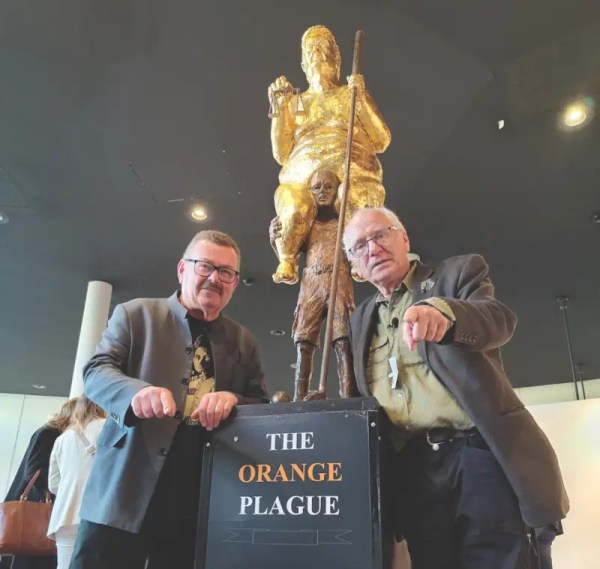
The Orange Plague, also known as King of Injustice, is a political sculpture and activist-art project created by Danish sculptor Jens Galschiøt as a satirical representation of Donald Trump, American political power, climate policy, global inequality and the geopolitical dependence of Europe upon the United States. The sculpture, approximately 2.5 metres high including its plinth, is constructed in copper and covered with 23-karat gold leaf. It depicts a monumental, naked Trump figure sitting upon the shoulders of a considerably smaller and frail man. Trump holds a golf club and a world-shaped golf ball in one hand and the scales of justice in the other. The work was exhibited inside the European Parliament in Strasbourg, France, on 7–8 October 2026, after being hosted by Danish MEP Per Clausen of the Left group.
The central composition establishes a visual hierarchy of power and burden. The enormous golden political figure is physically supported by the weaker human figure beneath him. The smaller man therefore represents the politically dependent, economically subordinate or institutionally weaker actor, while the figure above represents concentrated political power capable of transferring its consequences to others. The sculpture’s inscription makes this relationship explicit: “I am sitting on the back of a man. He is sinking under my burden. I will do anything to help him. Except stepping down from his back.” The phrase converts the physical posture into a political proposition: power declares that it will assist the very society upon which it continues to impose its weight.
The title The Orange Plague is itself part of the political vocabulary of the work. “Orange” refers to the visual and political caricature associated with Trump, while “plague” transforms the individual political personality into a metaphor for a spreading political influence. The alternative title, King of Injustice, establishes the principal contradiction represented by the sculpture: a ruler who possesses the symbolic instruments of justice while being accused by the artist of producing injustice. The closed or impassive expression, the scales, the golf club and the golden body together construct an image of authority, wealth, spectacle and power without accountability.
The golf club is not an incidental accessory. Golf is one of the most recognisable elements of Trump’s public persona and is associated in the sculpture with wealth, privilege, property and elite political culture. The golf-ball-shaped representation of the Earth extends the metaphor from personal lifestyle to planetary politics. The planet becomes golf equipment and a geopolitical object, suggesting that decisions taken by powerful political actors can treat the Earth as though it were an object within a private game.
The scales of justice create the second major contradiction. Traditionally representing impartial law and equality before justice, they are placed in the hands of the figure identified as the King of Injustice. Justice is therefore transformed from an abstract principle into an instrument held by political power. The sculpture consequently asks a deeper question concerning who possesses the authority to define justice and whether international institutions are capable of constraining those who possess disproportionate political, military and economic power.
The work is explicitly connected by Galschiøt to Hans Christian Andersen’s The Emperor’s New Clothes. In Andersen’s tale, a ruler becomes convinced that he is magnificently dressed although he is actually naked; fear, social conformity and collective deception allow the illusion to continue until the truth is spoken publicly. Galschiøt reverses and intensifies this structure. His ruler is visibly naked but covered in 23-karat gold, making the nakedness simultaneously obvious and spectacular. The gold represents wealth, privilege and political grandeur, while also functioning as a visual distraction. As the artist has explained, the figure is made so visually dominant that “nobody can see other people.”
The gold therefore has a double meaning. It represents the aesthetic of power, particularly the association of Trump with gilded interiors, luxury and conspicuous wealth, but it also represents the capacity of spectacle to obscure structural consequences. The political ruler is naked, yet the public gaze is attracted to the gold. In Sarvarthapedia’s conceptual vocabulary, the sculpture can consequently be read as an examination of the relationship between Power → Spectacle → Attention → Dependency → Silence.
The Orange Plague also belongs to the larger artistic genealogy of Galschiøt’s Survival of the Fattest, created in 2002, in which a massively overweight woman sits upon the shoulders of a starving African child. That earlier sculpture became an international symbol of global inequality. The new work retains the fundamental structure—a powerful figure carried by a weaker human being—but replaces the anonymous representation of Western wealth with a specific contemporary political personality. The metaphor consequently shifts from general global inequality toward an explicit criticism of American power, Trumpism, and the international consequences attributed to Trump’s policies.
The principal political target identified by Galschiøt is the global climate order. According to the artist, Trump represents a major threat to the rule-based international order, democratic values and international efforts to confront climate change. Galschiøt has argued that governments and non-governmental organisations may hesitate to criticise Trump’s policies because of possible tariffs, funding reductions, deportation policies and other forms of political or economic pressure. The sculpture therefore attempts to perform a function that conventional diplomacy may avoid: saying publicly what politically dependent institutions may be reluctant to say.
This explains the significance of its location in the European Parliament. The sculpture is not merely an anti-Trump object placed in an art gallery. It was deliberately brought into the institutional centre of European political decision-making. Per Clausen defended the exhibition as a means of confronting European politicians with questions concerning European dependence upon the United States, the future of European security and the capacity of Europe to formulate independent political positions. He argued that democratic institutions should not operate through fear and self-censorship.
The exhibition consequently places European strategic autonomy alongside climate politics. The frail figure beneath Trump can be interpreted not only as humanity or the Global South but also as Europe itself: a political entity possessing considerable economic and institutional resources but still carrying a larger external power upon its shoulders. The sculpture thus transforms a personal caricature into a question concerning the structure of the transatlantic relationship.
The exhibition also demonstrates the relationship between institutional democracy and political art. Its presence inside the European Parliament required sponsorship and institutional approval. The work was placed near a heavily used parliamentary area, ensuring that MEPs, European officials, journalists, lobbyists and visitors encountered it as part of the political environment rather than as a remote museum object. The unveiling on 7 October 2026 generated immediate attention and became a subject of international media circulation.
Its presence also exposed the limits of political tolerance. Supporters interpreted the work as legitimate satire and a defence of artistic freedom. Critics regarded the naked caricature of a sitting American president as excessive, insulting and damaging to the dignity of the Parliament and to relations with a major European ally. The disagreement is therefore not simply about whether the sculpture is aesthetically successful. It concerns a larger constitutional and civilizational question: How much insult, ridicule and symbolic violence must a democratic political system tolerate in order to preserve freedom of expression?
Galschiøt has deliberately extended the work beyond the physical sculpture through 3D-printed miniature versions. These miniature sculptures function as protest tokens, allowing visitors and supporters to carry the political image away from the original exhibition. The artist has also made digital files available so that the sculpture can be reproduced independently. The strategy changes the nature of political monuments. A traditional monument depends upon location, permanence and institutional protection; a digitally reproducible protest object depends upon network distribution, replication and participation. The monument therefore becomes a networked political meme in physical form.
This method is consistent with Galschiøt’s broader history of activist art, including his Pillar of Shame works associated with human-rights commemoration and political repression. His artistic practice repeatedly attempts to transform sculpture from a passive object into an instrument of public confrontation. The purpose is not simply to represent an injustice but to place the representation where political power must encounter it.
Before its Strasbourg exhibition, The Orange Plague had appeared at the COP30 climate summit in Belém, Brazil, and at other political events, including appearances in Copenhagen and Munich. Following Strasbourg, Galschiøt planned to take the sculpture to COP31 in Antalya, Türkiye, extending its confrontation with climate politics from European parliamentary space to the international climate-governance system.
The importance of The Orange Plague within contemporary political art therefore lies less in its novelty as a caricature of Donald Trump than in its construction of a complete political semiotic system. Trump represents concentrated political power; gold represents wealth and spectacle; nudity represents the stripping away of political illusion; the golf club represents elite privilege and Trump’s personal political imagery; the Earth-shaped golf ball represents planetary vulnerability; the scales represent the contested meaning of justice; the frail bearer represents dependency; and the inscription converts the entire composition into a statement about power that refuses to relinquish its burden.
The sculpture thus belongs to the wider history of political satire as a weapon against political abstraction. Instead of presenting a diplomatic argument through reports, speeches or policy papers, it reduces the argument to a physical relationship that can be understood immediately: one gigantic figure sits upon another person’s back, while claiming the authority to define justice. Its supporters regard this as a necessary act of political courage; its opponents regard it as crude provocation. Both reactions form part of the work’s intended political life.
The Orange Plague — Sarvarthapedia Conceptual Network
Node
The Orange Plague
Primary Node: Political Art / Political Satire / Contemporary Activist Sculpture
Creator: Jens Galschiøt
Political Sponsor: Per Clausen, Danish Member of the European Parliament
Place: European Parliament, Strasbourg, France
Date: October 2026
Alternative Name: King of Injustice
Form: 23-karat gold-leafed political sculpture depicting Donald Trump seated upon a smaller, burdened man.
The node should not be treated merely as an artwork about Donald Trump. Its Sarvarthapedia significance lies in the network of concepts activated by the sculpture:
Power → Wealth → Spectacle → Dependency → Injustice → Climate Politics → Global Order → European Autonomy → Political Satire → Freedom of Expression → Institutional Power → Digital Protest
Core Concept
Power and Burden
The fundamental visual proposition is:
Power Above → Burden Below
Trump’s oversized body rests upon a smaller man’s shoulders. The smaller figure represents the bearer of political and economic consequences, while the larger figure represents concentrated power.
This produces the conceptual chain:
Political Power → Dependency → Burden → Exhaustion → Resistance
The inscription reinforces the relationship by presenting the ruler as willing to help the person carrying him while refusing to step down from his back.
Political Power
Personalisation of Power
Donald Trump → Trumpism → Executive Power → Political Personality → Global Influence
The sculpture transforms an abstract system of American power into a single human figure. This is important for political satire because institutions become visible through personality.
Cross-reference:
Donald Trump ↔ Trumpism ↔ American Presidency ↔ Executive Power ↔ Political Personality
American Power
United States as Geopolitical Power
United States → Military Power → Economic Power → Diplomatic Power → Trade Power → Global Influence
The sculpture’s political argument extends beyond Trump as an individual.
Its deeper network is:
Trump → United States → International Power → European Dependency
Thus:
The Orange Plague ↔ American Hegemony ↔ Transatlantic Relations ↔ European Strategic Autonomy
European Strategic Autonomy
Europe and Dependency
The European Parliament location changes the meaning of the sculpture.
Outside Europe, it can be read principally as anti-Trump political art.
Inside the European Parliament, it becomes:
Europe → United States → Security Dependence → Political Dependence → Strategic Autonomy
The burden-bearing figure can consequently be interpreted as Europe carrying an external geopolitical dependency.
Cross-reference:
The Orange Plague ↔ European Union ↔ European Parliament ↔ European Strategic Autonomy ↔ NATO ↔ Transatlantic Relations
Global Order
Rule-Based International Order
Galschiøt presents Trump as a challenge to what he describes as the rule-based world order, democratic values and international climate cooperation.
Therefore:
The Orange Plague → Trump → International Order → Rules → Institutions → Sovereignty → Power
This creates a broader Sarvarthapedia node:
Rule-Based International Order
linked to:
United Nations ↔ European Union ↔ International Law ↔ Multilateralism ↔ Sovereignty ↔ Great-Power Politics
Climate Politics
Climate as a Global Governance Problem
The sculpture’s political argument is substantially connected to climate policy rather than merely personal hostility toward Trump.
Trump → Climate Policy → Paris Agreement → Emissions Policy → Clean Energy → Global Climate Governance
The Earth represented alongside the golf imagery creates another conceptual chain:
Golf Ball → Earth → Planetary Resource → Political Decision → Environmental Consequence
Thus:
The Orange Plague ↔ Climate Change ↔ Environmental Governance ↔ Paris Agreement ↔ Global Commons
Global Inequality
Survival of the Fattest
The work should be cross-referenced with Galschiøt’s earlier Survival of the Fattest.
The conceptual transformation is:
Survival of the Fattest → Global Inequality → Western Wealth → Global South → Dependency
followed by:
Survival of the Fattest → The Orange Plague → Personalised American Power
The earlier work establishes the structural inequality; the later work identifies a contemporary political actor as the symbol of that structure.
Wealth
Gold as Political Language
The 23-karat gold is not merely decorative.
It produces:
Gold → Wealth → Luxury → Status → Power → Spectacle
The golden body simultaneously represents wealth and political visibility.
This connects the sculpture to:
Conspicuous Consumption ↔ Political Branding ↔ Wealth Culture ↔ Elite Power ↔ Political Spectacle
Spectacle
Politics as Visual Performance
The sculpture itself is a study of political spectacle.
Gold Body → Nakedness → Monumental Scale → Shock → Photography → Viral Circulation → Political Attention
Therefore:
The Orange Plague ↔ Spectacle Politics ↔ Media Politics ↔ Attention Economy ↔ Political Communication
The sculpture does not merely communicate through language. It attempts to capture attention before interpretation begins.
The Emperor’s New Clothes
Political Nakedness
The principal literary cross-reference is Hans Christian Andersen’s The Emperor’s New Clothes.
Conceptual chain:
Emperor → Authority → Illusion → Collective Silence → Nakedness → Truth
Galschiøt reverses the original metaphor:
Nakedness + Gold → Political Spectacle
The central Sarvarthapedia relationship becomes:
The Emperor’s New Clothes ↔ Political Illusion ↔ Public Fear ↔ Authority ↔ Truth-Telling ↔ Satire
Injustice
King of Injustice
The alternative title King of Injustice creates a deliberate contradiction:
King → Authority → Justice
versus
King of Injustice → Authority → Abuse of Power
The scales of justice placed in the figure’s hand intensify the contradiction:
Justice → Institution → Symbol → Political Possession → Question of Legitimacy
Cross-reference:
King of Injustice ↔ Rule of Law ↔ Justice ↔ Political Authority ↔ Legitimacy
Political Satire
Satire as Counter-Power
The sculpture belongs to the wider conceptual category:
Political Satire → Ridicule → Exposure → Delegitimisation → Public Debate
Satire performs a function different from conventional political argument.
Political Speech: explains power.
Political Satire: exposes power.
Therefore:
Satire ↔ Criticism ↔ Ridicule ↔ Dissent ↔ Counter-Power
Freedom of Expression
Art versus Institutional Dignity
The European Parliament location introduces a second-order conflict:
Freedom of Expression ↔ Political Offence
and:
Artistic Freedom ↔ Institutional Dignity
The controversy therefore becomes a separate node:
Limits of Political Speech
connected to:
Censorship ↔ Democracy ↔ Parliamentary Privilege ↔ Artistic Expression ↔ Political Offence
Institutional Power
Parliament as Exhibition Space
The European Parliament is simultaneously:
Legislative Institution + Political Workplace + Symbol of European Democracy + Exhibition Space
Consequently:
The Orange Plague → European Parliament → Institutional Space → Political Speech
The physical placement changes the artwork from an external protest into an intrusion of protest into the institutional environment itself.
Protest Art
Sculpture as Political Weapon
The sculpture belongs to:
Activist Art → Protest Art → Political Sculpture → Public Intervention
The conceptual progression is:
Art Object → Public Shock → Political Conversation → Collective Interpretation → Protest
This links the node to:
Pillar of Shame ↔ Survival of the Fattest ↔ Political Monuments ↔ Human-Rights Art
Pillar of Shame
Galschiøt’s Activist-Art Network
Pillar of Shame ↔ Hong Kong ↔ Tiananmen Memory ↔ Political Repression ↔ Monumental Art
and:
Pillar of Shame → Replication → Protest Objects → Digital Distribution
This provides a direct bridge to The Orange Plague.
Digital Protest
From Monument to Network
Traditional political monument:
One Object → One Place → One Audience
Digital protest sculpture:
One Object → Digital File → Thousands of Copies → Global Distribution
Therefore:
3D Printing → Political Replication → Decentralised Protest → Networked Activism
The miniature versions of The Orange Plague transform the sculpture from a geographically limited installation into a potentially distributed political symbol. The organiser’s European Parliament account specifically describes the distribution of miniature versions as a means of spreading the message.
Meme Civilization
Political Symbol as Replicable Information
A deeper Sarvarthapedia connection is:
Sculpture → Image → Photograph → Social Media → Meme → Replication → Political Memory
The physical sculpture therefore becomes an information object.
This connects:
Political Art ↔ Information Civilization ↔ Network Society ↔ Attention Economy ↔ Digital Activism
Climate Protest
COP30 → European Parliament → COP31
The sculpture’s institutional geography produces another network:
COP30, Belém → European Parliament, Strasbourg → COP31, Antalya
This creates:
Climate Summit ↔ Political Protest ↔ International Institution ↔ Artistic Intervention
The Strasbourg exhibition therefore becomes one node in a larger transnational campaign rather than an isolated exhibition.
Europe–America Relationship
Transatlantic Dependency
The central geopolitical network can be represented as:
United States
↕
NATO
↕
European Security
↕
European Union
↕
Strategic Autonomy
The Orange Plague enters this network at the point:
Dependency → Burden → Resistance → Autonomy
Power–Justice Network
The Scales of Justice
The scales connect the sculpture to:
Justice → Law → Rule of Law → Equality → Legitimacy → State Power
But the scales are held by the alleged King of Injustice.
Therefore:
Justice Symbol → Possession by Power → Contradiction → Political Question
This is a central Sarvarthapedia conceptual mechanism:
Who Holds the Symbol of Justice?
Power–Economy–Environment Network
Three Systems
The sculpture can be read through three interconnected systems:
Political Power
→ government
→ executive authority
→ diplomacy
→ international order
Economic Power
→ wealth
→ tariffs
→ markets
→ dependency
→ inequality
Environmental Power
→ climate policy
→ energy
→ emissions
→ planetary resources
→ global commons
Their intersection produces:
Political Power + Economic Power + Environmental Power = Civilizational Consequence
Burden Civilization
The Man Beneath the Ruler
The smaller man is the most important non-Trump figure in the sculpture.
He represents:
Labour → Society → Citizen → Dependent State → Working Population → Global South → Future Generations
Thus:
Power Above → Society Below
and:
Decision-Maker → Decision → Consequence-Bearer
This establishes a fundamental Sarvarthapedia concept:
The Asymmetry of Decision and Consequence
Those who make decisions may not be the people who bear their consequences.
Attention Economy
Gold as Attention Capture
The sculpture’s visual excess can be mapped as:
Gold → Visibility → Shock → Photography → Viral Distribution → Public Debate
Therefore:
Political Art → Attention Economy
The artwork competes not primarily for physical space but for human attention.
Fear and Silence
Political Silence
Galschiøt’s argument concerning governments and NGOs produces another node:
Power → Fear → Economic Retaliation → Self-Censorship → Silence
The counter-process is:
Art → Provocation → Speech → Public Debate → Resistance
Thus:
Silence ↔ Satire
and:
Fear ↔ Artistic Courage
Democratic Resilience
Can Democracy Tolerate Insult?
The sculpture creates a useful conceptual test:
Democracy → Dissent → Offence → Tolerance → Institutional Resilience
The deeper question is not whether The Orange Plague is offensive.
The deeper question is:
Can a political institution tolerate an offensive representation of political power without collapsing into censorship or institutional retaliation?
This links directly to:
Democracy ↔ Freedom of Expression ↔ Political Satire ↔ Institutional Resilience
Civilization and Counter-Power
From Ruler to Citizen
The historical sequence can be conceptualised as:
Sacred Ruler → Absolute Monarch → Constitutional Monarch → Representative Government → Democratic Institution → Mass Media → Networked Citizen
Political satire evolves alongside this:
Court Jester → Pamphlet → Cartoon → Political Poster → Sculpture → Television → Meme → 3D-Printed Protest
The Orange Plague therefore belongs to the contemporary phase:
Networked Political Art
Information Civilization
Sculpture as Information
The physical object is only the first layer.
Sculpture
→ meaning
→ photograph
→ article
→ social-media circulation
→ miniature replica
→ 3D-printing file
→ political discussion
→ historical memory
Therefore:
Object → Information → Network → Civilization
This makes The Orange Plague relevant to Sarvarthapedia’s broader study of Information Civilization.
Core Sarvarthapedia Cluster
Political Power Cluster
The Orange Plague
↔ Donald Trump
↔ Trumpism
↔ American Presidency
↔ Executive Power
↔ American Hegemony
↔ Political Personality
↔ Political Spectacle
Justice Cluster
King of Injustice
↔ Justice
↔ Rule of Law
↔ Legitimacy
↔ Equality
↔ Political Authority
↔ Institutional Trust
Europe Cluster
European Parliament
↔ European Union
↔ European Strategic Autonomy
↔ Transatlantic Relations
↔ NATO
↔ European Security
↔ Sovereignty
Climate Cluster
Climate Politics
↔ Trump
↔ Paris Agreement
↔ Climate Governance
↔ Energy Policy
↔ Emissions
↔ Global Commons
↔ Planetary Crisis
Inequality Cluster
Survival of the Fattest
↔ The Orange Plague
↔ Global Inequality
↔ Wealth
↔ Global South
↔ Dependency
↔ Economic Power
Satire Cluster
Political Satire
↔ The Emperor’s New Clothes
↔ Ridicule
↔ Nakedness
↔ Political Exposure
↔ Dissent
↔ Freedom of Expression
Protest-Art Cluster
The Orange Plague
↔ Pillar of Shame
↔ Activist Art
↔ Political Sculpture
↔ Human-Rights Art
↔ Public Intervention
↔ Protest
Network Civilization Cluster
3D Printing
↔ Digital Replication
↔ Political Meme
↔ Network Activism
↔ Decentralised Protest
↔ Information Civilization
Primary See Also Knowledge Web
Direct Nodes
Donald Trump
↔ Trumpism
↔ American Presidency
↔ American Hegemony
↔ European Union
↔ European Parliament
↔ European Strategic Autonomy
↔ Climate Politics
↔ Political Satire
↔ Freedom of Expression
Historical and Artistic Nodes
Hans Christian Andersen
↔ The Emperor’s New Clothes
↔ Jens Galschiøt
↔ Survival of the Fattest
↔ Pillar of Shame
↔ Political Sculpture
↔ Activist Art
Structural Nodes
Power
↔ Dependency
↔ Inequality
↔ Justice
↔ Legitimacy
↔ Institutional Power
↔ Political Resistance
Civilizational Nodes
Information Civilization
↔ Network Civilization
↔ Attention Economy
↔ Digital Protest
↔ Political Communication
↔ Memetic Politics
Master Conceptual Chain
The Orange Plague as a Sarvarthapedia Network
The Orange Plague
→ Political Satire
→ Donald Trump
→ American Power
→ Transatlantic Dependency
→ European Strategic Autonomy
→ Rule-Based International Order
→ Climate Governance
→ Global Inequality
→ Power and Burden
→ Justice and Legitimacy
→ Freedom of Expression
→ Institutional Resilience
→ Activist Art
→ Digital Replication
→ Networked Protest
→ Information Civilization
→ Civilizational Power
Central Sarvarthapedia Proposition
Power → Burden → Resistance → Information
The deepest conceptual network represented by The Orange Plague can be reduced to:
Power creates Burden.
Burden creates Dependency.
Dependency creates Silence.
Silence creates the need for Counter-Power.
Satire becomes Counter-Power.
Art converts Counter-Power into an Image.
Digital Networks convert the Image into Information.
Information converts the isolated artwork into a Distributed Political Symbol.
Thus the final Sarvarthapedia relationship is:
POWER → BURDEN → DEPENDENCY → SILENCE → SATIRE → PROTEST → INFORMATION → NETWORK → COUNTER-POWER
Within a Sarvarthapedia framework, The Orange Plague can therefore be classified not merely as a sculpture but as a node connecting Political Art ↔ Satire ↔ Freedom of Expression ↔ Trumpism ↔ American Power ↔ European Strategic Autonomy ↔ Climate Politics ↔ Global Inequality ↔ Rule-Based International Order ↔ Institutional Power ↔ Digital Protest. Its significance derives precisely from this network: the sculpture converts an individual political caricature into a broader examination of how power is accumulated, displayed, normalised, defended and resisted in the contemporary international system.